
The 9th House in Astrology: Travel, Philosophy & Higher Learning
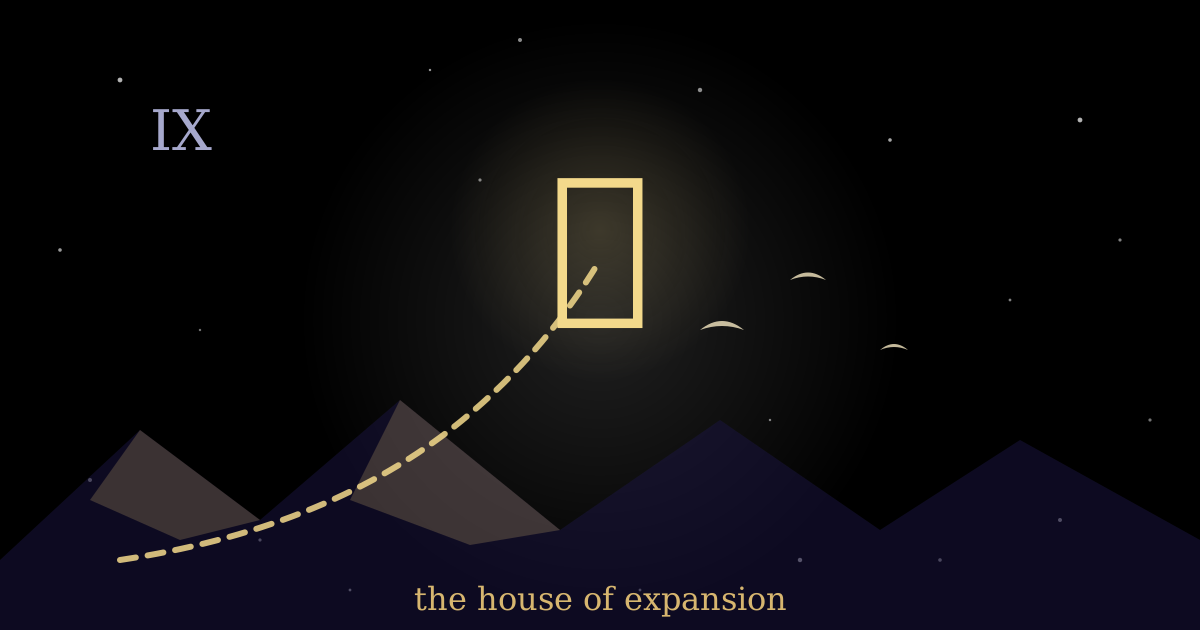
If the 3rd house is the neighborhood — your block, your school, your group chat — the 9th house is the open road beyond it. This is the most outward-looking room in the birth chart: the house of long-distance travel, of universities and self-taught mastery, of philosophy and religion, of foreign cultures and the teachers who change your life. Where other houses describe what happens to you, the 9th describes what happens when you go looking — and what you bring back.
This guide walks the full length of the 9th house. You'll learn what it rules, how to read its cusp sign and ruling planet, what each planet suggests when placed there, how astrologers traditionally read travel and relocation themes, the higher-learning and belief layer that gives the house its depth, which transits activate its journeys, and — because this house gets romanticized — how to read it honestly. As with all astrology, treat this as a reflective framework for self-understanding, not a set of predictions.
What the 9th House Rules
The 9th house gathers everything that takes you beyond the familiar — farther than your daily world, deeper than your everyday knowledge, bigger than your starting assumptions. Its traditional domains include:
- Long-distance travel: journeys far from home — the 9th is the classic house consulted when someone asks about travel, relocation, or life abroad.
- Higher learning: universities, graduate study, and just as often the self-taught path — the deep, chosen education, not the mandatory kind.
- Philosophy and worldview: the big questions — why are we here, how should we live, what is true — and the frameworks you build to answer them.
- Religion and spiritual traditions: faith as an organized path — doctrines, rituals, pilgrimages, sacred texts — rather than the private mysticism of the 12th house.
- Teachers and mentors: the gurus, professors, and guides who shape your mind — and the moments you become one for someone else.
- Publishing and media: spreading ideas at scale — books, broadcasting, blogs, teaching platforms. Traditionally the house of the book.
- Law, ethics, and justice: the principles that should govern us — courts, moral philosophy, and your personal code of right and wrong.
- Foreign cultures and languages: immigration, cross-cultural connection, the foods, customs, and tongues of everywhere-else.
- Luck and optimism: Jupiter's domain — the "Greater Fortune," the sense that doors open and the future is worth betting on.
- The quest for meaning: the house's true subject — everything above is a route; meaning is the destination.
The through-line is simple: the 9th house is about expansion — of horizons, of knowledge, of understanding. It is the least provincial house in the chart, and the most optimistic one.
Where the 9th Sits in Your Chart's Story
The 9th is a cadent house — one of the four houses (3rd, 6th, 9th, 12th) that come after the angles and scatter their energy outward. Cadent houses are traditionally associated with learning, adapting, and disseminating — and the 9th is the grandest of them, the house of ideas too big to stay home. It sits just before the Midheaven, the topmost point of the chart and the start of the 10th house of career. That placement is poetic: the 9th asks what you believe about the world, and the 10th shows what you do with that belief in public.
The 9th is the natural house of Sagittarius, the zodiac's archer — always aiming at something beyond the visible horizon. Its ruler is Jupiter, in both traditional and modern astrology, the planet of expansion, wisdom, optimism, and the "Greater Fortune." Jupiter's nature tells you what the 9th house is for: growth. Where Jupiter goes, things get bigger — knowledge, experience, generosity, faith. The shadow, astrologers note, is also bigger: exaggeration, dogma, overpromising, and the belief that the next horizon will fix everything.
The 9th house sits opposite the 3rd house of local learning, communication, and short trips — a polarity astrologers read as "the near mind versus the far mind." The 3rd describes how you gather information: facts, gossip, messages, the daily commute of the mind. The 9th describes how you turn information into meaning: philosophy, long study, the long voyage of the mind. Reading the two together shows your full learning temperament — are you a collector of details who occasionally synthesizes (3rd emphasis), or a seeker of meaning who sometimes skips the footnotes (9th emphasis)? Most of us are a negotiation between the two.
The Sign on Your 9th House Cusp
To find your 9th house, locate the Midheaven (MC) — the topmost line of your chart, where your 10th house begins. The wedge of sky just before it — the house whose cusp the MC follows — is your 9th house. The sign on that house's cusp, its starting edge, sets the flavor of your expansion story.
As a reflection prompt rather than a verdict, here is the traditional flavor of each sign on the 9th cusp:
- Aries 9th: The pioneer of belief: learns by doing, travels on impulse, and trusts direct experience over any doctrine. Faith is an adventure, not a doctrine.
- Taurus 9th: The steady seeker: builds philosophy slowly, from what has proven true over time. Travels for beauty and pleasure; beliefs must be practical to survive.
- Gemini 9th: The eternal student: collects philosophies, languages, and itineraries the way others collect stamps. Meaning is found in the variety itself.
- Cancer 9th: The roots traveler: journeys that lead home — ancestral lands, family history, the traditions of childhood. Belief is inherited and then made personal.
- Leo 9th: The grand philosopher: needs beliefs worth dramatizing — a cause, a stage, a teaching. Travels in style; learns best when the subject inspires devotion.
- Virgo 9th: The scholar of the sacred: studies belief systems with a researcher's eye, fact-checks the guru, and finds meaning in precision and service. Skepticism as a spiritual practice.
- Libra 9th: The diplomat of ideas: seeks wisdom in dialogue — every philosophy improved by its opposite. Travels for art, beauty, and the perfect conversation.
- Scorpio 9th: The seeker of hidden truth: distrusts surface answers; philosophy must go deep or it isn't philosophy. Drawn to psychology, mystery traditions, and the taboo beneath the doctrine.
- Sagittarius 9th: The house's own sign: the born philosopher-traveler — big questions, long journeys, unshakeable optimism about what lies over the horizon. The danger is believing the horizon before you check the map.
- Capricorn 9th: The builder of belief: constructs worldview like architecture — slowly, on solid foundations. Respects institutions, elders, and the long curriculum; travels with a plan and a purpose.
- Aquarius 9th: The heretic: beliefs must be original and future-facing — conventional wisdom is suspect by definition. Drawn to unconventional teachers, fringe philosophies, and the horizon nobody else is watching.
- Pisces 9th: The mystic: belief as feeling and art — faith experienced through compassion, music, poetry, or direct spiritual practice. Travels to dissolve boundaries: pilgrimages, retreats, the ocean. Discernment is the lifelong lesson.
Once you know the cusp sign, find its ruling planet — where is it placed, and what does it touch? That planet is the 9th house's working manager. A 9th house with a Gemini cusp is managed by Mercury; if your Mercury sits in the 7th, your quest for meaning likely runs through relationships and dialogue. Follow the ruler and the house starts talking.
Planets in the 9th House: What Each Placement Suggests
Planets in the 9th are traditionally read as energies that shape your relationship with travel, learning, and belief. None of these are verdicts on your fate; they are starting points for self-reflection:
- Sun in the 9th: Identity built on the quest: life is organized around big ideas, long journeys, or a defining philosophy. Drawn to teaching, publishing, or any role that spreads light on the bigger picture.
- Moon in the 9th: Emotional life needs horizons: restlessness when stuck, comfort found in new places and new ideas. Beliefs are felt before they are argued; homesickness for somewhere you've never been.
- Mercury in the 9th: The philosopher's mind: thinks in systems and stories, loves languages, debates, and the grand theory. Learns by teaching — explaining is how the ideas get real.
- Venus in the 9th: Love of the far and foreign: romances abroad or with foreign partners are common themes, and beauty is found in other cultures. Beliefs tend toward the humane and harmonious.
- Mars in the 9th: The crusader: beliefs defended with fire — passionate about causes, willing to argue the philosophy at full volume. Travels boldly; studies intensely; the shadow is dogma worn like armor.
- Jupiter in the 9th: The house's own planet at home: expansion is the life theme — teaching, publishing, travel, or philosophy as a way of life. Traditionally read as the signature of good fortune through wisdom and generosity; the caution is against overreach.
- Saturn in the 9th: Belief built the hard way: early skepticism or a narrow upbringing, followed by a worldview earned through study and experience. Respects real teachers, distrusts easy answers; later in life, often becomes the authority.
- Uranus in the 9th: The belief revolutionary: sudden changes of worldview, unconventional philosophies, and a refusal to inherit anyone's religion. Travel is irregular and inspired; the quest never stands still.
- Neptune in the 9th: Belief as mysticism and art: drawn to spiritual traditions, idealistic causes, and the transcendent — with a lifelong need to distinguish genuine inspiration from beautiful illusion.
- Pluto in the 9th: Belief as transformation: worldviews that die and are reborn — conversion experiences, the complete overhaul of a philosophy, power struggles with authorities over what is true. The quest is total or it isn't.
Again, the emphasis here is on patterns, not predictions. A planet in the 9th describes how you relate to expansion and meaning — it doesn't schedule your journeys.
Travel, Relocation & the Wanderlust Signature
This is the question the 9th house gets asked most: "Do I have travel in my chart?" and its bolder cousin, "Will I live abroad?" Here's the honest traditional answer: the 9th house describes your appetite for the far and foreign, not your itinerary. A strong 9th — many planets there, its ruler well placed, Jupiter prominent — is traditionally read as a life with far-ranging movement woven in: long journeys, foreign connections, perhaps years lived abroad. A quiet 9th describes someone whose expansion happens through books, study, or ideas rather than boarding passes.
Neither is better, and neither is a forecast. Astrology maps tendencies, not tickets. What the 9th can genuinely offer is a set of reflective questions about your relationship with the wider world:
1. What kind of traveler are you? The cusp sign flavors the answer: fire cusps chase adventure and meaning, earth cusps travel with plans and budgets, air cusps travel for people and ideas, water cusps travel for feeling and belonging. Read it as your native travel temperament.
2. What pulls you outward? The planets in the 9th suggest the motive: Venus pulls toward beauty and romance, Mercury toward learning, Mars toward challenge, Jupiter toward the sheer joy of more world. The motive shapes the memory.
3. What do journeys give you? Find the 9th cusp's ruler and note its house: a 9th ruler in the 10th suggests travel that builds a career or reputation; in the 4th, journeys that reshape your sense of home; in the 11th, friendships and communities found far away. The journey's destination, astrologically speaking, is whichever house the ruler serves.
The traditional wisdom: people with strong 9ths don't just visit new places — they import them, bringing back ideas, beliefs, and versions of themselves that change the home they left.
Higher Learning, Belief & Your Philosophy of Life
Travel is the 9th house's most visible face, but its deeper subject is what you believe and how you came to believe it. This is the house of the university — and of every education that matters just as much: the trade mastered over a decade, the language learned at forty, the spiritual practice that quietly reorganized a life, the book that split everything into before and after.
It's also the traditional house of the guru — the teacher, mentor, or tradition that hands you a bigger map. The 9th asks two honest questions most charts gloss over: Who taught you what you know? And what would it take to outgrow the lesson? Some people inherit a worldview and polish it for life; some inherit one and spend decades rebuilding it from scratch; some assemble one from thirty traditions and a travel journal. The 9th house describes your version.
There's a shadow worth naming: dogma. The same house that produces philosophers produces fanatics — the moment belief hardens from a search into a weapon, from "this is what I've found" to "this is what you must find." Astrologers traditionally watch Mars and Pluto in the 9th for this edge, and Saturn in the 9th for its opposite — the refusal to believe anything without evidence. Both are the 9th house working as designed: belief under pressure, finding out what holds.
As an entertainment-framed reflection (never a prescription), try writing your personal credo in one paragraph: what do you believe about how the world works, and where did each belief come from? The 9th house rewards the exercise — most people have never asked themselves the question, and the answer is always a map of their own expansion.
Transits Through the 9th House: Expanding Seasons
When planets move through your 9th house by transit, astrologers read it as a season when expansion themes come to the foreground — a journey taken, a course begun, a belief questioned or deepened. Treat these as reflective prompts, not forecasts:
- Jupiter through the 9th (about a year): the classic "lucky chapter" — doors open through learning, travel, or teaching; optimism runs high and opportunities arrive from far away. The traditional caution is overreach: promising more than the expanded optimism can deliver.
- Saturn through the 9th (about two and a half years): the serious study. Degrees pursued, exams passed or retaken, inherited beliefs examined under a harsh light. The question of the period is "what do I actually believe?" — and the answer, earned slowly, tends to last.
- Uranus, Neptune, or Pluto through the 9th (years to decades): long chapters of worldview reinvention — Uranus brings sudden changes of direction and unconventional teachers, Neptune dissolves old certainties about what is true, and Pluto rebuilds the philosophy from the foundations up.
- Eclipses in the 9th: read as moments of revelation about direction — the journey finally booked, the course finally started, the belief finally abandoned or finally owned. Eclipses in this house often coincide with a changed answer to "where am I going?"
The through-line: 9th-house transits reward the practices the house itself rules — curiosity, study, honest questioning — and they punish the house's shadow: dogma, intellectual laziness, and the belief that the map you started with is the territory.
Three Myths About the 9th House
This house collects romantic ideas the way travelers collect souvenirs. Let's clear the big three:
- "A strong 9th house means you'll be rich." Jupiter is the Greater Benefic, and tradition does call the 9th the house of fortune — but its "luck" is about opportunity and outlook, not lottery tickets. It describes a tendency for doors to open and for you to walk through them — the wealth is in the walking.
- "An empty 9th house means you'll never travel." Emptiness in a house never cancels the life area — the cusp sign and its ruler always carry the story, and some of the most far-ranging lives are lived with empty 9th houses. Expansion takes many forms; the boarding pass is only one.
- "The 9th house only matters if you went to college." Higher learning here includes every deep education: trades, apprenticeships, self-study, languages, spiritual practice, the school of hard knocks with honors. The 9th doesn't ask for a diploma — it asks what you learned and what you did with it.
Working With Your 9th House: Grounded Practices
Whatever your placements, the 9th house responds to curiosity. These are practical, reflective habits astrologers associate with this house — general life-enrichment practices, not professional advice:
- Take the long way once: Plan one journey — a trip, a pilgrimage, even a long walk in a neighborhood you've never explored — and go with a question you want answered, not just a destination.
- Study something for real: Enroll in the course, start the language, commit to the practice. The 9th house distinguishes between collecting information and actual learning — it respects the second.
- Interview your own beliefs: Write down three things you believe deeply, then trace where each came from: family, school, experience, a teacher? Inherited beliefs you re-choose become twice as strong.
- Find a teacher — or be one: Seek the mentor you've been avoiding, or offer what you know to someone a step behind you. The 9th house is the house of the guru, and it works in both directions.
- Read one book from a tradition not your own: A philosophy, religion, or worldview you've never seriously considered. The 9th house expands through respectful encounter, not through winning arguments.
- Honor the Jupiter side: Practice deliberate optimism: note the doors that opened this month, the help that arrived from far away, the luck you were ready for. Jupiter's fortune favors the grateful.
Your Turn: A 10-Minute 9th-House Reading
Pull up your birth chart and try this:
- Step 1: Find your Midheaven (MC), then look at the wedge just before it — that's your 9th house. Note the sign on its cusp.
- Step 2: Note any planets inside that wedge. Read each one through the "expansion and meaning" filter above.
- Step 3: Find the ruler of your 9th cusp sign. Where is it? That planet's house and aspects show where your quest for meaning most often surfaces in daily life.
- Step 4: List your last three "expansions" — a trip, a course, a book, a changed mind. What pulled you outward each time? The 9th house's pattern is visible in your own history.
- Step 5: Ask honestly: what belief of mine is overdue for an upgrade? The 9th house's famous promise is that the horizon you're avoiding holds exactly the wisdom you're waiting for.
The 9th house is astrology's reminder that the world is larger than your starting point: every journey teaches, every teacher was once a student, and every belief worth keeping is a belief you've tested. Read the house with an open mind, and it opens yours right back.
Frequently asked questions
What does the 9th house represent in astrology?
The 9th house represents expansion: long-distance travel, higher learning, philosophy, belief systems, and the search for meaning. It covers universities and self-taught mastery, foreign cultures and languages, publishing and teaching, law and ethics, and the worldview you build from all of it. Astrologers read it as a reflective map of how you explore the world and what you do with what you find, not as a prediction of where you will go.
Which planet rules the 9th house?
The 9th is the natural house of Sagittarius, ruled by Jupiter in both traditional and modern astrology — the planet of expansion, optimism, wisdom, and good fortune. In your own chart, the planet that rules the sign on your 9th house cusp is the house's working ruler: follow that planet's placement to see where your quest-for-meaning themes express themselves most strongly.
What does an empty 9th house mean?
An empty 9th house simply means no planets are placed there — read the sign on the 9th house cusp and the position of its ruling planet instead. It never means you will not travel or that you lack curiosity; it means those themes run on a quieter track, activating mainly through transits and the movements of the cusp ruler. Many enthusiastic travelers have empty 9th houses.
Does the 9th house show travel or living abroad?
The 9th house is the traditional house astrologers consult when asked about long journeys, relocation, and life abroad — a strong 9th (many planets, or its ruler well placed) is traditionally read as a tendency toward far-ranging movement and foreign connection. But it describes tendencies and appetite, not itineraries: it cannot predict where you will go or guarantee a move. Read it as a reflection of your relationship with the wider world, not as a travel forecast.
How do I find my 9th house sign?
On your birth chart, find the Midheaven (MC) — the topmost line, where your 10th house begins. The wedge of sky just before it, the house cusp line that the 10th house cusp follows, marks your 9th house. The zodiac sign on that 9th house cusp (its starting edge) is your 9th house sign.
Keep exploring
The 12 Astrology Houses: Complete Meaning Guide
The 12 astrology houses explained: meanings for each house, how to read planets in houses, house systems, and what empty houses mean.
Read the meaning →
Planets in the Houses: How Placements Shape Each Life Area
Planets in the houses: what every planet means in each house. Learn the planet + sign + house blend with examples, stelliums, and a worked reading.
Read the meaning →
Empty Houses in Astrology: What They Really Mean & How to Read Them
Spot an empty house in your birth chart? Learn what empty houses really mean — how to read the cusp sign and ruling planet, and the transits that light them up.
Read the meaning →
The 8th House in Astrology: Transformation, Intimacy & Shared Resources
The 8th house rules transformation, shared resources & intimacy. Learn what your 8th house sign means, how to read planets in the 8th, and the merging cycles it reveals.
Read the meaning →