
Angular, Succedent & Cadent Houses in Astrology: Meaning & How to Read Them
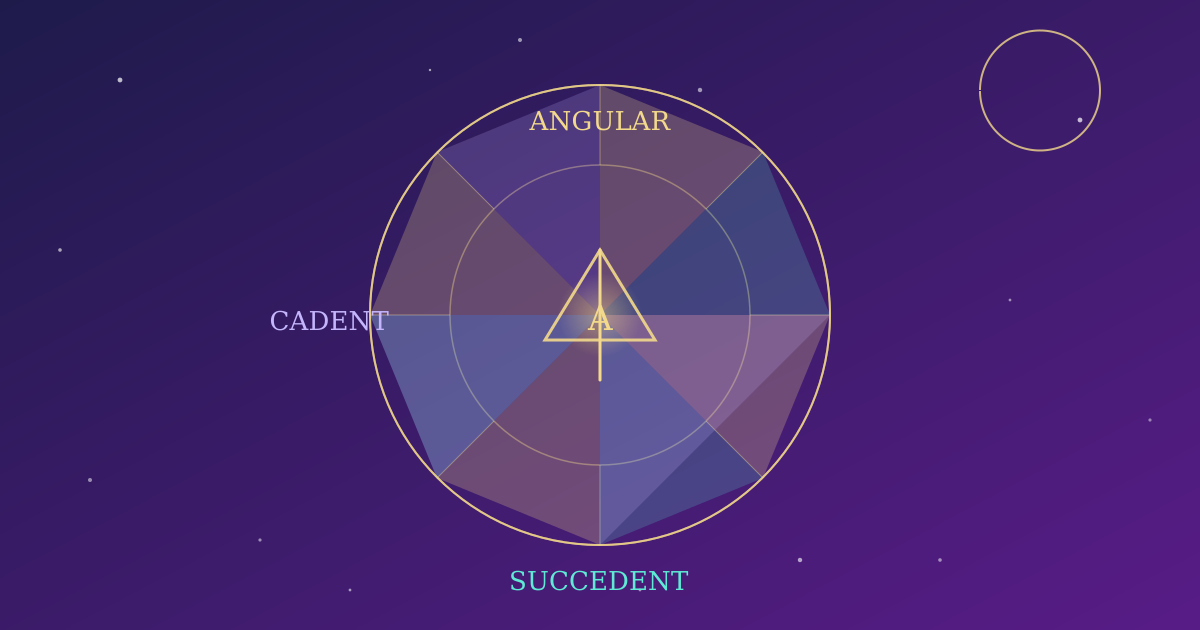
Every birth chart tells its story through twelve houses, but not all twelve houses speak in the same voice. Some shout from the front of the stage, some hold the stage steady, and some whisper from the wings while they prepare the next scene. Astrologers have sorted the houses into three qualities for centuries — angular, succedent, and cadent — and once you learn the rhythm, a chart suddenly reads less like a list of placements and more like a story with a beginning, a middle, and a turning point.
This guide explains the three house qualities in plain language: which houses belong to each group, what each quality traditionally means, how planets behave differently in each kind of house, and how to use the pattern in your own chart. As with all astrology here, treat this as a reflective lens for self-understanding, not a prediction about your life.
The Three Qualities: A Rhythm Around the Wheel
Walk around a birth chart counter-clockwise from the Ascendant and the pattern repeats four times, like a chorus: angular, succedent, cadent, angular, succedent, cadent, and so on. Each group of three forms one quadrant of the chart — the four quadrants anchored by the four angles. The rhythm matters because it mirrors how life itself moves: something begins, it gets built and enjoyed, and then it is learned from and released before the next beginning.
- Angular houses — 1st, 4th, 7th, 10th: Begin at the four angles. Traditionally the most prominent and action-oriented houses.
- Succedent houses — 2nd, 5th, 8th, 11th: Follow the angular houses. Traditionally the houses of stability, resources, and consolidation.
- Cadent houses — 3rd, 6th, 9th, 12th: Fall just before the angles. Traditionally the houses of learning, flexibility, and preparation.
The three qualities also echo the three modalities of the zodiac signs. Angular houses carry a cardinal flavor — initiating, like Aries, Cancer, Libra, and Capricorn. Succedent houses carry a fixed flavor — stabilizing, like Taurus, Leo, Scorpio, and Aquarius. Cadent houses carry a mutable flavor — adaptable, like Gemini, Virgo, Sagittarius, and Pisces. That is no accident: the house qualities and the sign modalities describe the same threefold rhythm of starting, sustaining, and changing.
Angular Houses: Where Life Begins and Shows Itself
The angular houses begin at the four angles of the chart — the four points that traditional astrologers considered the chart's power stations. The Ascendant on the left edge marks the start of the 1st house, the IC at the bottom marks the 4th, the Descendant on the right marks the 7th, and the Midheaven at the top marks the 10th. Everything in the chart is oriented around these four points, which is why the houses that open there are read as the most outward and immediate.
- 1st house — self and identity: The house of first impressions, appearance, and the way you meet the world. Angular energy here is direct: who you are shows up fast, for better and for worse.
- 4th house — home and roots: The house of family, ancestry, and emotional foundations. Angular energy here is foundational: the private base from which everything else is launched.
- 7th house — partnership: The house of one-to-one relationships, marriage, and open rivals. Angular energy here is relational: other people show up in your life in unmistakable ways.
- 10th house — career and reputation: The house of public life, vocation, and standing. Angular energy here is visible: what you do is seen, judged, and remembered.
Planets in angular houses are traditionally described as prominent — their themes tend to be obvious in a person's life, visible to others, and quick to act. A person with several angular placements often reads as someone whose life has clear turning points and public chapters. But prominence is a style, not a prize: an angular planet can just as easily describe a very public difficulty as a very public gift. The angular houses show where life insists on happening out in the open.
Succedent Houses: Where Life Is Built and Held
Succedent comes from the Latin for "following after," and these houses do exactly that: each one follows an angular house and stabilizes what the angle began. If the angular house starts the story, the succedent house gives it resources, pleasure, depth, or company — the things that make a beginning last.
- 2nd house — money and values: Follows the 1st house of self. What the self begins, the 2nd sustains with income, possessions, and values. Traditionally the house of what you own and what you consider worth keeping.
- 5th house — creativity and pleasure: Follows the 4th house of roots. What the home grounds, the 5th enjoys — romance, children, art, play, and self-expression as the reward of a secure base.
- 8th house — shared resources and transformation: Follows the 7th house of partnership. What partnership joins, the 8th merges — shared money, intimacy, debts, and the deep changes that come from binding your life to another's.
- 11th house — community and hopes: Follows the 10th house of career. What public life achieves, the 11th gathers around — friends, groups, allies, and the future goals that a career's rewards make possible.
Planets in succedent houses are traditionally read as steady and enduring. Their themes develop more slowly than angular ones, but they tend to stick: the savings account rather than the windfall, the long friendship rather than the first meeting, the craft refined over years rather than the debut. People with heavy succedent emphasis often describe their lives as built rather than launched — less drama at the start, more staying power in the middle. The classic caution is the fixed-quality shadow: holding on too long, whether to money, a relationship, a pleasure, or a group, after the season for it has passed.
Cadent Houses: Where Life Is Learned and Prepared
Cadent houses fall just before the angles — the last house of each quadrant, where one cycle winds down and the next one is prepared. The old word "cadent" means falling, and traditional texts sometimes called these the weakest houses, but that old judgment deserves a modern correction: cadent houses are not weak, they are inward. Their work is learning, refining, and releasing, which is quieter than launching or building but no less essential.
- 3rd house — communication and learning: Falls before the 4th house angle. What the mind gathers — siblings, neighbors, short trips, everyday knowledge — prepares the emotional foundation of the 4th.
- 6th house — work and daily routines: Falls before the 7th house angle. What the daily round refines — health habits, service, craft, routine — prepares you to meet another person as an equal in the 7th.
- 9th house — philosophy and higher learning: Falls before the 10th house angle. What the mind widens — travel, study, belief, law — prepares the public contribution of the 10th.
- 12th house — the unconscious and release: Falls before the 1st house angle. What the soul releases — solitude, dreams, endings, compassion — prepares the new self that rises at the Ascendant.
Planets in cadent houses are traditionally read as more flexible, adaptable, and sometimes less visible to others. Their themes often work behind the scenes: the research before the book, the practice before the performance, the inner work before the new chapter. A cadent-heavy chart can look quiet from the outside while a great deal is happening within — the mutable-quality gift of adjusting, learning, and letting go. The classic caution is diffusion: so much adapting and preparing that nothing ever quite launches, or so much inner work that the outer life waits too long.
Reading Planets by House Quality: The Same Planet, Three Styles
House quality changes how a planet's energy tends to show up, even when the planet and sign stay the same. Take Mars, the planet of drive and action, as an example. Mars in an angular house tends to act visibly and immediately — the argument in the open, the project launched on day one, the ambition everyone can see. Mars in a succedent house tends to act steadily and resourcefully — the savings built month by month, the rivalry sustained over years, the pleasure pursued until it is mastered. Mars in a cadent house tends to act through learning and adjustment — the skill practiced in private, the routine refined until it works, the frustration examined before it is expressed.
The same logic applies to every planet. Venus in an angular house loves out loud; in a succedent house it loves through loyalty and shared pleasures; in a cadent house it loves through understanding, service, or quiet devotion. Saturn in an angular house builds visible structures; in a succedent house it guards resources; in a cadent house it teaches through patience and inner discipline. None of these versions is better — they are the same energy wearing three different kinds of clothing, and a full chart usually contains all three.
Try this quick test on your own chart: count how many of your ten planets fall in each quality. A chart heavy in angular houses often describes a life of visible chapters and clear turning points. A succedent-heavy chart often describes a life built for endurance, with resources and relationships that compound. A cadent-heavy chart often describes a life of learning and adaptation, where the inner journey matters as much as the outer one. Most charts mix all three, and the mix is the point: a life needs beginnings, middles, and preparations alike.
House Quality in Transits and Timing
The three qualities also give transits a useful rhythm. When a slow planet enters an angular house, astrologers traditionally read it as a season when that life area moves to the foreground — a new identity chapter, a home move, a relationship beginning, a career step. These are the years people tend to remember as turning points, because angular transits show up in the outer life.
When a slow planet moves into a succedent house, the season is traditionally read as consolidation: the new relationship becomes shared finances, the new career becomes income, the new identity becomes something you can enjoy and sustain. And when a slow planet enters a cadent house, the season is read as preparation — study before the career, routine before the relationship, reflection before the new self. Cadent transits can feel frustratingly quiet while they happen and obvious only in hindsight, which is exactly why the quality framework helps: it tells you that a quiet season may be doing real work.
Eclipses follow the same logic. An eclipse in an angular house is traditionally read as a visible turning point in that area; in a succedent house, as a shift in what you hold or share; in a cadent house, as a revelation or release that prepares the next angle. Again, treat these as reflective prompts for journaling and conversation, never as forecasts of specific events.
Three Myths About House Qualities
- "Cadent houses are weak or unimportant." The old texts ranked cadent houses lowest in prominence, but prominence is not importance. Some of the most consequential work of a life — learning, healing, preparing, letting go — happens in cadent houses. A chart without cadent emphasis would have beginnings and middles but no wisdom about when to change.
- "Angular planets always succeed." Angular placement describes visibility, not victory. An angular Saturn can describe a very public obstacle just as readily as an angular Jupiter describes a very public opportunity. The quality tells you where the energy shows up, not whether it wins.
- "You should only care about your angular houses." Every chart needs all three qualities, and most charts contain all three. Ignoring succedent houses misses what sustains you; ignoring cadent houses misses what teaches you. The full wheel is the reading.
Your Turn: A 10-Minute House-Quality Reading
- Step 1: Pull up your birth chart and find the four angles — Ascendant, IC, Descendant, Midheaven. The houses starting there (1st, 4th, 7th, 10th) are your angular houses.
- Step 2: Count one house forward from each angle for your succedent houses (2nd, 5th, 8th, 11th), and one more for your cadent houses (3rd, 6th, 9th, 12th).
- Step 3: Count your planets in each quality. Which quality holds the most? Which holds the fewest — and does that quiet quality describe an area you tend to overlook?
- Step 4: Pick one planet in each quality and describe it in one sentence per style: how does it act visibly, how does it build steadily, how does it learn quietly?
- Step 5: Ask which quality your current season needs. If life feels all beginnings and no follow-through, the succedent answer is consolidation; if it feels stuck in routine, the cadent answer is learning something new; if it feels all preparation and no launch, the angular answer is one visible step.
The houses are the rooms of a life, but their qualities are the rhythm of how you move through them — beginning, building, learning, and beginning again. Read the rhythm, and the whole wheel starts to make sense.
Frequently asked questions
Which houses are angular, succedent, and cadent?
The angular houses are the 1st, 4th, 7th, and 10th — the houses that begin at the four angles of the chart. The succedent houses are the 2nd, 5th, 8th, and 11th, which follow the angular houses. The cadent houses are the 3rd, 6th, 9th, and 12th, which come just before the angles. Together the three groups cover all twelve houses in a repeating angular, succedent, cadent rhythm around the wheel.
What do angular houses mean in astrology?
Angular houses are traditionally read as the most active and visible houses in the chart — the places where life is initiated, seen, and felt most directly. The 1st house starts at the Ascendant, the 4th at the IC, the 7th at the Descendant, and the 10th at the Midheaven, so each angular house opens at a turning point of the chart. Planets in angular houses are often described as prominent and outward in their expression, used here as a reflective description rather than a prediction.
What is the difference between succedent and cadent houses?
Succedent houses follow the angular houses and are traditionally associated with stability, consolidation, and building on what the angular house began — the 2nd stabilizes the self, the 5th enjoys it, the 8th deepens shared bonds, and the 11th gathers the community around it. Cadent houses come just before the angles and are associated with learning, adaptation, and preparation — the 3rd gathers ideas, the 6th refines routines, the 9th widens perspective, and the 12th releases and reflects before the cycle begins again.
Are planets stronger in angular houses?
Traditional astrology gives angular houses the most prominence, succedent houses a steady middle strength, and cadent houses the least outward prominence — but prominence is not the same as importance. A planet in a cadent house can still shape a whole life through learning, service, or inner work; it simply tends to express itself more quietly or indirectly. Astrologers read house quality as a clue to style and visibility, never as a verdict on a planet's worth.
How do I find my angular houses?
On your birth chart, find the four angles: the Ascendant on the left starts the 1st house, the IC at the bottom starts the 4th, the Descendant on the right starts the 7th, and the Midheaven at the top starts the 10th. Those four houses are your angular houses. Count one house forward from each angle for the succedent houses (2nd, 5th, 8th, 11th) and one more for the cadent houses (3rd, 6th, 9th, 12th).
Keep exploring

The 12 Astrology Houses: Complete Meaning Guide
The 12 astrology houses explained: meanings for each house, how to read planets in houses, house systems, and what empty houses mean.
Read the meaning →
Planets in the Houses: How Placements Shape Each Life Area
Planets in the houses: what every planet means in each house. Learn the planet + sign + house blend with examples, stelliums, and a worked reading.
Read the meaning →
Stellium in Astrology: Meaning, Houses & How to Read One
What is a stellium? Three or more planets in one sign or house explained — how to spot one, stellium meanings by house, and how to work with concentrated chart energy.
Read the meaning →
The 1st House in Astrology: Self, Identity & How the World Sees You
The 1st house rules self, identity, appearance & new beginnings. Learn what your rising sign and Ascendant mean, how to read planets in the 1st, and the transits that activate it.
Read the meaning →