
Chart Ruler Meaning: How the Ruler of Your Ascendant Shapes Your Chart
Ask an astrologer to describe you and they will usually start with three things: your Sun sign, your Moon sign, and your rising sign. But ask them to explain why two people with the same rising sign can feel so different, and they will point to a fourth factor — one that beginners often miss entirely. That factor is the chart ruler, sometimes called the Ascendant ruler or the ruler of the chart.
The idea is beautifully simple. Every zodiac sign has a ruling planet. Your rising sign is the sign that was climbing over the eastern horizon at the moment you were born, and it opens your 1st house. The planet that rules that sign becomes, in effect, the manager of your whole chart: it steers how you meet the world, how you start things, and how you present yourself before anyone knows your Sun or Moon. This guide explains what the chart ruler is, how to find yours, how traditional and modern rulers differ, and how to read its house, sign, and aspects — as a reflective lens, never as a prediction about who you are destined to be.
What Is a Chart Ruler?
In astrology, rulership is an old system that pairs each zodiac sign with a planet that is said to govern it. Mars governs Aries, Venus governs Taurus and Libra, Mercury governs Gemini and Virgo, the Moon governs Cancer, the Sun governs Leo, Jupiter governs Sagittarius, and Saturn governs Capricorn. The three signs discovered after the telescope era — Scorpio, Aquarius, and Pisces — kept their traditional rulers and gained modern ones: Scorpio is ruled traditionally by Mars and in modern astrology by Pluto, Aquarius traditionally by Saturn and in modern astrology by Uranus, and Pisces traditionally by Jupiter and in modern astrology by Neptune.
Your chart ruler is simply the ruling planet of your Ascendant sign. It matters because the Ascendant is not just a sign — it is the cusp of your 1st house, the doorway of the whole chart. Traditional astrologers treated the ruler of the 1st house as the lord of the chart itself: the planet whose condition describes the strength, style, and fortunes of the person as a whole. Modern astrologers keep the idea but use it more psychologically: the chart ruler shows how you interface with the world, the toolkit you reach for first, and the part of life where your rising sign does its real work.
Here is a useful image. If your rising sign is the mask you wear into a room, your chart ruler is the person wearing it — the one deciding when to speak, when to listen, and which door to walk through next. Two Libra risings can look alike on the surface — polite, poised, harmony-seeking — but if one has Venus in Scorpio in the 2nd house and the other has Venus in Sagittarius in the 3rd, they will pursue harmony in very different ways: one through depth, loyalty, and shared resources, the other through ideas, humor, and conversation. The chart ruler is what explains the difference.
How to Find Your Chart Ruler in Three Steps
Step 1: Find your Ascendant sign. You need your birth time as well as your birth date and place — the rising sign changes roughly every two hours, so a chart cast without a time cannot give a reliable Ascendant. On a chart wheel, the Ascendant is the leftmost point, where the 1st house begins. The sign sitting there is your rising sign.
Step 2: Look up its ruling planet. Use this table:
- Aries rising: Mars
- Taurus rising: Venus
- Gemini rising: Mercury
- Cancer rising: Moon
- Leo rising: Sun
- Virgo rising: Mercury
- Libra rising: Venus
- Scorpio rising: Mars (traditional) and Pluto (modern)
- Sagittarius rising: Jupiter
- Capricorn rising: Saturn
- Aquarius rising: Saturn (traditional) and Uranus (modern)
- Pisces rising: Jupiter (traditional) and Neptune (modern)
Step 3: Find that planet in your chart. Note three things: the sign it sits in, the house it sits in, and the major aspects it makes to other planets. Those three facts are the whole reading. The sign colors how the ruler behaves, the house shows where it behaves, and the aspects show who it gets along with — and who it argues with.
Traditional vs. Modern Rulers: Which One Do You Use?
Beginners often worry about the signs with two rulers. The honest answer used by most working astrologers is: read both, and let the chart tell you which one speaks louder. The traditional ruler describes the older, structural layer — endurance, discipline, and the way things have always been done. The modern ruler describes the newer, generational layer — originality, transformation, and the spirit of the age.
Take Aquarius rising as an example. Saturn, the traditional ruler, suggests a rising style built on patience, structure, and earning trust over time — the serious side of the visionary. Uranus, the modern ruler, suggests the other side: sudden originality, rebellion against stale rules, and a love of the unconventional. A real Aquarius rising person usually shows both, in different proportions at different ages. The same logic applies to Scorpio rising (Mars for drive and courage, Pluto for depth and transformation) and Pisces rising (Jupiter for faith and expansiveness, Neptune for imagination and compassion).
One practical tip: if you are new to this, start with the traditional ruler, because it connects cleanly to the whole ancient system of dignities and house rulership. Then add the modern ruler as a second voice. You will quickly feel which one describes you better — and often, the answer is both, talking at once.
Reading the Chart Ruler by House: Where Your Energy Goes
The house of your chart ruler is often the single most revealing placement in a chart reading, because it shows where your rising-sign energy actually lands. A Leo rising with the Sun in the 10th house lives their identity in public, through career and reputation. The same Leo rising with the Sun in the 4th house lives it at home, through family and private roots. Same mask, different stage.
- Chart ruler in the 1st house: Your approach is direct and self-directed — you lead with yourself, and first impressions are strong and unmistakable. The growth edge is remembering that not every room needs your entrance to be the event.
- Chart ruler in the 2nd house: You meet the world through values, resources, and practical security. Self-worth and money are tangled together; building something tangible steadies you.
- Chart ruler in the 3rd house: You meet the world through words, learning, and everyday connections — siblings, neighbors, short trips, and conversation are your natural terrain.
- Chart ruler in the 4th house: Home, family, and private roots shape your public style more than people guess. You may seem reserved until someone is invited inside.
- Chart ruler in the 5th house: Creativity, romance, and play are your native language. You approach life like an artist or a performer — joy first, and the audience second.
- Chart ruler in the 6th house: Work, routine, and service are where you prove yourself. You meet the world by being useful, and daily habits quietly run your life.
- Chart ruler in the 7th house: Partnership is your mirror. You understand yourself best through one-to-one relationships, and other people often activate your rising sign before you do.
- Chart ruler in the 8th house: Depth, shared resources, and transformation are your terrain. You meet the world through intensity, trust, and the things people do not say out loud.
- Chart ruler in the 9th house: Travel, study, philosophy, and big ideas carry your rising sign. You grow by widening the horizon — a course, a journey, a belief examined honestly.
- Chart ruler in the 10th house: Career, reputation, and public life are your stage. Your approach to the world is visible, ambitious, and hard to miss — for better and for worse.
- Chart ruler in the 11th house: Friends, groups, and shared hopes are your engine. You meet the world through community, and your circle often opens the doors you walk through.
- Chart ruler in the 12th house: Solitude, imagination, and behind-the-scenes work are your power source. Your rising sign may be quieter than people expect — until the work speaks for itself.
Notice how this works as a life map rather than a label. A chart ruler in the 7th does not mean you cannot be independent; it means partnership is the arena where your approach to life gets tested and refined. Read the house as a setting, not a sentence.
Reading the Chart Ruler by Sign and Aspect
After the house, read the sign. The sign of your chart ruler flavors its behavior the way an accent flavors speech. Mars ruling an Aries rising chart but sitting in Pisces will act very differently from the same Mars in Capricorn: one pursues goals through empathy, timing, and imagination, the other through discipline, patience, and sheer endurance. Neither is better; they are different instruments playing the same note.
Then look at dignity, the old idea that a planet is stronger in some signs than others. A chart ruler in its own sign or exaltation — say, Venus ruling a Taurus rising chart and sitting in Libra — is traditionally read as operating with unusual ease and confidence. A chart ruler in its detriment or fall — say, Venus ruling a Libra rising chart and sitting in Aries — is read as operating against the grain, which often produces a more interesting, hard-won style rather than a weaker one. Treat dignity as a note about ease, not worth.
Finally, read the aspects. A chart ruler touched by a harmonious trine from Jupiter often reads as an approach to life that meets help along the way; the same ruler squared by Saturn often reads as an approach that meets tests, delays, and the need for patience. A conjunction with another planet blends the two energies: a chart ruler conjunct Mercury thinks before it acts, while one conjunct Mars acts before it thinks. Aspects are the supporting cast — they explain why your rising sign sometimes surprises even you.
Chart Ruler vs. Sun, Moon, and Rising: Who Does What?
It helps to give each of the big four a job description. The Sun is often read as your core purpose and the story you are growing into. The Moon is your emotional weather — what you need to feel safe and how you react under pressure. The rising sign is your interface — the first impression, the way you enter rooms and start things. And the chart ruler is the engine behind that interface: the planet whose placement explains how the interface actually runs.
When the Sun and the chart ruler pull in different directions, life feels like a negotiation between who you are and how you operate. A Capricorn Sun with a Gemini rising and Mercury in the 12th, for instance, may have serious ambitions wrapped in a light, curious, private style — the world meets the wit first and discovers the ambition later. When the Sun, Moon, and chart ruler agree — say, a Leo Sun, Aries Moon, and Aries rising ruled by a well-placed Mars — the chart reads as unusually direct: what you see is very much what you get. Neither pattern is better. The chart ruler simply explains the wiring.
A Worked Example: Virgo Rising, Mercury in the 9th
Imagine a Virgo rising chart with Mercury, its ruler, in Sagittarius in the 9th house, trine Jupiter. On the surface, Virgo rising suggests precision, helpfulness, and attention to detail. But the chart ruler tells the fuller story: Mercury in the 9th means that precision goes to work on big ideas — teaching, publishing, travel, philosophy — rather than on small details alone. Sagittarius colors Mercury with breadth and optimism, so the careful Virgo exterior opens into a love of big-picture learning. The trine from Jupiter adds ease: teachers, mentors, and lucky breaks tend to show up. The person still reads as Virgo on first meeting — tidy, observant, useful — but the chart ruler reveals that their real engine is a wandering, teaching mind. That is the chart ruler doing its job: it turns a one-word rising sign into a person.
Three Myths About the Chart Ruler
- "Your chart ruler decides your fate." It describes the style and setting of your approach to life — never a verdict. Two charts with the same ruler in the same house can still live utterly different lives, because the whole chart, and the choices made with it, always matter more than any single placement.
- "A chart ruler in a hard house is bad luck." A ruler in the 8th or 12th house is often read as private or intense, not unlucky. Some of the most effective behind-the-scenes workers, researchers, and healers carry exactly these placements; the house describes where the energy goes, not whether it succeeds.
- "You only need your rising sign, not its ruler." The rising sign alone is a snapshot. The ruler is the film: it shows where that snapshot came from and where it is headed. Skipping it is like meeting someone's handshake and never learning their name.
Your Turn: A 10-Minute Chart Ruler Reading
- Step 1: Find your Ascendant sign and its ruling planet using the table above. If your rising sign has two rulers, note both.
- Step 2: Find your chart ruler in your chart. Write down its sign and house in one sentence: for example, "Venus in Scorpio in the 2nd house."
- Step 3: Read that sentence back as a description of how you meet the world. Does the house match where you spend your energy? Does the sign match how you do it?
- Step 4: Check the aspects to your chart ruler. Note the closest one — it is usually the loudest voice in the room.
- Step 5: Ask one honest question: does my chart ruler describe the way I start things — or the way I wish I started them? The gap between those two answers is often the most useful part of the whole reading.
Your chart ruler will not tell you who you are. What it will do, quietly and reliably, is explain how you go about being who you are — the route you take into every room, every project, and every new chapter. Follow the ruler, and the rest of the chart starts to make sense.
Frequently asked questions
What is a chart ruler in astrology?
Your chart ruler is the planet that rules the zodiac sign on your Ascendant, the rising sign that begins your 1st house. Astrologers read it as the planet that steers how you meet the world: its sign, house, and aspects describe the style, setting, and relationships through which your rising sign expresses itself. It is a reflective tool, not a verdict about your character or fate.
How do I find my chart ruler?
First find your Ascendant sign on your birth chart, then look up that sign's ruling planet: Aries is ruled by Mars, Taurus and Libra by Venus, Gemini and Virgo by Mercury, Cancer by the Moon, Leo by the Sun, Scorpio by Mars traditionally and Pluto in modern astrology, Sagittarius by Jupiter, Capricorn by Saturn, Aquarius by Saturn traditionally and Uranus in modern astrology, and Pisces by Jupiter traditionally and Neptune in modern astrology. Then find where that planet sits in your chart — its sign and house complete the picture.
Is the chart ruler more important than the Sun sign?
Neither outranks the other; they describe different layers. The Sun sign is often read as core identity and purpose, the Moon sign as emotional nature, and the chart ruler as the steering mechanism of the Ascendant — how you present yourself and approach new situations. Many astrologers treat the chart ruler as one of the most personal planets in the chart because it is tied directly to the Ascendant.
What does it mean if my chart ruler is in the 12th house?
A chart ruler in the 12th house is traditionally read as a private, reflective way of meeting the world: much of your energy may go into inner life, solitude, behind-the-scenes work, or helping others quietly. It is not a hidden or unlucky placement by itself — it simply suggests that your rising sign expresses itself through retreat, imagination, and unseen effort as much as through public action.
Do I have one chart ruler or two?
If your Ascendant is Scorpio, Aquarius, or Pisces, you have both a traditional ruler and a modern ruler, and most astrologers read both. For example, an Aquarius rising chart is steered by both Saturn, the traditional ruler, and Uranus, the modern ruler. Read the traditional ruler for structure and endurance, and the modern ruler for originality and change, then see how the two work together in your chart.
Keep exploring

The 12 Astrology Houses: Complete Meaning Guide
The 12 astrology houses explained: meanings for each house, how to read planets in houses, house systems, and what empty houses mean.
Read the meaning →
Planets in the Houses: How Placements Shape Each Life Area
Planets in the houses: what every planet means in each house. Learn the planet + sign + house blend with examples, stelliums, and a worked reading.
Read the meaning →
The 1st House in Astrology: Self, Identity & First Impressions
The 1st house rules self, identity & first impressions. Learn what your 1st house sign means, how to read your Ascendant and planets in the 1st, and the identity patterns it reveals.
Read the meaning →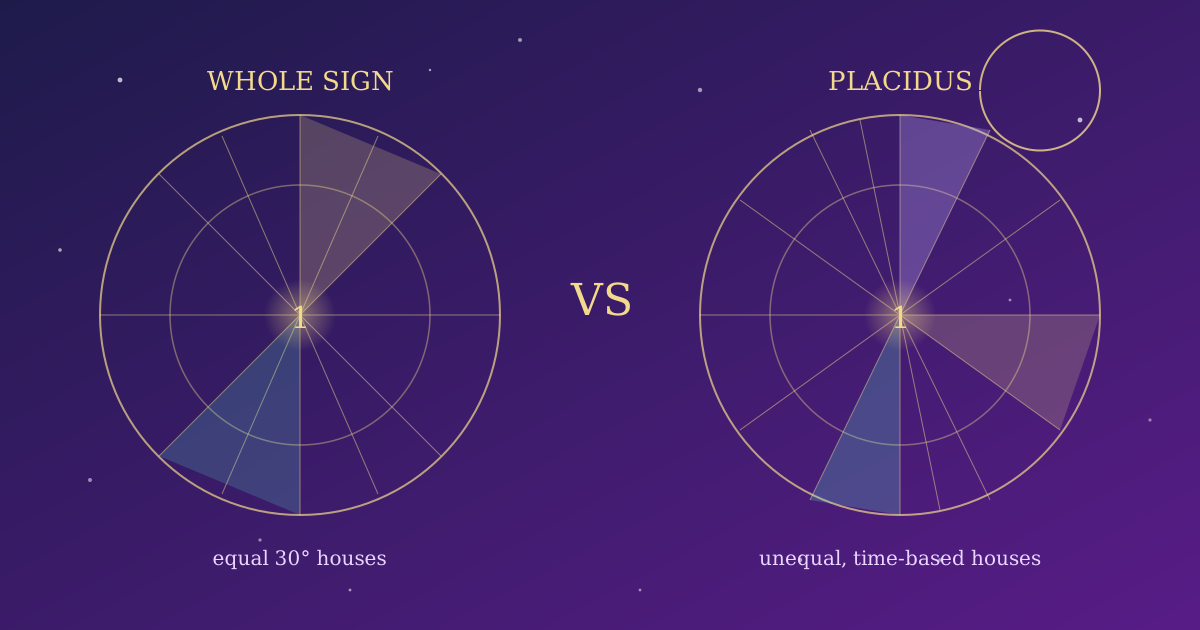
Whole Sign vs. Placidus House Systems: Which One Should You Use?
Whole Sign vs. Placidus house systems explained: how each system divides the twelve houses, when house cusps and signs shift, and how to choose the system that fits your chart reading.
Read the meaning →