
Derived Houses in Astrology: Meaning, How to Turn the Chart & Examples
Your birth chart is usually read as a map of one life: yours. The 1st house is you, the 2nd is your money, the 7th is your partner, the 10th is your career. But traditional astrologers discovered a clever trick hidden inside that same wheel: every house can become a new starting point. Turn the chart so that a different house sits at the Ascendant, and suddenly the whole wheel retells itself from someone else's point of view. That trick is called derived houses, and it is one of the oldest and most practical techniques in astrology.
With derived houses, a single chart can speak about the people around you: your partner's finances, your sibling's career, your child's relationships, your friend's ambitions. You do not need their birth time, and you do not need a second chart. You need only the counting rule, a clear head about what the technique can and cannot do, and a willingness to treat the results as reflection rather than fact. This guide explains the method step by step, with a cheat sheet of the most useful derivations and a worked example you can follow on your own chart.
What Are Derived Houses?
A derived house reading starts with a significator: the house that stands for the person or topic you are asking about. Your partner is the 7th house. Your siblings are the 3rd. Your children are the 5th. Your friends are the 11th. Your career is the 10th, your home the 4th, your money the 2nd.
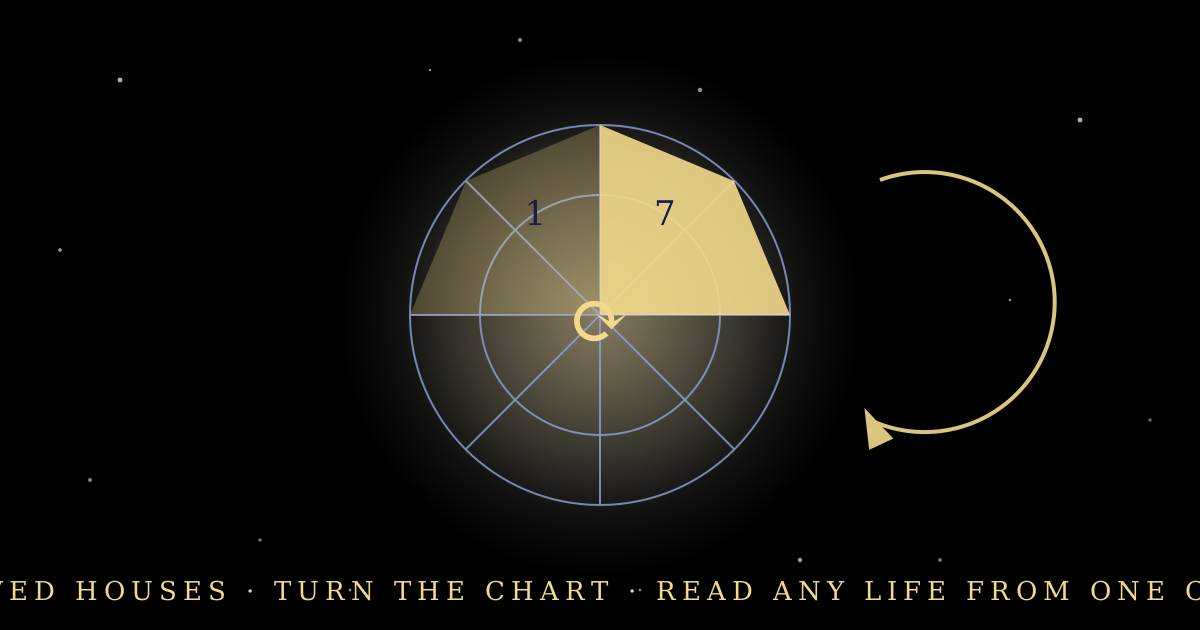
Now imagine rotating the chart until that significator house sits where the 1st house usually sits — at the Ascendant, on the left. From that new vantage point, the houses rearrange themselves around the other person. The house that falls in the 2nd position from the significator describes that person's money. The house in the 3rd position describes their siblings. The house in the 10th position describes their career. The whole wheel is the same; only the point of view has moved.
This is why the technique is also called "turning the chart." A traditional saying captures it neatly: every house is the 1st house of something. Your 8th house is your house of shared resources — and it is also, derived, your partner's 2nd house of money. Both readings are true at once, and a good astrologer holds both: the 8th describes your experience of shared finances, and the derived reading adds what that means for your partner's side of the story.
Derived houses come from the same tradition as the houses themselves — they appear in Hellenistic astrology, run through medieval and Renaissance practice, and remain a staple of traditional chart reading today. They are a technique for exploring relationships and connections, not a shortcut to fortune-telling. A derived house describes how a person shows up in your life and what your chart says about that bond; it never overrides that person's own choices, and it never replaces their own birth chart.
How to Count Derived Houses
The counting rule is simple, but it trips up nearly every beginner once, so take it slowly. Count inclusively, and wrap around the wheel when you pass the 12th house back to the 1st.
The rule: the significator house counts as 1. Each house after it adds one. When you reach the 12th, the next house is the 1st again.
Work through the classic example. You want your partner's money. Your partner is the 7th house, and money is a 2nd-house topic. Count 2 houses starting from the 7th, counting the 7th itself as 1: 7 is 1, 8 is 2. Your partner's money is your 8th house. That is exactly why traditional texts say the 8th house covers a partner's finances — the derived meaning and the ordinary meaning of the 8th (shared resources, joint money) point the same way.
Try one that wraps around. You want your partner's career. Career is a 10th-house topic, counted from the 7th: 7 (1), 8 (2), 9 (3), 10 (4), 11 (5), 12 (6), 1 (7), 2 (8), 3 (9), 4 (10). Your partner's career is your 4th house. It can feel odd at first — the 4th is your home and roots — but derived, it is your partner's public standing seen from inside your shared life, and traditional astrologers read it exactly that way.
One more, for practice. You want your sibling's money. Siblings are the 3rd house, money is the 2nd topic: 3 (1), 4 (2). Your sibling's money is your 4th house. Notice how the same house can carry several derived meanings at once: your 4th is your home, your partner's career, and your sibling's money. Context decides which reading you use, and a careful reader never forces all of them into one interpretation.
A handy formula, if you like arithmetic: derived house = significator + topic − 1, wrapping past 12 by subtracting 12. Partner's career: 7 + 10 − 1 = 16, minus 12 = 4. Sibling's money: 3 + 2 − 1 = 4. The counting and the formula always agree; use whichever feels easier, and double-check by counting on your fingers the first few times.
Derived House Cheat Sheet: The Readings People Use Most
Keep this list beside your chart. Each line names the person, the topic, the count, and the house you actually read:
- Partner's money: 2nd from the 7th = your 8th house. Your partner's income, resources, and attitude toward money as it touches your shared life.
- Partner's siblings: 3rd from the 7th = your 9th house. Your partner's brothers and sisters, and the wider family you marry or partner into.
- Partner's children: 5th from the 7th = your 11th house. Children you share with a partner, or your partner's children from another relationship, read through your hopes and community house.
- Partner's career: 10th from the 7th = your 4th house. Your partner's public standing and profession, seen from the private side of your life together.
- Sibling's money: 2nd from the 3rd = your 4th house. A sibling's resources and financial habits.
- Sibling's career: 10th from the 3rd = your 12th house. A sibling's profession and public life — often read as the part of their working life you see least directly.
- Child's partner: 7th from the 5th = your 11th house. Your child's spouse or serious partner, and the friendships and alliances surrounding them.
- Child's career: 10th from the 5th = your 2nd house. Your child's profession, read through the house of your own resources and values.
- Friend's money: 2nd from the 11th = your 12th house. A friend's finances — traditionally the least visible derivation, since the 12th is the house of what is hidden.
- Friend's career: 10th from the 11th = your 8th house. A friend's public life and ambitions, read through shared resources and deep bonds.
- Your own second look: any house derived from the 1st is itself. The 1st is you, so the 2nd from the 1st is simply your 2nd — a useful check that the counting works.
You can extend the chain further — your partner's sibling's career, for instance, is the 10th from the 9th (your partner's siblings), which is your 6th house — but each extra link weakens the signal. Traditional practice keeps derivations to one or two steps and treats longer chains as curiosity, not counsel.
How to Read a Derived House: Three Layers
Finding the derived house is only half the work. Reading it follows the same three layers as reading any house, applied to the other person:
1. The sign on the cusp. The sign on the derived house's cusp sets the flavor. If your partner's money house (your 8th) has Taurus on the cusp, the traditional read is a steady, security-minded approach to shared finances; if it has Sagittarius, a more expansive, risk-tolerant one. Read it as style, not as a bank balance.
2. The ruler of that sign. Find the planet that rules the cusp sign, and look at where it sits and what it touches. That planet is the derived house's manager. If your 8th has a Taurus cusp, Venus rules it: Venus in your 10th would traditionally link your partner's money to career and public standing, while Venus in your 12th would link it to quieter, less visible sources. Follow the ruler and the story starts to move.
3. Planets inside the house. Any planet placed in the derived house colors the topic directly. Jupiter in your partner's money house traditionally suggests generosity and expansion around shared resources; Saturn there suggests caution, structure, and lessons learned slowly. Benefic and malefic are old labels for tone, not verdicts — Saturn's caution can be exactly what a shared budget needs.
Read the three layers together, and always ask what they say about the relationship rather than about the other person in isolation. Derived houses describe the overlap between two lives: what your partner's money means for your shared life, what your sibling's career stirs in you, what your child's relationships ask of your hopes. That relational framing is what keeps the technique honest.
A Worked Example: Reading a Partner's Money
Imagine a chart with Taurus rising. The Ascendant is Taurus, so the 7th house cusp is Scorpio — the partner's house. Counting 2 from the 7th gives the 8th house, whose cusp is Sagittarius. The partner's money, derived, is read from that Sagittarius 8th house.
Layer one: Sagittarius on the 8th cusp traditionally suggests an expansive, optimistic style around shared money — big plans, generous gestures, a belief that resources will stretch. Layer two: Sagittarius is ruled by Jupiter, so find Jupiter in the chart. Suppose Jupiter sits in the 2nd house of personal resources. Traditionally, that ties the partner's money story to the native's own earning and values: shared finances and personal income rise and fall together, and money conversations are really values conversations. Layer three: suppose the 8th house itself holds no planets. Then the cusp sign and its ruler carry the whole reading — a quieter derived house, not an empty topic. An empty derived house never means the person has no money; it means the story runs through the sign and ruler instead.
Now turn the same chart toward a sibling. Siblings are the 3rd house: with Taurus rising, the 3rd cusp is Cancer. The sibling's career is the 10th from the 3rd, which lands on the 12th house, whose cusp is Aries. Aries on the sibling's derived career house traditionally suggests a pioneering, independent professional style — and the ruler, Mars, shows where that drive goes to work. One chart, two people, two stories, all from counting.
Derived Houses and Timing
Derived houses also give transits a second address. When a slow planet crosses your 8th house, the ordinary reading is a season of shared resources, debts, and deep bonds. The derived reading adds a layer: because the 8th is your partner's 2nd, the same transit can coincide with a chapter in your partner's financial life — a new job, a debt paid off, a shared purchase. Astrologers read such transits as prompts for conversation (about money, in this case), not as forecasts of what a partner will do.
The same logic works for progressions and solar returns, but the principle never changes: a transit to a derived house describes the relationship's weather, not the other person's fate. If Jupiter crosses your 11th house — your child's partner house, derived — the reflective read is a brightening season for your child's relationships and your hopes around them. It is not a prediction of an engagement, and treating it as one is exactly the misuse the tradition warns against.
Five Mistakes to Avoid
- Counting from zero: the significator house is 1, not 0. If you start counting at the next house, every derivation lands one house too far. Say the count out loud the first few times.
- Forgetting to wrap: after the 12th comes the 1st. Most wrong derived readings come from stopping at 12 or continuing to a nonexistent 13th.
- Reading the person instead of the relationship: a derived house shows the other person as they figure in your life. It cannot tell you their salary, their diagnosis, or their decisions, and it must never be used to judge someone who never asked for a reading.
- Stacking too many derivations: one step is strong, two steps are suggestive, three steps are noise. Your partner's sibling's child's career is a party trick, not a reading.
- Ignoring the house's ordinary meaning: your 8th house is still your 8th house. A derived reading adds a layer; it does not erase the house's own topics of shared resources, intimacy, and transformation.
Three Myths About Derived Houses
- "Derived houses let you read anyone without their permission." They let you reflect on your own relationships. Using them to pronounce on someone else's private life — their money, health, or marriage — crosses from reflection into intrusion, and no technique makes that fair.
- "An empty derived house means the topic doesn't exist." Emptiness in any house means no planet is stationed there; the cusp sign and its ruler always carry the story. Plenty of thriving partnerships sit under empty partner-derived houses.
- "Derived houses only work in Whole Sign." The counting works in every system, because it counts houses rather than degrees. Whole Sign makes the counting visually obvious, since each house holds exactly one sign, but Placidus and other systems derive identically.
Your Turn: A 10-Minute Derived-House Reading
- Step 1: Pick one person and one question: your partner's money, your sibling's career, your friend's ambitions. Name the significator house and the topic number.
- Step 2: Count inclusively from the significator, wrapping past the 12th, and write down the derived house. Check it with the formula: significator + topic − 1, minus 12 if the total passes 12.
- Step 3: Note the sign on the derived house's cusp, find its ruling planet, and list any planets inside the house.
- Step 4: Write one sentence in relational language: "My chart suggests my partner's money shows up in our life as…" — never "My partner will…"
- Step 5: Ask whether the sentence rings true to your lived experience of the relationship. If it does, you have a useful reflection; if it does not, the technique is not failing — it is reminding you that people are larger than any single house.
Derived houses are astrology at its most generous: one chart, generously turned, becomes a map of the people you love. Use them to understand the bonds you are already in — and let the people themselves tell you the rest.
Frequently asked questions
What are derived houses in astrology?
Derived houses are a traditional technique for reading another person or topic from your own chart. You treat the house of that person — for example, the 7th for a partner — as if it were their Ascendant, then count forward from it: the 2nd house from the 7th describes the partner's money, the 3rd from the 7th describes the partner's siblings, and so on. Astrologers use the technique reflectively, to explore relationships and connections, not to predict another person's life.
How do you count derived houses?
Count inclusively from the significator house, and wrap around past the 12th back to the 1st. The significator house itself counts as 1. So the partner's money is the 2nd from the 7th: count 7 (1), 8 (2) — the 8th house. The partner's career is the 10th from the 7th: count 7, 8, 9, 10, 11, 12, 1, 2, 3, 4 — the 4th house.
Which house is your partner's money?
Your partner is the 7th house, and money is the 2nd house topic, so your partner's money is the 2nd house counted from the 7th — your 8th house. That is why the 8th house traditionally covers both shared resources and a partner's finances: it is doing double duty as your 8th and as your partner's 2nd.
Can derived houses replace another person's birth chart?
No. A derived house reading describes the other person as they appear in your life and in your chart — your experience of them, and the role they play for you. It cannot replace their own birth chart, which is built from their own birth time and place. Use derived houses for reflection on relationships, and read a person's own chart for their own story.
Do derived houses work with any house system?
Derived houses work with any house system because the technique counts houses, not degrees: the 2nd from the 7th is the 8th whether you use Whole Sign, Placidus, or another system. The house system only changes where the cusps fall and which signs sit on them, not the counting itself.
Keep exploring

The 12 Astrology Houses: Complete Meaning Guide
The 12 astrology houses explained: meanings for each house, how to read planets in houses, house systems, and what empty houses mean.
Read the meaning →
Planets in the Houses: How Placements Shape Each Life Area
Planets in the houses: what every planet means in each house. Learn the planet + sign + house blend with examples, stelliums, and a worked reading.
Read the meaning →
The 11th House in Astrology: Friendships, Community & Hopes
The 11th house rules friendships, community, hopes & future goals. Learn what your 11th house sign means, how to read Uranus and planets in the 11th, and the social patterns it reveals.
Read the meaning →
The 7th House in Astrology: Love, Marriage & Partnerships
The 7th house in astrology rules love, marriage & partnerships. Learn what your Descendant, 7th house ruler & planets in the 7th reveal about relationships.
Read the meaning →