
House Cusps in Astrology: Meaning, How to Find Yours & How to Read Them
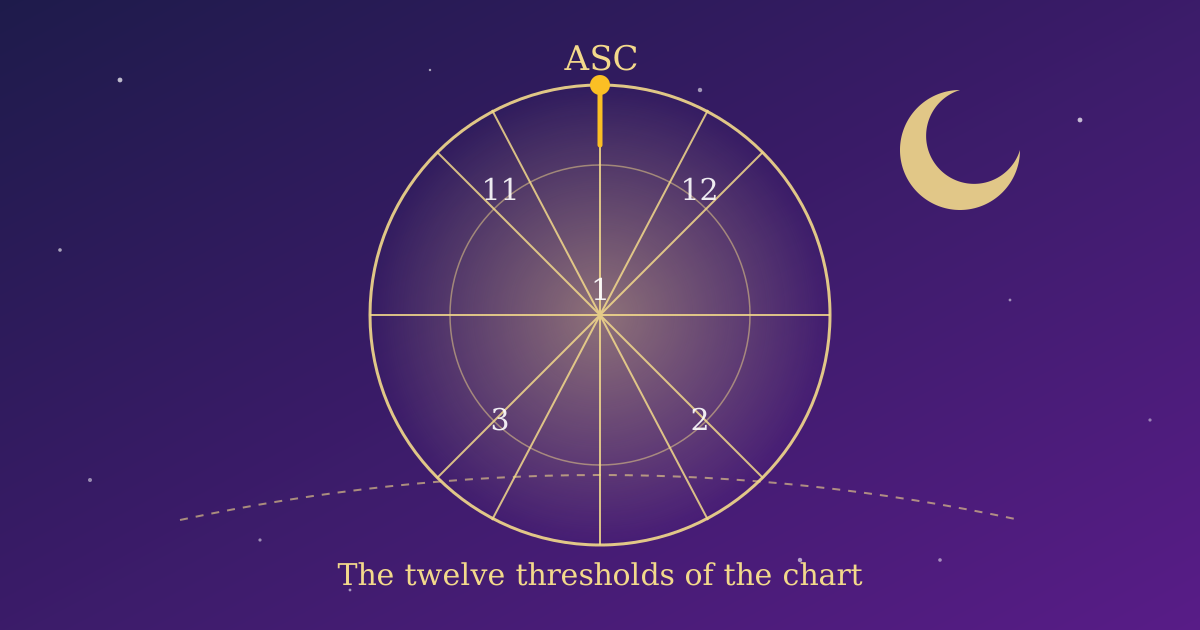
Open any birth chart and you see a wheel divided into twelve wedges. Most readers look straight at the planets inside those wedges and skip the lines between them. That is a mistake, because those lines are doing some of the most important work in the chart. Each line is a house cusp: the threshold where one life area ends and the next begins. The sign sitting on that threshold colors the entire house that follows it, the way the doorway of a room sets the tone for everything inside.
This guide explains what house cusps are, how they are calculated, how to find yours, what each of the twelve cusps means, how cusps differ between house systems, and how to read a planet sitting near a cusp. As with all astrology here, treat this as a reflective framework for self-understanding, not a prediction about your career, relationships, or future.
What Is a House Cusp?
The word cusp comes from the Latin cuspis, meaning a point or edge, and in astrology it means exactly that: the sharp edge where a house starts. A birth chart is a 360-degree circle, and the twelve houses divide it into twelve segments. The first degree of each segment is its cusp. Every cusp is described by a sign and a degree, for example 14 degrees of Leo, written as 14 Leo, and that sign is called the cusp sign of the house.
Why does the cusp sign matter so much? Because it sets the style of the house. Think of the house as a room and the cusp sign as its decor. A 7th house of partnership with Libra on the cusp reads very differently from a 7th house with Scorpio on the cusp: the first suggests a partnership style that seeks harmony and fairness, the second a style that seeks depth and intensity. The house names the life area, but the cusp sign names how you tend to approach it. Two people can both have an empty 7th house and still have very different relationship patterns, because their 7th house cusps carry different signs.
The cusp also gives astrologers a way to read a house that holds no planets. An empty house is not a missing house: its cusp sign still speaks, and the planet that rules that sign still acts. If your 2nd house cusp is Taurus, Venus rules your 2nd house, so astrologers look at where Venus sits in your chart to see where your money and values story plays out. This technique, called reading the house ruler, is one of the main reasons cusps are considered essential rather than decorative.
How House Cusps Are Calculated
House cusps are calculated from your birth time and place, and that is why an accurate birth time matters so much in astrology. The sky turns roughly one degree every four minutes, so even a small error in birth time shifts the cusps. A chart drawn with a rounded or guessed birth time may still get the Sun, Moon, and planets roughly right, since planets move slowly, but its cusps can be off by a whole sign, which changes the reading of every house.
The calculation starts with the Ascendant, the degree of the zodiac rising over the eastern horizon at the moment of birth. That degree becomes the 1st house cusp. From there, the house system you use decides where the remaining eleven cusps fall. In the Whole Sign system, each house takes one whole sign, so the cusps fall neatly at 0 degrees of each sign in order. In Placidus, the most widely used system in the English-speaking world, the houses are unequal, sized by the time it takes each degree to rise, so cusps can fall at any degree and houses can be wide or narrow. Other systems, such as Koch, Equal House, and Regiomontanus, divide the circle by yet other rules, which is why two calculators can show different cusp signs for the same birth data.
That disagreement is normal and does not mean one chart is wrong and the other right. Astrologers choose a system and read consistently within it. If you are just starting out, note which system your calculator uses, and compare charts only within the same system. Switching systems mid-reading is like switching measuring units mid-recipe: the numbers stop lining up.
The Four Angle Cusps: The Chart's Cornerstones
Four cusps carry special weight because they mark the chart's angles, the four most sensitive points in the wheel. The 1st house cusp is the Ascendant, the sign rising in the east at birth, traditionally read as your outward manner, first impressions, and approach to new beginnings. The 10th house cusp is the Midheaven, the highest point in the chart, read as career, reputation, and public direction. Opposite them sit the 7th house cusp, the Descendant, read as partnership and how you meet others one-to-one, and the 4th house cusp, the Imum Coeli or IC, read as home, roots, and private life.
These four angles anchor the whole chart. Planets close to an angle are usually read as especially prominent, and transits crossing an angle are often read as turning points in the corresponding life area. When you learn your cusps, learn these four first: they are the corners of the house you live in, and everything else hangs off them.
All Twelve House Cusps: What Each Threshold Means
Here is the traditional flavor of each cusp, read as a reflective theme rather than a verdict. The cusp sign describes how the house's life area tends to be approached:
- 1st house cusp (Ascendant): How you meet the world. The cusp sign here is your rising sign, shaping first impressions, personal style, and how you start things.
- 2nd house cusp: How you handle money, possessions, and self-worth. An earth sign here suggests a practical, tangible approach to resources; a fire sign suggests a bolder, risk-taking one.
- 3rd house cusp: How you think, talk, and learn day to day. This cusp flavors everyday communication, sibling and neighbor relationships, and short journeys.
- 4th house cusp (IC): How you experience home, family, and emotional security. The cusp sign describes the atmosphere of your roots and what home needs to feel like.
- 5th house cusp: How you create, play, and romance. This threshold colors self-expression, pleasure, children, and the arts.
- 6th house cusp: How you work, organize, and care for daily health. The cusp sign shapes your routines, your attitude to service, and how you handle the details of everyday life.
- 7th house cusp (Descendant): How you meet partnership. The cusp sign describes what you tend to seek in a partner and how one-to-one relationships unfold.
- 8th house cusp: How you handle merging, shared resources, and transformation. This cusp flavors intimacy, joint finances, and the cycles of endings and rebirth.
- 9th house cusp: How you seek meaning, learning, and horizons. The cusp sign shapes your philosophy, your appetite for travel and study, and your big-picture beliefs.
- 10th house cusp (Midheaven): How you meet public life and career. This cusp describes the reputation you build and the direction your ambitions take.
- 11th house cusp: How you meet friendship, groups, and future hopes. The cusp sign colors your communities, your causes, and your sense of belonging to something larger.
- 12th house cusp: How you meet solitude, the unconscious, and the unseen. This threshold flavors dreams, retreat, hidden patterns, and spiritual life.
Read a cusp by combining its house meaning with its sign. A 10th house cusp in Capricorn, for example, traditionally suggests a career style that is patient, structured, and built over time, while a 10th house cusp in Sagittarius suggests a career style that seeks variety, learning, and room to roam. Same house, different doorway, different story.
Planets Near a Cusp: The Threshold Effect
One of the most asked-about cusp questions is what happens when a planet sits very close to a cusp line. Astrologers read a planet within a few degrees of the next house's cusp as standing at the threshold: it belongs to the house it sits in, but it leans into the next one. A Venus at the very end of the 6th house, just before the 7th house cusp, is read as a work-and-routine planet with a strong partnership flavor, or sometimes as already working in the 7th house of relationships, depending on the astrologer and the orb they allow.
The usual working rule is a small orb: within about five degrees of the next cusp, many astrologers let the planet color both houses, with the house it actually sits in taking the lead. Beyond that, the planet belongs cleanly to its own house. This threshold effect is also why birth time accuracy matters again: a planet that looks safely mid-house on a rounded birth time might actually sit on a cusp, and that changes its reading.
Do not confuse this with being born on the cusp of two signs. That popular phrase means being born near the date boundary between two Sun signs, and astrologers generally read the Sun as being in one sign or the other, not a blend of both. A planet near a house cusp, by contrast, is a genuine chart position with a genuine threshold reading, and it is one of the finer details that separates a careful reading from a quick one.
Cusps, Intercepted Signs, and House Systems
In unequal house systems such as Placidus, some houses are so wide that they swallow a whole sign, and some signs never touch a cusp at all. A sign that sits entirely inside a house, touching no cusp, is called an intercepted sign, and its house is called an intercepted house. Traditional readings treat intercepted energy as present but harder to access, like a room with no doorway of its own: you reach it through the house that contains it.
This is another reason the house system matters. Whole Sign has no interceptions, because every sign gets its own house and every cusp falls at 0 degrees. Placidus, especially at extreme latitudes, can produce both interceptions and very wide or narrow houses. Neither system is more correct in any absolute sense; they are different maps of the same sky, and experienced astrologers pick one and learn its language deeply rather than hopping between them.
One practical tip: if your chart shows an intercepted sign, do not panic and do not treat it as a missing piece of yourself. Read the house it sits in, read its ruling planet, and notice where that planet sits. The intercepted sign's story is still in your chart; it simply arrives by a side door rather than the front one.
Transits to Cusps: When the Thresholds Light Up
Cusps are not only birth-chart features. When a transiting planet crosses a cusp, astrologers read it as that house's life area coming into focus for a season. A slow planet crossing your 7th house cusp is traditionally read as a partnership chapter opening; one crossing your 10th house cusp, the Midheaven, as a career or reputation chapter. Faster planets crossing cusps mark shorter seasons: a few days of attention on that life area rather than a year of it.
This is a useful timing tool for reflection. If you know your cusps, you can watch which threshold the slow planets are approaching and ask the corresponding question in advance: what in this life area needs attention, repair, or a fresh start? Treat transit-to-cusp moments as seasons with a theme, not as events with a date stamped on them, and pair every transit observation with a practical step in ordinary life.
Your Turn: A 10-Minute Cusp Reading
Pull up your birth chart and try this:
- Step 1: Write down all twelve cusp signs in order, starting with the Ascendant. Note the degree of each cusp too, if your calculator shows it.
- Step 2: Circle the four angles: Ascendant, IC, Descendant, and Midheaven. These four cusp signs are the headline of your chart's structure.
- Step 3: Pick one house you care about right now, such as career or partnership. Read its cusp sign, then find that sign's ruling planet and note which house it sits in. That house is where this life area's energy most often goes to work.
- Step 4: Check for threshold planets: any planet within five degrees before a cusp. Note which two houses it bridges, and ask how those two life areas already overlap in your life.
- Step 5: Check for intercepted signs, if your system allows them. If one house holds a whole extra sign, read that sign as a quiet second flavor of the house, reached through its ruling planet.
House cusps are easy to overlook and hard to overstate. They are the thresholds of your chart: the twelve doorways through which every planet's energy enters a life area. Learn them, and the wheel stops being a scatter of symbols and starts reading like a floor plan, with every room labeled by the sign on its door.
Frequently asked questions
What is a house cusp in astrology?
A house cusp is the boundary line where one astrology house begins. Each cusp carries a zodiac sign and degree, and that sign flavors the whole house that follows it. The 1st house cusp is the Ascendant, the 10th house cusp is the Midheaven, and the other ten cusps divide the rest of the chart into its twelve life areas.
How do I find my house cusps?
Generate a birth chart from your birth date, time, and place, and look at the degree marked at the start of each house wedge. That degree and its sign are the cusp. You need an accurate birth time: without it, the cusps, and therefore the houses, cannot be calculated reliably.
What does it mean to be born on the cusp?
Being born on the cusp usually means being born near the boundary between two zodiac signs, and astrologers generally read the Sun as being in one sign, not both. A planet sitting close to a house cusp is a different idea: it is read as standing at the threshold of the next house, blending the two houses themes.
Why do house cusps change with the house system?
Different house systems divide the sky differently. Whole Sign gives each house a full sign, so cusps fall at 0 degrees, while Placidus and other time-based systems produce unequal houses, so cusps can fall at any degree. That is why two calculators can show different cusp signs for the same birth data.
Do empty houses still have cusps?
Yes. Every house has a cusp whether or not a planet sits inside it. Astrologers read an empty house through its cusp sign and through the planet that rules that sign, looking at where that ruling planet sits in the chart.
Keep exploring
The 12 Astrology Houses: Complete Meaning Guide
The 12 astrology houses explained: meanings for each house, how to read planets in houses, house systems, and what empty houses mean.
Read the meaning →
Planets in the Houses: How Placements Shape Each Life Area
Planets in the houses: what every planet means in each house. Learn the planet + sign + house blend with examples, stelliums, and a worked reading.
Read the meaning →
Empty Houses in Astrology: What They Really Mean & How to Read Them
Spot an empty house in your birth chart? Learn what empty houses really mean — how to read the cusp sign and ruling planet, and the transits that light them up.
Read the meaning →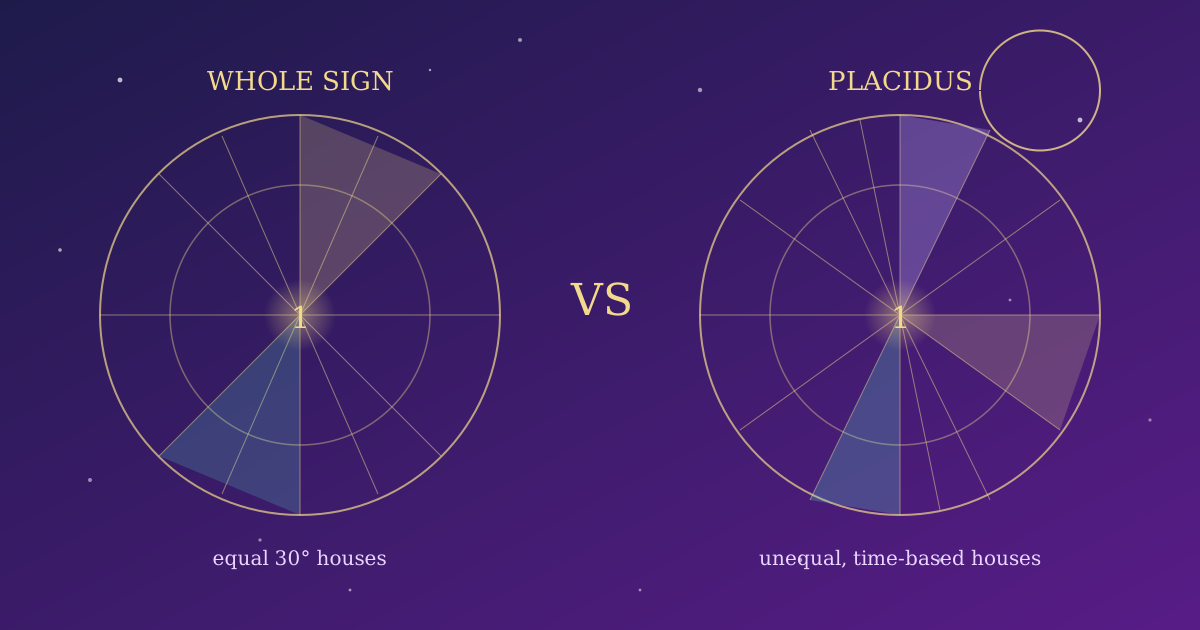
Whole Sign vs. Placidus House Systems: Which One Should You Use?
Whole Sign vs. Placidus house systems explained: how each system divides the twelve houses, when house cusps and signs shift, and how to choose the system that fits your chart reading.
Read the meaning →