
Intercepted Houses in Astrology: What an Intercepted Sign Really Means
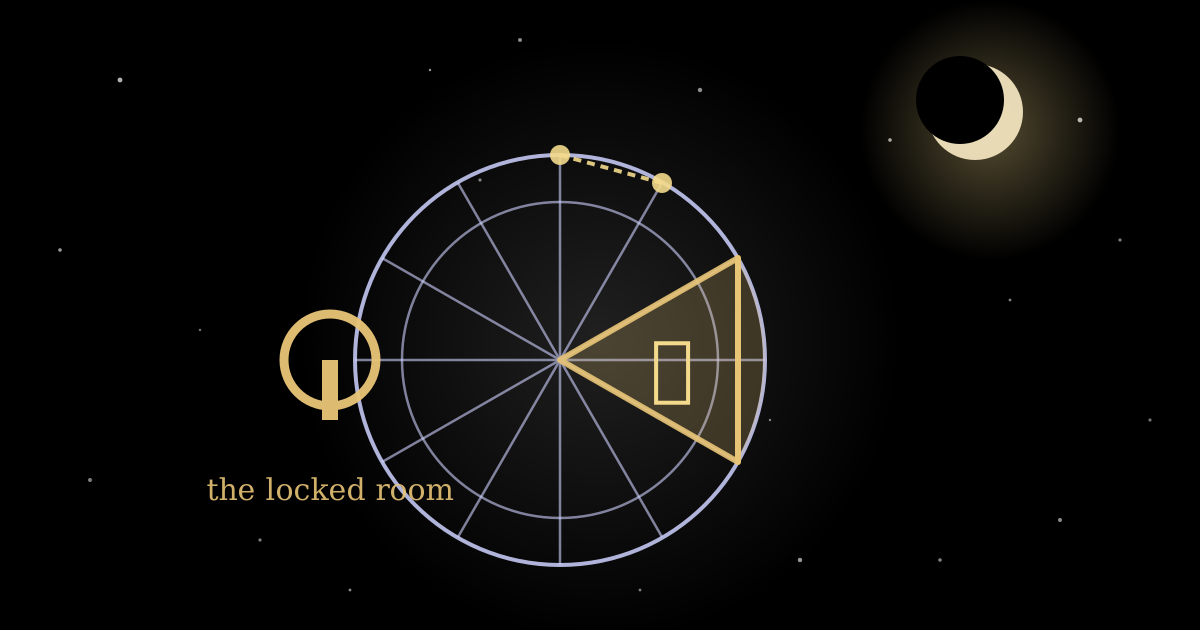
Scan the outer ring of your birth chart and you may notice something odd: a zodiac sign floating inside a house, touching neither of its boundary lines. Every house has two cusps — a starting line and an ending line — and usually each cusp lands in a different sign. But sometimes a house stretches so wide that an entire sign fits between the cusps, belonging to no cusp at all. That sign is intercepted, and the house containing it is an intercepted house.
Interception is one of the most mysterious-sounding concepts in astrology, and chart calculators do a terrible job of explaining it — they just list "Intercepted: Leo, Aquarius" with no context. This guide unpacks what it actually is, why it happens, and how to read the locked rooms of your chart like a professional.
What Is an Intercepted Sign?
Each of the twelve houses begins at a cusp — a degree of the zodiac that acts as the house's front door. In most charts, house 1 might start in late Pisces, house 2 in mid-Aries, house 3 in early Taurus, and so on: each cusp in a fresh sign, the signs marching along in order.
An intercepted sign breaks that order. Imagine house 3 starts in late Aries and house 4 starts in early Gemini. Between them, the entire sign of Taurus sits inside the house span, touching neither cusp. Taurus is intercepted in that house. The house has a front door (Aries) and a back door (Gemini), and Taurus is the long hallway between them — present, but with no door of its own.
Interception always comes in axis pairs. Because the zodiac is a circle, if Taurus is intercepted on one side of the chart, Scorpio is intercepted on the opposite side. The pairs are always: Aries/Libra, Taurus/Scorpio, Gemini/Sagittarius, Cancer/Capricorn, Leo/Aquarius, and Virgo/Pisces.
Why Interception Happens: House Systems
Interception is not a cosmic judgment — it's a side effect of how you slice the chart. In unequal house systems (Placidus, Koch, Regiomontanus, Alcabitus), house boundaries are calculated from the angles of the chart and the ascendant, so houses near the horizon can stretch far wider than 30 degrees while others shrink. A wide house can swallow a whole sign.
Two factors make interception more likely:
- Birth latitude: The farther north or south you were born, the more unequal the Placidus houses become. Interception is common at latitudes like New York, London, or Chicago, and rare near the equator.
- Birth time: The ascendant's degree decides where the unequal slicing falls. Two people born on the same day in the same city can have different intercepted signs if their rising signs differ.
In the whole-sign system — the oldest house system, and the one most Hellenistic and many modern traditional astrologers use — each house is exactly one sign. The 1st house is the whole rising sign, the 2nd house is the whole next sign, and so on. Interception is impossible there: there are no wide houses and no swallowed signs.
Which system should you use? That's a genuine debate in astrology with strong voices on every side, and it changes the chart you're reading. The useful takeaway: if interception is confusing or distressing you, check your chart in whole-sign houses too. The underlying planetary positions are identical — only the room divisions change. Treat house systems as different lenses for reflection, not competing prophecies.
How to Check Whether You Have Intercepted Signs
Most chart calculators list intercepted signs somewhere near the bottom of the report, but you can also spot them yourself in about a minute:
- Step 1: Pull up your chart in Placidus (the default on most sites).
- Step 2: List the sign on each of the twelve house cusps in order, 1 through 12.
- Step 3: Look for a sign that appears nowhere on a cusp but appears on the chart wheel inside a house. That's your intercepted sign.
- Step 4: Confirm the axis: its opposite sign should also be missing from the cusps. If both are missing, you've found an interception pair.
Also watch for the mirror image: a sign that appears on two adjacent cusps. That's a duplicated sign — interception's twin, covered in the next section.
Interception's Twin: Duplicated Signs
Where interception hides a sign, duplication promotes one. A duplicated sign spans two house cusps — say, both the 4th and 5th houses begin in Cancer. That sign gets two front doors instead of one, and its themes show up in two life areas at once.
The pairs always travel together: interception on one axis creates duplication on the perpendicular axis. If Leo and Aquarius are intercepted, then (typically) Scorpio and Taurus are duplicated. Astrologers often read the two together: the duplicated signs are the loud, obvious themes of the chart — so prominent they need two rooms — while the intercepted signs are the quiet ones, operating behind a locked door. One person's chart might broadcast Scorpio intensity across two houses while their Leo/Aquarius axis works entirely backstage.
What an Intercepted Sign Means: The Locked Room
The traditional reading is vivid: an intercepted sign is a locked room in your chart. The energy exists — the furniture is all there — but you don't have a key to the front door. You experience the sign's themes indirectly, through the house that contains it and through the sign's ruler placed elsewhere in the chart.
In practice, astrologers describe intercepted signs as:
- Delayed rather than denied: The classic signature is the "late bloomer." Intercepted Leo people often don't own their creative spotlight until their thirties; intercepted Virgo people may take years to trust their own competence. The quality develops — it just arrives on its own schedule.
- Accessed through the containing house: An intercepted sign in the 10th house expresses through career milestones. In the 4th, it surfaces in family and home life. The house is the hallway; you reach the room through it.
- Known by its ruler: Every sign has a ruling planet, and that planet is never intercepted — it sits somewhere in the chart doing its work. Follow the ruler. If your intercepted Taurus is ruled by Venus in the 11th house, your Taurus qualities express through friendships and community, even if you don't recognize them as "Taurus" at first.
- Intensely private or intense when released: Some astrologers note that intercepted energy, when it finally finds an outlet, comes out with unusual force — the quiet person who turns out to be the fiercest debater in the room.
Here is the part worth hearing clearly: an intercepted sign is not a defect. Roughly half of all charts cast in Placidus at mid-to-high latitudes have at least one intercepted pair. It doesn't mean you're broken, cursed, or missing a piece of your personality. It means one axis of your chart works backstage instead of onstage — and backstage work can be the most interesting kind.
The 12 intercepted signs at a glance
As a reflection prompt (not a verdict), here's the flavor each sign carries when intercepted:
- Intercepted Aries: Asserting yourself feels harder than it should — initiative builds quietly, then arrives all at once.
- Intercepted Taurus: Your relationship with stability and self-worth develops slowly, often through the house that contains it.
- Intercepted Gemini: Curiosity runs deep but private — you may learn voraciously while doubting your own voice.
- Intercepted Cancer: Emotional needs get tucked behind the containing house's business; nurturing others comes more easily than naming your own needs.
- Intercepted Leo: The spotlight feels foreign until later in life — creativity and pride are real but stage-shy.
- Intercepted Virgo: Competence without confidence is the theme; mastery arrives, self-trust follows.
- Intercepted Libra: Partnership patterns feel fated or confusing — balance is learned through experience, not instinct.
- Intercepted Scorpio: Intensity is kept under lock and key; depth is enormous but shared with almost no one.
- Intercepted Sagittarius: Big-picture faith and philosophy develop through lived experience rather than easy optimism.
- Intercepted Capricorn: Ambition and authority feel like borrowed clothes at first — they fit better with time.
- Intercepted Aquarius: Originality runs underground; you may feel like an outsider to your own unconventionality.
- Intercepted Pisces: Spirituality and imagination are vast but hard to articulate — art and dreams become the outlet.
Intercepted Planets: Double-Locked Energy
Planets can sit inside intercepted signs, and astrologers read these as double-locked: the planet's normal expression filtered through a sign that's already hard to access. An intercepted Mars may feel like anger you can't quite locate; an intercepted Venus like affection you're slow to show; an intercepted Mercury like thoughts that arrive fully formed but resist being spoken.
The reading method doesn't change, though — it deepens. Read the planet in its sign and house normally, then add the interception layer: where does this planet find its key? Look at:
- The planet's aspects: A planet in tight aspect to the Sun or Moon has a direct line to consciousness, interception or not. Hard aspects (squares, oppositions) to the intercepted planet are often where the locked energy leaks out — as friction you can actually work with.
- The sign's ruler: If your intercepted Mars is in Taurus, Venus is the key-holder. Whatever house Venus occupies is the room where the intercepted Mars gets to stretch its legs.
- The containing house: Life events in that house's domain — career moves for the 10th, relocations for the 4th, relationships for the 7th — are the moments the intercepted planet wakes up.
How Transits and Progressions Wake Interception Up
Here is the most hopeful part of the traditional teaching: interception is not permanent in experience, even though it's permanent in the natal chart. The sky keeps moving, and when it moves through your locked rooms, things happen. (As with all astrology, treat these as reflective prompts for your own thinking, not guarantees about what will happen.)
- Slow transits through the intercepted house: When Jupiter, Saturn, or an outer planet crosses an intercepted house, astrologers read it as a season when the locked themes demand attention — Saturn as a renovation, Jupiter as an expansion.
- The progressed Ascendant: In secondary progressions, the Ascendant slowly changes signs over a lifetime. When it moves into (and later out of) your intercepted sign, many astrologers describe it as a multi-year chapter when the locked quality becomes a conscious part of your identity.
- Saturn returns: Around ages 29 and 58, transiting Saturn returns to its natal position. If it passes through or aspects your intercepted axis, it's traditionally read as a maturity checkpoint for exactly those locked themes.
- Eclipses on the axis: Eclipses near your intercepted/duplicated axis are read as sudden developments — doors opening or closing quickly in that life area.
This is also why interception often feels like a life-phase signature rather than a lifelong sentence. People frequently report that their intercepted themes "came online" in their late twenties or thirties — right on schedule with the transits above.
Working With Interception: A Practical Approach
If you've found intercepted signs in your chart, here is how astrologers suggest working with them — as self-reflection, not as fate:
- Name the room: Write down your intercepted pair and the houses that contain them. Just naming it — "I have Leo/Aquarius intercepted in my 2nd and 8th houses" — turns a vague feeling into something you can observe.
- Interview the ruler: Find each intercepted sign's ruling planet and note its house and aspects. Ask: where in my life does this planet already express the intercepted theme? You may find the energy was never missing — just filed under a different name.
- Watch the house, not the sign: Since the intercepted sign has no cusp, track transits through the containing house instead. When planets move through that house, journal what comes up. Many people discover their "locked" themes surface reliably during those windows.
- Give it a creative outlet: Intercepted energy is famously expressive through art, writing, and private ritual — channels that don't require the front door. An intercepted Leo who can't stand spotlights may be a brilliant anonymous creator.
- Compare house systems once: Look at your chart in whole-sign houses. Noticing which themes stay put and which rearrange can be genuinely clarifying — and a good reminder that the map is not the territory.
Your Turn: A 10-Minute Interception Reading
Pull up your birth chart in Placidus and try this:
- Step 1: List the sign on each house cusp, 1 through 12.
- Step 2: Find the sign that's missing from the cusps but present on the wheel — and its opposite. That's your intercepted axis.
- Step 3: Note the houses containing them, and the sign on the two adjacent cusps (your duplicated signs).
- Step 4: Find each intercepted sign's ruling planet: where is it, and what aspects does it make? Write one sentence: "My intercepted [sign] expresses through my [planet] in the [house] house."
- Step 5: Ask yourself honestly: does this axis feel like a locked room, a late bloomer, or something that was never locked at all? Your lived experience is the final authority on your chart.
Interception is astrology's reminder that not everything important in a chart announces itself. Some of the most distinctive qualities people carry work entirely backstage — and when the door finally opens, what's inside is often worth the wait.
Frequently asked questions
What is an intercepted house in astrology?
Interception happens when a zodiac sign sits entirely inside a house without touching either of its cusps. It occurs in unequal house systems like Placidus, where one house can stretch wider than 30 degrees and swallow a whole sign. The intercepted sign's opposite is always intercepted on the other side of the chart.
Is an intercepted sign bad?
No. An intercepted sign is traditionally read as energy that is harder to access consciously — like a locked room in your chart — not as a curse or a missing trait. Many astrologers read it as a delayed or deeply developed quality, and roughly half of all Placidus charts at mid-to-high latitudes have at least one intercepted pair.
Can an intercepted sign be unlocked?
Astrologers say yes. The ruler of the intercepted sign still works elsewhere in the chart, planets placed in the intercepted sign remain active, and major transits or progressions through the house are read as moments when the locked energy gets a key. Many people report their intercepted themes coming online in their late twenties or thirties.
Does the whole-sign house system have intercepted signs?
No. In the whole-sign system, each house is exactly one sign, so interception is impossible. Interception only appears in unequal house systems such as Placidus, Koch, or Regiomontanus. Comparing your chart in both systems can be a useful reflection exercise.
How do I read a planet in an intercepted sign?
Read the planet in its sign and house normally, then add the interception layer: its expression may feel muffled, delayed, or intensely private until later in life. Look at the planet's aspects and its house position — that is where the intercepted energy finds its outlet — and follow the sign's ruling planet to see where the key is kept.
Keep exploring
Empty Houses in Astrology: What They Really Mean & How to Read Them
Spot an empty house in your birth chart? Learn what empty houses really mean — how to read the cusp sign and ruling planet, and the transits that light them up.
Read the meaning →
The 12 Astrology Houses: Complete Meaning Guide
The 12 astrology houses explained: meanings for each house, how to read planets in houses, house systems, and what empty houses mean.
Read the meaning →
Planets in the Houses: How Placements Shape Each Life Area
Planets in the houses: what every planet means in each house. Learn the planet + sign + house blend with examples, stelliums, and a worked reading.
Read the meaning →
The 10th House in Astrology: Career, Reputation & Life Direction
The 10th house in astrology rules career, reputation & life direction. Discover what your Midheaven sign and 10th house planets say about your calling.
Read the meaning →