
Planet Rulers of the 12 Houses: A Complete Guide
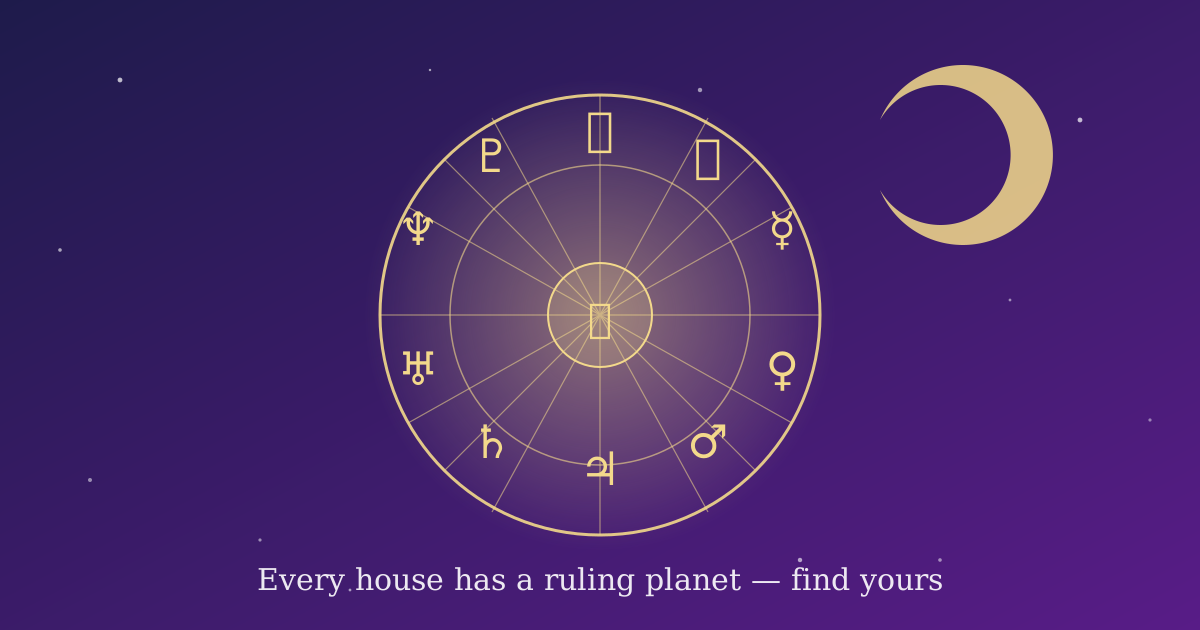
Most birth-chart readings start with the planets sitting inside each house. But a large part of the chart's story lives somewhere else entirely: in the planets that rule the houses from the outside. Every house has a ruler, a planet assigned to it through the sign on its cusp, and that ruler acts like the house's ambassador. Wherever the ambassador travels in the chart, the house's business follows.
This guide explains what house rulers are, gives you the complete table of rulers for all twelve houses, shows you how to find your own house rulers step by step, explains the traditional-versus-modern ruler question, and walks through how to read a ruler's placement, with worked examples. As with all astrology here, treat this as a reflective framework for self-understanding, not a prediction about your career, relationships, or future.
What Is a House Ruler?
A house ruler is the planet that rules the zodiac sign sitting on a house's cusp. The chain has three links. First, each house begins at a cusp, a boundary line marked by a sign and degree. Second, every zodiac sign has a ruling planet: Mars rules Aries, Venus rules Taurus, and so on. Third, the planet ruling the cusp sign becomes the ruler of that house. So if your 2nd house cusp is Taurus, Venus is the ruler of your 2nd house, because Venus rules Taurus.
Why does this matter? Because the ruler carries the house's story wherever it goes. A house with no planets inside it is not silent: its ruler is somewhere in the chart, doing the house's work in another life area. And a house with several planets inside it still has a ruler, whose placement adds a second layer to the reading, like a background thread connecting two rooms of the chart. Astrologers call this technique "reading by rulership," and it is one of the oldest tools in the tradition, far older than the modern focus on planets-in-houses alone.
One more distinction is worth making early. The ruler of a house is not the same as a planet sitting in that house. A planet in the 7th house is a guest in the house of partnership; the ruler of the 7th house is the planet that owns the deed, wherever it happens to be standing. Both matter, and a good reading uses both: the guests describe what is happening in the house right now, and the ruler describes where the house's energy is being spent.
The Natural Rulers of the 12 Houses
Before you find your personal house rulers, it helps to know the "natural" rulers: the rulers of the houses when the zodiac runs in its natural order, with Aries on the 1st house cusp, Taurus on the 2nd, and so on. This is the default map most textbooks start from, and it is a useful reference even though your own chart will shuffle the signs around:
- 1st house (self): natural sign Aries, ruled by Mars.
- 2nd house (money and values): natural sign Taurus, ruled by Venus.
- 3rd house (communication and learning): natural sign Gemini, ruled by Mercury.
- 4th house (home and roots): natural sign Cancer, ruled by the Moon.
- 5th house (creativity and pleasure): natural sign Leo, ruled by the Sun.
- 6th house (work and daily health): natural sign Virgo, ruled by Mercury.
- 7th house (partnership): natural sign Libra, ruled by Venus.
- 8th house (shared resources and transformation): natural sign Scorpio, ruled by Mars traditionally and Pluto in modern astrology.
- 9th house (philosophy and travel): natural sign Sagittarius, ruled by Jupiter.
- 10th house (career and reputation): natural sign Capricorn, ruled by Saturn.
- 11th house (friendship and hopes): natural sign Aquarius, ruled by Saturn traditionally and Uranus in modern astrology.
- 12th house (solitude and the unconscious): natural sign Pisces, ruled by Jupiter traditionally and Neptune in modern astrology.
Notice the pattern: the Sun and Moon each rule one sign, Mercury, Venus, Mars, Jupiter, and Saturn each rule two signs, and the three modern planets each co-rule one sign. That is why the traditional system has exactly seven rulers for twelve signs, and why modern astrologers added three more. Your own chart keeps the sign-to-planet rulerships fixed; what changes is which sign sits on each house cusp.
Traditional vs. Modern Rulers: Which Should You Use?
The traditional system, used for roughly two thousand years before the outer planets were discovered, assigns rulership using only the seven visible planets. In that system, Mars rules both Aries and Scorpio, Jupiter rules both Sagittarius and Pisces, and Saturn rules both Capricorn and Aquarius. Every sign has exactly one ruler, and the system is beautifully symmetrical.
The modern system, developed after the discoveries of Uranus in 1781, Neptune in 1846, and Pluto in 1930, gives those three planets rulership of Aquarius, Pisces, and Scorpio respectively, while keeping the traditional rulers as co-rulers. So a modern reading of a Scorpio-cusp house considers both Mars and Pluto; an Aquarius-cusp house considers both Saturn and Uranus; a Pisces-cusp house considers both Jupiter and Neptune.
Which should you use? The honest answer is that both are widely used and neither is more correct in any absolute sense. A practical approach that many astrologers take is to read both rulers and let them describe different layers: the traditional ruler often describes the grounded, everyday, practical side of the house, while the modern ruler describes its deeper, more collective, or more transformative side. If you are just starting out, begin with the traditional rulers, because they give every house one clear answer, and add the modern co-rulers once you are comfortable with the basic technique.
How to Find Your Own House Rulers in 4 Steps
Pull up your birth chart and work through these steps:
- Step 1: List your twelve cusp signs in order, starting with the Ascendant, which is your 1st house cusp. You will need an accurate birth time for this: the cusps move about one degree every four minutes, so a guessed birth time can put the wrong sign on a cusp.
- Step 2: For each cusp sign, write down its ruling planet using the table above. For Scorpio, Aquarius, and Pisces cusps, note both the traditional and modern rulers.
- Step 3: Find each ruling planet in your chart and note which house and sign it sits in. That house is where the original house's energy goes to work. If your 2nd house ruler sits in your 10th house, your money story is tied to your career and public life.
- Step 4: Note the sign the ruler sits in, too. A ruler in its own sign or a sign it rules is traditionally read as strong and well-placed; a ruler in the sign opposite its rulership is read as working harder for its results. The aspects the ruler makes to other planets add further detail.
Worked example: suppose your 7th house cusp is Gemini. Mercury rules Gemini, so Mercury is your 7th house ruler. If Mercury sits in your 3rd house of communication, partnership themes in your life tend to play out through conversation, learning, and everyday exchanges, and you may be drawn to partners you can talk with endlessly. If Mercury sits in your 10th house instead, partnership and career intertwine, and you may meet significant partners through work or share a public project with one. Same house, same ruler, different placement, different story.
Reading a Ruler's Placement: What to Look For
Once you know where a house ruler sits, four things sharpen the reading. First, the house it sits in: this is the life area where the original house's themes most often appear, and it is the single most useful piece of rulership information. Second, the sign it sits in: this describes the style in which the ruler works. A 10th house ruler in cautious Capricorn suggests a career path built patiently over time, while the same ruler in adventurous Sagittarius suggests a career path that seeks variety, learning, and room to roam.
Third, the aspects the ruler makes. A ruler in a smooth aspect to a benefic planet like Venus or Jupiter is traditionally read as supported, while a ruler in a tense aspect to Saturn or Mars is read as facing obstacles or delays in that house's area. Aspects are not verdicts: they describe the weather around the house's themes, not whether you will succeed or fail at them. Fourth, the ruler's condition: a ruler in the sign it rules, or in the sign of its exaltation, is traditionally read as dignified and able to act freely, while a ruler in its detriment or fall is read as working against the grain. These old dignity rules are a refinement, not a requirement, so do not worry about them until the basic house-to-house links feel natural.
Two special cases deserve a mention. When a house ruler sits in its own house, the house's energy is self-contained and direct: a 2nd house ruler in the 2nd house suggests money matters handled on their own terms, without much borrowing from other life areas. And when two houses share the same ruler, because their cusp signs are ruled by the same planet, those two houses are linked by that planet, and their themes tend to rise and fall together. Mercury ruling both your 3rd and 6th houses, for example, ties your everyday communication to your work routines through a single planet.
Common Mistakes When Reading House Rulers
The most common mistake is treating a house ruler as a prediction. A 7th house ruler in the 12th house does not mean a hidden or doomed partnership; traditionally it suggests that partnership themes connect with solitude, privacy, or inner life, and the actual story depends on the whole chart and on real-life choices. Another mistake is reading only the modern ruler for Scorpio, Aquarius, and Pisces houses and dropping the traditional one. The traditional ruler is still doing work in the chart, and skipping it throws away half the picture.
A third mistake is forgetting the house system. Your cusp signs, and therefore your house rulers, depend on the house system your calculator uses. Whole Sign gives each house a full sign, so its rulers are simple to find, while Placidus produces unequal houses and can even produce intercepted signs, where a sign sits inside a house without touching a cusp. If you switch systems mid-reading, your rulers change, and the reading stops lining up. Pick one system, note it, and compare charts only within it. Finally, do not read a ruler in isolation. Rulership is a linking technique: its power comes from connecting two houses, two signs, and the aspects around the planet, not from any single placement on its own.
House rulers are the quiet wiring of the chart. Planets in houses show you what is happening in each room; rulers show you how the rooms connect, which doors open into which, and where the energy of an empty room has gone. Learn your twelve rulers, and the wheel stops being twelve separate boxes and starts reading like a house with hallways, with every room reachable from every other.
Frequently asked questions
What is the ruling planet of a house?
A house's ruling planet is the planet that rules the zodiac sign on that house's cusp. If your 2nd house cusp is Taurus, Venus rules your 2nd house, because Venus rules Taurus. Astrologers read the house through its ruling planet: where that planet sits in your chart shows where the house's themes play out.
How do I find the rulers of my houses?
Generate your birth chart and note the sign on each house cusp, starting with the Ascendant for the 1st house. Then look up each sign's ruling planet: Aries is ruled by Mars, Taurus by Venus, Gemini by Mercury, Cancer by the Moon, Leo by the Sun, Virgo by Mercury, Libra by Venus, Scorpio by Mars (traditionally) or Pluto (modern), Sagittarius by Jupiter, Capricorn by Saturn, Aquarius by Saturn (traditionally) or Uranus (modern), and Pisces by Jupiter (traditionally) or Neptune (modern).
Should I use traditional or modern house rulers?
Both systems are used, and neither is wrong. Traditional rulership uses the seven classical planets and gives every sign one clear ruler. Modern rulership adds Uranus, Neptune, and Pluto as co-rulers of Aquarius, Pisces, and Scorpio. Many astrologers read both: the traditional ruler for the house's grounded, everyday story and the modern ruler for its deeper or more collective layer.
What does it mean when a house ruler sits in another house?
The house where a ruler sits is where that house's energy goes to work. If the ruler of your 7th house of partnership sits in your 10th house of career, partnership themes tend to show up through your public life and work. This linking of houses is one of the main ways astrologers trace connections between different life areas in a chart.
Can an empty house still have a ruler?
Yes. Every house has a cusp sign, and therefore a ruling planet, whether or not any planet sits inside the house. Reading an empty house through its cusp sign and its ruling planet is the standard technique for understanding houses with no planets in them.
Keep exploring
The 12 Astrology Houses: Complete Meaning Guide
The 12 astrology houses explained: meanings for each house, how to read planets in houses, house systems, and what empty houses mean.
Read the meaning →
Planets in the Houses: How Placements Shape Each Life Area
Planets in the houses: what every planet means in each house. Learn the planet + sign + house blend with examples, stelliums, and a worked reading.
Read the meaning →
Empty Houses in Astrology: What They Really Mean & How to Read Them
Spot an empty house in your birth chart? Learn what empty houses really mean — how to read the cusp sign and ruling planet, and the transits that light them up.
Read the meaning →
House Cusps in Astrology: Meaning, How to Find Yours & How to Read Them
What is a house cusp? Learn how the twelve cusps divide your birth chart, how to find your cusp signs, what each cusp means, and why cusps matter more than planets alone.
Read the meaning →