
Stellium in Astrology: Meaning, Houses & How to Read One
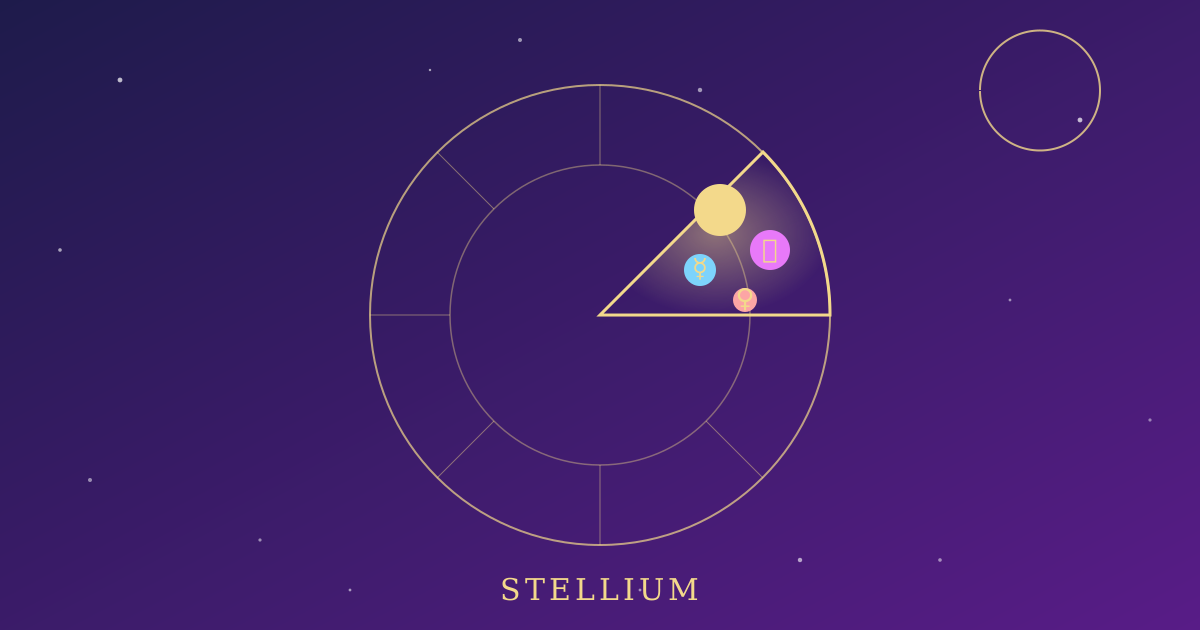
Most birth charts spread their planets around the wheel like guests at a party, a few in each room, chatting in small groups. A stellium chart looks different. Open it and you find the party has moved: half the guests are crowded into a single room, talking over each other, all about the same subject. That crowded room is the stellium, and astrologers consider it one of the most eye-catching patterns a chart can hold.
This guide explains what a stellium is, how many planets it takes, how to spot one in your own chart, what a stellium means in each of the twelve houses, how the sign and the planets involved color the story, and how to work with concentrated chart energy in a balanced way. As with all astrology here, take this as a reflective lens for self-understanding, not a prediction about your career, relationships, or future.
What Is a Stellium?
The word stellium comes from the Latin stella, meaning star, and in astrology it means a gathering of stars: three or more planets in the same zodiac sign or the same house. Some astrologers set the bar at four planets, and a few count the Ascendant or Midheaven in the cluster, but the working rule most readers use is simple: three planets together is a stellium, four or more is a strong one, and the closer together the planets sit, the more concentrated astrologers consider the energy.
Why does the cluster matter? In chart reading, each planet is a different function: the Sun is identity and purpose, the Moon is feeling and instinct, Mercury is thought and communication, Venus is affection and values, Mars is drive and action, and the outer planets add generational and transformative layers. When several of those functions gather in one sign or one house, they stop acting independently and start acting as a team. The result, astrologers say, is emphasis: one theme in life gets far more of the chart's attention than the rest.
A stellium can also be read two ways at once. A stellium in a sign concentrates style: several planets express through the same sign's qualities, so a Scorpio stellium reads as intense, private, and probing across many functions of life. A stellium in a house concentrates life area: several planets work in the same arena, so a 10th house stellium puts career, reputation, and public life at the center of the chart. Many stelliums do both, when the clustered planets share one sign and one house wedge, and those are the ones astrologers tend to call the most defining.
How to Spot a Stellium in Your Chart
Pull up your birth chart — any free chart calculator will draw one from your birth date, time, and place — and look for a clump of planet glyphs sitting close together. Here is the step-by-step check:
- Count the cluster: Are three or more planet glyphs grouped in the same sign (the same 30-degree slice of the zodiac) or the same house wedge? If yes, you have a stellium by the common definition.
- Note the planets: Which planets are involved? Personal planets (Sun, Moon, Mercury, Venus, Mars) make the stellium feel personal and daily; outer planets (Uranus, Neptune, Pluto) add generational or transformative weight.
- Note the sign: What sign holds the cluster? The sign describes how the whole group expresses itself — its style, tempo, and attitude.
- Note the house: What house wedge holds the cluster? The house describes where the group does its work — the life area that absorbs the energy.
- Check the spread: Are the planets within a few degrees of each other, or spread across the whole sign? A tight cluster reads as more focused; a wide one reads as a broader theme with several subplots.
- Find the ruler: Which planet rules the sign of the stellium? That planet is the cluster's manager: where it sits, and what it touches, shows where the stellium's energy gets directed.
One more distinction matters. A stellium is not the same as a conjunction, though it contains them. A conjunction is two planets close together; a stellium is three or more planets sharing a sign or house, whether or not every pair is tightly conjunct. And a stellium is not automatically permanent: planets move, so a stellium in a transit chart or a progressed chart is a temporary season, while a stellium in the birth chart is a lifelong pattern to learn from.
Stellium Meanings by House
The house of a stellium is usually the first thing an astrologer asks about, because it names the life area where the concentration lands. Here is the traditional flavor of a stellium in each house, read as a reflective theme rather than a verdict:
- 1st house stellium: Identity takes center stage. Self-expression, appearance, and first impressions carry unusual weight, and the person is often strongly self-directed — sometimes to the point of needing to learn to share the spotlight.
- 2nd house stellium: Money, values, and self-worth dominate the chart story. Resources, earning, and what the person considers truly valuable get sustained attention, for better or for worse.
- 3rd house stellium: Communication, learning, and the immediate environment buzz with activity. Writing, talking, studying, and sibling or neighbor relationships may all run at high volume.
- 4th house stellium: Home, family, and emotional roots anchor the chart. Private life, ancestry, and the need for a secure base shape decisions more than public ambition does.
- 5th house stellium: Creativity, romance, and pleasure shine brightly. Self-expression, play, children, and the arts may absorb enormous energy, with the growth edge being consistency when the fun fades.
- 6th house stellium: Work, health, and daily routines become a life theme. Devoted workers, healers, and crafters cluster here; the caution is letting the job or the routine swallow everything else.
- 7th house stellium: Partnerships dominate. One-to-one relationships — romantic, business, or close friendship — become the main arena of growth, and the person often learns the most about themselves through others.
- 8th house stellium: Shared resources, intimacy, and transformation run deep. Merging with others, joint finances, and the cycles of endings and rebirth carry unusual intensity.
- 9th house stellium: Travel, philosophy, and higher learning call loudly. Big questions, distant horizons, and the search for meaning may organize the whole life story.
- 10th house stellium: Career, reputation, and public life take the lead. Ambition and visibility get sustained focus, and the person is often known for their work above all else.
- 11th house stellium: Friendship, community, and future hopes gather force. Groups, causes, and networks become the stage, and belonging to something larger matters deeply.
- 12th house stellium: The inner life, solitude, and the unconscious hold unusual depth. Dreams, spirituality, and hidden patterns may be rich and absorbing, with the growth edge being bringing that inner world into everyday life.
Read your stellium's house first, then layer in the sign and the planets. The house tells you where the energy goes; the sign tells you how it behaves when it gets there.
Stellium by Sign and Element: The Flavor of the Cluster
When the clustered planets share a sign, the sign's element and quality shape the whole group. Fire stelliums (Aries, Leo, Sagittarius) read as bold, warm, and action-oriented — the group wants to move, create, and be seen. Earth stelliums (Taurus, Virgo, Capricorn) read as steady, practical, and building-oriented — the group wants results it can touch. Air stelliums (Gemini, Libra, Aquarius) read as social, mental, and idea-driven — the group wants to connect, discuss, and understand. Water stelliums (Cancer, Scorpio, Pisces) read as deep, feeling, and intuitive — the group wants to feel, merge, and heal.
The sign's quality adds a second layer. Cardinal stelliums (Aries, Cancer, Libra, Capricorn) push to initiate and lead in their house's arena. Fixed stelliums (Taurus, Leo, Scorpio, Aquarius) hold on, deepen, and refuse to let go of their theme. Mutable stelliums (Gemini, Virgo, Sagittarius, Pisces) adapt, vary, and keep the theme in motion. A fixed-sign stellium in the 10th house, for example, suggests a career focus that persists for decades; a mutable-sign stellium in the 3rd suggests a communication style that keeps reinventing itself.
The planets in the cluster matter just as much. A stellium led by the Sun reads as identity-driven: the cluster is about who the person is. One led by the Moon reads as feeling-driven: the cluster is about emotional security. Mercury-heavy clusters think and talk their way through the theme; Venus-heavy ones relate and value their way through it; Mars-heavy ones act and push their way through it. Outer planets in the mix add a generational or transformative undertone that plays out over years rather than days.
Stellium or Something Else? Telling Patterns Apart
New chart readers sometimes confuse a stellium with other patterns. A few quick distinctions help. A grand trine is three planets in a triangle of harmonious aspects — it spreads across the chart rather than clustering in one place. A T-square is a tense triangle of two oppositions and a square — again, spread out, not gathered. A bundle pattern is a chart where all ten planets fall within about a third of the wheel, which may contain a stellium but is a whole-chart shape rather than a single cluster. And an empty house is simply a house with no planets in it — the opposite of a stellium, and no less meaningful, since its cusp sign and ruling planet still carry its story.
Another common question is whether a stellium can be "broken" or balanced. Astrologers do not treat it as something to fix. The usual advice is integration: let the cluster do what it does well, and deliberately feed the rest of the chart too. A 10th house stellium person might schedule protected time for the 4th house of home; a 7th house stellium person might protect solo time for the 1st house of self. Balance, in this reading, is not about weakening the stellium but about giving the quieter houses a seat at the table.
Transits and Progressions: Temporary Stelliums
Stelliums are not only birth-chart features. When transiting planets gather in one sign or house for a season, astrologers read it as a temporary stellium: a period when one life area suddenly demands unusual attention. A year when several slow planets cross your 7th house, for instance, is traditionally read as a relationship-heavy chapter, even if your birth chart has no stellium there. Similarly, a progressed stellium — formed as progressed planets drift together over years — is read as a slow chapter of concentration that builds and releases gradually.
These temporary clusters are useful for timing reflection. If transits are piling up in your 6th house, the reflective question is about work and routine: what system needs attention right now? If they gather in your 9th, the question is about learning and horizons: what bigger picture is asking for room? Treat transit stelliums as seasons with a theme, not as events with a date stamped on them.
Working With Your Stellium: Grounded Practices
Whatever your cluster, astrologers suggest the same balanced approach: honor the concentration, and keep the rest of the chart fed. These are reflective habits, not predictions or advice about any life decision:
- Name the theme in one sentence: "My energy gathers around home and family" or "My energy gathers around career and reputation." A single sentence makes the pattern usable.
- Give the cluster a daily outlet: A 5th house stellium needs a creative hour; a 3rd house stellium needs a writing or learning slot; a 6th house stellium needs a routine worth keeping. The cluster is happiest with a job to do.
- Feed the opposite house: Every house has a partner across the wheel — 1st with 7th, 4th with 10th, 6th with 12th. A little deliberate time in the opposite house keeps the stellium from becoming the whole life.
- Watch the one-sidedness trap: When one theme explains everything, it can start excusing everything. Notice when the stellium's story becomes the only story you tell about yourself.
- Use the ruler planet: Find the planet that rules your stellium's sign and check where it sits. Its house is often the practical doorway: the place where the cluster's energy most easily turns into action.
- Journal the cluster's seasons: When transits activate your stellium's sign or house, note what comes up. Over time the pattern of your own seasons becomes clearer than any textbook description.
Three Myths About Stelliums
Stelliums collect mythology almost as fast as they collect planets. Let's clear the big three:
- "A stellium means you are a genius in that area." It means concentrated energy and attention, not guaranteed talent or success. Focus helps mastery, but mastery still takes work, and a stellium guarantees neither.
- "A stellium means you are doomed to be one-sided." Concentration is a tendency, not a sentence. Many people with strong stelliums live richly varied lives precisely because they learned to feed the rest of the chart on purpose.
- "No stellium means a boring chart." Most charts have no stellium at all, and they are not missing anything. A spread-out chart simply distributes its energy more evenly, and its story is told through aspects, house rulers, and the angles instead.
Your Turn: A 10-Minute Stellium Reading
Pull up your birth chart and try this:
- Step 1: Scan the wheel for any clump of three or more planet glyphs in one sign or one house wedge. Circle it — that is your stellium, if you have one.
- Step 2: List the planets, the sign, and the house. Write the theme in one sentence: the house's life area, in the sign's style, driven by those planets.
- Step 3: Find the ruler of the stellium's sign. Where does it sit? Its house and aspects show where the cluster's energy most often goes to work.
- Step 4: Ask: where does this concentration help me, and where does it crowd other things out? Name one opposite-house activity you could protect this week.
- Step 5: Note one small, concrete outlet for the cluster — a daily hour, a weekly practice, a conversation — and try it for seven days. A stellium rewards being used, not just admired.
A stellium is astrology's way of saying: here is where your chart leans in. Read it honestly, give it work to do, keep the rest of the wheel in the conversation, and the loudest room in your chart becomes a resource instead of a rut.
Frequently asked questions
What is a stellium in astrology?
A stellium is a cluster of three or more planets in the same zodiac sign or the same astrology house. Astrologers read it as concentrated energy: a large share of the chart's attention gathers in one life area or one style of expression, making that theme unusually prominent in the person's chart story.
How many planets make a stellium?
Most astrologers require at least three planets, and many count four or more as a true stellium. The Sun, Moon, and planets count; the Ascendant and Midheaven usually do not, though some astrologers include them. The tighter the cluster, the stronger astrologers consider the concentration.
Is a stellium good or bad?
A stellium is neither good nor bad — it is concentrated. It can bring deep focus, talent, and drive in one life area, and it can also bring one-sidedness, since so much energy flows through one channel. Astrology treats it as a reflective pattern, not a verdict on success or happiness.
What is the difference between a stellium in a sign and a stellium in a house?
A stellium in a sign concentrates style: several planets express through the same sign's qualities, such as Scorpio intensity or Gemini versatility. A stellium in a house concentrates life area: several planets work in the same arena, such as the 10th house of career or the 7th house of partnership. Many stelliums do both at once, when the clustered planets share a sign and a house.
How do I find my stellium?
Pull up your birth chart and look for three or more planet glyphs grouped close together in one sign or one house wedge. Note which planets are involved, which sign they share, and which house they sit in — that combination is the core of your stellium's story.
Keep exploring
The 12 Astrology Houses: Complete Meaning Guide
The 12 astrology houses explained: meanings for each house, how to read planets in houses, house systems, and what empty houses mean.
Read the meaning →
Planets in the Houses: How Placements Shape Each Life Area
Planets in the houses: what every planet means in each house. Learn the planet + sign + house blend with examples, stelliums, and a worked reading.
Read the meaning →
Empty Houses in Astrology: What They Really Mean & How to Read Them
Spot an empty house in your birth chart? Learn what empty houses really mean — how to read the cusp sign and ruling planet, and the transits that light them up.
Read the meaning →
The 6th House in Astrology: Work, Health & Daily Routines
The 6th house rules work, health, daily routines & service. Learn what your 6th house sign means, how to read Mercury and planets in the 6th, and the everyday habits it reveals.
Read the meaning →