
How to Interpret Your Big Three: Sun, Moon & Rising Read as One Story
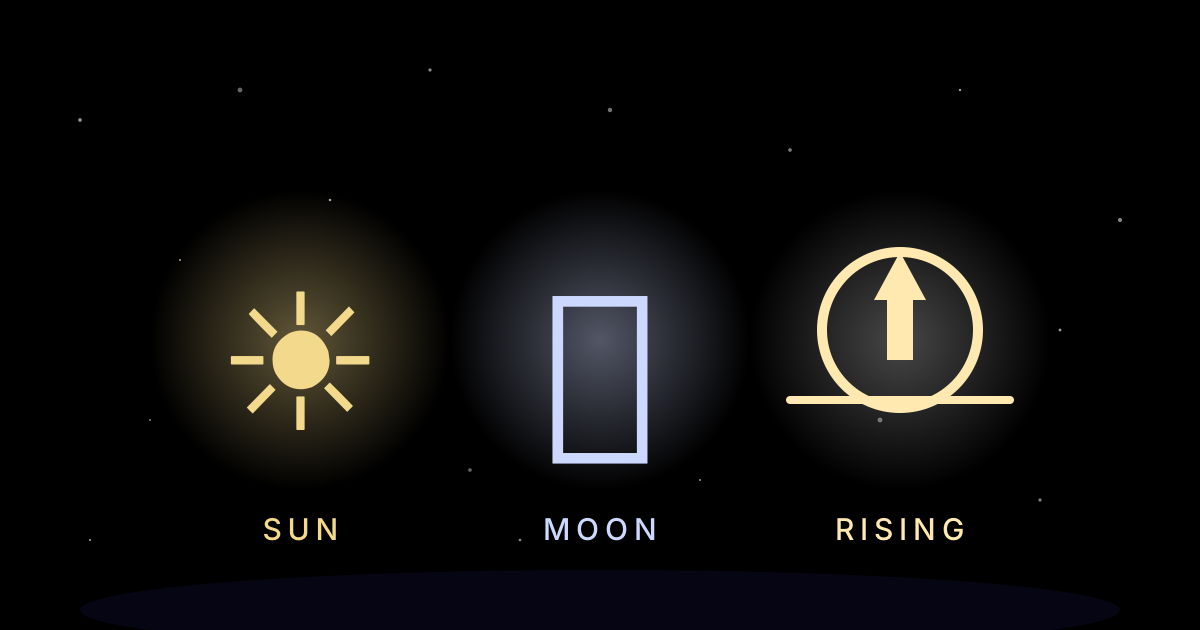
Most astrology beginners collect their Sun, Moon, and Rising signs like three separate horoscope stickers — and then feel oddly misrepresented by all of them. The Sun sign post sounds too confident, the Moon description sounds too sensitive, the Rising summary sounds like a stranger. That mismatch is the clue that the Big Three was never meant to be read as three standalone fortunes. In astrological tradition, the trio works as a system: three characters in one story, each shaping how the other two show up.
Here is the classic shorthand astrologers use when they meet a new chart: the Rising is how you enter the room, the Sun is what drives you, and the Moon is what you need when you get home. The Rising (Ascendant) is the sign that was rising on the eastern horizon at your birth — your social style, your instincts in new situations, the vibe people pick up on before you speak. The Sun is your core identity and life direction — the self you are growing toward across your whole life, not the one you already are. The Moon is your emotional weather — your instincts, your habits, your private self, and what you genuinely need to feel safe. Three faces, one person.
Reading the trio together is the single biggest leap in chart fluency, because it explains the contradictions that make people feel unexplainable to themselves. Why does the bold Leo Sun freeze in new social situations? Check a shy Pisces Rising. Why does the calm Taurus Moon explode when pushed? Check a fire Sun underneath. Why does someone look spontaneous but plan everything? Rising says one thing, Sun says another. The apparent contradictions are not errors in the system — they are the system. People are layered, and the Big Three is astrology's first approximation of that layering.
The Three Roles: A Simple Framework
Before you read your trio, learn the three roles. Astrologers have argued for centuries about which placement matters most, but they agree on what each one does. Think of the Sun, Moon, and Rising as the roles in a small theater company, each with a distinct job.
The Rising: your opening scene
Your Rising sign is the mask, the doorway, the opening shot. It governs first impressions, personal style, reflexes in unfamiliar situations, and the general attitude with which you meet life. People with a Capricorn Rising tend to lead with competence and caution; with a Gemini Rising, with curiosity and quicksilver friendliness; with a Scorpio Rising, with watchful intensity. Traditional astrologers call the Ascendant the helm of the chart — the steering wheel — because it sets the style of everything else. Here is a telling detail: many people do not identify with their Rising at all. It is the part you see least, because you are inside it. Ask three close friends to describe your vibe, and they will usually name your Rising more accurately than you can yourself.
The Sun: your core story
Your Sun sign is your essence and life direction — the self you are becoming, not a fixed personality you were issued at birth. This is the most misunderstood placement in astrology: your Sun sign is better read as a curriculum than a description. The Aries Sun is learning courage, the Libra Sun is learning partnership, the Pisces Sun is learning compassion — the sign describes the lifelong growing edge, and many people feel their Sun most strongly after age thirty, once they have lived into it. It is also the engine of your vitality: the Sun sign points to what recharges you and what your life is about at the largest scale. Where the Rising is the opening scene, the Sun is the protagonist's arc.
The Moon: your inner weather
Your Moon sign is your emotional operating system — instincts, habits, needs, and the private self that only appears around people you trust. Astrologers consider it the most personal of the three: where the Rising is public and the Sun is aspirational, the Moon is real. A Cancer Moon needs nesting and emotional closeness to reset; an Aquarius Moon needs space and intellectual stimulation; a Leo Moon needs warmth and appreciation. The Moon also governs your automatic reactions — what you do before you think — which is why it dominates under stress, in conflict, and in love. Many astrologers say that knowing someone's Moon sign is the fastest way to understand what they are actually like at home.
Step by Step: Reading Your Trio as One Portrait
Now the fun part. Gather your three signs, then read them in this order — outside in, like peeling a portrait from the frame to the canvas.
Step 1: Count the elements
Assign each placement its element — fire (Aries, Leo, Sagittarius), earth (Taurus, Virgo, Capricorn), air (Gemini, Libra, Aquarius), water (Cancer, Scorpio, Pisces) — and see what dominates. Two or three in one element is a loud signature: double fire means a person whose default mode is bold, fast, and impatient; double water means feeling runs the whole show; double earth means everything gets practical-tested; double air means everything gets talked through first. A missing element is equally informative: no earth can mean brilliant ideas that never get scheduled; no air can mean feelings with nowhere to be verbalized; no fire can mean energy that needs coaxing; no water can mean a person who intellectualizes their emotions. Neither is better — they are just different weather systems.
Step 2: Notice the modalities
Each sign is also cardinal (initiating), fixed (sustaining), or mutable (adapting). Your modality mix describes how you handle change. Two or three cardinal placements make a starter — someone who launches things brilliantly and may need systems to finish. Fixed-heavy trios make finishers — loyal, steady, and slow to pivot. Mutable-heavy trios make adapters — flexible, curious, and prone to scattering. The classic friction pattern is fixed Sun versus mutable Rising: a core that wants commitment wrapped in a style that wants options — or the reverse. Read your three signs' qualities together and you get a rhythm profile: do you start, sustain, or adjust?
Step 3: Read the Rising as the filter
Now layer the Rising over the Sun: your Rising colors how your Sun expresses itself. A Leo Sun with a Virgo Rising is still theatrical at heart, but the delivery is dry, precise, and understated — the show arrives in footnotes. A Virgo Sun with a Leo Rising is still meticulous, but the presentation is charismatic and warm. The Rising is the accent your Sun speaks in. This is also where the birth-time mystery pays off: two people born on the same day can have wildly different first impressions because of different Rising signs, which is why astrologers trust the trio over the Sun sign alone.
Step 4: Let the Moon set the terms
Finally, ask what your Moon needs in order for the other two to function. A fire Sun can burn through life brilliantly, but if the Moon is in Cancer, the whole machine needs regular emotional refueling — home, closeness, rest — or it sputters. Astrologers often say that ignoring the Moon is the main reason people feel fraudulent about their Sun sign: you cannot sustain the protagonist's arc on an empty emotional tank. The practical reading is simple: honor the Moon first, and the Sun gets easier. Schedule for your Moon and dream for your Sun.
Step 5: Find the tension and name the dance
Look for the most contradictory pair in your trio and describe their negotiation instead of choosing sides. Fire Sun with water Moon: the pioneer who needs a long bath. Earth Rising with air Sun: the serious-looking person with a mind full of escape plans. Fixed Moon with mutable everything: deep loyalties carried by a drifter's lifestyle. The astrological word for this is polarity, and mature readers treat it as range, not flaw. Every great character in literature is a contradiction held together by a story — your job is to be the author who makes the three characters work as a cast.
Example Trios: How It Looks in Practice
Three quick sketches show how the system works. Picture a Sagittarius Sun, Cancer Moon, Virgo Rising: outwardly precise and helpful (Virgo Rising), driven by adventure and big-picture meaning (Sagittarius Sun), privately tender and home-loving (Cancer Moon). The person looks like a meticulous planner, dreams like a wanderer, and cries at animal-rescue videos. The trio explains the whole person in a way no single sign could.
Now a Scorpio Sun, Gemini Moon, Aries Rising: bold, fast first impression (Aries Rising), intense and private at the core (Scorpio Sun), mentally restless and chatty underneath it all (Gemini Moon). This is the person who looks impulsive but is actually researching you — the Rising acts, the Sun broods, the Moon processes everything out loud. Finally, a Libra Sun, Capricorn Moon, Pisces Rising: gentle and dreamy on the surface (Pisces Rising), harmony-seeking at the core (Libra Sun), and surprisingly strict with themselves in private (Capricorn Moon). The soft exterior hides the hardest inner critic of the zodiac.
These are sketches, not predictions — entertainment astrology, read for insight and fun, not as fate. But they show the method: style, drive, emotional engine, and the conversation between them. Try it with your own trio and notice how quickly it starts sounding like someone you know. It should — it is you.
The Three-Sentence Reading Method
Want a reading you can actually memorize? Astrologers and hobbyists alike use a three-sentence formula that captures the whole system in plain language. Fill in the blanks with your signs:
Sentence one — the Rising: “I come across as [Rising sign keyword], so people meet me as [trait].” (Example: “I come across as calm and capable, so people meet me as steady.”)
Sentence two — the Sun: “At my core I am becoming [Sun sign keyword], which means my life is about [theme].” (Example: “At my core I am becoming adventurous, which means my life is about seeking truth and experience.”)
Sentence three — the Moon: “But underneath, I need [Moon sign keyword] to feel safe and steady.” (Example: “But underneath, I need deep emotional bonds to feel safe and steady.”)
Run the formula with your own three signs and you have a thirty-second introduction to your chart that beats any generic horoscope paragraph. It works at dinner parties, in journals, and as the first page of a chart-reading notebook. And notice what the formula does: it gives each placement its job instead of piling three descriptions on top of each other. That is the whole skill of reading the Big Three — not three labels, but one team with three roles.
Common Trio Patterns Worth Knowing
After reading hundreds of charts, astrologers notice repeating trio patterns. The double-downer — all three in the same element — is unmistakable: triple fire is a bonfire of enthusiasm (and burnout), triple earth is a fortress (and a rut), triple air is a think tank (and a spinning wheel), triple water is an ocean (and a flood). These people are coherent, intense, and often famously one-note — in the best way and the worst.
The split personality — each placement in a different element — describes the person everyone agrees is hard to pin down. The hidden core — Rising and Moon in one element, Sun in another — is the classic “nobody would guess” chart: the fierce activist with a soft private core, or the clown with an iron will. And the anchor trio — two placements fixed, one mutable — is the person who seems changeable but quietly never budges on what matters. If your trio contains a striking pattern like these, it is probably the first thing an astrologer would mention about your chart — and now it is the first thing you can mention about it yourself.
Going Deeper: Houses, Rulers, and the Rest of the Chart
The Big Three is the gateway, not the destination. Your Sun lives in a house — the area of life where your core drive plays out. Your Rising has a chart ruler — the planet ruling your Ascendant sign, whose condition flavors your whole approach. Your Moon has aspects — conversations with other planets that shape how your emotional engine runs. Astrologers sometimes say the Big Three is the trailer and the full chart is the movie.
But here is the honest secret of working astrologers: most of what people want to know about themselves is already in the trio. Identity, instincts, style, needs, tensions, patterns — the Big Three covers the questions people actually ask. The full chart refines and complicates, and there is a lifetime of depth there. But if you learn to read your three placements as one story, you will know more about how astrology actually works than most people who can recite every planet in their chart.
Closing: Three Characters, One You
Your Big Three is not three verdicts about who you are. It is one portrait with three layers: the style you lead with, the self you are growing into, and the emotional truth underneath both. Read the Rising as the doorway, the Sun as the direction, the Moon as the fuel — and suddenly the contradictions stop looking like flaws and start looking like depth.
So write your three sentences. Count your elements. Name the dance between your most contradictory pair. And remember the real punchline of the Big Three: you were never supposed to be one simple thing. Nobody interesting is. The trio just gives you the language to say so — and to read the next chart, and the next, and the next, until the whole sky starts telling stories.
Frequently asked questions
How do I read my Big Three together?
Treat your Sun, Moon, and Rising as three characters in one story rather than three separate fortunes. The Sun describes your core drive and the self you are growing into, the Moon describes your emotional engine and private needs, and the Rising describes your style, first impressions, and how you approach new situations. Read them in order — outer style (Rising), inner drive (Sun), hidden emotional truth (Moon) — and you get a portrait that actually sounds like you.
Which Big Three placement matters most?
Astrologers disagree, and that disagreement is useful: no single placement is the whole person. Most traditional astrologers rank the Sun first as the core of identity, the Rising second as the chart's steering wheel, and the Moon third as the emotional undercurrent. But many modern practitioners start with the Rising, because it is literally the sign on the eastern horizon at birth and colors everything else. The honest answer is that the trio works as a system — each placement shapes how the others express.
What if my Sun and Moon signs clash?
A clashing Sun and Moon — say a fiery Sun with a watery Moon — does not mean you are broken or fated to struggle. Astrologers read it as inner tension that can become range: the part of you that wants to charge ahead negotiating with the part that needs to feel everything first. People with apparently contradictory placements often describe feeling like two people, and the astrological advice is the same as the psychological one: neither side gets to win permanently; you learn to let each one drive when it is best suited.
Do I need my birth time for the Big Three?
You need your exact birth time for the Rising sign — it changes roughly every two hours, so it is the one placement that truly requires it. Your Sun sign needs only your birth date, and your Moon sign needs the date and year (the Moon moves fast, so exact day matters). If your birth time is unknown, you can still work with your Sun and Moon, and some astrologers use a sunrise chart or rectification to estimate the Rising.
What is my Rising sign if I do not know my birth time?
Without a birth time there is no reliable way to calculate your exact Rising sign, since the Ascendant shifts through all twelve signs in a single day. Common workarounds include checking your birth certificate or hospital records, asking family members, or having an astrologer rectify your chart by testing Rising candidates against known life events. Many people start with their Sun and Moon while they track down the time.
Keep exploring

Sun Sign Meaning: Your Core Identity & Life Purpose
What is your Sun sign and what does it really mean? Discover how your Sun placement shapes your core identity, ego, vitality, and the life direction you are growing into.
Read the meaning →
Moon Sign Meaning: Your Emotional Inner World
What is your Moon sign and what does it mean? Discover how your Moon placement shapes your emotions, instincts, and what you need to feel safe and loved.
Read the meaning →
Rising Sign Meaning: Your Mask, Style & First Impressions
What is your Rising sign and what does it mean? Discover how your Ascendant shapes your style, first impressions, and the way you meet the world.
Read the meaning →
How to Find Your Big Three: The Birth Time Guide
Find your Sun, Moon, and Rising signs step by step. Learn what birth info you need, where to look up your birth time, and what to do if it is unknown.
Read the meaning →