
Neptune Sign Meaning: Your Generation's Dreams & Imagination
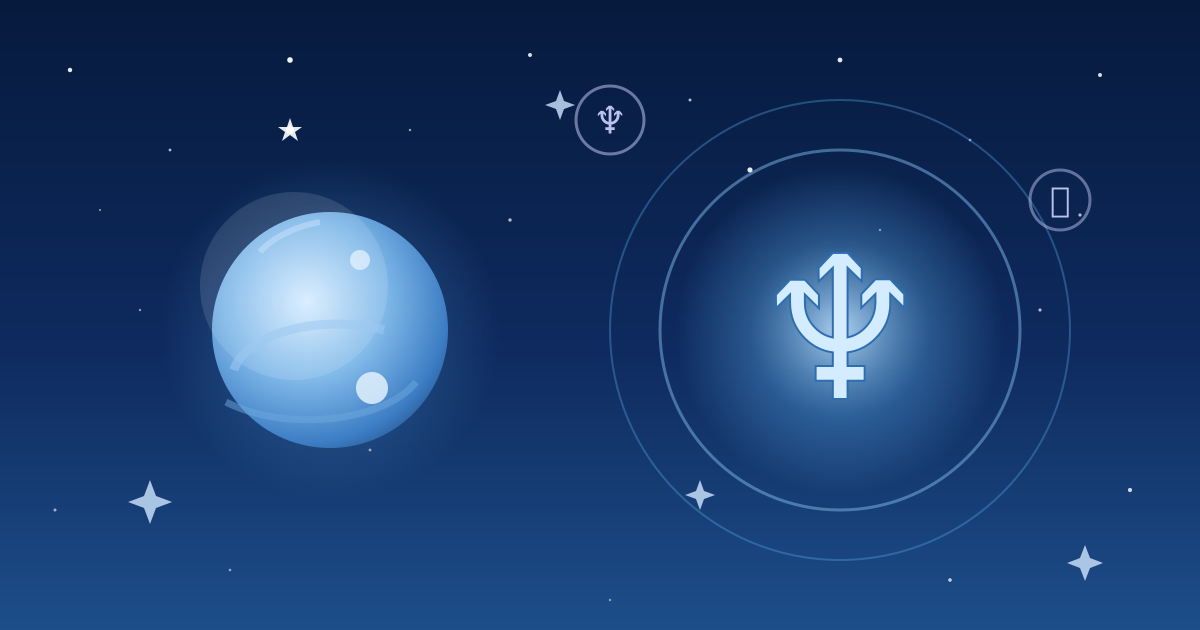
If your Sun sign is who you are and your Saturn sign is where you get serious, then your Neptune sign is what your generation dreamed about. Named for the Roman god of the sea, Neptune is the blue, distant world of the chart — the planet of dreams, imagination, intuition, spirituality, and illusion. It is the part of your chart that answers a softer, stranger question: not who you are, but what your age group collectively believed in, what it escaped into, and what it refused to see clearly.
This is what makes Neptune so elusive and so revealing. Every other planet in these guides speaks to you personally. Neptune speaks to millions of people at once. It moves so slowly — roughly fourteen years per sign — that everyone born within a whole era shares a Neptune sign. Astrologers call it a generational planet: less like a personal trait and more like the shared daydream your generation lived inside, the background longing everyone your age felt, the ideal nobody questioned because everybody assumed it was simply true. Read this way, Neptune becomes a mirror for your generation's inner life — what it worshipped, what it romanticized, what it fled from, and what it hoped the world could become.
One note before we begin: this is astrology as a lens for reflection, not a prediction. Neptune's themes — dreaming, longing, idealism — are real human experiences. The astrological framing is a way to think about them, to find patterns in how generations imagine and escape and believe. Treat the descriptions below as conversation starters about your generation's dream, not as verdicts about yours.
What Neptune Rules in Astrology
In astrological tradition, Neptune governs everything that dissolves boundaries. It is the planet of the ocean in the symbolic sense: the vast, the formless, the things that cannot be held in the hand — dreams, music, faith, fantasy, and the longing for something beyond the everyday. Astrologers look at Neptune to understand how a person — or a generation — relates to the invisible: what it idealizes, what it escapes into, and where it loses itself.
Dreams and imagination: the inner ocean
Neptune's core theme is the imagination itself — not the practical creativity of Mercury or the self-expression of the Sun, but the deep, drifting, oceanic kind: daydreams, night dreams, visions, the stories we tell ourselves about who we could be. In mythology, Neptune (Poseidon) rules the sea, and the astrological planet inherits that territory: the unconscious, the dream world, the place where hard edges soften and anything feels possible. Astrologers describe the Neptune pattern as the inner ocean — the part of us that does not want answers, but wonders. Your Neptune sign describes how your generation dreamed: boldly or quietly, through art or through faith, in public or behind closed doors.
Spirituality and compassion: the longing for oneness
Neptune is also the planet of spirituality and compassion — the longing to dissolve the boundary between self and other, to feel part of something larger. Astrologers read Neptune placements for how people relate to the sacred: do they seek it in religion, in music, in nature, in service to others, in the feeling of being lost in a crowd at a concert? Every Neptune sign has a characteristic relationship with the transcendent. Some generations find it in churches; some in festivals; some in meditation apps and wellness culture; some in the simple act of helping a stranger. Your Neptune sign is sometimes called your generation's spiritual style — the way your age group collectively reaches for the infinite.
Illusion: the beautiful lie
The ocean connection gives Neptune its shadow side: illusion — the beautiful lie, the idealization that blinds, the escape that becomes a trap. Astrologers say each Neptune sign governs what a generation is prone to romanticize: the movement that promised utopia, the celebrity it worshipped, the substance or screen it disappeared into, the story it told itself because the truth was too heavy. It is no coincidence, they argue, that each era has its characteristic fantasy — the dream that defined it and the disillusionment that followed. The illusion is not a curse in this reading. It is the raw material of the dream. Nothing is imagined until it is first idealized, and every generation's best art comes from the same place as its worst self-deception.
How to Find Your Neptune Sign
Your Neptune sign is the sign Neptune occupied on the day you were born. Any free birth chart calculator will show it from your birth date alone — no birth time needed, because Neptune moves so slowly that the date settles it completely.
That slowness is the whole story. Neptune takes about 165 years to travel the full zodiac, spending roughly fourteen years in each sign. This means a Neptune sign covers not a birthday cohort but a generational block: everyone born across an entire era shares it. Here is the recent history, the signposts of living generations:
Neptune in Sagittarius — roughly 1970 to 1984: the late Baby Boom and early Generation X, born into an era of spiritual seeking, big-idea optimism, and the search for meaning after the upheavals of the sixties.
Neptune in Capricorn — roughly 1984 to 1998: the core Generation X and oldest Millennials, born as the dream went corporate — ambition, image, and the material world as the place where ideals were tested.
Neptune in Aquarius — roughly 1998 to 2012: the Millennial and oldest Gen Z cohorts, born into the internet's rise and the dream of a connected humanity — a generation that grew up online, fluent in networks and collective identity.
Neptune in Pisces — roughly 2012 to 2026: Gen Z proper and the youngest cohorts, born into Neptune's home sign, an era of empathy, creativity, wellness culture, and the blurring of every boundary.
Neptune in Aries — 2026 to about 2039: the new era, entering in 2026, a fourteen-year stretch astrologers associate with the dream catching fire — idealism turned into action, spirituality with a spine, imagination that refuses to stay in the daydream.
Find your block, and you have your Neptune sign — and the generation you share it with. What astrologers do next is read the character of the sign as the style of that generation's dreaming.
Neptune Through the Generations: Five Styles of Dreaming
Each Neptune sign dreams of something different. Here is how astrologers describe the five living cohorts — read yours, but read the others too. The pattern only becomes visible in sequence.
Neptune in Sagittarius (1970–1984): the seekers of meaning
Sagittarius is the sign of philosophy, travel, and big ideas — and Neptune here spent fourteen years filling the collective imagination with the search for meaning. This generation was born as the spiritual marketplace exploded: gurus and workshops, self-help shelves, journeys east and inward, the conviction that truth was out there somewhere if you traveled far enough. Astrologers describe Neptune in Sagittarius as the cohort that inherited the sixties' questions and was tasked with finding personal answers. The shadow work: spiritual tourism, belief as fashion, the guru who promised enlightenment and delivered a bill. The gift, astrologers say, is a generation that refuses a borrowed faith — that insists on direct experience, on a spirituality tested by living. If you have ever watched this generation trade a church for a mountain trail and call it worship, you have watched Neptune in Sagittarius at work.
Neptune in Capricorn (1984–1998): the dreamers of the material world
Capricorn is the sign of ambition, structure, and achievement — and Neptune here took the dream into the material world. This generation grew up as the fantasy became a brand: the music video as myth, the celebrity as demigod, success itself as the spiritual goal. Astrologers describe Neptune in Capricorn as the cohort of idealized achievement: the ones who dreamed in corner offices and stadium lights, who learned early that image is a kind of magic. The shadow work: worshipping wealth, confusing fame with worth, the burnout of chasing a dream that keeps moving its finish line. The gift: an almost supernatural ability to make the imagined real — to build the thing, launch the project, turn the daydream into a structure that stands. This generation does not just dream. It produces.
Neptune in Aquarius (1998–2012): the dreamers of connection
Aquarius is the sign of networks, technology, and the collective — and Neptune here dreamed of a connected humanity. This generation came of age as the internet dissolved every distance: friends across continents, movements organized in a weekend, identity itself becoming something you could try on and share. Astrologers describe Neptune in Aquarius as the cohort that inherited a world of shared consciousness and was tasked with figuring out what it means to be together all the time. The shadow work: the curated self, the parasocial bond, the feed that replaced the friend, belonging as performance. The gift: a generation that genuinely believes in the collective — that organizes, shares, and imagines a future no one builds alone. The dream is out there, and this generation is determined to network it into existence.
Neptune in Pisces (2012–2026): the dreamers in the home sign
Pisces is Neptune's home sign — the ocean planet in the ocean sign — which is why astrologers call this cohort the Neptune generation par excellence. Born into an era of feeling made public — mental health spoken aloud, empathy as a value, art and music as medicine, the boundary between inner life and outer world thinner than ever — this generation grew up fluent in the language Neptune speaks. Astrologers describe Neptune in Pisces as the cohort of radical sensitivity: the ones who dream in color, feel other people's pain as their own, and treat imagination as a real place. The shadow work: overwhelm, escapism, the temptation to dissolve completely rather than face the hard edge of a problem. The gift: compassion without performance, creativity without apology, a generation that knows the inner world is not a luxury but a necessity. This generation does not hide its softness. It builds with it.
Neptune in Aries (2026–2039): the dreamers who act
Aries is the sign of courage, action, and the self — and Neptune's arrival here in 2026 opens a fourteen-year chapter astrologers describe as the dream catching fire. The themes are already legible: idealism with a spine, spirituality that moves, imagination that refuses to stay in the daydream and insists on becoming a deed. Astrologers read this as Neptune's longest-running question made concrete — what happens when the dreamer picks up a sword? — asked at generational scale. Whatever this generation becomes, it will grow up inside the answer. The rest of us are just visiting their era; they will be the ones who finish the dreaming and show us what it was for.
Why Neptune Is a Generation Planet (and What That Means for You)
Here is the honest astrological caveat: because Neptune signs span fourteen years, your Neptune sign says more about your generation than about you personally. Millions of strangers share your exact Neptune placement. It cannot be the thing that makes you unique — and astrologers do not pretend otherwise. They treat the outer planets (Uranus, Neptune, Pluto) as collective weather: the background conditions everyone born in your era breathes.
But weather matters. You do not choose the climate you grow up in, and it shapes everything — what your generation longs for, what it escapes into, what it cannot stop idealizing, what it quietly agrees is sacred without ever saying so. Knowing your Neptune sign is knowing the dream you were raised inside. It explains why certain longings feel personal to your whole age group at once: why everyone your age seems to be chasing the same feeling, or fleeing the same emptiness, or believing the same beautiful story. That is Neptune, working at scale. The personal part of your chart is elsewhere — and it is where Neptune gets specific.
Your Neptune House: The Personal Part
If the Neptune sign is the generation's dream, the Neptune house is where the dream enters your house. This is the personal layer — and it needs your birth time, because houses are set by the Earth's rotation at the moment you were born. Two people born the same day in different cities can have Neptune in the same sign but in entirely different houses.
Astrologers read the Neptune house as the area of life where you meet imagination and illusion most directly — where the boundary-blurring themes of your own life tend to cluster. Neptune in the 4th house: dreams centered on home, family, and roots — the idealized childhood, the longing for belonging, the family story retold as myth. Neptune in the 7th: relationships as the dream — partners idealized, love as transcendence, the beloved seen through a soft-focus lens. Neptune in the 10th: career as the dream — the calling pursued as a vision, public image as art, the slow work of making a vocation out of a longing.
The pattern astrologers describe is consistent: wherever Neptune sits by house, life there is never quite literal. It is the area where things shimmer — where you idealize, escape, or create, sometimes all three at once. But it is also, they say, the area where you end up with the deepest imagination: the person who has dreamed their home into a sanctuary, or their work into a calling, carries a kind of vision no purely practical path could produce. Your Neptune house is your personal ocean. Everyone visits. You live there.
Neptune Retrograde and Neptune Transits: Timing the Dream
Two timing questions come up with Neptune more than any other planet, and both deserve straight answers.
Neptune retrograde: the annual inward tide
Neptune goes retrograde every year for about five months — it is retrograde nearly half the time. Astrologers read Neptune retrograde as the inward tide of the dream: the illusions thin out, the idealizations get tested, and the longing you have been projecting outward turns back toward yourself. Because it happens so often, astrologers treat it less as an event and more as a rhythm — the tide going out so you can see what was under the water. The practical reading is simple: when Neptune stations retrograde, expect the dreamy themes to get clearer and more honest for a while. Notice what you have been idealizing. Notice what survives clear sight. The ocean prefers to be visited with open eyes.
Neptune transits: the long seasons of imagination
A Neptune transit — transiting Neptune crossing one of your personal planets or angles — takes years, not weeks. Astrologers describe these as the long seasons of imagination, idealism, or confusion in a life: the years when a career felt like a calling and then did not, when a relationship shimmered and then clarified, when a spiritual path opened and then dissolved. They do not arrive with fireworks. They arrive as the years when everything felt strangely beautiful and slightly unreal, and you only understood why later. The gift of a Neptune transit, astrologers say, is not the answer. It is the permission to dream bigger — and the wisdom to check the dream against reality before building your life on it.
Living Your Neptune: Three Practices for Dreaming Well
You cannot change your Neptune sign, and you would not want to — it is the water you swim in. What you can do is swim consciously. These are the practices astrologers and depth psychologists alike keep returning to for Neptune's territory.
Keep a dream journal
Neptune's domain is the dream world — and dreams fade or deepen depending on whether they get attention. The practice is embarrassingly simple: write the dream down before the day washes it away. A notebook by the bed, a voice memo at 3 a.m., three lines before coffee — the container matters less than the habit. Astrologers say Neptune rewards the person who visits the inner ocean on purpose: record the image, the feeling, the strange logic that made perfect sense at night. What is written can be worked with. What is forgotten runs the show from the basement. Your generation's Neptune sign describes what your whole cohort is dreaming; your job is your own dream, night by night.
Make something from the longing
Neptune rules longing — and most people do longing badly: the endless scroll, the fantasy that never leaves the head, the ache that curdles into numbness. The Neptune practice is making something from it: the song that carries the feeling, the painting that holds the image, the letter you never send but needed to write, the garden that turns grief into growth. Astrologers describe Neptune's gift as imagination, but imagination has a prerequisite, and it is the part everyone skips: the honest act of creation. Turn the dream into a thing you can touch, and it stops being an escape and starts being a compass.
Check the dream against reality, kindly
Every Neptune placement has an illusion question, and the practice is to answer it before life asks it for you. Notice where you have idealized someone or something — a partner, a job, a movement, a version of yourself — and ask, gently, what is real underneath the glow. Notice where you have been escaping, and whether the escape is rest or avoidance. Astrologers frame this as Neptune's ethical curriculum: dreaming is not the problem, unexamined dreaming is. The person who checks their illusions becomes trustworthy with bigger dreams. The person who refuses to look at them eventually gets the lesson delivered externally, which is never the gentle version. Dream big, and check kindly, and Neptune — the planet of the deep — becomes an ally instead of a fog.
Closing: The Dream You Swim In
Your Neptune sign will not tell you who you are. It will tell you what your generation dreamed of — the inner life your age group was born into, the ideals it chased, the escapes it chose, the beauty it refused to let go of. Look at your cohort's Neptune sign and then look at your cohort: the match is usually uncanny, and it usually explains the longing everyone your age keeps feeling.
And then look at your Neptune house, because that is where the generational dream becomes your dream — the specific rooms of your life where the ocean keeps coming in. That is the personal Neptune, and it is worth knowing well. The ocean, the old stories say, is not a place of danger. It is a place of depth — but only for those willing to dive and bring something back up. Your generation is down there together. Bring back something beautiful.
Frequently asked questions
How do I find my Neptune sign?
Your Neptune sign is the zodiac sign Neptune was in on the day you were born. Enter your birth date in a free birth chart calculator to find it. Neptune spends roughly 14 years in each sign, so entire generations share a Neptune sign — everyone born across a whole era has the same one.
What does the Neptune sign mean in astrology?
Astrologers associate Neptune with dreams, imagination, intuition, spirituality, and illusion. Your Neptune sign describes the collective dream your generation grew up inside — what it idealized, what it escaped into, and what it longed for. It is less personal than your Sun or Moon and more like the shared daydream of your age group.
What is Neptune in Pisces?
Neptune was in Pisces from 2012 to 2026, its home sign. Astrologers describe this stretch as a fourteen-year deepening of Piscean themes — spirituality, empathy, creativity, and the blurring of boundaries — visible in wellness culture, dreamwork, music as medicine, and a generation fluent in feeling. Neptune enters Aries in 2026, opening a new chapter.
How is my Neptune sign different from my Neptune house?
Your Neptune sign is generational — millions of people born within the same decade-plus share it, since Neptune stays in each sign for about 14 years. Your Neptune house needs your birth time and is personal: it shows which area of your own life — career, home, relationships, identity — is where dreamy, imaginative, boundary-blurring themes play out most directly.
Does Neptune affect my daily life?
Astrologers read Neptune as slow, background influence rather than a daily weather report — more like the climate your generation breathes than a passing storm. Its transits are described as long seasons of imagination, idealism, or confusion, not single events. For day-to-day guidance, astrologers look to the Moon and your personal planets instead.
Keep exploring

Sun Sign Meaning: Your Core Identity & Life Purpose
What is your Sun sign and what does it really mean? Discover how your Sun placement shapes your core identity, ego, vitality, and the life direction you are growing into.
Read the meaning →
Moon Sign Meaning: Your Emotional Inner World
What is your Moon sign and what does it mean? Discover how your Moon placement shapes your emotions, instincts, and what you need to feel safe and loved.
Read the meaning →
Pluto Sign Meaning: Your Generation's Deep Transformation
What is your Pluto sign and what does it mean? Explore how your Pluto placement reflects generational themes of transformation, power, and rebirth — plus Pluto through the signs and your Pluto house.
Read the meaning →
How to Find Your Big Three: The Birth Time Guide
Find your Sun, Moon, and Rising signs step by step. Learn what birth info you need, where to look up your birth time, and what to do if it is unknown.
Read the meaning →