
Saturn Sign Meaning: Your Lessons, Limits & Life Mastery
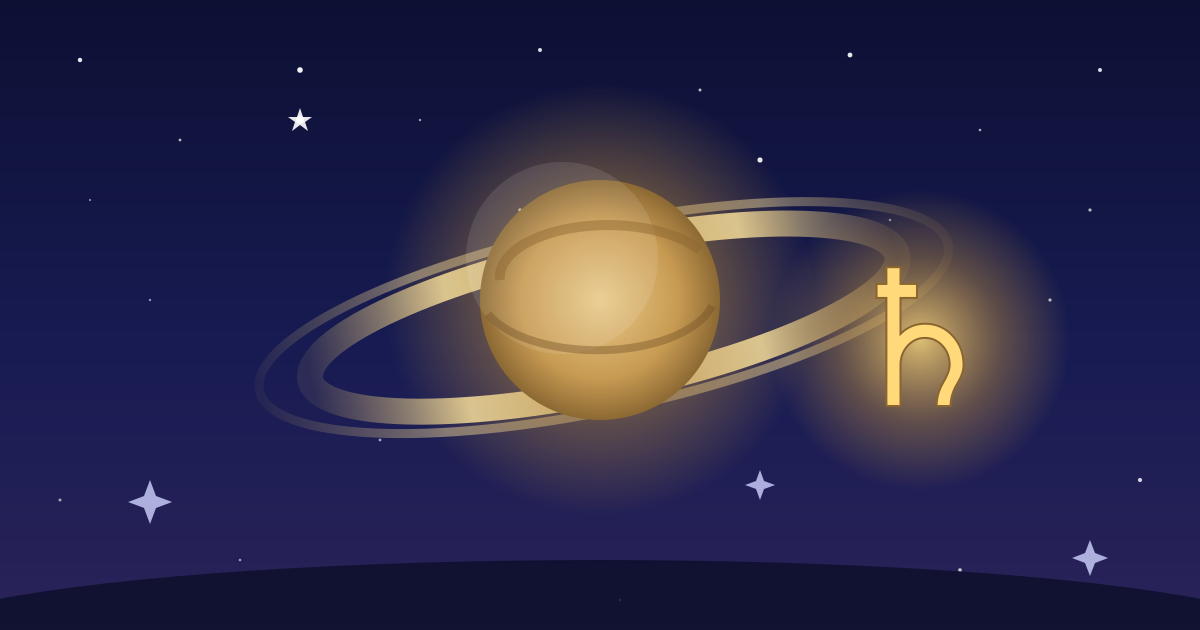
If your Sun sign is who you are and your Jupiter sign is how you grow, then your Saturn sign is where you get serious. Named for the Roman god of time and harvest, Saturn is the outermost planet visible to the naked eye — the far edge of the classical sky, and the traditional planet of boundaries, discipline, responsibility, and hard-won wisdom. It is the part of your chart that answers the question: where does life ask the most of you?
Everyone has a territory like this. The part of life that never came easy — the confidence that had to be built brick by brick, the money that only appeared once you learned budgeting, the relationships that only worked once you learned boundaries, the career that only moved once you stopped winging it. Astrologers would say that is your Saturn territory: the workshop of your chart, where raw material slowly becomes craft. Saturn does not hand out gifts. It hands out assignments — and the completed assignment becomes the thing nobody can ever take from you.
Saturn has a fearsome reputation, and it is half-deserved. In astrological lore, Saturn is the taskmaster, the strict teacher, the planet of no-shortcuts. But astrologers also insist that Saturn placements are where people become authorities. The classic pattern is unmistakable: the person who struggled most with structure in youth becomes the most reliable adult in the room; the one who feared money becomes the careful steward; the one who dreaded commitment becomes the anchor of every group they join. Saturn's gift is never ease. It is competence — the deep kind, earned the long way, that turns out to be worth more than talent.
What Saturn Rules in Astrology
In astrological tradition, Saturn governs everything that lasts — and everything it takes to make things last. It is the planet of structure: time, form, effort, and the quiet architecture under every stable life. Astrologers look at Saturn to understand where a person meets their edges and how they respond — whether they build or avoid, commit or flee.
Discipline and mastery: where effort becomes excellence
Your Saturn sign marks the area of life where discipline pays the highest interest. For some it is finances, for others relationships, communication, health, or career. Astrologers say Saturn shows where you start behind and finish ahead — where the slow, unglamorous reps eventually produce a mastery that looks like talent to everyone else. This is why Saturn placements are famous for late bloomers: the person who felt clumsy with money at 22 and is the family treasurer at 42; the one who hated public speaking and now teaches it. Saturn rewards the student who keeps showing up after the quick learners have quit.
Boundaries and limits: where you learn to say no
Saturn is the planet of the healthy no. Your Saturn sign describes how you handle limits — both the ones life puts on you and the ones you must set yourself. Some Saturn signs struggle with overcommitment, some with fear of missing out, some with saying no to people they love, some with accepting that they cannot do everything. Astrologers treat these friction points as the actual curriculum: each Saturn sign has a characteristic boundary lesson, and learning it is how the placement matures. The paradox of Saturn is that limits create freedom — the budget creates the savings, the schedule creates the free evening, the boundary creates the respect.
Time, responsibility, and karma: the long game
Saturn rules time itself — aging, patience, the long arc. Your Saturn sign shapes your relationship with responsibility: what you feel duty-bound to carry, what you avoid, and what grows on your shoulders whether you chose it or not. In the karmic reading of astrology, Saturn is the ledger: the place where past choices show up as present conditions, and where present choices become future stability. Psychologically framed, it is simpler: Saturn is where you stop outsourcing your life. Blame is the first thing Saturn burns off. What remains is authorship — the recognition that this part of your life is yours to build, nobody else's.
How to Find Your Saturn Sign
Your Saturn sign is the sign Saturn occupied on the day you were born. Any free birth chart calculator will show it from your birth date alone — no birth time needed, because Saturn moves slowly enough that the date settles it.
That slowness has an interesting consequence: Saturn spends about two and a half years in each sign, so whole cohorts share a Saturn sign. Everyone born from 1988 to 1991 has Saturn in Capricorn; everyone born from 1994 to 1996 has it in Pisces. Astrologers read Saturn as a generational placement as well as a personal one — your age group shares a collective lesson, a shared relationship with authority, work, and reality. Your Saturn house (which needs your birth time) is the personal part: it says where in your specific life that generational discipline-work plays out.
Saturn takes about twenty-nine years to travel the full zodiac, returning to your natal Saturn sign roughly every 29 years — the famous Saturn return. Astrologers treat these returns (around ages 27 to 30, 56 to 60, and 85 to 90) as life's great audit seasons: the structures that are solid get reinforced, and the ones built on sand tend to crack. More on that below — it is Saturn's signature event, and understanding it changes how people read their late twenties forever.
Saturn Through the Elements: Four Styles of Discipline
The twelve Saturn signs fall into four elements, and each element meets its lessons in its own way. Find your element to understand your native style of hard work — and what your particular Saturn is trying to teach you.
Fire Saturn (Aries, Leo, Sagittarius): the lesson of sustained effort
Fire Saturn struggles with the long game. These are the sparks — brilliant starters whose challenge is finishing. Saturn in a fire sign tends to teach patience the hard way: through projects that stall, through the discovery that enthusiasm is not a plan, through seasons where the only way forward is boring consistency. Astrologers say Fire Saturn's mastery comes through endurance: learning to keep the flame lit after the excitement fades. The payoff is real authority — the person who once flitted between passions becomes the one who can carry a vision across years. The lesson, in a sentence: finish what you start, and start fewer things.
Earth Saturn (Taurus, Virgo, Capricorn): the lesson of flexibility
Earth Saturn is the placement of the natural builder — and its challenge is knowing when the structure has become a cage. These are the reliable ones, the planners, the people everyone counts on. Saturn in an earth sign can make responsibility feel like identity: overwork, perfectionism, difficulty delegating, the belief that rest must be earned. Astrologers say Earth Saturn's mastery comes through release: learning that control is not the same as security, and that some things are built by letting go. The lesson, in a sentence: build well, then trust what you built.
Air Saturn (Gemini, Libra, Aquarius): the lesson of commitment
Air Saturn wrestles with depth. These are the thinkers and connectors — curious about everything, allergic to being pinned down. Saturn in an air sign tends to teach through the consequences of the shallow game: the relationships that never deepened, the expertise never quite earned, the opinions held without the homework. Astrologers say Air Saturn's mastery comes through commitment: choosing one path, one person, one craft long enough to become genuinely good at it. The lesson, in a sentence: go deep somewhere; breadth without depth is just tourism.
Water Saturn (Cancer, Scorpio, Pisces): the lesson of boundaries
Water Saturn carries the heaviest emotional homework. These are the feelers — empathetic, intuitive, porous. Saturn in a water sign often shows up as difficulty with boundaries: absorbing others' moods, fearing abandonment, building walls instead of fences, or drowning in feelings that were never examined. Astrologers say Water Saturn's mastery comes through containment: learning that feelings are information, not orders, and that caring for others requires a self that is cared for. The lesson, in a sentence: feel everything, be ruled by nothing.
The Saturn Return: Your 29-Year Growth Checkpoint
No Saturn topic draws more search traffic — or more dread — than the Saturn return, and it deserves a clear explanation. Every 29 years, transiting Saturn returns to the exact degree it occupied when you were born. Astrologers describe the roughly two-and-a-half-year window around it as a cosmic audit: career, relationships, living situation, identity — everything load-bearing gets inspected.
The first Saturn return, around ages 27 to 30, is the famous one. It is the traditional passage into full adulthood: the job that no longer fits gets unbearable, the relationship running on inertia gets honest, the lifestyle borrowed from your early twenties stops working. None of this is punishment in the astrological view — it is alignment. What is real gets stronger; what was propped up falls. People who enter their Saturn return with honest foundations usually describe it as the hardest and most clarifying stretch of their lives, and emerge with a career, a partnership, or a direction that actually fits.
The second return, around 56 to 60, is the harvest audit: what did you build, and is it what you meant to build? The third, around 85 to 90, is the elder's return — the reckoning with a whole life's work. Astrologers who have watched clients through multiple returns report the same pattern every time: the return does not destroy what is solid; it destroys what is hollow. The practical advice is unglamorous and works whether or not you believe in astrology: audit your own foundations before life does it for you. Pay the debts, have the conversations, fix the cracks you can see. Saturn respects preparation.
Saturn and Career, Money & Authority
The question everyone asks about Saturn is the career question, and astrologers give a consistent answer: Saturn describes how you earn authority, not whether you will. A Saturn in Capricorn is associated with rising through institutions; in Aquarius through reform and innovation; in Aries through self-made ventures; in Libra through partnerships and mediation. The through-line is that Saturn favors the arena where you have paid dues — the credibility follows the work, not the other way around.
For money, astrologers read Saturn as the stewardship indicator: your relationship with saving, debt, and long-term security. Saturn-heavy charts are famous for the slow build — the person who was broke at 25 and financially unshakeable at 45. The traditional advice is Saturn's own: respect the ledger. Track the money, kill the debt, automate the savings, think in decades. It is the least exciting financial advice ever given and the most reliable. Saturn does not do windfalls; it does foundations — and foundations compound.
One more traditional note: Saturn is associated with mentors and elders — the stern teachers, the demanding bosses, the critics whose standards irritated you and whose lessons you now quote. Astrologers say your Saturn sign describes both the authority figures who shaped you and the authority you are growing into for others. Notice whose standards you have internalized; that is your Saturn, wearing a human face. And notice who now seeks your counsel — that is the sign your Saturn has matured.
Living Your Saturn: Three Practical Habits
Your Saturn sign is not a sentence; it is a training plan. Working with it instead of resenting it turns the hardest placement in the chart into the most rewarding one.
Do the reps in your Saturn's territory
Every Saturn sign has a home turf where growth is slowest — and where effort compounds fastest. Fire Saturn: finish one thing this month. Earth Saturn: delegate one thing this week. Air Saturn: go deep on one subject for ninety days. Water Saturn: set one boundary and hold it. For one season, aim your discipline at your Saturn's weak spot instead of avoiding it. Astrologers would call this appeasing Saturn; a coach would call it training your weakness. Either way, notice what changes. Most people avoid their Saturn territory for decades and wonder why it never improves. Saturn people train there on purpose.
Keep one promise to yourself daily
Saturn is the planet of kept promises, and its oldest traditional teaching is that self-trust is built in small units. Pick one tiny daily commitment — make the bed, walk ten minutes, write one page, save five dollars — and keep it for thirty days. This is not about the bed or the walk; it is about proving to the part of you that doubts yourself that your word means something. Astrologers say Saturn notices consistency the way Jupiter notices generosity. Start embarrassingly small, stay ruthlessly consistent, and watch the current reverse. Confidence, it turns out, is a ledger too.
Watch the shadow: the inner critic
Every planet has a shadow, and Saturn's is the merciless inner critic: the voice that says you are behind, that everyone else figured it out, that rest is laziness and mistakes are verdicts. Astrologers call this Saturn in excess — the teacher who became a tyrant. The cure is not to abandon standards but to separate the standard from the shame. Ask: what would this lesson look like if I were teaching a friend? The discipline stays; the cruelty goes. Saturn at its best is the wise elder — firm, fair, and quietly proud of how far you have come. Grow like an oak, not like a whip.
Closing: The Master in the Mirror
Your Saturn sign will not hand you an easy life. It offers something rarer: a self you can rely on. The lessons are slow, the tests are real, and the diploma — when it comes — is permanent. Everyone admires the person who is unshakable in exactly the area where life once shook them. That is Saturn's finished work, and it is available to anyone willing to do the reps.
So learn your Saturn sign, learn your element's lesson, and start training there. Keep the small promises. Set the boundary. Do the unglamorous work. And remember the oldest Saturn wisdom of all: the obstacle is the curriculum, and the curriculum becomes the craft. Ten years from now, you will be the authority you once wished you could find — because you built yourself the long way, the way that lasts.
Frequently asked questions
How do I find my Saturn sign?
Your Saturn sign is the zodiac sign Saturn was in on the day you were born. Enter your birth date in a free birth chart calculator to find it. Saturn spends about two and a half years in each sign, so large groups of people born around the same years share a Saturn sign.
What does the Saturn sign mean in astrology?
Astrologers associate Saturn with discipline, responsibility, limits, and life lessons. Your Saturn sign describes where you face your hardest growing edges — the area of life where things come slowly, require effort, and ultimately become your greatest mastery. Astrologers call Saturn the taskmaster: it marks where you are tested so you can become solid.
What is a Saturn return and when does it happen?
A Saturn return happens when transiting Saturn comes back to the exact place it was in your birth chart — roughly every 29 years, so around ages 27 to 30, 56 to 60, and 85 to 90. Astrologers describe it as a major reality-check season: structures that are shaky tend to crack, and the life you have actually built gets to prove itself. It is traditionally the rite of passage into full adulthood.
Is Saturn a bad placement in a birth chart?
No — astrologers treat Saturn as a teacher, not a curse. Saturn placements point to where you work hardest and learn slowest, which also makes them the placements where you end up most capable. The classic line is that Saturn gives nothing for free, but what it gives cannot be taken away. Many astrologers consider a strong Saturn placement a signature of a late bloomer who becomes an authority.
How is the Saturn sign different from the Moon sign?
Your Moon sign describes your emotional nature and what you need to feel safe — your inner weather. Your Saturn sign describes your relationship with discipline, limits, and responsibility — where life asks you to grow up. If the Moon is the child you were, Saturn is the adult you are becoming: the part of your chart that sets standards, keeps commitments, and builds what lasts.
Keep exploring

Sun Sign Meaning: Your Core Identity & Life Purpose
What is your Sun sign and what does it really mean? Discover how your Sun placement shapes your core identity, ego, vitality, and the life direction you are growing into.
Read the meaning →
Moon Sign Meaning: Your Emotional Inner World
What is your Moon sign and what does it mean? Discover how your Moon placement shapes your emotions, instincts, and what you need to feel safe and loved.
Read the meaning →
Jupiter Sign Meaning: Your Luck, Growth & Expansion Style
What is your Jupiter sign and what does it mean? Discover how your Jupiter placement shapes your luck, growth, optimism, and where life expands for you.
Read the meaning →
How to Find Your Big Three: The Birth Time Guide
Find your Sun, Moon, and Rising signs step by step. Learn what birth info you need, where to look up your birth time, and what to do if it is unknown.
Read the meaning →