
Uranus Sign Meaning: Your Generation's Rebellion & Innovation
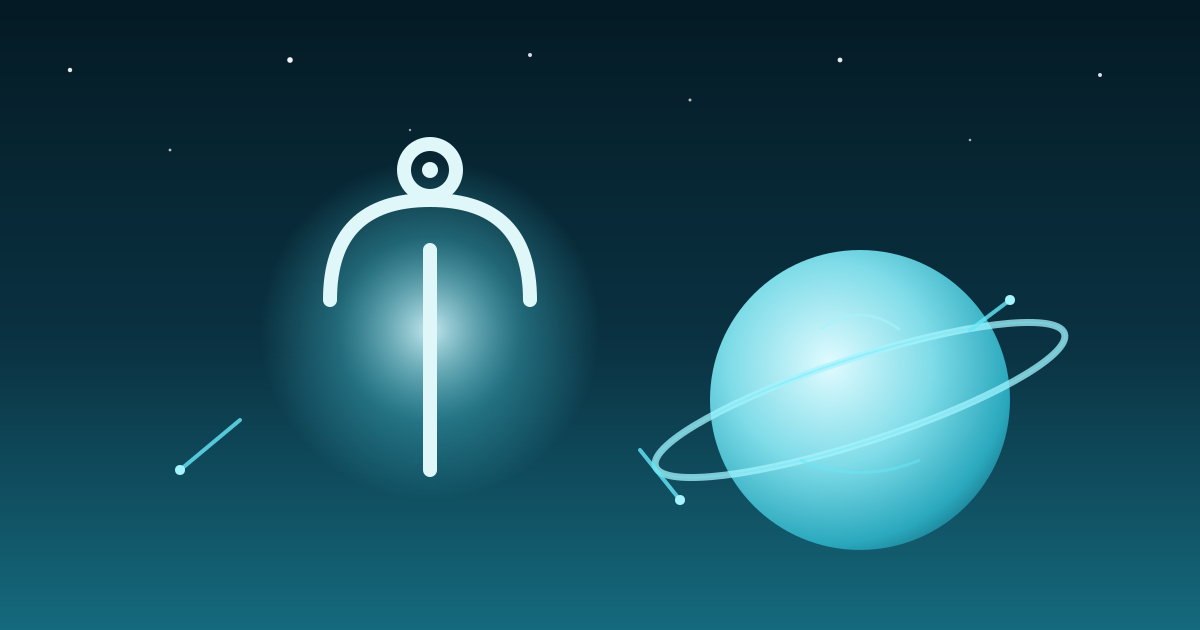
If your Sun sign is who you are and your Neptune sign is what your generation dreamed about, then your Uranus sign is what your generation refused to put up with. Named for the Greek god of the sky, Uranus is the tilted, turquoise oddball of the chart — the planet of rebellion, innovation, freedom, and sudden change. It is the part of your chart that answers a sharp, electric question: not who you are, but what your age group broke, what it built in the rubble, and what it would not sit still for.
This is what makes Uranus so distinctive and so revealing. Every other planet in these guides speaks to you personally. Uranus speaks to millions of people at once. It moves so slowly — roughly seven years per sign — that everyone born within a whole era shares a Uranus sign. Astrologers call it a generational planet: less like a personal trait and more like the shared shockwave your generation rode, the old rule everyone your age questioned at the same time, the invention nobody questioned because everybody assumed it was simply the future. Read this way, Uranus becomes a mirror for your generation's breaking point — what it rebelled against, what it invented instead, and what it refused to accept as normal.
One note before we begin: this is astrology as a lens for reflection, not a prediction. Uranus's themes — rebellion, invention, freedom — are real human experiences. The astrological framing is a way to think about them, to find patterns in how generations break rules and build new ones. Treat the descriptions below as conversation starters about your generation's revolution, not as verdicts about yours.
What Uranus Rules in Astrology
In astrological tradition, Uranus governs everything that breaks the pattern. It is the planet of the lightning strike in the symbolic sense: the sudden insight, the rule that snaps, the technology that changes everything overnight, the moment a whole generation looks at the old way of doing things and says, no more. Astrologers look at Uranus to understand how a person — or a generation — relates to freedom: what it refuses, what it invents, and where it insists on being different.
Rebellion and freedom: the refusal
Uranus's core theme is the refusal itself — not the polite reform of Saturn or the gentle dreaming of Neptune, but the flat no: the norm rejected, the authority questioned, the script torn up. Uranus was discovered in 1781, in the age of revolutions, and the astrological planet inherited that timing: the American and French Revolutions, the steam engine, the idea that the old order was not inevitable. Astrologers describe the Uranus pattern as the breaker — the part of us that cannot tolerate a cage, even a comfortable one. Your Uranus sign describes how your generation refused: loudly or quietly, through protest or through invention, in the streets or behind a screen.
Innovation and technology: the invention
Uranus is also the planet of innovation and technology — the new tool, the new system, the idea nobody had before and everybody uses after. Astrologers read Uranus placements for how people relate to the future: do they build it, fear it, or simply live inside it before anyone else catches up? Every Uranus sign has a characteristic relationship with invention. Some generations invent the machine; some invent the network; some invent the new way of working, loving, or belonging. Your Uranus sign is sometimes called your generation's technology style — the way your age group collectively rewired the world.
Sudden change: the lightning strike
The sky-god connection gives Uranus its signature move: sudden change — the lightning strike, the overnight reversal, the event nobody saw coming that rearranges everything. Astrologers say each Uranus sign governs what a generation experiences as a shock: the industry that collapsed, the institution that fell, the technology that arrived all at once, the truth that went public and could not be put back. It is no coincidence, they argue, that each era has its characteristic disruption — the break that defined it and the new normal that followed. The disruption is not a disaster in this reading. It is the raw material of progress. Nothing is reinvented until it is first broken, and every generation's best invention comes from the same place as its worst upheaval.
How to Find Your Uranus Sign
Your Uranus sign is the sign Uranus occupied on the day you were born. Any free birth chart calculator will show it from your birth date alone — no birth time needed, because Uranus moves so slowly that the date settles it completely.
That slowness is the whole story. Uranus takes about 84 years to travel the full zodiac, spending roughly seven years in each sign. This means a Uranus sign covers not a birthday cohort but a generational block: everyone born across an entire era shares it. Here is the recent history, the signposts of living generations:
Uranus in Libra — roughly 1968 to 1975: the late Baby Boom, born into an era of relationship revolution — divorce law, feminism, and the reimagining of partnership itself.
Uranus in Scorpio — roughly 1975 to 1981: late Generation X's oldest edge, born as the hidden went public — sexuality, debt, and power dragged into the open.
Uranus in Sagittarius — roughly 1981 to 1988: core Generation X, born into the age of the personal computer and the global journey — belief itself going digital and worldwide.
Uranus in Capricorn — roughly 1988 to 1995: the Millennial vanguard, born as the old order fell — the Berlin Wall, the Soviet collapse, and institutions cracking open.
Uranus in Aquarius — roughly 1995 to 2003: the Millennial and oldest Gen Z cohorts, born into the internet's explosion — the network as the new public square.
Uranus in Pisces — roughly 2003 to 2010: Gen Z proper, born into the age of the feed — music, image, and identity dissolving into the stream.
Uranus in Aries — roughly 2010 to 2018: younger Gen Z, born into the age of the individual brand — self-expression as rebellion, the selfie as a flag.
Uranus in Taurus — roughly 2018 to 2026: the youngest cohorts, born as the material world shook — money, food, land, and the body all up for reinvention.
Uranus in Gemini — 2026 to about 2033: the new era, entering in 2026, a seven-year stretch astrologers associate with the revolution of communication itself — language, media, and the mind rewired.
Find your block, and you have your Uranus sign — and the generation you share it with. What astrologers do next is read the character of the sign as the style of that generation's rebellion.
Uranus Through the Generations: Five Styles of Rebellion
Each Uranus sign rebels against something different. Here is how astrologers describe the five most recent cohorts — read yours, but read the others too. The pattern only becomes visible in sequence.
Uranus in Capricorn (1988–1995): the rebels against institutions
Capricorn is the sign of structure, authority, and institutions — and Uranus here spent seven years filling the collective imagination with the fall of the old order. This generation was born as walls came down and empires dissolved: the Berlin Wall, the Soviet Union, the certainty that the big structures would last forever. Astrologers describe Uranus in Capricorn as the cohort that inherited the establishment and was tasked with watching it crack. The shadow work: cynicism, the belief that nothing solid can be trusted, the institution replaced by nothing at all. The gift, astrologers say, is a generation that rebuilds from scratch — that starts the company, founds the movement, and writes the new rules instead of inheriting the old ones. If you have ever watched this generation shrug at a corporate ladder and build its own staircase, you have watched Uranus in Capricorn at work.
Uranus in Aquarius (1995–2003): the rebels of the network
Aquarius is Uranus's home sign — the sign of networks, technology, and the collective — which is why astrologers call this cohort the Uranus generation par excellence. Born into the internet's explosion, this generation grew up as the network dissolved every distance: friends across continents, knowledge free for anyone, identity itself becoming something you could build online. Astrologers describe Uranus in Aquarius as the cohort of radical connection: the ones who rebelled not by leaving the system but by wiring around it. The shadow work: the echo chamber, the crowd that replaces the self, belonging as performance. The gift: a generation that genuinely believes in the collective — that organizes, shares, and invents a future no one builds alone. The rebellion is out there, and this generation is determined to network it into existence.
Uranus in Pisces (2003–2010): the rebels of the dream
Pisces is the sign of imagination, feeling, and the formless — and Uranus here dreamed its rebellion through the stream. This generation came of age as music, image, and identity dissolved into the feed: the playlist as personality, the aesthetic as a flag, the self as something you could curate and share in real time. Astrologers describe Uranus in Pisces as the cohort that inherited a world of shared feeling and was tasked with figuring out what it means to be yourself when everything is public. The shadow work: the performed self, the feeling that never quite lands, identity as content. The gift: a generation fluent in empathy and image — that turns emotion into art, and art into a language everyone speaks. This generation does not just rebel. It remixes.
Uranus in Aries (2010–2018): the rebels of the self
Aries is the sign of courage, action, and the individual — and Uranus here took the rebellion into the personal. This generation grew up as self-expression itself became the revolution: the personal brand, the creator economy, the kid with a phone and an audience bigger than a television network. Astrologers describe Uranus in Aries as the cohort of individual ignition: the ones who refused to wait for permission, who launched before they were ready, who treated identity as something you declare, not something you are given. The shadow work: rebellion as branding, the self as a product, the fire that burns out before it builds. The gift: an almost supernatural courage to start — to post, to launch, to say the thing out loud. This generation does not ask for a seat at the table. It builds its own table, on camera.
Uranus in Taurus (2018–2026): the rebels of the material world
Taurus is the sign of money, food, land, and the body — and Uranus here took the revolution into the physical world. This generation is growing up as the material order shakes: cryptocurrency and remote work, food systems and farming, the meaning of a job, a home, and a dollar all up for renegotiation. Astrologers describe Uranus in Taurus as the cohort of practical upheaval: the ones who will not inherit the old definitions of security, and are inventing new ones — the side hustle as a career, the digital wallet as a bank, the body and the land as things to protect rather than exploit. The shadow work: instability mistaken for freedom, the ground shifting under everyone at once. The gift: a generation that knows value is something you create, not something you are handed. This generation does not just dream of a new economy. It is already building it, one disruption at a time.
Why Uranus Is a Generation Planet (and What That Means for You)
Here is the honest astrological caveat: because Uranus signs span seven years, your Uranus sign says more about your generation than about you personally. Millions of strangers share your exact Uranus placement. It cannot be the thing that makes you unique — and astrologers do not pretend otherwise. They treat the outer planets (Uranus, Neptune, Pluto) as collective weather: the background conditions everyone born in your era breathes.
But weather matters. You do not choose the climate you grow up in, and it shapes everything — what your generation refuses, what it invents, what it cannot stop questioning, what it quietly agrees is broken without ever saying so. Knowing your Uranus sign is knowing the revolution you were raised inside. It explains why certain rebellions feel personal to your whole age group at once: why everyone your age seems to be quitting the same job, or building the same kind of thing, or refusing the same old rule. That is Uranus, working at scale. The personal part of your chart is elsewhere — and it is where Uranus gets specific.
Your Uranus House: The Personal Part
If the Uranus sign is the generation's rebellion, the Uranus house is where the rebellion enters your house. This is the personal layer — and it needs your birth time, because houses are set by the Earth's rotation at the moment you were born. Two people born the same day in different cities can have Uranus in the same sign but in entirely different houses.
Astrologers read the Uranus house as the area of life where you meet freedom and disruption most directly — where the rule-breaking themes of your own life tend to cluster. Uranus in the 4th house: rebellion centered on home, family, and roots — the unconventional household, the break from family tradition, the home that looks nothing like the one you grew up in. Uranus in the 7th: relationships as the rebellion — partnerships that defy convention, love on your own terms, the beloved chosen freely rather than traditionally. Uranus in the 10th: career as the rebellion — the unconventional vocation, public life lived differently, the slow work of making a career out of a refusal.
The pattern astrologers describe is consistent: wherever Uranus sits by house, life there is never quite conventional. It is the area where things shake — where you break rules, invent, or liberate, sometimes all three at once. But it is also, they say, the area where you end up with the deepest originality: the person who has rebuilt their home from scratch, or their work into something nobody had done before, carries a kind of freedom no purely traditional path could produce. Your Uranus house is your personal lightning strike. Everyone feels the storm. You live in the place it hit.
Uranus Retrograde and Uranus Transits: Timing the Breakthrough
Two timing questions come up with Uranus more than any other planet, and both deserve straight answers.
Uranus retrograde: the annual inward shock
Uranus goes retrograde every year for about five months — it is retrograde nearly half the time. Astrologers read Uranus retrograde as the inward turn of the rebellion: the outer disruptions quiet down, and the question turns inward — what freedom do you actually want, and what are you still tolerating? Because it happens so often, astrologers treat it less as an event and more as a rhythm — the lightning pausing so you can see what it illuminated. The practical reading is simple: when Uranus stations retrograde, expect the rebellious themes to get quieter and more personal for a while. Notice what you have been rebelling against. Notice what survives honest reflection. The storm prefers to be met with open eyes.
Uranus transits: the long seasons of change
A Uranus transit — transiting Uranus crossing one of your personal planets or angles — takes years, not weeks. Astrologers describe these as the long seasons of disruption, liberation, or sudden change in a life: the years when a career cracked open, when a relationship rearranged itself, when an identity you had outgrown finally broke and something truer took its place. They do not arrive with fireworks. They arrive as the years when everything felt strangely electric and slightly unstable, and you only understood why later. The gift of a Uranus transit, astrologers say, is not the answer. It is the permission to break the pattern — and the wisdom to build something better in the space that opens up.
Living Your Uranus: Three Practices for Breaking Well
You cannot change your Uranus sign, and you would not want to — it is the sky you were born under. What you can do is break consciously. These are the practices astrologers and depth psychologists alike keep returning to for Uranus's territory.
Question one rule a week
Uranus's domain is the rule — and rules harden or dissolve depending on whether they get examined. The practice is embarrassingly simple: pick one rule you live by — a habit, a should, a this-is-how-it's-done — and ask whether it still serves you. A notebook entry, a conversation, a small experiment — the container matters less than the habit. Astrologers say Uranus rewards the person who questions on purpose: name the rule, test it, keep what works, drop what does not. What is examined can be chosen. What is never questioned runs the show from the basement. Your generation's Uranus sign describes what your whole cohort is breaking; your job is your own rule, week by week.
Build something new from the break
Uranus rules disruption — and most people do disruption badly: the break that never becomes a build, the rebellion that stops at refusal, the freedom that curdles into chaos. The Uranus practice is building something from it: the project that replaces the job you left, the community that replaces the institution you outgrew, the routine that replaces the habit you broke, the idea that turns a no into a new yes. Astrologers describe Uranus's gift as innovation, but innovation has a prerequisite, and it is the part everyone skips: the honest act of construction. Turn the break into a thing you can use, and it stops being destruction and starts being a beginning.
Check the freedom against reality, kindly
Every Uranus placement has a freedom question, and the practice is to answer it before life asks it for you. Notice where you have broken something — a relationship pattern, a career path, a belief — and ask, gently, what is real underneath the break. Notice where you have been rebelling, and whether the rebellion is liberation or habit. Astrologers frame this as Uranus's ethical curriculum: breaking is not the problem, unexamined breaking is. The person who checks their freedom becomes trustworthy with bigger ones. The person who refuses to look at them eventually gets the lesson delivered externally, which is never the gentle version. Break boldly, and check kindly, and Uranus — the planet of the sky — becomes an ally instead of a storm.
Closing: The Revolution You Were Born Into
Your Uranus sign will not tell you who you are. It will tell you what your generation broke — the old order your age group was born into, the rules it refused, the inventions it built, the freedom it would not give up. Look at your cohort's Uranus sign and then look at your cohort: the match is usually uncanny, and it usually explains the rebellion everyone your age keeps feeling.
And then look at your Uranus house, because that is where the generational rebellion becomes your rebellion — the specific rooms of your life where the lightning keeps striking. That is the personal Uranus, and it is worth knowing well. The sky, the old stories say, is not a place of danger. It is a place of possibility — but only for those willing to look up and build something new under it. Your generation is up there together. Build something worth the storm.
Frequently asked questions
How do I find my Uranus sign?
Your Uranus sign is the zodiac sign Uranus was in on the day you were born. Enter your birth date in a free birth chart calculator to find it. Uranus spends roughly seven years in each sign, so whole generations share a Uranus sign — everyone born across a whole era has the same one.
What does the Uranus sign mean in astrology?
Astrologers associate Uranus with rebellion, innovation, freedom, and sudden change. Your Uranus sign describes what your generation refused to accept, what it invented, and how it defined freedom. It is less personal than your Sun or Moon and more like the shared shockwave your age group rode.
What is Uranus in Taurus?
Uranus was in Taurus from 2018 to 2026, shaking up the sign of money, food, land, and the body. Astrologers describe this stretch as a seven-year disruption of the material world — cryptocurrency and remote work, food systems and farming, and a generation rethinking what security and value actually mean. Uranus enters Gemini in 2026, opening a new chapter.
How is my Uranus sign different from my Uranus house?
Your Uranus sign is generational — millions of people born within the same seven-year stretch share it, since Uranus stays in each sign for about seven years. Your Uranus house needs your birth time and is personal: it shows which area of your own life — career, home, relationships, identity — is where rebellious, innovative, freedom-seeking themes play out most directly.
Does Uranus affect my daily life?
Astrologers read Uranus as slow, background influence rather than a daily weather report — more like the climate your generation breathes than a passing storm. Its transits are described as long seasons of disruption, liberation, or sudden change, not single events. For day-to-day guidance, astrologers look to the Moon and your personal planets instead.
Keep exploring

Sun Sign Meaning: Your Core Identity & Life Purpose
What is your Sun sign and what does it really mean? Discover how your Sun placement shapes your core identity, ego, vitality, and the life direction you are growing into.
Read the meaning →
Moon Sign Meaning: Your Emotional Inner World
What is your Moon sign and what does it mean? Discover how your Moon placement shapes your emotions, instincts, and what you need to feel safe and loved.
Read the meaning →
Neptune Sign Meaning: Your Generation's Dreams & Imagination
What is your Neptune sign and what does it mean? Explore how your Neptune placement reflects your generation's dreams, imagination, spirituality, and illusions — plus Neptune through the signs and your Neptune house.
Read the meaning →
Pluto Sign Meaning: Your Generation's Deep Transformation
What is your Pluto sign and what does it mean? Explore how your Pluto placement reflects generational themes of transformation, power, and rebirth — plus Pluto through the signs and your Pluto house.
Read the meaning →