
Birthstone Anniversary Gifts by Year: The Complete Chart from Year 1 to 60
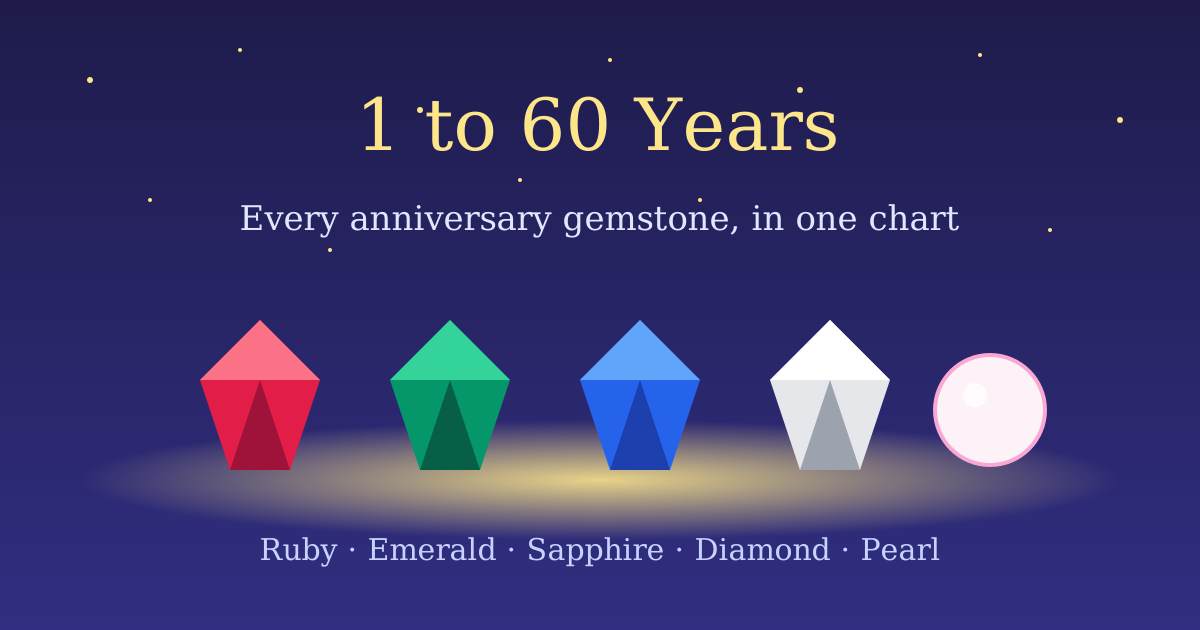
Everyone knows the silver anniversary and the golden anniversary. Far fewer people know that the tradition behind them covers every single year, with a gemstone assigned to each one. The first anniversary is gold. The second is garnet. The tenth is diamond — decades before most couples expect a diamond anniversary at all. This is the lesser-known cousin of the birthstone tradition: instead of a stone for the month you were born, it gives you a stone for the year you married, a way to mark time itself in gemstones.
Like birthstone lore, anniversary gemstones are folklore and entertainment, not fact — a charming custom that jewelers have kept alive for generations, not a rule anyone must follow. But as a gift guide, the tradition is genuinely useful. It answers the hardest anniversary question of all: what do you buy for the person who already has everything? A stone tied to the year itself is personal in a way a generic gift can never be, and it builds over time into a collection that tells the story of a marriage, one stone per year.
Where Anniversary Gemstones Come From
The anniversary gift tradition began in medieval Europe, where wives were presented with silver wreaths on their 25th anniversary and gold wreaths on their 50th — the origin of the silver and golden anniversaries. The idea spread slowly: by the Victorian era, gift lists covered more years, with materials growing more precious as the marriage endured. Paper for the fragile first year, wood for the fifth, tin for the tenth, and so on — each material a small metaphor for how the relationship had grown stronger.
The gemstone list came later. In 1937, the Jewelers of America published a modern anniversary list that paired many years with gemstones, and jewelers have refined it ever since. That is why the list has two layers that sometimes overlap: the traditional material list (paper, cotton, leather) and the gemstone list (gold, garnet, pearl). For the early years, the two lists often name different things, and for the great milestones they converge — silver at 25, pearl at 30, ruby at 40, sapphire at 45, gold at 50, diamond at 60. When they disagree, the gemstone version is the one jewelers use, and it is the version in the chart below.
The Complete Anniversary Gemstone Chart: Years 1 to 60
The chart below follows the widely used jewelers' gemstone list. Years 1 through 24 each have their own stone, and after that the tradition marks only the great milestones — 25, 30, 35, 40, 45, 50, 55, and 60 — which is why the gaps between later entries grow wider. For in-between years, most couples either celebrate with the traditional material for that year or simply borrow the nearest milestone stone.
Years 1 to 10: The First Decade
The first decade moves quickly through some of the most wearable stones in the whole list. Year 1 is gold — a gold band or pendant to mark the fragile, precious first year. Year 2 is garnet, the deep red stone of January, followed by pearl at year 3 and topaz at year 4. Year 5 is sapphire, year 6 amethyst, year 7 onyx, year 8 tourmaline, year 9 lapis lazuli, and year 10 diamond. A diamond at year 10 surprises many people, because diamond is also the 60th anniversary stone — the tradition bookends the journey with the hardest stone of all, once at the first decade and once at the last.
Years 11 to 24: The Building Years
The second stretch of the chart is where the list gets interesting, because it names stones many people have never bought before. Year 11 is turquoise, year 12 jade, year 13 citrine, year 14 opal, and year 15 ruby — the first of the great milestones, and a far earlier ruby than most couples expect. Year 16 is peridot, year 17 carnelian, year 18 cat's eye (chrysoberyl), year 19 aquamarine, year 20 emerald, year 21 iolite, year 22 spinel, year 23 imperial topaz, and year 24 tanzanite. These are wonderful years for adventurous gifts: an opal pendant at 14, an aquamarine ring at 19, a tanzanite piece at 24 — stones with real character that most jewelry boxes do not already hold.
Years 25 to 60: The Great Milestones
From year 25 on, the tradition stops naming every year and honors only the milestones, and each one is a classic. Year 25 is silver, the silver anniversary, usually marked with silver jewelry or a white stone set in silver. Year 30 is pearl, year 35 emerald, year 40 ruby, year 45 sapphire, year 50 gold, year 55 alexandrite (with emerald as the traditional material), and year 60 diamond, the diamond anniversary. Notice how the great stones repeat across a lifetime: ruby at 15 and again at 40, emerald at 20 and again at 35, diamond at 10 and again at 60. A couple that follows the list ends up with a collection that rhymes with itself.
Milestone Spotlights: The Anniversaries Everyone Celebrates
10th Anniversary: Diamond
The 10th anniversary diamond is the tradition's best-kept secret. Most people associate diamond anniversaries with year 60, but the jewelers' list gives diamond to year 10 as well — a decade of marriage, marked with the stone of endurance. A small diamond pendant or a diamond-accent band is the classic gift, and it pairs beautifully with a vow renewal. If a large diamond is out of reach, a diamond chip in a necklace or a pair of diamond studs carries the same symbolism.
25th Anniversary: Silver
Silver is the oldest anniversary tradition of all, going back to those medieval silver wreaths. The classic 25th gift is silver jewelry, often a piece the couple chooses together, and many jewelers set a white stone — diamond, white sapphire, or moonstone — in silver for the occasion. Silver is also the most forgiving milestone metal: it suits every style and nearly every budget, which is part of why the 25th is the most widely celebrated anniversary of all.
40th Anniversary: Ruby
Ruby at 40 is the warmest milestone in the list. The deep red stone has been tied in lore to passion and protection for centuries, and four decades of marriage is exactly the kind of milestone a bold red stone suits. Ruby earrings or a ruby pendant are the usual gifts, and because ruby is one of the most expensive stones, many couples choose a smaller ruby, a lab-grown ruby, or ruby accents alongside the partner's birthstone.
50th Anniversary: Gold
The golden anniversary needs no introduction. Gold jewelry — a band, a bangle, a pendant, a gold-set stone — is the classic gift, and many families mark the occasion with a piece that can be passed down. Gold's advantage as a milestone gift is its flexibility: it can be yellow, white, or rose, it can be a simple band or an elaborate setting, and it never goes out of style. Some modern lists add imperial topaz for the 50th, but gold remains the gift everyone recognizes.
60th Anniversary: Diamond
Diamond at 60 closes the circle that opened at year 10. Sixty years of marriage is rare enough that the gift is almost always a family affair, with children and grandchildren contributing to a single piece. A diamond pendant or a diamond-set ring is traditional, and many families choose a piece designed to be inherited — the stone that marked the beginning of the last chapter becoming an heirloom for the next generation.
How to Choose an Anniversary Gemstone Gift
Start with the year, then make it personal. The most memorable anniversary gifts combine the year's stone with something specific to the couple: the partner's birthstone set beside the anniversary stone, a stone in the color of the wedding flowers, or an engraving with the wedding date. A 15th-anniversary ruby ring becomes a story when the ruby sits next to a garnet for a January-born partner, and a 20th-anniversary emerald pendant becomes one when it is chosen in the exact green of the original bouquet.
Next, be honest about budget, and let the jewelry type do the work. The stone is what matters, not its size: a 10th-anniversary diamond can be a small accent stone, a 40th-anniversary ruby can live in a pendant rather than a ring, and a 25th-anniversary silver piece can be a simple bangle rather than a set. Lab-grown stones are a legitimate way to get a larger, finer stone at a lower price, and a good jeweler will disclose exactly what you are buying. Finally, think about wearability: rings suit hard stones such as diamond, sapphire, ruby, and spinel, while softer anniversary stones such as opal, pearl, turquoise, and tanzanite last longer and look better in pendants and earrings.
Caring for Anniversary Gemstones
Most anniversary stones follow the same gentle rule as birthstones: lukewarm water, mild soap, and a soft cloth, with ultrasonic cleaners reserved for hard, untreated stones only. Softer milestone stones — pearl at 30, opal at 14, turquoise at 11, tanzanite at 24 — need extra care: keep them away from perfumes, chemicals, and hard knocks, and store them separately so harder stones do not scratch them. Gold and silver settings should be polished with a soft cloth and kept in a lined box, and any anniversary piece worn daily is worth an annual check of its setting by a jeweler. A stone that marks a decade deserves to last another one.
From gold at year 1 to diamond at year 60, the anniversary gemstone list turns a marriage into a collection — one stone per chapter, each one a small, sparkling record of a year survived together. You do not have to follow it year by year to enjoy it: even a single milestone stone, chosen with care, carries the whole tradition with it. Find your year, find your stone, and give a gift that could only belong to this anniversary.
Frequently asked questions
What gemstone is for a 25th wedding anniversary?
The 25th anniversary is the silver anniversary, and its traditional gemstone pairing is silver itself. Many couples mark it with silver jewelry, often set with a white stone such as diamond or white sapphire, or with a piece that combines silver with the partner's birthstone.
What is the gemstone for a 50th wedding anniversary?
The 50th anniversary is the golden anniversary. Its gemstone is gold, and gold jewelry — a band, a pendant, or a gold-set stone — is the classic gift. Some modern lists also name imperial topaz for the 50th, but gold remains the traditional and most recognized choice.
Do anniversary gemstones differ from birthstones?
Yes. Birthstones are tied to the month of birth, while anniversary gemstones are tied to the number of years married. The two traditions overlap in the stones they use — diamond, ruby, emerald, and sapphire appear in both — but they answer different questions: which stone is yours, versus which stone marks this year.
What if the anniversary gemstone is too expensive?
Choose a smaller stone, a lab-grown version, or the same stone in a pendant or earrings instead of a ring. A 10th-anniversary diamond can be a small diamond accent, and a 40th-anniversary ruby can be a ruby pendant rather than a large ring stone. The tradition is about the gesture and the stone, not the size.
Which anniversary years have no gemstone?
The classic gemstone anniversary list covers every year from 1 to 24 and then the major milestones — 25, 30, 35, 40, 45, 50, 55, and 60. Years between milestones, such as 27 or 33, traditionally fall back on the general anniversary gift materials, like paper or wood themes, or simply reuse the nearest milestone stone.
Keep exploring

Birthstone Chart by Month: Every Stone, Meaning & History
The complete birthstone chart by month — all 12 months' stones, their meanings, alternative birthstones, fascinating stories, and the history of the tradition.
Read the meaning →
Birthstone Alternatives for Every Month: Affordable Swaps & Second Stones
Love your birth month but not its stone? Explore birthstone alternatives for every month — affordable swaps, traditional second stones, and how to choose one that suits your style and budget.
Read the meaning →
Birthstone Necklace Gift Guide: How to Choose the Perfect Pendant
How to choose a birthstone necklace — stone, setting, chain length, and budget — plus the mistakes to avoid when buying a birthstone pendant as a gift.
Read the meaning →
Birthstones by Zodiac Sign: Every Sign's Gemstone & Meaning
Birthstones by zodiac sign: every sign's traditional gemstone, from Aries' diamond to Pisces' bloodstone — plus the classical vs. monthly list debate and which stone to actually wear.
Read the meaning →