
Candle Magic for Money: Green Candle Rituals, Abundance Spells & Practical Steps
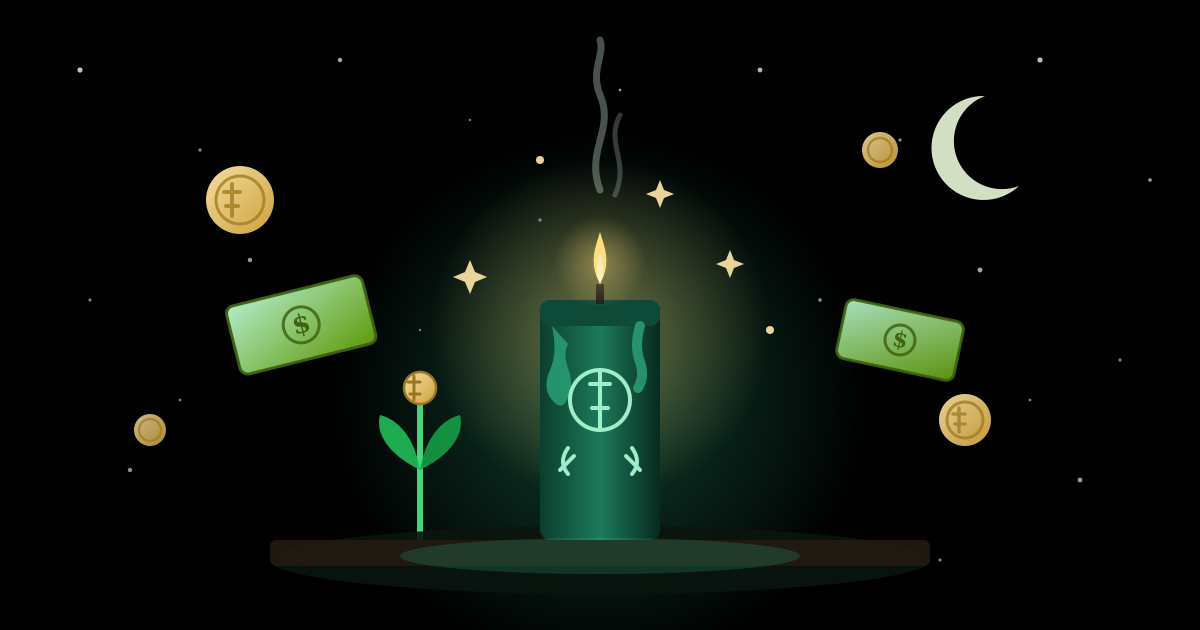
Money is the oldest reason anyone ever lit a candle on purpose. Long before manifestation was a hashtag, shopkeepers burned green candles over their tills, farmers lit them at planting, and families set one on the table on the first of the month and named, out loud, what the household needed. The ritual has survived because it does something ordinary life rarely offers: it makes you sit still with your money for twenty minutes and say exactly what you want, in numbers, without flinching.
That is the honest heart of money candle magic. The flame does not print banknotes. What it does — and what practitioners have claimed for centuries — is turn a vague wish ("I need more money") into a specific intention ("I need $400 for the car repair by the 15th, and I will pick up two extra shifts to cover it"). This guide covers the tradition properly: the colors, the timing, the herbs and oils, a complete step-by-step money ritual, how practitioners read the flame and wax, the safety rules, and the mistakes that turn a useful ritual into a comfortable way of avoiding the real work. Folk lore presented for entertainment, not guaranteed outcomes and never a substitute for financial advice.
What Is Candle Magic for Money?
In the folk tradition, money candle magic is a focus ritual: a candle, a color, a carved symbol, and a spoken intention, combined to concentrate attention on a financial goal. The classic form is simple on purpose. You choose a green candle, dress it with oil, carve a money glyph into the wax, write the goal on paper, light the candle, and sit with the flame while you picture the goal as already handled — the bill paid, the savings account growing, the offer accepted. Then you snuff the flame and take one practical step the same day.
The tradition distinguishes three kinds of money workings, and the distinction matters, because each one asks for a different candle and a different kind of honesty:
- Income workings. The everyday kind — steady work, a side income, clients arriving, a raise. Green candles, Thursday timing, waxing moon. This is the money magic most practitioners actually practice, week after week.
- Windfall workings. The lottery-ticket kind — sudden money, found money, a surprise gift. Gold candles, Sunday timing, full moon. The tradition is blunt about these: they are the least reliable workings in the craft, and the ones most likely to be performed instead of doing the practical work.
- Debt-clearing and protection workings. Paying something off, stopping a leak, protecting what you already have. Green paired with black or brown, Saturday timing, waning moon. These workings aim at removing a burden rather than attracting a gain, and practitioners treat them as the most grounded of the three — because the practical step is usually obvious: a payment plan, a call to the creditor, a budget line.
Our guide on how to do candle magic covers the general technique — intention-setting, dressing, and timing — that every money working builds on.
The Colors of Money Candle Magic
Color is the first choice in any money working, and the tradition gives each shade a different job:
- Green: the money color itself — income, growth, saving, steady prosperity, and the everyday flow of money in and out. Green is the color of growing things and of banknotes, which is why it anchors nearly every money ritual. When a guide says "money candle" without specifying, it means green. See our full green candle guide for shades and pairings.
- Gold: wealth at scale — career success, recognition, big contracts, business growth, and the kind of money that changes a year rather than a week. Gold pairs with green when a working needs both growth and shine: green for the income, gold for the achievement it comes through.
- White: the substitute. When no green or gold candle is available, white stands in for any purpose in the tradition, and intention does the heavy lifting. Practitioners who own only white candles are not at a disadvantage — the tradition says so plainly.
- Brown: the grounding color for money — practical budgeting, keeping what you earn, home finances, and the unglamorous work of not spending what you do not have. Brown pairs with green in debt-clearing workings: green draws the income, brown holds it.
- Black: the banishing color for money — ending a debt, cutting a spending habit, blocking a drain. Black is used carefully and briefly in money work, always paired with a positive color, because the tradition warns against aiming banishing energy at your own income by accident.
The practical rule: green for income, gold for success, brown for keeping, black for clearing — and white whenever the drawer holds nothing else.
Timing: Days, Moon Phases, and the Money Calendar
Timing is the part of money magic practitioners argue about most, and the part beginners overthink. The traditional calendar is simple:
- Thursday is the money day, ruled by Jupiter, planet of expansion and abundance. The classic money ritual is performed on a Thursday evening. If you can only remember one timing rule, remember this one.
- The waxing moon is the money phase — the nights between new moon and full moon, when the light is growing. The folk logic is direct: growing light, growing income. Start a money working on the new moon and burn a little each night through the waxing phase.
- Sunday is the second choice, ruled by the sun, for success and career money — the raise, the promotion, the business win. Gold candles belong to Sunday the way green candles belong to Thursday.
- The first of the month is the household money day in many traditions: one candle, one honest look at the month's money, one intention for the month ahead. Practitioners who do nothing else all month still do this.
The honest note matters: a Thursday candle lit with a clear goal beats a perfectly timed Sunday candle lit with a vague wish. Timing supports the working; it never replaces the intention or the practical step.
Herbs, Oils, and the Money Altar
The classic money dressing kit is small, cheap, and already in most kitchens:
- Basil. The money herb of the folk tradition — prosperity, business luck, and steady income. A pinch sprinkled around the candle's base, or a fresh leaf laid beside it.
- Cinnamon. The accelerator — speed and warmth. Practitioners add cinnamon when money needs to move faster: an overdue invoice, a slow month, a deal that needs closing. A pinch only; cinnamon near a flame can flare.
- Bay leaf. The wish herb. The classic money spell is a wish written on a bay leaf, burned in the candle's flame or tucked under the candle. Bay leaves are the tradition's cheapest, oldest money tool.
- Mint. The fresh-money herb — new income, new clients, new streams. Mint suits the freelancer's working and the side-hustle candle better than the salary candle.
- Bergamot, patchouli, and cinnamon oil. The classic money oils for dressing the candle. Rub a drop or two upward, from base to wick, which the tradition reads as drawing money in. Learn the full technique in our guide on how to dress a candle.
The altar itself needs nothing fancy: a fireproof dish, the candle, the written goal, and optionally a coin or banknote placed under the dish — the tradition's way of giving the working something real to point at. A coin from the year you were born is the classic choice, and it costs nothing.
A Step-by-Step Money Candle Ritual
This is the classic Thursday working: about twenty-five minutes, one specific goal, and one practical step taken the same day. Fire safety first — everything else second.
1. Write the goal in numbers
Before lighting anything, write the goal on paper in exact numbers: the amount, the date, and the practical step. Not "more money" but "$400 for the car repair by the 15th, covered by two extra shifts." The tradition insists on this step because a vague wish cannot be pictured, and a working that cannot be pictured cannot be focused on. Fold the paper and set it under the candle's dish.
2. Prepare the candle
Set a green candle in a fireproof dish. If you have bergamot or cinnamon oil, anoint the candle lightly, drawing the oil upward from base to wick. If you have basil or cinnamon, sprinkle a pinch around the base — never in a heap near the wick. Place a coin under the dish.
3. Carve the money glyph
With a pin, carve a dollar sign inside a circle into the wax, or a simple upward arrow if you prefer no currency symbol. The tradition reads the carving as the whole point: it turns a shop-bought candle into your instrument for this goal. One glyph, one goal — never carve two goals into one candle.
4. Light and picture the handled goal
Light the candle and speak the goal once, plainly, in your own voice — the amount, the date, the step. Then sit for ten to fifteen minutes picturing the goal as already handled: the bill paid, the account balance, the conversation where you asked for the raise. Practitioners describe this as the working's real product: not magic but rehearsal — the mind practicing the outcome until the practical step feels ordinary rather than frightening.
5. Snuff, then take the step
Snuff the flame — never blow it out, in the folk manner — and take one practical step before the day ends: send the invoice, book the shift, open the savings account, make the call. The tradition's rule is ironclad here: a money ritual without a same-day step is just a nice light. Burn the candle in short sessions across the waxing moon, one goal per candle, until the goal is reached or honestly abandoned.
Reading a Money Candle: Flame and Wax Signs
Folk pyromancy treats the burn as commentary on the working — with the honest hierarchy the old practitioners used: physics first, folklore second.
- Steady, tall flame: the tradition's best money sign — strong energy behind the goal, and a working aimed at something real. Practically, a still room and a trimmed wick also do this. Enjoy it either way.
- Low, dim flame: read as the goal needing more practical fuel — not failure, but a signal that the plan, not the candle, needs work. Trim the wick and ask whether the goal's step is big enough.
- Flickering, restless flame: in lore, competing money worries pulling at the working — bills, doubts, other people's opinions; in physics, often a draft. Close the window, then name the competing worry on paper.
- Crackling or sputtering: the folk read is obstacles or gossip around the money; the practical read is moisture or herbs near the wick. Either way, the response is the same: clear the wick, then clear the obstacle you can actually touch.
- Clean, even burn with little soot: read as a working running clean — the goal is honest, the step is clear, and the money path has no hidden snag. The clearest of money's signs.
For the full vocabulary of what candle flames mean and how to read the wax after the burn, see our ceromancy guide.
Fire Safety for Money Candles
- Never burn while sleeping or out of the room. The ritual ends with the snuff — always. Set a timer for your twenty-five minutes so the working cannot turn into an unattended burn.
- Dressed candles burn unpredictably. Oil and herb dressings change how wax melts and can make flames flare. Never leave a dressed money candle unattended, keep herbs away from the wick, and trim the wick shorter than usual — an eighth of an inch if dressed.
- Cinnamon and loose herbs flare. A pinch around the base is tradition; a heap near the flame is a fire risk. If the flame jumps, snuff it, let it cool, and clear the dressing before relighting.
- The candle stays in its dish. Money workings are still — sitting, writing, picturing. Do that from a chair, not while carrying the candle. The flame stays in one place; you stay a safe distance from it.
- Mind the paper. The written goal sits under the dish, never beside the flame. Paper and open flame share no table space in the tradition — or in fire safety.
When NOT to Burn a Money Candle
Money is the craft's most tempting color, and even temptation has its limits — the cases where practitioners themselves say put the candle down:
- Not instead of a budget. The most common money-magic failure: lighting a candle instead of looking at the bank statement. The ritual clarifies the goal; the budget is the plan. Check the color against the goal in the color guide before every working — and check the numbers too.
- Not for money that belongs to someone else. The tradition draws a hard line here: workings aimed at another person's money, a partner's wallet, or an outcome that harms someone are considered bad craft and bad luck alike. Aim every money working at your own income and your own debts.
- Not as a substitute for financial help. A money ritual cannot replace a debt counselor, a benefits check, a payment plan, or professional financial advice for a real money crisis. The candle can sit on the table and hold the intention; it cannot be the plan.
- Not for gambling or speculation. Practitioners warn against aiming money candles at lottery tickets, bets, or risky trades. The tradition's logic is blunt: a ritual that promises easy money teaches the mind to wait for easy money, which is the most expensive lesson in the craft.
- Not every night. A money candle burned nightly for months stops being a ritual and becomes a comfort — the glow that stands in for the step. The tradition's test is simple: after two weeks, has anything practical actually moved? If not, the working has become the avoidance, and the honest move is the step the candle has been standing in for.
Common Mistakes to Avoid
Setting a vague goal. "More money" is not a goal; it is a mood. The ritual cannot focus on a mood. Every money working needs an amount, a date, and a step — written down before the match is struck.
Burning for someone else's money. The working aimed at an ex's paycheck, a parent's savings, or a stranger's wallet is the fastest way to turn a useful ritual into a sour one. Aim at your own income, always.
Skipping the same-day step. The ritual's power is in step five — the invoice sent, the shift booked, the call made. Practitioners who light and then wait report the same result every time: nothing. The candle marks the intention; the step moves the money.
Mixing goals on one candle. One candle, one goal. The candle carved for the car repair cannot also carry the side hustle, the raise, and the lottery ticket. The tradition is strict here because focus is the entire mechanism — split it, and there is nothing left to focus.
A Grounded View: Why Money Candles Work
You do not have to believe in money energy to get something from a green candle. The ritual is doing several very ordinary things at once: it forces a specific number (writing $400 by the 15th replaces a vague dread with a solvable problem), it creates a routine anchor (the same Thursday hour, the same flame, the same paper under the dish), and it borrows the color's cultural weight — green is the color of growth and of banknotes in nearly every culture, which is why it reads as prosperous before a single word is spoken.
Psychologists would recognize the pattern as implementation intention plus visualization: naming the amount, the date, and the step converts a wish into a plan, and picturing the handled goal rehearses the practical move until it feels ordinary. People who do this regularly report the same effect whether they call it magic or routine — the invoice they dreaded sending gets sent, the raise they dreaded asking for gets asked for, the budget they dreaded opening gets opened. The green candle did not move your money. It gave your money goal a quiet room, a number, and a first step.
Closing: The Steady Flame
Every other candle in the craft asks you to reach for something — to love deeper, to listen quieter, to stand steadier. The money candle asks you to be specific: an amount, a date, a step, a flame. It is the only one whose whole symbolism points at something you can count — and that is its gift. Money dread thrives on vagueness, on the unopened statement and the unasked question. The green candle's answer to vagueness is twenty-five minutes, a number on paper, and a flame that will not let you look away until the number is named.
So light one the next time the money worry gets loud: the repair bill, the slow month, the raise you have been rehearsing for weeks, the savings goal that keeps slipping to next month. Write the number, carve the glyph, sit with the flame — and then, the part that matters, take the step before the day ends. Practitioners have an old saying about money candles: every other candle changes the room, but the green one changes the ledger. The flame does not perform for you. It just burns there, low and green, until the number on the paper becomes the step you actually took.
Frequently asked questions
What color candle is best for money magic?
Green is the traditional first choice for money candle magic — the color of growing things, banknotes, and steady income. Gold is the second choice, used for larger wealth, career success, and recognition, while white works as a substitute for any purpose when no green candle is available. Practitioners pick green for everyday income and saving, and gold when the goal is a raise, a promotion, or a business win.
What day of the week is best for a money candle ritual?
Thursday is the traditional money day in candle magic, ruled by Jupiter, the planet of expansion and abundance. The waxing moon is the classic moon phase for money workings, since the growing light mirrors growing income. Sunday, ruled by the sun, is the second choice for success and career money. The folk rule is simple: Thursday for money, waxing moon for growth.
Does candle magic for money actually work?
There is no evidence that a candle ritual changes your finances by itself, and this guide presents the practice as folk tradition and entertainment, not financial advice. What money candle rituals reliably do is force a focused pause: naming an exact amount, writing a concrete step, and sitting with your money honestly for twenty minutes. Practitioners report that the ritual's real value is the clarity and the follow-through it produces — the budget started, the invoice sent, the raise asked for.
Can I reuse a money candle across several rituals?
Yes, and most practitioners do. A money candle is traditionally burned in short sessions — fifteen to thirty minutes at a time — and snuffed between sessions, so one candle can carry a working across a whole waxing moon. The folk rule is one candle per goal: do not mix a money working and a love working on the same candle. When the goal is reached or abandoned, let the candle burn out or retire it.
What herbs and oils are used in money candle magic?
The classic money herbs are basil, cinnamon, bay leaf, and mint, and the classic oils are bergamot, patchouli, and cinnamon oil. Practitioners dress a green candle by rubbing oil upward, from base to wick, to draw money in, and sprinkle a pinch of herb around the candle's base. Keep dressings light: heavy oil or loose herbs near the flame can flare, so fire safety always outranks tradition.
Keep exploring
Green Candle Meaning & Uses: Growth, Prosperity & Money Rituals
Green candle meaning explained: what green candles are used for — growth, prosperity, money, and new beginnings — plus a simple prosperity ritual, a shade guide, and fire safety.
Read the meaning →
Manifestation Candle Ritual: A Step-by-Step Guide
Manifestation candle ritual explained: how to set an intention, dress a candle, and time your working with the moon — plus the practical steps that turn a wish into a plan.
Read the meaning →
How to Do Candle Magic: A Beginner's Guide
How to do candle magic: a complete beginner's guide. What you need, the 8 steps of a candle spell, timing with moon phases, and common mistakes to avoid.
Read the meaning →
Candle Color Meanings: The Complete Guide
Candle color meanings explained: what each candle color means in magic, how to pick the right one for love, money, protection, or healing, plus pairings.
Read the meaning →