
Crown Chakra Meaning: Sahasrara & Spiritual Connection
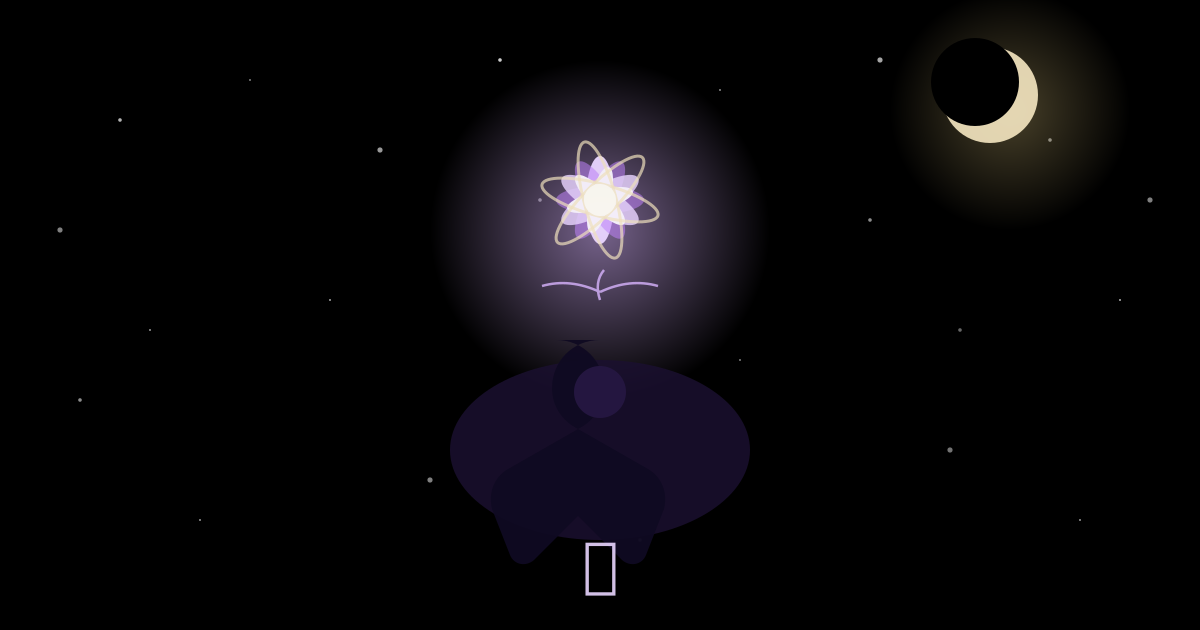
At the very top of the chakra system sits Sahasrara, the crown — the thousand-petaled lotus that opens upward like a blossom catching sunlight. Every chakra below it deals with something you can point to: safety, pleasure, willpower, love, expression, intuition. The crown points at something you cannot point to at all. It is the center of connection itself: the felt sense that you are not a separate fragment drifting through an indifferent universe, but a thread woven into something vast.
This is the most abstract of the chakras, and the easiest to misunderstand. Crown chakra work is not about collecting mystical experiences or believing the right things. In the tradition, it is about surrender — the quiet, repeated practice of loosening the mind's grip on control, certainty, and separation, until the sense of connection arrives on its own terms. This guide explores what Sahasrara means, how a closed or overactive crown shows up in ordinary life, and the gentle practices tradition associates with opening it — framed as contemplative self-care, never as medical advice or guaranteed spiritual results.
Sahasrara: The Crown Chakra in Depth
Sanskrit name: Sahasrara (“thousand-petaled”). Location: crown of the head, often depicted as opening upward, above the skull. Colors: violet and white (gold in some traditions). Element: thought, or consciousness itself. Seed sound: silence — or OM, the sound of the universe, chanted as a fading exhale. Associated themes: connection, unity, transcendence, surrender, trust in life, wisdom, spiritual belonging, and the dissolving of the boundary between self and everything else.
The lotus image is doing real philosophical work here. A lotus with a thousand petals cannot be fully opened by force — it unfolds when conditions are right. That is the crown's whole teaching: you cannot pry open the sense of connection. You can only prepare for it — clear the noise, soften the certainty, show up — and let it arrive. Every practice in this tradition is preparation, not production. The crown opens the way a flower opens: gradually, and on its own schedule.
Psychologists have noticed a parallel: the experiences people describe at moments of deep connection — awe at a night sky, absorption in music, the dissolving of self during meditation or even during “flow” at work — share a family resemblance across cultures and belief systems. The crown chakra is the spiritual vocabulary for that human capacity: the ability to feel, however briefly, that the walls of the self are not the walls of reality.
Signs Your Crown Chakra May Need Attention
Remember: “blocked” or “overactive” crown is symbolic language for patterns, not a diagnosis of anything. Common themes the tradition associates with a closed crown include:
Mental and emotional patterns
- A persistent sense of disconnection or spiritual flatness — life feels mechanical
- Cynicism or contempt toward anything transcendent, symbolic, or sacred
- Rigid, closed-loop thinking: needing everything proven before anything can be felt
- Difficulty trusting life's unfolding — a tight, white-knuckled need for control
- Feeling alone even in company, as if everyone else got an invitation you missed
- A nagging “is this all there is?” that material success does not answer
The overactive crown: when openness becomes escape
The crown has a shadow too, and it runs in the opposite direction. Tradition describes an overactive crown as being so absorbed in spiritual ideas, experiences, and identities that the rest of life atrophies: neglecting the body, drifting through relationships, using “higher perspective” to avoid earthly responsibilities, or chasing one peak experience after another. The tradition has a stern term for this: spiritual bypassing — using transcendence to dodge the grounded work of being human. The warning is ancient and practical: enlightenment that cannot pay its rent is not enlightenment.
If either pattern feels familiar, the crown framework offers a compassionate reframe: disconnection is not a verdict — it is an invitation. And if low mood, anxiety, or a sense of meaninglessness is significantly affecting your daily life, please also speak with a qualified counselor or therapist. Spiritual practice and professional support are allies, not alternatives.
The Philosophy of Surrender: Why the Crown Comes Last
There is a deliberate sequence to the chakras, and the crown's position at the summit is the point of it. The teaching is uncompromising: you cannot skip to the top. Someone who tries to open the crown before tending the root usually ends up anxious and ungrounded; before healing the heart, the “oneness” they chase can curdle into grandiosity. Each lower chakra builds the vessel that can actually hold the crown's opening — safety, vitality, will, love, voice, and insight, in that order.
This is why the crown's primary virtue is surrender, not striving. Every other chakra has something you do: ground, create, assert, love, speak, see. The crown has something you stop doing — stop gripping, stop forcing, stop needing the universe to sign your paperwork. Practitioners describe the shift as moving from “making meaning happen” to “letting meaning arrive.” It sounds passive; experienced meditators insist it is the hardest practice of all, because the controlling mind defends its territory fiercely.
There is a quiet radicalism in putting surrender last. It means the spiritual path ends not in achievement but in receiving — not in becoming extraordinary but in recognizing that the ordinary was never separate. The tradition's punchline: the crown does not take you somewhere else. It shows you that you were already there.
Crown Chakra Opening Practices
Silence meditation
The signature practice, and the simplest: sit with nothing to do. No mantra, no visualization, no counting breaths. Sit upright, close your eyes, and let awareness rest on the spaciousness at the crown of the head — some practitioners visualize a soft violet or white light there, but the light is optional; the silence is the practice. When thoughts come (they will), do not fight them; notice them, let them pass like weather. Start with five minutes. The tradition holds that regular silence meditation slowly widens the sense of what you are — and even skeptics report that a quiet mind feels remarkably like connection.
Inviting awe
Awe is the crown's natural doorway, and researchers agree it reliably produces a small, measurable sense of self-transcendence. The practice: deliberately seek experiences that make you feel small in the good way. A genuinely dark sky full of stars. An ocean at the edge of hearing. Old-growth trees, mountain overlooks, a cathedral's ceiling. Stand in them without photographing them — let the bigness do its work. Even ten minutes of true awe, tradition and psychology both suggest, loosens the self's borders. Crown work, it turns out, can look a lot like stargazing.
Prayer and contemplation
Whatever your beliefs — theistic, agnostic, or somewhere in between — the posture of prayer is crown territory: addressing something larger than yourself sincerely. This can be formal prayer, or something as simple as speaking your gratitude, grief, or questions into the quiet each morning and listening afterward. The tradition is not particular about the addressee; it is particular about the sincerity. The practice that opens the crown is not believing correctly — it is asking honestly.
Wisdom reading and journaling
Read slowly. Choose a wisdom text that has survived centuries — the traditions that produced the chakra system also produced the Upanishads, the Tao Te Ching, the poetry of Rumi — and read a single page as slowly as you would eat something delicious. Then journal on the questions the crown specializes in: What am I connected to? What do I trust? What remains when I stop performing? The tradition treats self-inquiry as a crown practice because the questions, pursued honestly, dissolve the asker — which was the point all along.
Dream journaling
Dreams are the crown's nightly theater: unedited, symbolic, and stubbornly resistant to the controlling mind. Keep a journal by your bed and write down whatever you remember each morning — no interpretation required at first. Many practitioners report that the simple act of taking dreams seriously deepens a felt relationship with the unconscious, which the tradition reads as the crown stirring. Review the journal monthly; the patterns are often more instructive than any single dream.
Service without spotlight
The tradition insists on an unlikely crown practice: do good anonymously. Help someone who cannot repay you, and tell no one. The logic is elegant — the ego feeds on recognition, and service without an audience starves the part of you that needs to be the center. Practitioners describe anonymous kindness as a surprisingly direct route to the sense of oneness the crown represents: for a moment, the boundary between your wellbeing and someone else's genuinely blurs.
A 7-Day Crown Awareness Practice
A gentle week of preparation — not force:
- Day 1: Five minutes of silence meditation. Visualize a soft violet light at the crown. Do nothing else.
- Day 2: Spend 15 unhurried minutes somewhere that inspires awe — a park, a skyline, the night sky. No phone.
- Day 3: Write a page of honest questions: what do you believe, what do you doubt, what do you long to trust?
- Day 4: Do one anonymous kindness. Small is perfect — pay for a stranger's coffee, leave a kind note.
- Day 5: Read one page of a wisdom text slowly. Sit with a single sentence for five minutes.
- Day 6: Write down last night's dream in detail, even the fragments. Notice any recurring theme.
- Day 7: Repeat the silence meditation, longer if it feels natural. Journal: when did I feel most connected this week?
Notice the pattern: none of these manufacture an experience. Each one clears a little noise — and connection, the tradition promises, fills cleared space on its own.
Living From the Crown: Integration
The tradition is clear that opening experiences are not the goal — integration is. A moment of profound oneness on a mountaintop is lovely; the real practice is bringing a fraction of that spaciousness into a traffic jam, a difficult conversation, a hospital waiting room. Practitioners describe the long-term shift in plain terms: less frantic certainty, more curiosity; less needing to be right, more willingness to wonder; a background sense, even on ordinary days, that they belong to something bigger than their to-do list.
The crown's final lesson is also its first: you are not separate, and you never were. The thousand petals were always unfolding. The practices in this guide are simply ways of paying attention to it — and attention, the tradition insists, is the real sacrament. Everything else is commentary.
Frequently asked questions
What is the crown chakra?
The crown chakra (Sahasrara) is the seventh and final chakra, traditionally located at or just above the crown of the head. Its name means "thousand-petaled lotus" in Sanskrit, and it represents connection to something larger than the self — whether you call that the universe, spirit, or simply a sense of oneness. Its colors are violet and white, and its element is thought or consciousness.
What are the signs of a blocked crown chakra?
Symbolically, a closed crown chakra is described as spiritual disconnection: feeling adrift or purposeless, cynicism toward anything transcendent, rigid thinking, difficulty trusting life's flow, and feeling isolated even among people. An overactive crown is associated with the opposite pattern — being so absorbed in abstract or spiritual ideas that daily life, relationships, and the body get neglected. These are symbolic patterns for self-reflection, not medical diagnoses.
How do you open the crown chakra?
Traditional and modern practices include silent meditation and mindfulness, spending time in nature and inviting awe, prayer or contemplation in whatever form feels sincere, reading wisdom texts slowly, journaling on big questions, keeping a dream journal, and service to others. The shared theme is loosening the grip of the thinking mind to make room for a felt sense of connection.
Can you open the crown chakra before the other chakras are balanced?
Tradition generally teaches a bottom-up path: root first, then sacral, solar plexus, heart, throat, third eye, and finally crown. The reasoning is practical — chasing transcendent experiences without a grounded foundation tends to produce escapism rather than wisdom. That said, many people experience moments of spontaneous connection at any stage; tradition would call these glimpses, and welcome them, while still recommending steady work on the lower chakras.
Keep exploring

The 7 Chakras: Meanings, Colors & Balancing Guide
The 7 chakras explained: meanings, colors, signs of imbalance, and gentle balancing practices. A complete beginner-friendly guide to the chakra system.
Read the meaning →
Root Chakra Healing: Grounding Your Foundation
Root chakra healing: what Muladhara means, the signs it needs attention, and grounding practices — meditation, nature, routine, nourishment — for safety.
Read the meaning →
How to Balance Your Chakras: A Complete Routine
How to balance your chakras: a beginner routine with a 20-minute guided meditation, a 5-minute daily version, mantras, yoga poses, and a weekly focus.
Read the meaning →
What Does It Mean to Dream About Water?
Water in dreams mirrors your emotional state. Discover what dreaming about water means — calm seas, floods, drowning — and how each reflects feelings.
Read the meaning →