
Root Chakra Meaning: Muladhara & the Foundation of Safety
Before a tree can grow tall, it has to root. That is the whole philosophy of the root chakra in a single image, and it is why the tradition places Muladhara first — not because it is the most glamorous of the seven chakras, but because nothing else in the system stands without it. The heart chakra can open, the throat chakra can speak, the third eye can see, but if the ground beneath them is shaking, every one of those higher gifts wobbles. A person who does not feel safe, the tradition says, cannot fully afford creativity, love, or spiritual curiosity, because some part of them is always scanning for the next threat.
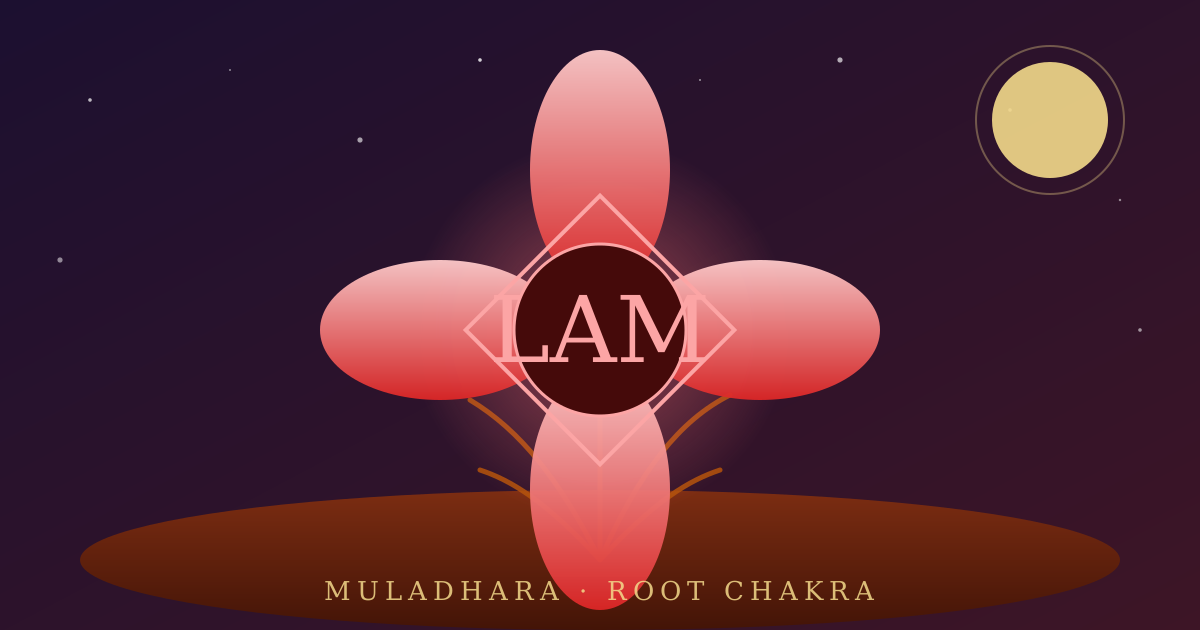
The word Muladhara comes from Sanskrit: mula meaning root, and adhara meaning support or foundation. Together they name exactly what this chakra is for — the support underneath everything else. In the traditional map, it sits at the base of the spine, near the pelvic floor, and it is pictured as a four-petaled red lotus holding a yellow square, the symbol of the earth element, with the seed sound LAM at its center. The imagery is deliberately humble. There are no wings here, no thousand petals, no cosmic visions. There is soil, a square, four petals, and a sound you can hum. The root chakra is the chakra of ordinary life done well: a roof, a meal, a body that feels like home, people you can count on.
What the Root Chakra Symbolizes
Every symbol attached to Muladhara points downward, toward the ground, and that is the point. Its color is red — the color of blood, of earth, of the body's most basic aliveness. Its element is earth, the only element you can stand on. Its sense is smell, the most primal of the senses, the one that tells a newborn where its mother is and tells an animal whether a place is safe. Its animal, in some traditional depictions, is the elephant: massive, steady, unhurried, impossible to push around. Even its four petals carry meaning — in the tradition they stand for the four directions, the four states of mind, or the four foundations of a stable life, depending on which teacher you ask. The details vary; the message does not: this chakra is about being here, on solid ground, in a body, in a life.
The yellow square at the lotus's center deserves a second look. In the tradition's visual language, shapes carry meanings: circles suggest movement, triangles suggest fire and transformation, and squares suggest stability — four equal sides, nothing leaning, nothing about to tip. A square does not roll. It stays. That is the root chakra's promise and its question, asked of every life: what in your world stays? What can you stand on when everything else moves? The tradition does not ask you to answer with philosophy. It asks you to answer with a home you can return to, a routine you can trust, a body you can live in without flinching, and a handful of people who know your name.
It also helps to understand what Muladhara is not. It is not ambition, although it touches money and work. It is not courage in the heroic sense, although steady people often look brave. And it is not the same as comfort — a comfortable life can still feel rootless, and a hard life can still feel grounded. The tradition draws a careful line here: root chakra energy is not about having everything you want. It is about trusting that you can meet what comes. A person with a strong foundation, in this framework, is not someone who has never been shaken. It is someone who knows, from experience, that shaking does not have to mean falling.
What Muladhara Governs in Daily Life
The tradition maps the root chakra onto the most practical territory of a human life, and the map is worth walking slowly because it explains why root chakra talk shows up in such ordinary places. First, the body itself: physical health, energy, sleep, appetite, the feeling of being at home in your own skin. Second, the material foundations: housing, income, food, the bills paid and the roof kept. Third, belonging: family, ancestry, community, the feeling of being one of a people and one of a place, rather than a visitor everywhere. Fourth, the nervous system's baseline — what modern language would call the sense of safety. When the tradition says the root chakra governs survival, it does not only mean dramatic survival. It means the daily, unglamorous kind: getting through the week, keeping the lights on, knowing where the next meal comes from, trusting that tomorrow will resemble today closely enough to plan for it.
This is also why root chakra imbalance, in the tradition's telling, rarely announces itself in spiritual language. It shows up as restlessness in a new apartment, as money worry that outlasts the actual money problem, as the feeling of being a guest in your own life, as the urge to move, quit, or disappear when things get hard. People rarely say, “My Muladhara is blocked.” They say, “I can't settle.” “I don't feel safe anywhere.” “I keep waiting for the other shoe to drop.” The tradition hears those sentences as root chakra sentences, and its response is practical rather than mystical: go back to the ground. Eat regularly. Sleep at the same hour. Walk outside. Put your feet on actual earth. Fix one small thing in your home. The remedies are humble because the chakra is humble — it is repaired by the same ordinary acts that build a life.
7 Signs of a Balanced Root Chakra
1. You feel safe in your body
Not invincible, not perfect — just at home. The tradition describes this as the absence of a low hum of dread: you can sit still without needing to move, eat without guilt or hurry, sleep without rehearsing disasters. The body stops feeling like a place you are visiting and starts feeling like a place you live.
2. Home feels like home
Whether it is a house, an apartment, a single room, or a van, the place you return to feels like yours. You have put something of yourself into it — a plant, a picture, a chair placed where you like it — and walking through the door lowers your shoulders rather than raising them.
3. Practical problems do not become existential ones
A bill arrives, and it is a bill, not proof that your life is collapsing. A setback at work is a setback, not a verdict on your worth. The tradition treats this proportionality as a hallmark of a steady root: problems stay their own size instead of swelling to fill the whole sky.
4. You can be present instead of braced
A braced person lives slightly in the future, rehearsing what might go wrong. A grounded person, in the tradition's language, can stand in the present moment — this room, this conversation, this meal — without one foot already out the door. Presence, here, is not a meditation achievement. It is the luxury of not needing to flee.
5. You belong somewhere, to someone
Belonging does not require a large family or a hometown. It can be one friendship, one community, one table where you are expected. The tradition says the root chakra is fed by being known — by people who would notice if you disappeared — and that even a small circle, held steadily, counts as roots.
6. Routine feels like rhythm, not a cage
Morning coffee, the evening walk, the weekly call home: a balanced root turns repetition into reassurance. The same day that would bore a restless mind steadies a grounded one, because routine is how the nervous system learns that the world is predictable enough to trust.
7. You trust yourself to handle what comes
This is the deepest sign, and the quietest. Not confidence that nothing bad will happen — the tradition makes no such promise — but a lived knowledge that you have handled hard things before and will handle the next one too. The root chakra's gift, in the end, is not safety from life. It is trust in your own ability to meet it.
When the Root Chakra Feels Out of Balance
The tradition describes two directions of imbalance, and they feel very different. An underactive root chakra shows up as the classic ungrounded pattern: spaciness, chronic worry, difficulty finishing things, a sense of floating through life without landing anywhere, and money or housing anxiety that never quite resolves no matter what changes. An overactive root chakra, by contrast, shows up as gripping too tightly: hoarding, rigid routines, fear of any change, possessiveness over people or things, and a resistance to growth that mistakes stillness for safety. Both are, in the tradition's framing, the same problem seen from opposite sides — a relationship with security that has lost its flexibility. The underactive root cannot hold; the overactive root cannot let go.
Our companion guide covers the underactive pattern in detail, with 12 symbolic signs and grounding practices: Blocked Root Chakra: Signs & How to Heal It. If the signs above feel distant and the ungrounded pattern feels familiar, start there. And if your worry is persistent, overwhelming, or tied to real financial or housing insecurity, the honest answer is practical help first — a counselor, a financial advisor, a community support service — with chakra practice as a companion to that help, not a replacement for it. The tradition is a map of inner experience, not a substitute for the material foundations it describes. You cannot meditate your way out of an unpaid bill, and no honest teacher claims otherwise.
Gentle Practices for Grounding Muladhara
Walk, and feel the ground
The simplest practice is also the oldest: walk outside, slowly, and notice your feet meeting the ground. The tradition adds a barefoot variation — standing on grass, soil, or sand for a few minutes — and modern fans call it earthing. Strip away the debate about mechanism and what remains is a real experience: attention moving from a spinning mind down into the body, one step at a time.
Build one small, reliable routine
Choose one anchor — the same breakfast, a morning walk, ten minutes of tidying before bed — and keep it for a month. The tradition treats routine as root-building in miniature: each kept promise to yourself is a small root laid down, and a life of kept small promises begins to feel like ground you can stand on.
Chant LAM, slowly
The seed sound of Muladhara is LAM, pronounced with a long, low “ah” — lahmm — felt in the base of the body rather than the throat. Chant it a few times before meditation, or hum it on a long exhale when worry spikes. The tradition's claim is modest: sound vibrates the body, and a low sound draws attention downward, out of a racing head and into the place the chakra is said to live.
Tend your home and your foundations
Fix the dripping tap. Clear one drawer. Review the budget for twenty minutes without judgment. The tradition is blunt that grounding is not only a spiritual act — it is a practical one. Every small act of care for your material life is, in this framework, an act of care for Muladhara, and the chakra responds to a mended fence the way it responds to a mantra.
Work with red, and with the earth
Wear red, place red stones such as garnet or red jasper where you will see them, garden, cook a root vegetable, sit against a tree. The tradition treats these as symbolic reminders, not magic objects: the color and the soil keep pulling attention back to the theme — I am here, I am supported, I belong on this earth — until the reminder becomes a habit of mind.
The Root Chakra and the Other Six Chakras
It is tempting to treat the chakras as a ladder, with the root at the bottom and the crown at the top, and to read that ladder as a ranking. The tradition resists that reading. A better image is a house: the root chakra is the foundation, the sacral chakra the hearth of creativity, the solar plexus the will that acts, the heart the room where others are welcomed, the throat the window through which truth is spoken, the third eye the skylight, and the crown the roof open to the sky. A house with a beautiful roof and no foundation is not a better house. It is a ruin waiting for weather. And a foundation with nothing built on it is not a failure either — it is a beginning, waiting for the rest of the house.
This is why teachers traditionally begin chakra work at the root, even for students drawn to the higher chakras' visions and insights. The order is practical, not moral: first, be safe. First, be here. First, know that you have a place, a body, a life that holds. Then creativity has somewhere to happen, love has somewhere to land, and spiritual experience has a steady person to return to afterward. If you have ever had a powerful insight that evaporated the moment ordinary life resumed, the tradition would nod knowingly: the roof was beautiful, but the foundation was not yet ready to hold it. Go back to the ground, it says. The sky will wait.
What Root Chakra Meaning Is Not
It is not a diagnosis. Feeling anxious about money does not mean your chakra is blocked in any medical sense, and feeling steady does not mean it is open — these are poetic descriptions for self-reflection, and persistent anxiety, depression, or financial distress deserve professional support, not just a practice. It is not a promise: no chant, stone, or routine guarantees safety, wealth, or belonging, and anyone selling that guarantee is selling something else. It is not a judgment, either — a person whose foundations are shaken by job loss, illness, displacement, or grief is not spiritually failing; they are a person in hard circumstances, and the tradition's grounding practices are meant to accompany real help, not replace it. And it is not a one-time fix: foundations, like gardens, need tending. The root chakra, in the end, is not a destination you reach but a relationship you keep — with your body, your home, your people, and the ground beneath your feet — one ordinary, steady day at a time.
Frequently asked questions
What does the root chakra represent?
In chakra tradition, the root chakra (Muladhara) represents safety, grounding, belonging, and the basic foundations of life: home, money, health, family, and a sense of having a place in the world. It is the first of the seven chakras, located at the base of the spine, and is associated with the color red, the earth element, and the seed sound LAM.
What are the signs of a balanced root chakra?
The tradition describes a balanced root chakra as a quiet sense of steadiness: feeling safe in your body, at home where you live, able to handle practical problems without panic, connected to people you trust, and present in the moment rather than constantly braced for the next crisis. These are symbolic descriptions for self-reflection, not medical or psychological diagnoses.
How do you balance the root chakra?
Traditional and modern grounding practices include walking in nature, barefoot time on grass or soil, steady routines for sleep and meals, body-based movement such as walking or gentle yoga, organizing your home or finances in small steps, chanting the seed sound LAM, and working with red stones such as garnet or red jasper as symbolic reminders. Consistency matters more than intensity.
Is the root chakra the most important chakra?
The tradition calls Muladhara the foundation, not the most important. Its image is architectural: a house needs solid foundations before anything else can stand, but a foundation alone is not a home. The other six chakras — creativity, confidence, love, expression, intuition, and spiritual connection — all build on the sense of safety the root chakra represents.
Keep exploring
Blocked Root Chakra: Signs & How to Heal It
Blocked root chakra signs: persistent anxiety, financial worry spirals, restlessness, and feeling ungrounded. Learn what blocks Muladhara and grounding practices to heal it.
Read the meaning →
Root Chakra Healing: Grounding Practices That Work
Root chakra healing practices: grounding routines, body-based movement, and small daily habits that restore a sense of safety and steadiness.
Read the meaning →
How to Balance Your Chakras: A Complete Routine
How to balance your chakras: a beginner routine with a 20-minute guided meditation, a 5-minute daily version, mantras, yoga poses, and a weekly focus.
Read the meaning →
The 7 Chakras: Meanings, Colors & Balancing Guide
The 7 chakras explained: meanings, colors, signs of imbalance, and gentle balancing practices. A complete beginner-friendly guide to the chakra system.
Read the meaning →