
Root Chakra Opening: 12 Signs Your Muladhara Is Awakening
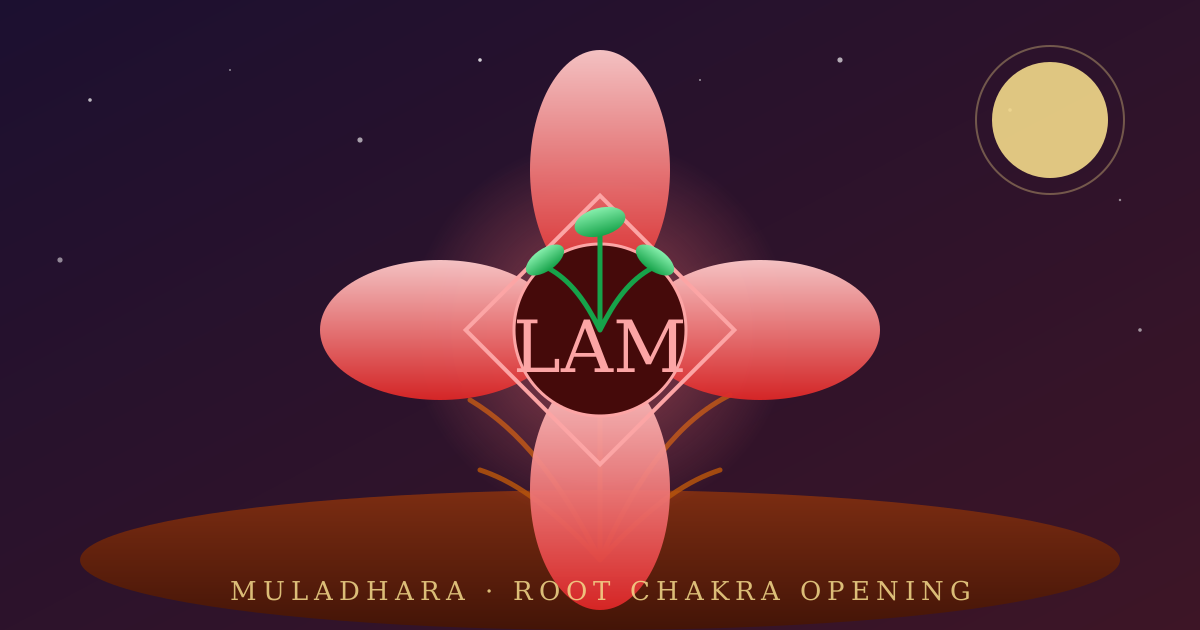
Most people picture a chakra opening as something that happens above them — light pouring down, a crown lifting, a third eye blazing. The root chakra opens in the opposite direction: downward. Muladhara, the first of the seven chakras, sits at the base of the spine, and in the tradition its opening feels less like ascending and more like landing. You stop bracing. The floor under your feet, which you had somehow been hovering an inch above for months, becomes solid again. Nothing in your life has necessarily changed — same job, same apartment, same bank balance — and yet the background hum of emergency quiets, and ordinary life starts to feel livable rather than merely survivable. That quiet landing is, in the tradition's language, Muladhara opening.
It is the least glamorous opening in the chakra system, and the tradition treats it as the most important. A tree does not grow from its crown; it grows from its roots, and a spiritual life built on a shaky foundation, the teachers say, will wobble no matter how beautiful its upper branches. That is why the signs of a root opening are so stubbornly practical. They show up in the kitchen and the bank account, in sleep and in the soles of your feet, long before they show up in meditation. If you have been waiting for a mystical experience and instead find yourself, one Tuesday, calmly fixing the leaking tap instead of spiraling about it, the tradition would not call that a failure of spirituality. It would call it the root chakra doing exactly its job.
What Root Chakra Opening Actually Means
Muladhara means "root support," and the tradition reads its opening as the return of a basic trust: that the ground will hold, that your needs can be met, that you belong here. A closed root, in this symbolic vocabulary, is not a damaged root. It is a root doing its job too hard — gripping, scanning for danger, holding its breath — after instability, loss, or years of living one emergency from the edge. An opening root is that grip learning, slowly, that it can loosen without falling. Safety, belonging, and steadiness are not manufactured in the process; the tradition insists they were always available, waiting underneath the vigilance.
It helps to separate opening from two things it is often confused with. First, opening is not the same as becoming wealthy or perfectly secure. A root can be opening while money is still tight, because the shift is in the relationship to insecurity, not the disappearance of it. Second, opening is not the same as becoming passive or settled in a bad situation. In fact, one of the clearest signs of an opening root, covered below, is the ability to make a practical change — leave, stay, ask, repair — from steadiness rather than panic. The tradition's image for the open root is not a fortress with the gates shut; it is a tree that bends in the wind because it trusts its roots to hold.
There is also a rhythm to it that surprises people. Root opening rarely proceeds at a steady pace, because it is tied to real life. A period of calm can be interrupted by a sudden bill or a move, and the old vigilance flares again. The tradition is unbothered by this: roots, it says, grow in seasons, not in straight lines, and a flare of old fear after a real setback is not a relapse. It is the root doing its job — checking the ground again — and then, with practice, settling a little faster each time.
12 Signs Your Root Chakra Is Opening
1. The background hum of emergency quiets
Before opening, many people live with a low, constant sense of alarm — not a panic attack, just a hum, the feeling that something is about to go wrong even on a good day. As the root opens, the tradition says, that hum gets quieter. Not silent, and not gone forever, but quieter. You notice it most in retrospect: an afternoon passes without the chest-tightening scan for what is next, and you realize the afternoon was simply an afternoon. The tradition reads this as Muladhara loosening its grip on the alarm.
2. Money stops running the whole show
Money worries do not vanish — the rent is still the rent — but they stop colonizing every thought. The tradition describes this as the difference between fear and attention: the guarded root obsesses over money at 2 a.m. without acting, while the opening root looks at the numbers in daylight, makes a plan, and then puts the worry down. If you find yourself checking your balance once and then going for a walk instead of checking it six times and then lying awake, something has shifted. The shift is not in the bank account. It is in the root.
3. Your body starts to feel like home again
A closed root, in the tradition's language, often feels like living upstairs from your own body — aware of it mainly when it hurts or fails. As Muladhara opens, people report a simple, unglamorous homecoming: noticing hunger before it becomes a crash, enjoying a stretch, feeling their feet on the floor. Treat this as poetry, not physiology. In the tradition's reading, the body is the root's territory, so feeling at home in it is read as the root opening its doors again.
4. Sleep deepens and the night stops being a second shift
The guarded root treats night as another shift to work: rehearsing tomorrow, replaying today, scanning for threats in the dark. An opening root, the tradition says, lets the night be night. Sleep comes a little easier, and the 3 a.m. wake-ups — when they still happen — pass more quickly, without the full committee meeting of worries. If sleep is persistently broken, that deserves real attention from a medical professional, not just a practice; but the tradition counts steadier sleep among the earliest signs that the foundation is settling.
5. Routine stops feeling like a cage and starts feeling like a floor
This is the sign that most contradicts the popular image of spiritual freedom. A root that is truly opening does not reject routine; it builds one. The same breakfast, the same walk, the same bedtime — not as a prison but as a floor, something solid to stand on while the rest of life moves. The difference, in the tradition's framing, is motive: the guarded root clings to routine from fear, the restless root flees routine from boredom, and the opening root keeps routine because steadiness itself has become a pleasure.
6. You fix the small practical thing instead of spiraling about it
The leaking tap, the unanswered email, the drawer that sticks — the guarded root turns each one into evidence that everything is falling apart. The opening root, the tradition says, simply fixes it, or books the fix, or decides to live with it for now. The change is not in competence; it is in scale. Small things stay small. When a broken appliance stops feeling like a verdict on your entire life, Muladhara is doing its work.
7. You feel a sense of place
Not necessarily a new place — often the same street, the same room, the same chair, seen differently. Practitioners describe this as belonging arriving without a change of address: the neighborhood becomes familiar rather than merely convenient, the apartment becomes yours rather than temporary, the ground under a favorite tree feels known. The tradition treats this as diagnostic, not decorative. A root that can belong somewhere, it says, is a root that has stopped waiting to be somewhere else.
8. Food becomes nourishment instead of negotiation
The root chakra governs survival, and in the tradition's symbolic language, eating is its daily ritual. A guarded root negotiates with food — skipping, binging, eating while standing, eating while panicking. An opening root eats sitting down, more often than not, and notices fullness without a courtroom drama. This is symbolic language for self-reflection, not dietary advice, and disordered eating deserves professional support. But the tradition reads a calmer table as a calmer root.
9. You stop catastrophizing the setback
A flat tire, a rejected application, a delayed payment — the guarded root reads each as the first domino in a collapse. The opening root reads it as a flat tire. The tradition is comfortable with how ordinary this sign sounds: steadiness, it says, is not the absence of setbacks but the absence of the story that every setback is the end. When you catch yourself mid-catastrophe and think, plainly, "this is one thing, not everything," the root has spoken.
10. Your feet and legs feel heavier, in a good way
Tradition describes the physical signature of an opening root in symbolic terms: a sense of weight, warmth, or groundedness in the legs and feet, sometimes during grounding meditation or walking barefoot, sometimes entirely unprompted — standing in a kitchen, waiting for a bus, feeling the ground through thin shoes. Treat this as poetry, not physiology, and do not use it to diagnose anything. In the tradition's reading, the legs are the root's branches into the earth, so heaviness there is read as the root reaching down again. If you notice it, the tradition simply says: notice it, and do not chase it.
11. You can stay, or leave, from steadiness rather than panic
The guarded root either clings to a bad situation from fear of the unknown or flees a good one at the first tremor. The opening root, the tradition says, can do either one from steadiness: stay because the place is worth the work, or leave because it is not, and make the practical plan either way. This sign tends to arrive late, and it tends to arrive quietly, as a decision made without the usual storm around it. A root that can choose, rather than react, is a root that has opened.
12. A sense of enough, starting at the ground
The final sign is the hardest to describe and the easiest to recognize: a sense, arriving in flashes, that what you have and where you stand might be enough — not perfect, not finished, but enough. The tradition links this to the root's position at the base of the whole system: when the foundation is open, the upper chakras stop being asked to compensate for a missing floor, and the feeling of chronic lack quiets. It rarely arrives as a permanent state. It arrives as a morning, an evening walk, a meal eaten sitting down — and then, with practice, it arrives more often.
The Stages of Root Chakra Opening
The tradition does not offer a timetable, but it does describe a rough arc that many practitioners recognize. The first stage is awareness: noticing the grip — the 2 a.m. money spiral, the hovering, the way every small problem feels existential — without yet being able to loosen it. Awareness alone can feel worse than numbness, because you can now see the cage. The second stage is settling: sleep steadies, routine becomes a floor, small practical things get fixed, and the practices below become daily rather than occasional. The third stage is trust: the new responses — the calm look at the numbers, the setback kept in scale, the decision made without the storm — start to arrive without effort, at least sometimes. The fourth stage is grounding as background: the open root stops being a project and becomes a condition, the way good posture eventually stops requiring thought. Most people cycle through these stages repeatedly, with different pressures at different stages, for years. That is normal. The tradition has no graduation ceremony, and anyone selling one is selling something else.
One warning belongs at every stage: opening can be unsettling if it is forced, and it cannot be forced while life is genuinely unstable. The tradition's own teachers are blunt about this — a root chakra practice is not a substitute for rent, safety, medical care, or a stable home, and anyone in a real crisis deserves practical help first. Gentle, regular practice — the kind described below — is the tradition's recommended pace, and it pairs well with ordinary life: a budget reviewed in daylight, a routine kept, friends who tell the truth, professional support when the weight is heavy. An opening root needs a steady life around it, not a dramatic one.
Gentle Practices That Support an Opening Root
Walk barefoot on the earth, ten minutes
Grass, soil, sand, a garden path — the tradition's simplest root practice is also its most literal: skin on earth. Ten minutes, without a podcast, noticing the temperature and texture underfoot. The tradition reads this as the root remembering what it is rooted in. It is also, plainly, a pleasant walk, and that is part of the point.
The grounding sit, morning and night
Sit with both feet flat on the floor, spine straight, hands resting on your thighs. Breathe slowly, and on each exhale imagine weight traveling down through your legs into the ground, the way a tree's weight travels into soil. Five minutes, twice a day. Chant the seed sound LAM quietly if that part of the tradition appeals to you. The tradition's claim is modest: a body that feels its weight tends to feel its place, and a root cannot open upward while it is still hovering.
One practical repair a day
Fix one small thing: the drawer, the bill, the appointment you have been avoiding, the shelf that needs a bracket. The tradition treats practical repair as root work in disguise — each fixed thing is a small proof that the ground can be improved rather than merely endured. Keep it small. The root learns steadiness from completed small things, not from grand overhauls abandoned halfway.
Build a floor, not a fortress
Choose three anchors and keep them for a month: a wake time, a daily walk, one meal eaten sitting down. Do not add a fourth until the three are boring. The tradition's logic is that the root learns openness by practicing steadiness in miniature, where the stakes are low and the habit can take root — and a floor, unlike a fortress, is something you can build on.
What Root Chakra Opening Is Not
It is not the end of fear, and anyone promising that is selling a fantasy. An open root still worries, still sometimes braces, still sometimes grips — it simply recovers faster and stays steady longer between scares. It is not a moral achievement, either: a person with a guarded root is not a weaker person, only a more protected one, and protection is often wisdom earned the hard way. It is not a substitute for money, housing, therapy, or medical care; spiritual language describes inner experience, and persistent anxiety, financial crisis, or physical symptoms deserve professional support, not just a practice. And it is not permanent in the sense of irreversible: roots grip again after new shocks, and reopening is not starting over but returning to a familiar road, usually a little faster than the first time.
If you recognize several of the 12 signs above, the tradition would offer a simple conclusion: your foundation is not broken, and it was never absent. It was gripping, and now — in small, unglamorous, daily ways — it is learning that it can loosen its hold and still be safe. That learning is the opening. Not the fireworks. The landing, the floor, the morning when the small thing gets fixed and the setback stays small. Keep the practices gentle, keep the expectations modest, and let the root do what it has always known how to do: reach down, hold steady, and let the rest of life grow from there.
Frequently asked questions
What does it feel like when your root chakra opens?
In symbolic language, root chakra opening is described as a settling rather than a surge: steadier nerves, a sense of being supported, less urgency around money and safety, easier sleep, and a feeling of belonging in your own body and life. It is usually gradual and practical — it shows up in daily choices more than in dramatic sensations.
How long does it take for the root chakra to open?
There is no fixed timeline in the tradition. Opening is described as a practice over weeks, months, or years, shaped by life circumstances, stability, routine, and daily grounding habits. Because the root chakra concerns safety and survival, the tradition says it tends to open as outer life becomes steadier — and that forcing it while life is in crisis rarely helps.
What are the physical signs of a root chakra opening?
Tradition describes symbolic physical signatures: warmth or tingling at the base of the spine, a sense of heaviness or groundedness in the legs and feet, deeper sleep, and a loosening of chronic tension. These are poetic descriptions for self-reflection, not medical claims. Persistent pain, numbness, or other physical symptoms should always be checked by a qualified medical professional.
What practices help open the root chakra?
Traditional and modern practices include walking barefoot on the earth, grounding meditation, a steady daily routine, chanting the seed sound LAM, red foods and red clothing in symbolic association, time in nature, and practical steps toward financial and home stability. The tradition treats consistency and real-world steadiness as more important than intensity.
Keep exploring
Root Chakra Meaning: Muladhara & the Foundation of Safety
Root chakra meaning explained: Muladhara at the base of the spine — safety, grounding, belonging, and the practical foundations of life — plus balanced signs and gentle grounding practices.
Read the meaning →
Blocked Root Chakra: Signs & How to Heal It
Blocked root chakra signs: persistent anxiety, financial worry spirals, restlessness, and feeling ungrounded. Learn what blocks Muladhara and grounding practices to heal it.
Read the meaning →
Root Chakra Healing: Grounding Your Foundation
Root chakra healing: what Muladhara means, the signs it needs attention, and grounding practices — meditation, nature, routine, nourishment — for safety.
Read the meaning →
Sacral Chakra Opening: 12 Signs Your Svadhisthana Is Awakening
Sacral chakra opening signs: returning creativity, emotions moving through more easily, pleasure without guilt, and playfulness coming back — plus stages and gentle practices that support it.
Read the meaning →