
Composite Chart vs Synastry: Two Ways to Read Your Relationship
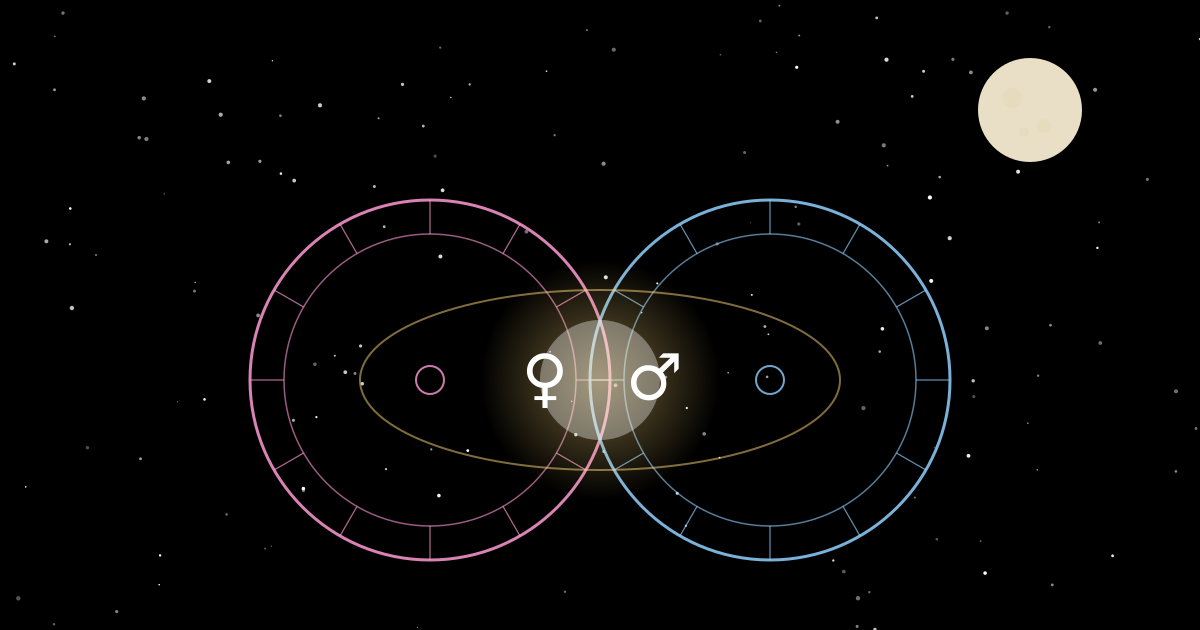
There is the you in a relationship. There is the them. And then there is the third thing — the relationship itself. Anyone who has been in a long partnership knows what that means: couples develop their own jokes, their own rhythms, their own little culture. The pair becomes something neither person is alone. Astrology has spent decades building two different lenses for exactly this, and beginners mix them up constantly: synastry and the composite chart. They are not rivals. They are two instruments in the same orchestra, and understanding which one to listen to — and when — changes everything about how you read a couple's stars.
This guide explains both techniques in plain language: what synastry actually measures, what a composite chart is and how it is made, the real differences between them, what to look at first in each, and how to use them together as a thoughtful reflection on love — not a verdict on anyone's future.
What Is Synastry? The Chart of You-and-Me
Synastry is the older and simpler technique. You take two natal charts — yours and your partner's — and lay one over the other, usually shown as a bi-wheel with one chart in the center and the other ringing it. Then you look for aspects between the charts: your Venus making a conjunction with their Mars, your Moon trining their Sun, your Saturn squaring their Mercury. These inter-chart aspects are read as the dynamics of the relationship — where two people click, where they spark, where they snag.
What makes synastry so readable is that it keeps both people intact. You can still see who is doing what to whom: your planets falling into your partner's houses shows where you land in their life (see our guide to synastry house overlays for the full tour), and their planets in your houses shows where they land in yours. There is a planet-person and a house-person, an actor and a stage. When your Mars sits in your partner's seventh house, for example, you are the one who energizes their partnerships — you may excite them, argue with them, or push them to act, and they are the one who feels it.
Synastry's strength is the day-to-day texture of two people in a room together: attraction (the classic Venus–Mars contacts), emotional attunement (Moon contacts), communication friction (Mercury squares), the deep glue or gravity (Saturn contacts). If you have ever felt that a partner brings out a side of you that no one else touches, synastry is the language that names it. Its limitation is exactly the same thing: it shows two people affecting each other, but it never quite captures the entity they become together.
What Is a Composite Chart? The Chart of Us
The composite chart — popularized in the 1970s by astrologers including John Townley — takes a radically different approach: instead of comparing two charts, it melts them into one. Every point in the composite is the midpoint between the same two points in the partners' charts. Your Sun and their Sun are averaged to find the composite Sun; your Moon and their Moon give the composite Moon; and so on through every planet, the Ascendant, and the Midheaven. The result is a complete third chart that belongs to neither person — it is the chart of the relationship itself, as if the couple were its own being with its own birthday.
This is read like an ordinary natal chart, except the "native" is the partnership. The composite Sun describes the relationship's purpose and core identity — what the couple is for. The composite Moon describes the emotional climate: how it feels to be inside this relationship, its rhythms of comfort and care. The composite Venus shows how the couple loves as a unit; the composite Saturn shows what tests the relationship and what could make it endure. The composite Ascendant describes how the couple appears to the world — the face the partnership shows at dinner parties and family gatherings.
There is a second, older midpoint technique called the Davison relationship chart, which uses the actual midpoint in time and space between the two births. Most software defaults to the midpoint composite, and most working astrologers use it too, so when someone says "composite chart" they almost always mean the midpoint method. The Davison is a beautiful idea but far less common in practice.
Composite Chart vs Synastry: The Key Differences
The heart of the difference is this: synastry keeps two people visible; the composite erases them on purpose. In synastry, your Venus is still your Venus, acting on your partner's Mars. In the composite, there is no "your" anything — there is only the couple's Venus, an average that may sit in a sign neither partner has. That loss of individuality is the composite's power and its blind spot at once: it shows the emergent thing, but it can never tell you which partner brought what to the table.
A second difference is how the reading feels. Synastry reads like a conversation — aspect by aspect, contact by contact, each one a little story about two people. Composite reading feels more like a portrait: one chart, one personality, one overall character to interpret. Synastry tells you that your Moon squares their Mercury, so emotional talks get tangled; the composite tells you the couple has a Leo Moon, so the relationship as a whole needs warmth, recognition, and play to feel loved.
A third difference is what the houses depend on. Synastry house overlays are meaningful even without perfect birth times, because they use the partners' natal houses. The composite's houses — and especially its Ascendant — are sensitive to both birth times and to the location chosen for the composite, since the relationship "exists" somewhere. Most astrologers cast the composite for the place where the couple lives or where the relationship began, and they warn that a missing birth time makes the composite Ascendant unreliable.
Finally, the two techniques fail differently. Synastry can make two fascinating individuals look doomed or destined based on a handful of aspects, missing the forest for the trees. The composite can make a couple look serene or stormy as a unit while saying nothing about whether the two humans inside it are actually good for each other. That is why experienced relationship astrologers refuse to read one without the other.
What to Look at in a Composite Chart
Approach a composite chart the way you would approach a new person's natal chart — start with the luminaries and the angles. The composite Sun's sign and house is the relationship's reason for being: a composite Sun in the tenth house describes a couple defined by shared ambition and public life, while a composite Sun in the fourth describes a couple whose purpose is home-building and roots. Ask what this relationship is for, and the Sun usually answers.
Next, the composite Moon: the emotional weather system of the pair. A composite Moon in a water sign often describes a relationship with deep, private, tide-like feelings; in an air sign, a couple that bonds through talk, ideas, and friendship. The house placement shows where the couple feels most emotionally at home — the seventh for togetherness itself, the eleventh for friendship and shared community.
Then Venus and Mars: the couple's love style and its engine. Composite Venus shows how the relationship gives and receives affection as a unit — the aesthetic of the pair, the way they celebrate and enjoy. Composite Mars shows how the couple acts, desires, and fights: the difference between a pair that charges at problems together and one that simmers. Saturn is the composite's most respected planet: its aspects describe what the relationship must work through and what could make it last. A well-aspected composite Saturn is traditionally read as the signature of endurance — the couple that can weather winters together.
Do not skip the composite Ascendant: the couple's public face, often eerily accurate as a description of how friends see the pair. And watch for a stellium — three or more planets gathered in one sign or house — which concentrates the relationship's energy in one arena of life. A seventh-house stellium makes partnership itself the whole curriculum; a twelfth-house stellium can describe a bond that is intensely private, even hidden, for better or worse.
When to Trust Which: Synastry or Composite?
Think of it as a timeline question. In the early stages of dating, synastry usually tells you more: the attraction, the communication sparks and snags, how you affect each other, whether the conversation flows. You are still two people colliding, and synastry is the physics of the collision. The composite of a two-week romance is a chart of something that barely exists yet — interesting, but thin.
In established, committed relationships, the composite comes into its own. Once two people have built a shared life — a home, routines, inside jokes, mutual friends — the relationship genuinely has a character of its own, and the composite describes it. Long-married couples often recognize their composite chart instantly: that is us, they say, in a way neither natal chart alone could capture.
There are also question-specific answers. Wondering why you fight about the same thing every month? Synastry's Mercury and Mars contacts will show it. Wondering what your relationship is becoming, or why friends describe you two the way they do? Read the composite Sun, Moon, and Ascendant. One shows the machinery; the other shows the machine.
How to Make a Composite Chart
Making a composite is easy with modern software — the hard part is the birth data. You need both partners' birth dates, times, and places. Free tools like Astro-Seek and Astro.com's extended chart selection both offer composite charts; choose the midpoint composite, enter both sets of data, and pick a location for the composite itself — usually where the couple lives now or where the relationship started, since that is where the partnership "lives."
A practical note: if a birth time is missing, you can still generate an approximate composite, but treat the Ascendant, Midheaven, and house placements as unreliable. Many astrologers will cast it anyway and read only the planetary midpoints, noting the chart is symbolic rather than precise. And keep the chart private or shared with care — a composite chart is a map of something intimate, and reading someone's relationship chart without both partners' openness is poor form.
Using Both Charts Wisely
The richest way to read a relationship is to let the two charts talk to each other. Start with the composite for the big picture — what is this relationship for, what is its emotional climate, what is its public face. Then turn to synastry for the mechanics — who brings the spark, who brings the steadiness, where the friction lives, how the two of you actually talk to each other at midnight. The composite tells you the novel; synastry tells you the sentences.
A gentle but important framing: these charts are maps for reflection, not verdicts. A challenging synastry aspect has carried thousands of couples through decades of honest growth, and a glowing composite has graced partnerships that ended anyway — because charts describe tendencies and themes, while real outcomes belong to real people making real choices. Use both charts the way you would use a good novel about your relationship: for insight, for language, for the questions you had not thought to ask — and then do the human work that no chart can do for you.
Frequently asked questions
What is the difference between synastry and a composite chart?
Synastry compares two separate birth charts to show how two people interact — the aspects between your planets and your partner's describe chemistry, friction, and communication. A composite chart blends both charts into one brand-new chart, the chart of the relationship itself, which is read like a natal chart to describe the couple as a single entity. One shows the duet; the other shows the song.
Which is more accurate, synastry or a composite chart?
Neither is more accurate because they answer different questions. Synastry is better for understanding day-to-day dynamics between two people — attraction, arguments, how you communicate. The composite is better for describing the life of the relationship as a whole: its purpose, emotional climate, and long-term character. Most relationship astrologers read both together rather than choosing one.
Can I make a composite chart without my partner's birth time?
You can make an approximate composite without an exact birth time, but it will be less precise. The midpoint composite needs accurate birth data for both people, and the composite Ascendant — one of the most-read points in the chart — is sensitive to location and time. If the birth time is unknown, most astrologers note the chart is approximate or read the composite with the house placements treated as symbolic rather than literal.
What does a stellium in a composite chart mean?
A stellium — three or more planets in the same sign or house — in a composite chart is traditionally read as a concentration of the relationship's energy in one area of life. A stellium in the seventh house concentrates the relationship on partnership itself, while one in the tenth house suggests a couple defined by shared ambitions or public life. It describes where the relationship's intensity gathers, not a guarantee of any outcome.
Can a composite chart predict whether a couple will break up?
Composite charts are best used as a reflective lens on a relationship's character, not as a verdict on its future. They can describe a relationship's purpose, emotional climate, and recurring themes, but real outcomes depend on the choices two real people make — how they communicate, handle conflict, and care for each other. Treat the chart as insight and conversation, not a prediction.
Keep exploring
Synastry House Overlays Explained: Where You Land in Your Partner's Chart
What it means when your planets fall into your partner's astrology houses — the most powerful overlays for romance, the planet-person vs. house-person dynamic, and how to read them like a relationship astrologer.
Read the meaning →
Venus Sign Love Compatibility: How You Love & Who You Love Best
Venus sign love compatibility explained — find your Venus sign and see exactly how all 12 Venus placements love, clash, and harmonize in relationships.
Read the meaning →
Moon Sign Compatibility: Emotional Needs & Deep Bonds Explained
Moon sign compatibility explained — how your Moon sign shapes emotional needs, comfort, and intimacy, and how two Moon placements bond, soothe, or clash in a relationship.
Read the meaning →
Neptune Sign Compatibility: Romance, Dreams & Spiritual Bonding
Neptune sign compatibility explained — how your Neptune sign shapes your romantic ideals, shared dreams, and spiritual connection, and which Neptune pairings dream the same dreams.
Read the meaning →