
Rhodonite Meaning: The Stone of Emotional Healing & Forgiveness
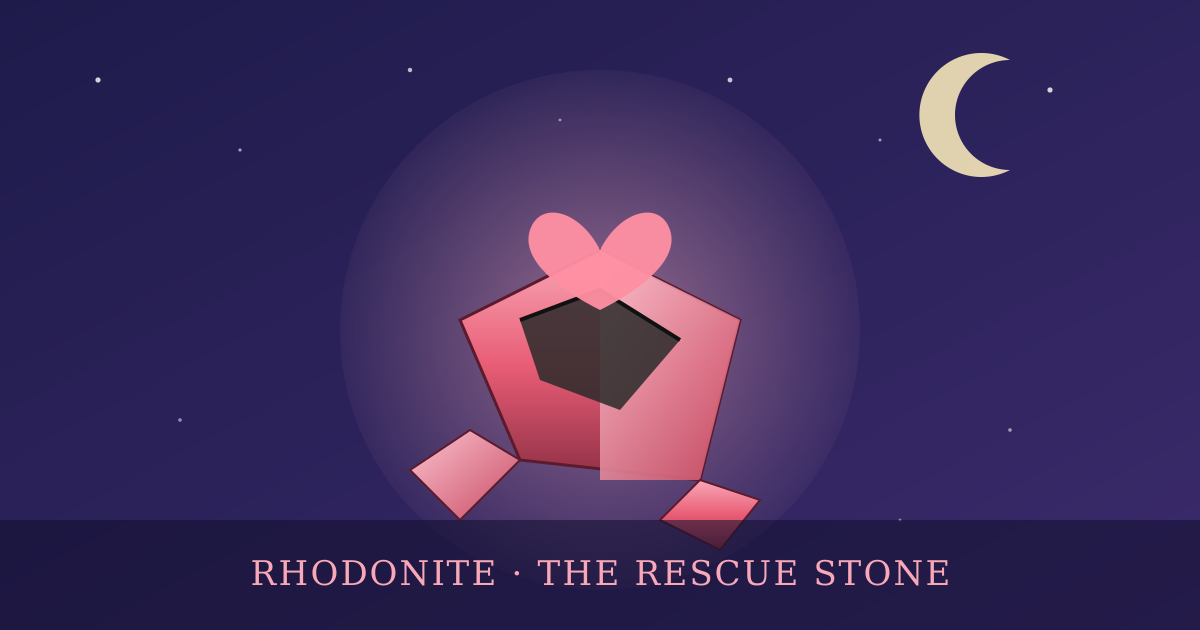
The Pink Stone With Black Veins
Rhodonite looks the way healing feels: not pure and untouched, but beautiful precisely because of its marks. The stone is a warm rose pink, cut through with wandering veins of black manganese oxide, like a heart that has been cracked and kept beating anyway. No two pieces share the same pattern. Some are almost entirely pink, soft as a blush; others are webbed so heavily with black that the pink shows through only in patches, like light through branches. Collectors prize the balance — pink enough to glow, black enough to ground it.
The name comes from the Greek rhodon, meaning rose, and the stone has been known by that name since it was formally described in 1819, though it was mined and carved in Russia's Ural Mountains long before that. Russian craftsmen cut rhodonite into vases, tabletops, and ornamental boxes; the stone was so associated with the Urals that it became a symbol of the region, and the Hermitage Museum still holds grand rhodonite pieces from the imperial workshops. In crystal folklore it earned a gentler nickname: the rescue stone, carried by travelers and kept in homes as a symbol of first aid for the heart — the stone you reach for when something has hurt and you need to believe it will not hurt forever.
As with all crystal content here, the framing is honest: everything below is spiritual and cultural tradition — belief, symbolism, and ritual — not medicine, not therapy, and not a substitute for professional support when grief, trauma, or depression are involved. Rhodonite will not heal a wound on its own, repair a relationship, or make forgiveness arrive on schedule. What it does, genuinely and reliably, is give emotional work a pink, tactile anchor — and rituals, done consistently, change behavior. The stone is the reminder; the healing is yours.
What Rhodonite Represents
Rhodonite's symbolism follows directly from its appearance — pink softness held together by black lines. The tradition clusters around four themes:
- Emotional healing: the signature meaning — the stone of recovery after heartbreak, betrayal, loss, or a long season of self-criticism. Practitioners use rhodonite to name what hurt, feel it fully, and let it loosen its grip.
- Forgiveness: not the forced, instant kind, but the slow kind — forgiving others without excusing them, and forgiving yourself for the choices you made with less information than you have now. Rhodonite is the stone of the sentence I release this, not because it was okay, but because carrying it costs me more.
- Self-love and compassion: the pink of rhodonite is warmer and earthier than rose quartz's soft blush, and the tradition reads that difference as maturity: self-love that includes boundaries, not just tenderness. Loving yourself, in this framing, means protecting your own time and saying no without guilt.
- Balance in relationships: the black veining is read as grounding — the stone that keeps an open heart from becoming an unguarded one. Practitioners use rhodonite when they tend to give too much, forgive too fast, or return to people who have not changed.
The through-line is softness with backbone. Rose quartz opens the heart; rhodonite teaches the heart to stay open without staying naive. In a collection, it is the recovery stone — the one you reach for after the hard conversation, the ended relationship, or the year you were too hard on yourself.
Rhodonite for Forgiveness: The Practice That Actually Works
Forgiveness is the most common reason people seek out rhodonite, and also the most misunderstood. The tradition is clear on one point that psychology agrees with: forgiveness is not reconciliation, not forgetting, and not declaring that what happened was acceptable. It is the decision to stop letting an old injury set today's agenda. The stone does not make that decision for you — but a ritual built around it can make the decision concrete.
The ritual practitioners swear by is called the letter ritual: hold a rhodonite tumbled stone, write an unsent letter to the person (or the past version of yourself) you are angry with, and say everything uncensored — the hurt, the unfairness, the things you wish you had said. Then read it aloud once, holding the stone, and destroy the letter safely: tear it up, burn it in a fire-safe bowl, or bury it. The stone sits beside you through the whole process, pink and veined, as a physical anchor for the intention I am allowed to put this down. At the end, you either feel lighter or you do not, and the ritual can be repeated — forgiveness, like grief, rarely finishes in one sitting.
Why does a pink stone help where willpower failed? Because it externalizes the decision. Trying to forgive by thinking harder about it usually means replaying the injury harder. A ritual gives the feeling somewhere to go: hands holding a stone, words on a page, a letter destroyed. The mechanism is the same one behind athletes' pre-game routines and therapists' empty-chair exercises — the body learns the release before the mind fully believes it. Rhodonite does not erase the past. It marks the moment you stopped rehearsing it, which is where all forgiveness work actually begins. That distinction is the whole game: do not wait to feel forgiving. Make the stone the reminder that release is a practice, not a feeling.
A practical layout practitioners use: rhodonite on the nightstand for evening journaling, rose quartz nearby for tenderness, and black tourmaline or smoky quartz for grounding when the feelings get big. Some keep a small rhodonite piece in a coat pocket on days they expect a difficult conversation — not as a charm, but as a daily nudge every time fingers find it: respond, do not react.
Rhodonite and the Heart Chakra: Love With Boundaries
In chakra tradition, rhodonite is the stone of Anahata — the heart chakra, located at the center of the chest, associated with love, compassion, empathy, and emotional balance. While the root chakra is about safety and the throat chakra about expression, the heart chakra is about connection: the part of you that loves, grieves, forgives, and keeps going after loss.
The classic practice: lie down, place a rhodonite palm stone over the center of the chest, breathe slowly into the ribs for ten minutes, and picture one relationship — with a person, or with yourself — that needs softening. Many practitioners journal immediately afterward, treating the session as a way to hear what the heart actually wants beneath the noise of resentment or fear. Whether you read that as chakra work or as ten quiet minutes of body-aware reflection, the practical payoff is reported by everyone who tries it: you arrive at the next conversation already warmed up, and less likely to say the sharp thing you would regret.
People in helping professions — nurses, teachers, therapists, parents of teenagers — use rhodonite specifically against compassion fatigue. The ritual: hold the stone at the end of the day and name three things you gave today and one thing you kept for yourself. The naming rebalances what the day tilted. Keep rhodonite in the bedroom rather than the office if your work is emotional labor; the stone belongs where you recover, not where you spend.
One honest caveat from experienced practitioners: rhodonite's energy reads as activating for feelings, not numbing. It can bring up the very emotions you have been avoiding, and the first sessions may feel heavier, not lighter. That is considered normal in the tradition — the stone stirs what needs moving — but if the feelings stay overwhelming, step back and seek professional support. A stone is a companion for reflection, never a replacement for care.
Rhodonite Through History: The Urals, the Hermitage, and the Rescue Stone
Few pink stones have so grand and so tender a history:
- The Ural mines: rhodonite was mined in the Ural Mountains of Russia from the 1700s, and Russian lapidaries made it famous — carving it into vases, obelisks, and tabletops for palaces. The stone's pink-and-black pattern became a signature of Russian decorative art.
- The Hermitage treasures: the State Hermitage Museum in St. Petersburg holds monumental rhodonite works, including vases and columns cut from single blocks. A stone that furnished palaces and soothed travelers: rhodonite has always lived at both scales.
- The rescue-stone lore: in European folk tradition, rhodonite was called the rescue stone and carried as a first-aid charm for the heart — kept in pockets on journeys, placed in sickrooms, and given to the grieving. The lore is unproven, but the instinct behind it is recognizable: when someone hurts, you hand them something solid and warm.
- Modern sources: today rhodonite is mined in Russia, Australia, Brazil, Sweden, and the United States, with Australian material often showing the deepest pink. It remains affordable, which keeps it honest: a beautiful stone at a working person's price.
Rhodonite also has a serious mineral identity: it is a manganese silicate, and its pink color comes from manganese — the same element that paints the black veins as manganese oxide. The stone is literally colored by the element that also darkens it. Pink and black, wound and healing, in the same piece: that is a biography worth owning.
How Practitioners Actually Use Rhodonite
Beyond the letter ritual, rhodonite shows up in daily practice in a handful of well-worn ways:
- The nightstand stone: a palm stone or tumbled piece beside the bed for evening journaling and morning intention-setting — the stone that starts and ends the day with the heart.
- The bracelet: rhodonite bead bracelets keep the stone in contact all day, and practitioners reach for them in moments of friction — fingers find the beads before words find the sharp edge.
- The pendant: a rhodonite pendant resting over the heart chakra is the classic placement in crystal tradition, worn during difficult seasons like breakups, grief, or family strain.
- The couples' stone: some practitioners give a matched pair of rhodonite stones to partners working through a rough patch — one each, as a symbol of two people choosing repair rather than retreat. The tradition is careful here: stones support conversations; they do not replace them.
- Crystal grids for healing: a grid with rhodonite at the center, rose quartz for tenderness, and clear quartz points radiating outward (traditionally amplifying the intention). Set it at the start of a healing season, dismantle it when the season turns. The grid is a calendar with feelings.
Pairings practitioners love: rhodonite with rose quartz (the healing duo — mature forgiveness plus gentle tenderness), rhodonite with black tourmaline (the shield stack — open heart plus grounded protection), and rhodonite with clear quartz (the amplifier pairing — feeling plus clarity). Keep the palette honest: pink stones together feel like dawn after a long night, which is rather the point.
Cleansing, Charging, and Caring for Rhodonite
Rhodonite is a moderately hard stone with straightforward care:
- Cleaning: wipe with a soft, damp cloth and dry promptly. A brief rinse is fine, but do not soak it for hours, and keep it away from salt water, harsh cleaners, and ultrasonic cleaners, which can damage the polish.
- Smoke and sound: a pass through incense smoke or a singing bowl nearby is the classic cleanse — no water involved, no risk to the stone.
- Moonlight: overnight on a dry windowsill is traditional, and safe as long as the sill stays dry and the stone is not left in harsh midday sun for weeks, which can fade some pink stones.
- Selenite: resting on a selenite plate overnight is the classic hands-off cleanse — and it keeps the stone dry.
Care notes: rhodonite rates 5.5 to 6.5 on the Mohs scale — harder than a fingernail, softer than quartz — so it can scratch and be scratched. Store it wrapped or in its own pouch, away from harder stones like quartz and topaz, and take bracelets off before heavy manual work. The black veining is natural and not a flaw; pieces with strong, even veining are often the most valued.
Spotting Real Rhodonite (and Telling It From Rhodochrosite)
Rhodonite is affordable, so outright fakes are uncommon — but confusion with its pink cousins is the whole story, and buyers should know the differences:
- The rhodochrosite test: rhodochrosite is banded in bright pink and white stripes, softer (Mohs 3.5 to 4), and often translucent; rhodonite is opaque, softer pink, and veined with black. If it has black veins, it is almost certainly rhodonite.
- The dyed-stone test: dyed pink stones — often dyed howlite or marble sold as rhodonite — show unnaturally even, hot-pink color with no black veining, and the dye may concentrate in cracks. Real rhodonite's pink varies across the piece, and the black veining is irregular and organic.
- The hardness test: rhodonite (Mohs 5.5 to 6.5) resists scratching by a steel knife better than rhodochrosite or calcite-based imitations. A stone that scratches easily under a coin is probably not rhodonite.
- Fake rhodonite: resin or plastic imitations feel warm and light, lack the cool, dense weight of real stone, and show mold seams or bubbles. Real rhodonite feels cool, solid, and mineral in the hand.
Price is a reliable guide: a tumbled rhodonite stone for a few dollars is honest, and even a fine carved piece is affordable next to precious gems. Anyone selling rhodonite at luxury prices is selling a story, not a stone. The pink-and-black piece should cost you pocket change, not a fortune — it is the reminder that healing is built day by day, not bought in a single grand gesture.
Buying Rhodonite Without Overpaying
- Start with tumbled stones: the classic entry — a few dollars, pocket-sized, and the perfect letter-ritual stone. Buy three: nightstand, pocket, and one to gift to someone going through a hard season.
- Look for balanced veining: hold candidates to the light. The best rhodonite shows a warm, even pink with black veins that wander rather than blotch. Very pale or greyish pieces are still rhodonite, but the pink is the quality marker.
- Choose your form honestly: palm stones (the meditation piece), tumbled stones (pocket-friendly), bracelets (daily wear), and carved hearts (the gift piece). The form that draws you is the form for you — tradition says the stone chooses the person.
- Check for damage: inspect edges for chips and faces for dull patches before buying, and ask how the piece was stored — damp shop storage dulls any stone's polish over time.
- Bracelets and pendants: for daily wear, check that settings hold the stone firmly and that beads are well-polished (no rough spots that snag). A rhodonite bead bracelet is the classic everyday piece.
Rhodonite is the people's rescue stone — beautiful, historic, and honest in price. Anyone selling it at luxury prices is selling a story, not a stone. The pink-and-black piece should not cost you an arm and a leg; it should sit on your nightstand and get you to speak to yourself with kindness.
Closing: The Veined Stone
Rhodonite endures — in Ural workshops and Hermitage halls, in travelers' pockets and grieving people's hands — because it answers a permanent human need: the need to believe a hurt heart can heal without pretending it was never hurt. Not to forget, not to excuse — to carry the mark and keep going. Every forgiveness in the world was once an unspoken letter, and the distance between those two states is the whole of human endeavor. Rhodonite is a small pink stone, veined with black, that marks the crossing.
So put it on the nightstand tonight. Hold it, write the letter you will never send, and destroy it safely. Then keep going, because release is the only spell that has ever worked. The stone will sit there, pink and veined, witnessing the one thing healing always needed: you, showing up for your own heart.
The stone does not heal you. It reminds you that you can.
Frequently asked questions
What is rhodonite good for spiritually?
In crystal tradition, rhodonite is the stone of emotional healing and forgiveness — used to release old wounds, soften resentment, and rebuild self-love after a breakup, a betrayal, or a long period of self-criticism. Practitioners hold it during journaling, wear it as a bracelet, or keep it by the bed as a symbol of a heart learning to trust again. Everything here is spiritual and cultural tradition, not science: the practical value is the ritual — a pink stone that reminds you to speak to yourself with the same kindness you offer others.
Which chakra is rhodonite associated with?
Rhodonite is traditionally linked to the heart chakra (Anahata), the center of love, compassion, and emotional balance. Its pink color and manganese content tie it to the heart in crystal lore, and practitioners place it over the chest during meditation or wear it as a pendant that rests near the heart. Some traditions also connect it to the root chakra for grounding emotional work in the body.
Can rhodonite go in water?
A brief rinse under running water is generally considered safe for rhodonite, but prolonged soaking is not recommended — it can dull the polish over time, and the black manganese oxide veining may be affected by harsh chemicals. Clean it with a soft, damp cloth and dry it promptly, and cleanse it with moonlight, sound, or smoke instead of a water bath. Keep it away from salt water and household cleaners.
What is the difference between rhodonite and rhodochrosite?
Rhodonite and rhodochrosite are both pink manganese minerals, but they differ in appearance and hardness. Rhodonite is usually a softer, opaque pink veined with black manganese oxide, and it is harder (Mohs 5.5 to 6.5). Rhodochrosite is typically banded in brighter pink and white stripes, softer (Mohs 3.5 to 4), and more translucent. Rhodonite's black veining is its most reliable visual signature.
Where should I place rhodonite in my home?
Tradition places rhodonite where emotional life happens: on the nightstand, in the bedroom, or in a quiet corner used for journaling and reflection. Many practitioners keep a piece near the front door as a symbol of welcoming kindness into the home, or on a desk as a reminder to respond rather than react during difficult conversations. The honest mechanism is the cue: a pink stone in view reminds you to pause, soften, and choose the kinder reply.
Keep exploring

Rose Quartz Meaning: The Stone of Unconditional Love
Rose quartz meaning & uses: the soft pink stone of unconditional love, tenderness & emotional healing. History, heart chakra practices, buying, cleansing & care.
Read the meaning →
How to Cleanse and Charge Crystals: Complete Guide
How to cleanse and charge crystals: water, smoke, moonlight, sound & selenite methods. Which stones to keep dry, plus a simple monthly ritual.
Read the meaning →
Carnelian Meaning: The Stone of Motivation & Creative Fire
Carnelian meaning & uses: the fiery orange stone of motivation, creativity & confidence. Momentum rituals, sacral chakra practices, buying, cleansing & care — an honest guide.
Read the meaning →
Green Aventurine Meaning: The Stone of Luck & New Opportunities
Green aventurine meaning & uses: the soft green stone of luck, new opportunities & calm confidence. Heart chakra practices, opportunity rituals, buying, cleansing & care — an honest guide.
Read the meaning →