
The 17-Second Manifestation Rule: Abraham Hicks' Focus Technique Explained
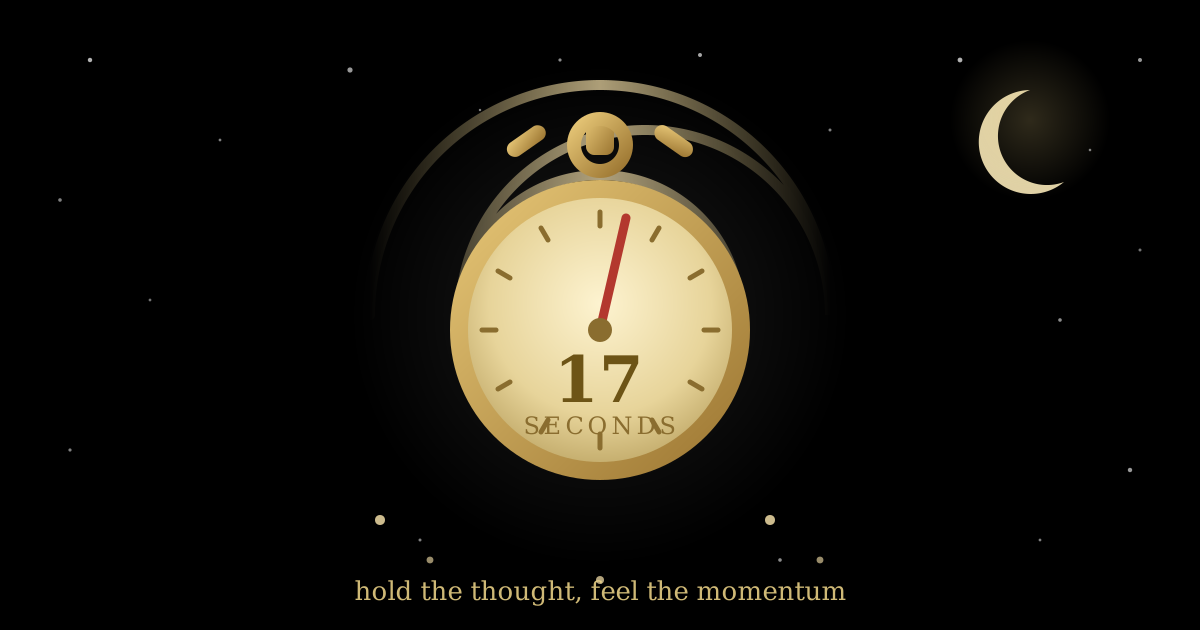
It is one of the strangest-sounding ideas in all of manifestation culture: that seventeen seconds — less time than it takes to tie a shoe — is the threshold at which a thought begins to move something. Not seventeen minutes of meditation. Not an hour of journaling. Seventeen seconds of one thought, held pure, and the momentum begins. Four rounds of it — 68 seconds total — and the teaching says you have reached the combustion point, where the thought is now strong enough to keep growing on its own.
The rule comes from Abraham Hicks, the channeled teachings of Esther Hicks, one of the founding lineages of the modern law-of-attraction movement — the same lineage behind the Whisper Method's obsession with focused thought. For all its odd specificity, the 17-second rule has survived decades of spiritual trends because it does something clever: it turns vague advice (just visualize!) into a concrete, gamified attention exercise. This guide explains the teaching as its practitioners actually use it — the ritual, the pure-thought problem, and the honest version of why it works.
Where the 17 Seconds Come From
The Abraham Hicks teaching holds that a thought held purely and without contradiction for 17 seconds begins to attract another thought of the same vibrational quality — and that thought attracts another, and another. Each additional 17 seconds of uninterrupted focus compounds the momentum. At 68 seconds — four full rounds — the teaching describes a combustion point: the thought has gathered enough energy that it begins to sustain itself, and its manifestation in physical reality becomes, in their words, imminent.
Strip away the vibrational vocabulary and you can see the shape of a genuine insight about attention. The teaching's real claim is that most of us never hold a single thought purely for even a few seconds — our minds dart between the desire, the doubt, the grocery list, and the memory of last Tuesday. The 17-second rule is, at minimum, a noticing exercise: it reveals how fragmented your attention actually is, and it trains you, one 17-second rep at a time, to hold a single intention steady. Practitioners report that the first week of trying is humbling — almost nobody reaches a clean 17 seconds on the first attempt.
As with every technique on this site, treat the spiritual claims as inspiration and the reported results as stories, not evidence. No study has measured thought-momentum with a stopwatch. What you can take from the teaching regardless of your beliefs is a compact, portable concentration drill that costs just over a minute — and attention is a skill that serves every goal, spiritual or not.
What Counts as a "Pure Thought"?
This is the whole difficulty of the practice, and the teaching is specific about it. A pure thought is one single, specific thought about something you want — held without contradiction, without hedging, and without a competing thought sneaking in underneath. It is not affirmation recitation; it is sustained, single-pointed attention on one desire, the way you might watch a candle flame without looking away.
The rules practitioners follow for choosing the thought:
- One thought, not a list. Not my whole vision board — one sentence about one desire. "I love my calm, sunlit apartment" is a pure thought. A rotating slideshow of the apartment, the job, and the relationship is three thoughts, and the count resets.
- Wanted, never avoided. The mind holds the subject of the sentence, not your preference about it. "I am not stressed about money" keeps stress and money in the frame together. The wanted version is "I feel calm and capable with money" — attention on calm, attention on capability.
- Present or already-real, not future-distant. "Someday I will travel" places the thought on someday. "I am so grateful for my travels" — held as a present feeling — is the version the teaching asks for. If the gratitude feels false, ladder it down the way the Mirror Technique suggests: "I am planning my travels and it feels good."
- Feeling-carried, not just worded. The teaching emphasizes that the thought must carry the feeling of the desire, not just the syllables. Holding the words "I am loved" while your shoulders are at your ears and your jaw is clenched is not pure — the body is running a contradictory broadcast. Relax first, then hold the thought.
Good candidates practitioners use: "I love how supported I feel by my friends." "My work is flowing easily today." "I am so thankful for this quiet morning." Notice they are all small, believable, and present — the teaching insists you start with thoughts you can genuinely feel, not the biggest dream on your list. The muscle is single-pointed attention; the size of the desire is secondary.
The Ritual, Step by Step
Set aside two minutes in a place you will not be interrupted. The full practice is four 17-second rounds — 68 seconds — plus the setup. Here is how practitioners do it:
Step 1: Choose your single thought. Before you begin, settle on one sentence. Write it down if it helps. Committing to the sentence in advance is part of the discipline — deciding mid-ritual is itself a competing thought.
Step 2: Set a timer for 68 seconds — or do not. Some practitioners use a silent timer set to 68 seconds and close their eyes; others count four slow rounds of roughly 17 seconds each. Do not use a ticking or beeping countdown — a harsh alarm at the end shatters the state. A soft chime, or simply counting your own breaths (about four to five slow breaths per round), works better. The timer is a container, not a judge.
Step 3: Relax your body for ten seconds. Unclench the jaw, drop the shoulders, soften the hands. A contradictory body, as the last section noted, is a contradictory thought. Ten seconds of deliberate relaxation is the on-ramp.
Step 4: Hold the thought for 17 seconds. Eyes open or closed, whichever lets you stay with the sentence. When your mind offers a competing thought — the doubt, the errand, the criticism — do not argue with it. Notice it the way you would notice a cloud passing, and return to your sentence. If you lose it completely, restart the round. The restart is not failure; it is the exercise.
Step 5: Continue for three more rounds. Seventeen more seconds, then seventeen more, then the final seventeen. Practitioners describe the rounds feeling different: the first is effort, the second is settling, the third is flow, and the fourth — the approach to 68 seconds — is where many report a felt shift, a warmth or clarity or simple calm. Whether that shift is vibrational combustion or just a minute of undivided attention doing its quiet work, it is the reason people keep the practice.
Step 6: Release and go about your day. The teaching is explicit here: once the 68 seconds are done, let the thought go. Do not monitor the universe for results. Go make coffee. The release is part of the technique — clinging to the desire after the ritual reintroduces the very tension the practice dissolved.
The 68-Second "Combustion Point"
The teaching's most poetic claim is that 68 seconds of purely held thought is a combustion point — the moment the thought becomes self-sustaining, like a fire that no longer needs the match. After combustion, in the teaching's framing, manifestation is only a matter of time and non-resistance: you have done your part, and the rest is allowing.
Here is the honest read. Sixty-eight seconds of genuine, undivided attention on one positive thought is an altered state by modern standards — most adults go days without giving anything a full minute of unbroken attention. What practitioners feel at the end of four clean rounds (warmth, clarity, an odd sense of certainty) is the real, well-documented effect of sustained attention: the nervous system settles, the thought feels more real because you have rehearsed it without interruption, and the mind's usual background static is briefly quiet. Call it combustion or call it concentration — the minute itself is the medicine, and nobody needs to believe in vibrational physics to benefit from a daily minute of deliberate, positive focus.
One caution from the tradition itself, worth taking seriously: the teaching says that contradiction during the 68 seconds — a single "but what if it doesn't work" — dilutes the round. Psychologically, that warning has a useful side effect: it trains you to notice self-sabotaging thoughts the moment they appear. Many practitioners say the noticing outlasts the ritual and starts showing up in ordinary life — which is arguably the practice's greatest gift.
5 Mistakes That Break the 17 Seconds
The practice is only a minute long, so the failure modes are subtle:
- Watching the clock. Checking how much time is left is itself a competing thought — "am I done yet?" is not your sentence. Trust the timer or your breath count, and stay with the thought. If you need structure, count slow breaths instead of seconds; the mind tracks rhythm more peacefully than numbers.
- Stacking thoughts. Starting with "I love my apartment" and drifting into "and my job interview went well and I should call my mother" is three thoughts, not one. Pick the sentence before you start and treat any departure as a gentle restart, not a disaster.
- Smuggling in the "but." "I am calm and steady in the meeting — well, if I prepare enough" is a pure thought with a contradiction hiding inside it. The "but" clauses are the mind's way of hedging, and the teaching treats them as the whole game. When the hedge appears, notice it, let it pass, and return to the unhedged sentence.
- Forcing the feeling. Straining for euphoria turns a quiet focus exercise into performance anxiety. The feeling the teaching asks for is appreciation or calm — a 6 out of 10, not a 10. "This quiet morning is nice" held gently beats "I AM ECSTATIC" shouted internally through clenched teeth.
- Doing it once and watching the sky. The teaching frames a single 68-second session as the start of momentum, not the completion of it — and then asks you to release the desire entirely. Practitioners who do one session and then spend the day scanning for signs have undone the release step, which is half the technique. Do the minute, then live the day.
Gentle Variations
The classic form is the seated 68-second ritual, but practitioners have built several variations around it:
The written 17 seconds. Instead of holding the thought mentally, write your single sentence on paper slowly for 17 seconds — one line, written deliberately, pen never stopping. This is scripting compressed to its essence, and practitioners who find mental focus slippery often find the written version easier: the moving pen anchors the attention that the wandering mind keeps losing.
The rampage of appreciation. An Abraham Hicks original that pairs naturally with the rule: spend a minute listing small things you appreciate, one after another — the coffee, the light through the window, the text from a friend. It is easier than a single pure thought (each item is its own 17 seconds, roughly) and it trains the same muscle: sustained attention on wanted things. Many practitioners use the rampage as the warm-up and the single-sentence 68 seconds as the main set.
The pre-sleep round. Doing one 68-second round in bed, lights out, merges the technique with the Pillow Method's logic: the last thoughts before sleep get extra rehearsal time in the dreaming mind. Keep the sentence gentle at night — appreciation rather than striving — so the ritual does not become a stimulant.
The morning anchor. Pairing the 68 seconds with the first minutes of the day, before the phone is touched, makes it the day's opening frame. The morning manifestation routine guide places it as the second step, right after a glass of water and before the day's noise begins — because the teaching holds that the thoughts you think first set the tone for the momentum that follows.
The Honest Psychology
Strip the vibrational claims away and the 17-second rule is a remarkably well-designed attention exercise, which is why it keeps working for people who do not believe a word of the metaphysics. Holding one positive sentence for a full minute, daily, does three verifiable things. First, it rehearses the desired state — the brain treats vivid, repeated mental rehearsal as experience, which is why athletes visualize. Second, it trains attentional control itself — the noticing-and-returning is the same mechanism as mindfulness meditation, compressed into 68 seconds. Third, it builds a daily habit of self-directed kindness, which compounds the way all small habits compound.
None of that means a thought can summon a job offer or a partner. The entertainment framing this site keeps is the honest one: the 17-second rule is a ceremony of attention, not a technology for bending reality. What it reliably changes is the texture of your own mind — an unbroken minute of deliberately chosen thought in a day of fragmented ones. Practitioners who report life changes usually describe, on closer look, the downstream effects of that changed attention: they notice opportunities more, they act with slightly more confidence, they stop rehearsing the worst case. The ritual tunes the observer; the observer still has to move through the world.
So try the minute. Pick one sentence, hold it pure for four rounds of seventeen seconds, feel whatever shift arrives at the sixty-eighth second, and then let it go and live your day. If nothing mystical happens, you will still have given your mind the rarest gift of the modern era: sixty-eight unbroken seconds of a single, deliberately chosen thought.
Frequently asked questions
Is it really exactly 17 seconds, or is the number symbolic?
Treat the number as a teaching device, not a laboratory measurement. Abraham Hicks presents 17 seconds as the threshold at which a purely held thought begins to gather momentum, with 34, 51, and 68 seconds marking escalating stages of focus. Nobody has measured thought-momentum with a stopwatch in a lab. What the number gives you is a concrete, gamified target that turns vague visualization advice into a focused attention exercise — and focused attention is the real skill being trained.
What if my mind wanders before I reach 17 seconds?
That is the normal experience, especially in the first week — most people cannot hold a single thought purely for 17 seconds on their first attempts, which is precisely why the exercise is useful. When you notice the wander, gently return to your chosen sentence and start the count over. Practitioners suggest you will build the muscle within a week of daily tries, just like reps at a gym. Do not scold yourself for drifting; the return is the practice.
Can I use the 17-second rule for something I want to avoid or fix?
Not effectively, by the teaching's own logic. The rule requires a pure thought of what you want, because a sentence like "I do not want to be late" keeps your mind's attention on lateness itself. Abraham Hicks frames this as the universe responding to the subject of your attention, not your preference about it. Translate avoidance goals into their wanted opposites: instead of "I am not anxious," hold "I am calm and steady in the meeting."
How often should I do the 17-second rule each day?
Once or twice a day is plenty — many practitioners do it first thing in the morning and once more at night before sleep. The teaching suggests you will feel a shift after the 68-second combustion point and that repeating the ritual a few times daily keeps the momentum going. More than three or four sessions tends to turn a light ritual into an anxious compulsion, which is the opposite of the relaxed, appreciative state the practice asks for.
Keep exploring

The Whisper Method for Manifestation: Send Your Desire Telepathically
The Whisper Method: how to "telepathically" send your desire to someone's subconscious. The step-by-step visualization ritual, wording, timing, and the honest psychology.
Read the meaning →
The Pillow Method for Manifestation: Sleep on Your Desire
The Pillow Method: write your desire on paper, tuck it under your pillow, and fall asleep in the wish fulfilled. The exact 7-night ritual, note wording, the sleep science, and the mistakes to avoid.
Read the meaning →
Morning Manifestation Routine: A 15-Minute Ritual to Start Aligned
A 15-minute morning manifestation routine: the exact order — water, gratitude, the 68-second focus round, scripting, and mirror work — plus weekend and travel variations.
Read the meaning →