
The Two-Cup Method for Manifestation: How the Quantum Jumping Ritual Works
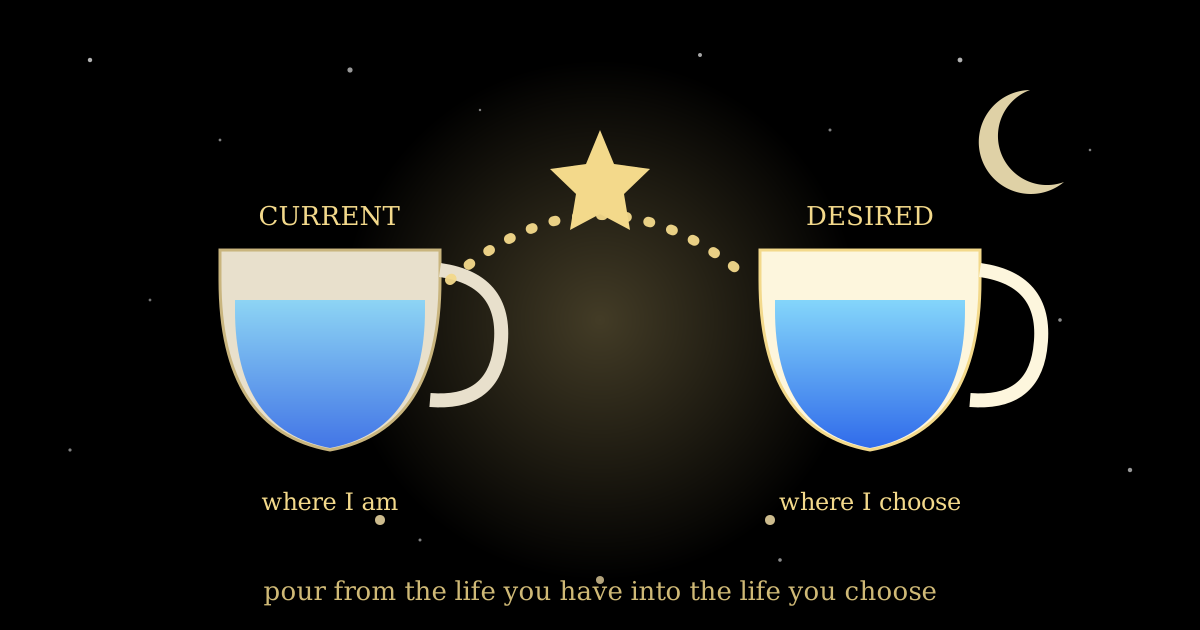
Of all the manifestation techniques that went viral on social media, the two-cup method is the most physical. There is no journaling, no visualization script, no app. Two ordinary cups, two sticky labels, a jug of water, and about five minutes of undivided attention. That physicality is exactly why people love it: unlike a thought, which evaporates the moment you get distracted, a pour is an event. You watch the water leave one container and enter another. Something has visibly changed, and the change is in your hands.
The method comes from the quantum jumping branch of manifestation culture, which borrows the language of the many-worlds interpretation of quantum physics — the idea that every possible outcome exists somewhere — and turns it into a personal practice: you do not create the desired reality, you shift into it. Real physicists will tell you, firmly, that this is not what the theory means, and this site agrees with them. What the ritual genuinely does is something smaller and more useful: it turns a vague wish into a decision you have acted on, in a form you can see. That is worth doing, and it is honest enough to stand on its own.
What You Need
Two cups or glasses — identical if possible, so the only difference between them is the label. Two small labels or slips of paper and tape. A pen. Clean drinking water. Five quiet minutes. That is the entire equipment list, and the simplicity is deliberate: the ritual is supposed to be doable tonight, with what is already in your kitchen, not after a shopping trip. Use glasses you can actually drink from, since drinking the water is the final step, and use fresh water — not water that has been sitting out for hours, which is the one place the ritual intersects with real-world hygiene.
Some practitioners add extras: a candle, crystals around the cups, or a particular time of day. None of it is required by the original method, and none of it changes the core action. If a candle helps you slow down and take the moment seriously, light one. If it turns a five-minute ritual into a production you keep postponing, skip it. The two-cup method works best when it stays easy enough to actually do.
The Ritual, Step by Step
Step 1: Name the current reality. Write your present situation on the first label, plainly and without drama. Not a complaint and not a curse — a description. "I am anxious about money and living paycheck to paycheck." "I am single and lonely on weekends." The honesty matters: a label you flinch from is a label you have not fully admitted, and the ritual's first job is admission. Stick the label on the first cup.
Step 2: Name the desired reality. Write the desired situation on the second label, in the present tense, as a lived fact rather than a request. "I am calm about money and my bills are paid with room to spare." "I am in a warm, steady relationship and my weekends are full." Present tense is the tradition's rule, and it has a practical benefit: it forces you to describe the outcome concretely instead of vaguely wishing for it. If you cannot write the desired reality in one clear sentence, the desire is not ready yet — spend a few minutes clarifying it first, or see manifestation journaling for a way to work it out on paper. Stick the label on the second, empty cup.
Step 3: Fill the current cup. Pour fresh water into the cup labeled with your current reality, about three-quarters full. Sit with both cups in front of you for a moment. This is the pause most people rush, and it is the most important part of the ritual: you are looking at the gap between the two labels, and acknowledging that the gap is real. Do not skip the pause. Thirty seconds of quiet attention is what separates a ritual from a party trick.
Step 4: Pour, slowly. Pick up the current cup and pour the water into the desired cup, slowly and deliberately. As you pour, hold the desired reality in mind — not as a fantasy montage, but as an ordinary scene: the feeling of the paid bill, the quiet of the shared Sunday morning. The tradition calls this the shift: the water, which stood for your current reality, now stands in the desired one. Pour all of it, or as much as fits, and set the empty current cup down. Some practitioners say a short phrase as they pour — "I choose this" or "I am shifting" — and a phrase is fine if it helps you focus, though silence works just as well.
Step 5: Drink. Drink the water from the desired cup. The tradition treats this as accepting the new reality into yourself — the shift is not complete until it is inside you. Drink it calmly, in a few sips rather than a gulp, and let the moment land. Then remove both labels and wash the cups. The ritual is over, and the cups go back to being cups. That return to ordinariness is part of the design: the sacred moment ends, and normal life resumes — with, ideally, one small action toward the desire before the day is out.
How to Word the Labels
Label wording is where the two-cup method usually succeeds or quietly fails, because the labels are the whole message. Three rules cover most cases. First, write about your own experience, not someone else's behavior: "I feel respected and heard at work" works better than "my boss stops ignoring me," because the first describes a state you can inhabit and the second describes a person you cannot control. Second, keep it to one desire per ritual. A label that reads like a shopping list — new job, new partner, new apartment, better health — splits your attention four ways and gives the ritual nothing to focus on. One cup, one shift. Third, make the desired label believable enough to hold in your mind without flinching. "I am a millionaire" usually triggers disbelief, and disbelief breaks the feeling the ritual depends on. "I am building steady income and my savings are growing" is a smaller step, but it is one you can actually picture — and a step you can picture is a step you can act on.
Here are label pairs practitioners commonly use, adapted to the rules above:
- Current: "I dread Mondays and feel stuck in my job." Desired: "I do work I enjoy and look forward to my week."
- Current: "I feel lonely most evenings." Desired: "I have warm friendships and my evenings feel full."
- Current: "Money worries keep me up at night." Desired: "I feel calm about money and my needs are covered."
- Current: "I am exhausted and run down." Desired: "I have steady energy and I take care of my health daily."
Notice that none of these promises a specific person, a specific job, or a specific sum of money. The desired labels describe a state, not a lottery ticket — and states are the things your daily choices can actually move toward.
The Honest Psychology: Why a Pour Feels Like a Shift
Strip away the quantum language and the ritual still earns its popularity, for reasons that have nothing to do with parallel realities.
It makes the decision physical. Most desires stay as background noise — thought about, worried over, never chosen. The two-cup method forces a choice into the open: you wrote two labels, you picked one up, you poured. Psychologists call this kind of physical commitment an implementation ritual: the body acts out the decision the mind has been avoiding, and the mind takes the decision more seriously afterward. That is the same mechanism behind signing a contract, throwing something away, or any ceremony that marks a before and an after.
It externalizes the gap. Two cups on a table make the distance between "where I am" and "where I want to be" visible and finite. A gap you can see is a gap you can think about clearly; a gap that only exists as anxiety is infinite and unmeasurable. Practitioners often report that writing the current label is the most relieving part of the ritual, because it finally names a situation they have been circling without words.
It rehearses the feeling. The slow pour, held in the desired scene, is a brief visualization exercise — the same mental rehearsal athletes and performers use, slowed down to the speed of pouring water. You are not just thinking about the desire; you are spending thirty seconds inside it, with your hands busy and your attention undivided. The quantum jumping guide covers this rehearsal idea in depth, and the pillow method uses sleep to do something similar overnight.
It ends with an action cue. The ritual's real test comes after the drinking: what do you do next? Practitioners who pair the pour with one concrete step — sending the application, making the call, starting the budget — report the strongest results, which should surprise no one. The ritual tunes the person; the person still has to move. A cup of water cannot schedule the future, but a person who has just performed a ceremony of choosing often can.
Popular Variations
The overnight version. Instead of drinking immediately, leave the desired cup overnight — some practitioners put it by the bed — and drink it first thing in the morning. The idea is that the water sits in the desired label's energy overnight, and you take it in as the day's first act. If you try this, cover the cup and use fresh water in the morning if it has been sitting uncovered; the symbolism is not worth a stomach bug.
The seven-day version. Repeat the ritual daily for seven days with the same desire, fresh labels each time. The repetition is the point: by day three the labels usually sharpen, because you have had three days to notice what you actually wrote versus what you actually want. This version pairs naturally with scripting, where the same sharpening happens on paper over a longer period.
The release version. For desires that are really about letting go — a grudge, an old identity, a finished chapter — some practitioners reverse the emotional direction: the current cup holds what you are releasing, and after pouring, the water goes onto a plant or down the drain rather than being drunk. The structure is the same; the meaning is release instead of arrival. Either direction works, as long as you know which one you intend before you pour.
5 Mistakes That Flatten the Ritual
- Stacking five desires into one pour. One cup, one shift. A label with four wishes is a label with no focus, and the pour becomes a gesture instead of a decision.
- Writing the desired label as a demand. "I must have this by Friday" turns a ceremony into an ultimatum, and ultimatums to the universe tend to produce anxiety, not clarity. Describe the state, not the deadline.
- Rushing the pour. A two-second splash is not a ritual. The slow pour is where the attention lives; if you cannot spare thirty seconds of focus, the ritual is not the problem — the hurry is.
- Doing it for someone else's outcome. Labels about another person's choices — who they date, what they decide — are wishes about control, not about your reality. Keep the desired label on your own experience.
- Treating the pour as the whole plan. The honest version of this practice treats the ritual as the evening half and your actions as the morning half. Pour the water, then take the step. The cup tunes the person; the person still has to move.
And the entertainment framing that runs through this site applies here too: the two-cup method is a ceremony of decision, not a machine for bending reality. No pour, however sincere, guarantees an outcome — no water in a cup can schedule the future, and anyone selling a guaranteed version of this ritual is selling something else entirely. What it reliably does is change the one thing you can actually control: the clarity of what you want, the honesty of what you admit, and the small action you take after the cups are washed. Pour slowly, drink calmly, and take the step. The rest is up to you — and honestly, that has always been the point.
Frequently asked questions
Do you have to drink the water in the two-cup method?
Drinking the water is the traditional final step: it symbolizes accepting the desired reality into yourself. If drinking it feels wrong — for example, if the cup is not clean or the water has been sitting out — pour it onto a plant instead and keep the meaning. The ritual is symbolic; the water itself carries nothing but the meaning you gave it.
How long does the two-cup method take to work?
Practitioners report everything from same-day shifts to months of nothing, and none of it is verifiable. A fairer way to judge it: give the desire a real-world deadline and a real-world plan alongside the ritual. If nothing has moved after a month of aligned action, the desire may need a different plan, not a louder ritual.
Can you do the two-cup method for someone else?
The tradition says the method works on your own reality, not someone else's. You can use it for a shared situation — a calmer household, a better relationship — but writing another person's outcome on your label and expecting them to change crosses from ritual into wishful control. Keep the desired label about your own experience.
What if you pour the water the wrong way?
Nothing bad happens. Pouring from the desired cup back into the current one is treated in the tradition as simply redoing the step — refill, relabel if needed, and pour again in the intended direction. A ritual that punishes a spill would be a superstition, not a practice; this one is forgiving by design.
Keep exploring

Quantum Jumping for Manifestation: Shift Into Your Desired Reality
Quantum jumping for manifestation: the parallel-realities idea, the guided meditation method, and the honest psychology behind the shift.
Read the meaning →
Scripting for Manifestation: Write Your Future Into Being
Scripting for manifestation: how to write your future in the present tense. The step-by-step method, a full example script, variations, and the psychology.
Read the meaning →
The Pillow Method for Manifestation: Sleep on Your Desire
The Pillow Method: write your desire on paper, tuck it under your pillow, and fall asleep in the wish fulfilled. The exact 7-night ritual, note wording, the sleep science, and the mistakes to avoid.
Read the meaning →