
Vision Board Manifestation: The Complete Guide
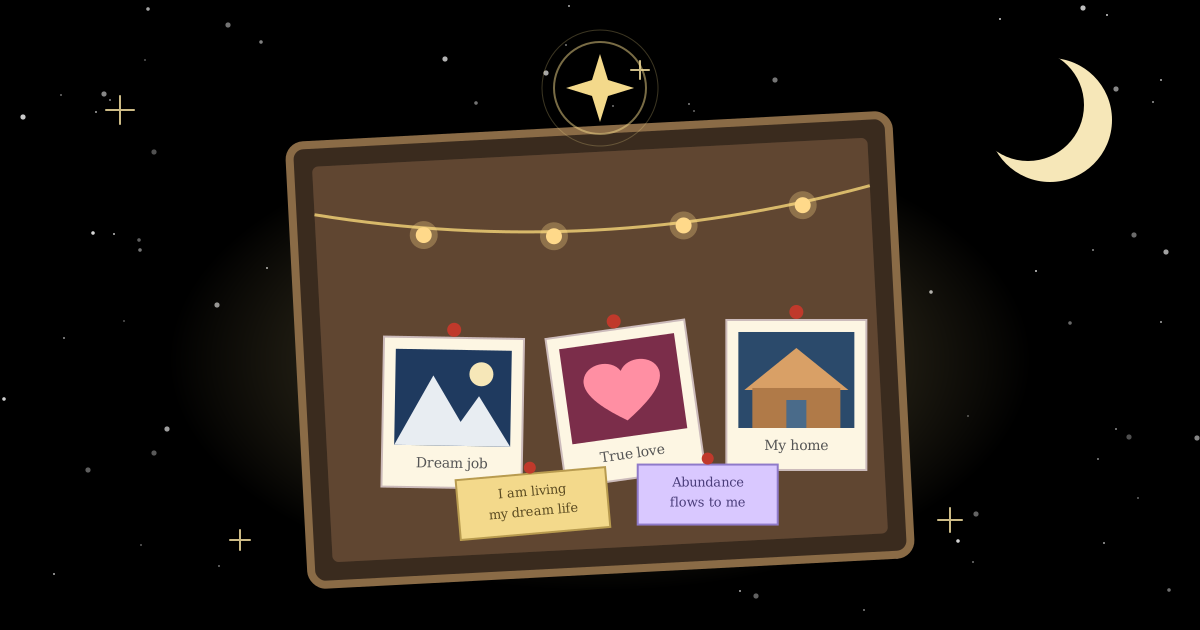
The vision board is manifestation's most beloved ritual, and also its most misunderstood. At its worst it is a pretty collage of other people's lives taped to a wall — aspirational wallpaper that quietly makes you feel further from your goals. At its best it is a daily training device for your attention: a visual anchor that keeps your real goals emotionally vivid while life tries to make you forget them. This guide shows you how to build the second kind — one honest step at a time.
What a Vision Board Actually Is (and Isn't)
A vision board is a curated collection of images, words, and symbols that represent the future you are building toward, arranged on one board (cork, foam, poster) or one digital canvas (phone wallpaper, Pinterest-style collage). The tradition treats it as a visualization amplifier: instead of trying to hold your whole dream in your head, you externalize it, and then your eyes do the remembering for you, dozens of times a day.
Here is what it is not: a magical ordering catalog. No image of a house summons a house. The honest framing — the only one that holds up — is that the board is a commitment device for your mind and behavior. It keeps goals specific instead of vague, keeps desire warm instead of dormant, and trains your attention to notice doors your distracted self would walk past. That is a real mechanism, and it is enough.
Why Vision Boards Work: The Honest Psychology
Strip away the mystical language and four well-documented psychological processes remain — which is exactly why this practice deserves a place in any honest manifestation guide:
- Selective attention (the 'red car effect'). Buy a red car and you suddenly see red cars everywhere — they were always there; your attention just learned the pattern. A vision board teaches your reticular activating system what to look for: the job posting, the grant, the introduction, the neighborhood. Opportunities get noticed instead of missed.
- Emotional rehearsal. Mentally vivid goals engage motivation differently than verbal ones. Gazing at the home you want, the body you are building, the work you are calling in — and letting yourself feel it — rehearses the emotional state of having it. Rehearsed emotion drives rehearsed behavior.
- Goal specificity. 'I want a better life' cannot steer decisions. A board covered with specific images — the paid-off statement, the finished marathon, the business storefront — converts fog into targets, and targets into choices.
- Daily re-commitment. Motivation is not a trait; it is a renewable resource. Seeing your board every morning is a micro-ceremony of recommitment — the same reason athletes review game film and founders restate the mission. Consistency compounds.
None of this requires believing in invisible energy. If you want the mystical framing, the tradition says the board 'charges' your intentions into the universe. If you prefer the grounded one, it charges your attention, emotion, and choices. Both readings point to the same daily practice.
What to Put on Your Vision Board: The 6 Life Areas
A great board is specific and personal, not generic. Organize yours into six zones — a complete picture of a life, not just one dream:
- Career & purpose: The role, the business, the body of work. Pin images of the workspace, the finished product, the credential — plus words that describe the feeling of the work ('mastery,' 'creative freedom,' 'impact').
- Love & relationships: Not a specific person's photo (the tradition is strict about that, and so is consent). Instead: images of the quality of relationship you want — warmth, partnership, laughter, calm mornings together.
- Health & body: The strong version of you: the trail you will hike, the sport, the rested face, the nourishing food. Keep it aspirational-but-kind, never punishing.
- Home & environment: The room, the view, the garden, the kitchen where the good mornings happen. Housing dreams respond especially well to specificity — the neighborhood, the light, the layout.
- Money & freedom: The paid-off balance, the savings milestone, the number from your budget. Financial images work best paired with words about what the money is for — security, generosity, choice.
- Growth & adventure: The trip, the skill, the spiritual practice, the person you are becoming. This zone keeps the board from being purely material — it is the soul's corner.
The rule of thumb: every image should make your chest tighten a little — with longing, recognition, or both. If an image leaves you flat, it is decoration, not intention. Take it off.
How to Make a Vision Board: Step by Step
Set aside an unhurried hour, preferably in the evening or on a weekend morning. This is a ritual, not an errand.
- Gather your materials. A cork board or large poster board, pushpins or tape, scissors, glue. Magazines, printed photos, postcards — anything visual. Pens and index cards for affirmation words. String lights if you want the full night-sky ambience.
- Clarify first, cut second. Before a single image, write one sentence per life area: 'In one year, my career looks like...' Cut images to match the sentences — never let random pretty pictures lead.
- Choose images with your body, not your eye. Flip through sources and notice which images make you pause, lean in, or get a little emotional. Those are the ones. The nervous system recognizes real desire faster than the mind does.
- Add words and numbers. Affirmations in your own handwriting ('I am living my dream life'), specific figures ($ amounts, dates, distances), and power words ('courage,' 'devotion,' 'freedom'). Words anchor what images cannot say.
- Arrange with meaning. Center the images that matter most — the tradition calls this the 'heart of the board.' Let related goals cluster together. Leave a little empty space: a crowded board reads as clutter, not clarity.
- Place it where you will actually see it. Bedroom wall, office, closet door — the board only works if your eyes land on it daily. The most beautiful board in the world does nothing inside a cupboard.
The Digital Vision Board (Phone Wallpaper Version)
If you live on your phone, a digital board may serve you better than a physical one. Build a collage at your screen's resolution (free apps like Canva make this easy), arrange your core images around the clock and app-free zones, and set it as your lock screen — the image you see dozens of times daily. Many practitioners keep both: the crafted physical board at home for depth, the phone version for constant gentle exposure. Just avoid making it your home screen behind a thicket of app icons — the board must be seen, not buried.
Vision Board Mistakes That Stall Everything
Most boards fail for fixable reasons. Audit yours against this list:
- Fantasy without a path. A mansion and a yacht with no income plan is not a vision — it is a daydream that breeds discouragement. Pair every big image with a next-step note (the course, the call, the habit) that connects the image to reality.
- Other people's dreams. The influencer's vacation, the celebrity's kitchen. If you would not actually want the thing — only the image of the thing — it is someone else's desire wearing your glue stick.
- The board of lack. Building the board while feeling behind charges it with anxiety. Do the clarification exercise from a place of gratitude for what is already good — the tradition insists the energy of the making becomes the energy of the board.
- Set-and-forget. A board you never look at is wall art. The daily ritual below is the actual engine; the board is just the fuel.
- Never updating. A board from two years ago shows who you were. Review it quarterly: move achieved goals to a 'harvest' envelope (deeply satisfying), remove goals that no longer fit, add the ones that have emerged.
The Daily Activation Ritual (5 Minutes)
This is the practice that separates working boards from decorations. Each morning, stand before your board for five minutes:
- 1. Scan slowly (1 minute): Let your eyes drift across every image. No analyzing — just noticing, the way you would gaze at a landscape.
- 2. Choose one image (30 seconds): Pick whichever pulls you today. The tradition says the pulling image is the one your subconscious is ready to work on.
- 3. Step inside it (2 minutes): Close your eyes and live that image for two minutes — sounds, textures, the feeling in your body. This is emotional rehearsal, the mechanism that makes the board real to your nervous system.
- 4. Name one action (1 minute): Open your eyes and name one concrete thing you will do today toward that image — send the email, make the call, save the amount, take the walk. Say it out loud or write it down.
- 5. Gratitude close (30 seconds): Thank the board — or the universe, or your own effort — for one thing already on its way. Gratitude keeps the practice in having energy rather than lacking energy.
Five minutes. That is the whole engine. Practitioners who do this consistently report the same pattern: within weeks the board stops feeling like a fantasy and starts feeling like a plan you are already inside.
When to Update Your Board
Your board is a living document. Update it when a goal is achieved (move it to your harvest envelope and celebrate — the tradition treats celebration as fuel), when a desire genuinely changes (cross it out without guilt; outgrown dreams are not failures), and every quarter as a deliberate review. Many practitioners time a full rebuild to the new year or to their birthday — a fresh annual cycle, fresh board. Never let guilt keep a dead goal on the board; it teaches your attention that the board is a place where things go to be ignored.
Signs It Is Working (and How to Stay Sane)
The first changes are internal and quiet: you notice opportunities you would have missed, you say yes faster, your goals feel nearer and more concrete. External results follow the behavior — the application sent, the habit kept, the introduction made. Enjoy synchronicities if they delight you, but hold them lightly; the honest measure is whether your life is moving toward the board, month by month.
And the sanity check that matters: if your board ever makes you feel worse — more lacking, more behind, more obsessed — step back. Rebuild from gratitude, shrink the images to believable-adjacent, or put the board away for a season. The board is a servant of your life, not its judge. This is entertainment and personal practice, not a guaranteed system — and a practice that hurts you is a practice to change.
Closing: The Board as Mirror
The deepest teaching of the vision board is not a technique at all. Stand before your finished board and notice what surprises you: the goal you did not know mattered so much, the image that makes your throat tight, the empty zone you keep avoiding. The board is a mirror of your real desires — clearer and more honest than your thoughts. Keep it visible, activate it daily, act on what it shows you, and update it as you grow. That loop — see, feel, act, update — is the whole of vision board manifestation, and it is entirely in your hands.
Frequently asked questions
Do vision boards really work?
A vision board cannot magically summon outcomes — anyone who guarantees that is selling certainty. What a vision board reliably does is keep your goals visible and emotionally vivid, which primes your attention to notice opportunities, rehearses success emotionally, and makes aligned daily action far more likely. It is offered here as a personal practice and entertainment, not a guarantee.
How long does it take for a vision board to work?
There is no honest timeline. The board's real job is internal — sharpening clarity, motivation, and consistency — and those shifts compound over weeks and months. Judge it by what changes in you: clearer goals, steadier habits, quicker recognition of opportunities. The outcomes follow the behavior, on their own schedule.
Should I make one vision board or several?
One well-organized board with distinct zones (career, love, health, home, money, growth) keeps your whole life's direction in a single daily view. If one area demands special focus — a career change, a home purchase — a separate dedicated board for that goal can be a powerful supplement. Avoid scattering yourself across many boards you never look at.
Is a physical vision board better than a digital one?
Physical boards win on craft and ritual — cutting, arranging, and pinning is a meditative act of commitment. Digital boards win on visibility, since most of us glance at our phone dozens of times a day. Many practitioners keep both: a physical board at home and a phone-wallpaper version for constant gentle exposure.
Keep exploring

How to Manifest Money: The Honest Guide
How to manifest money, honestly: clearing scarcity blocks, getting specific about wealth goals, embodiment practices, the best techniques, and aligned financial action.
Read the meaning →
Scripting for Manifestation: Write Your Future Into Being
Scripting for manifestation: how to write your future in the present tense. The step-by-step method, a full example script, variations, and the psychology.
Read the meaning →
369 Manifestation Method: The Complete Guide
The 369 manifestation method explained: Tesla's 3-6-9 numbers, the exact daily ritual step by step, the psychology behind it, and an honest look at results.
Read the meaning →
Morning Manifestation Routine: 10 Minutes a Day
Morning manifestation routine: a 10-minute daily practice of gratitude, visualization, affirmations, and intention — plus 2-minute and evening versions.
Read the meaning →