
Mercury Retrograde and Dreams: Why Your Dreams Get Vivid, Strange & Oddly Prophetic

The Retrograde Dream Surge: What People Report
Ask around during any Mercury retrograde — especially in the week before the station, which is right about now, with the Scorpio retrograde opening October 24 — and you'll hear the same report: dreams turned up to eleven. More vivid. More cinematic. More emotionally charged. And more personal, in the specific way of dreams that star people you haven't thought about in years.
The greatest-hits list is remarkably consistent across dream forums and group chats: the ex appears (again), you're back in your childhood home or your old school, you miss the flight or the phone won't work, teeth crumble or wobble, you show up somewhere important completely unprepared, and water shows up everywhere — oceans, floods, rain on windows. Many people describe the same unsettling feeling: that the dream was trying to tell them something.
Before we get to the lore, an honest baseline: there is no scientific evidence that a planet's apparent motion changes human sleep or dreaming. What there is plenty of evidence for is that dreams follow attention, stress, and sleep quality — and Mercury retrograde season rearranges all three at once. Understanding the honest mechanism doesn't make the dreams less interesting. It makes them more useful.
Why It Happens: The Honest Explanation
The most powerful dream ingredient during retrograde season is priming. For three weeks, your feeds, your group chat, and possibly your well-meaning friends are running a constant soundtrack: the past is resurfacing, expect the unexpected, watch for signs. Your brain takes instructions at bedtime the way a search engine takes keywords. When the dreaming mind builds its nightly collage, it reaches for exactly the material the day's chatter loaded into it — old relationships, old addresses, old regrets. Priming plus REM sleep equals a feature-length retrograde movie.
The second ingredient is restless sleep. Retrograde season, real or perceived, runs on low-grade stress: plans wobble, messages misfire, everyone is a little braced for impact. Stressed sleep is lighter sleep, and lighter sleep means more awakenings — including awakenings directly out of REM, which is when dream recall is richest. You may not be dreaming more during a retrograde. You may simply be waking up inside more dreams.
The third ingredient is attention. During an ordinary week, most dreams evaporate before your feet hit the floor. During retrograde season, you're watching for signs, so you catch them — and the catches get journaled, discussed, and remembered, which trains the brain to keep catching. It's a feedback loop, not a haunting.
And the lore's contribution? Astrology tradition holds that when Mercury appears to move backward, its energy turns inward — review, reflection, revisiting — and the dreaming mind, the ultimate review machine, gets louder. Take that as story and metaphor rather than mechanism. Stories are legitimate tools for self-reflection; they just aren't forces of nature.
The 6 Classic Retrograde Dream Themes
If you're going to dream retrograde-style, you'll probably dream in one of these six genres. Each comes with the lore's reading and the honest psychology — and a question worth journaling.
- 1. The ex appears. The single most reported retrograde dream. Lore says unfinished business is knocking; psychology says the retrograde chatter primed you, and the ex is the subconscious's favorite symbol for unresolved feelings about love, rejection, or your younger self. Journal question: What feeling did the dream-ex carry — and is that feeling actually about someone in my life right now?
- 2. Childhood home or old school. You're back in the house you grew up in, or wandering a school hallway that keeps changing. Lore reads this as roots and family patterns up for review; psychology reads it as the brain's storage room — these are the most detailed environments it has on file, perfect sets for a play about feeling unready or out of place. Journal question: Which part of me lives in that house now — and is it asking for something?
- 3. Technology fails in the dream. The phone screen won't respond, the GPS sends you in circles, the important message won't send. Lore calls it a direct transmission from Mercury; psychology calls it anxiety about communication rehearsing itself. Journal question: What message am I afraid to send — or afraid to receive?
- 4. Missed transport. The train leaves as you reach the platform, the gate changes, you're running through an airport that keeps expanding. Classic retrograde-travel energy translated into dream logic — and a near-universal anxiety dream in every season, retrograde or not. Journal question: What am I afraid of missing — and is the deadline real or imagined?
- 5. Teeth, hair, falling apart. Teeth crumble, hair falls out, the body glitches. These appear in dreams across cultures in all seasons; during retrograde they get filed under the same "everything is breaking" theme as the cracked phone screen. The honest read is usually about control and self-image, not dentistry. Journal question: Where in my life do I feel least in control right now?
- 6. Water everywhere. Flooded rooms, oceans rising, rain you can't escape. Water retrogrades are famous for this — all three 2026 cycles ran through water signs — and water in dreams traditionally stands for emotion. A flood is a feeling too big for its container. Journal question: What emotion have I been keeping at flood level?
Mercury in Scorpio 2026: What to Expect in Your Dreams
The retrograde opening October 24 runs in Scorpio, the zodiac's detective — and this is the cycle most associated with pointed dreams. Scorpio retrogrades have a reputation for dreams that feel like direct messages rather than collages: confrontations with specific people, secrets spoken out loud, dream-scenes that pick up a thread from a real unfinished conversation.
Why would Scorpio be special? In the lore's terms, Scorpio rules the hidden — secrets, intimacy, shared money, everything people pretend isn't happening. A retrograde here supposedly drags that material up into the dream queue. In honest terms, the Scorpio season's reputation itself does the work: when everyone tells you the dreams will be intense and direct, the priming effect gets intense and direct too.
There's also a calendar effect worth noting: this retrograde runs October 24 to November 13, overlapping Halloween and the season when nights are longest in the Northern Hemisphere. More darkness, more sleep, more dreaming — plus a cultural season already themed around the uncanny. The Scorpio retrograde dream surge is real in the sense that matters: people will genuinely experience it, whatever its cause.
A 7-Day Retrograde Dream Journaling Ritual
If you're going to be dreamed at by the universe anyway, you might as well take notes. This is a simple seven-night practice for the retrograde window — no crystals required, though no one will stop you.
- Night 1 — Set the frame. Before sleep, say or write: "I will remember my dreams tonight." Place a notebook and pen by the bed, phone face-down. This single habit is the biggest lever in dream recall; intention measurably improves it.
- Night 2 — Capture, don't interpret. On waking, write three fragments before you check your phone: one image, one feeling, one person or place. Present tense, no editing. ("I am running through a blue hallway. Panic. My third-grade teacher is there.")
- Night 3 — Find the theme. Read nights 1 and 2. Ask: what do these dreams have in common — a person, a place, an emotion? Circle the repeat. The repeat is the review theme.
- Night 4 — Talk to the dream. Write the dream's central figure or symbol a short question ("Why did you show up?") and answer it in the dream's voice, fast and unedited. This is a classic Gestalt technique — silly, and surprisingly revealing.
- Night 5 — Connect to the waking day. For each dream image, ask: "Where did this appear in my last three days?" A flooded kitchen often maps to one stressful email. Dreams recycle the recent past far more than they predict anything.
- Night 6 — Act on one insight. If a theme has emerged — the un-sent message, the boundary you keep redrawing — take one small real-world step. Dreams about unfinished business get quieter when the business gets finished.
- Night 7 — Close the loop. Re-read the week. Write one paragraph: what did this retrograde's dream season keep trying to show me? Then set the journal aside. The point of dream work is returning to waking life with slightly better information, not living in the journal.
Two ground rules: no interpreting dreams as literal predictions, and no making big life decisions at 3 a.m. because a dream felt urgent. Feelings are information; decisions are for daylight.
Recurring Retrograde Dreams: When to Pay Attention
Most retrograde dreams are one-night-only features. A recurring one — the same ex, the same house, the same missed train, three or more times in the season — deserves a closer look. Recurring dreams tend to track unresolved emotional loops: the conversation you keep rehearsing, the regret that hasn't been forgiven (by you or someone else), the life change you're circling without committing to.
The useful distinction: does the dream feel like it's processing something, or warning you about something? Processing dreams are emotional and repetitive; warning dreams feel urgent and specific. In the vast majority of cases, the honest answer is processing. If a dream ever causes genuine distress, disrupts your sleep for weeks, or replays something traumatic, that belongs in a conversation with a therapist — not a dream dictionary. Spiritual tools are for curiosity and reflection; they are not mental-health care.
Closing: Dreams Are Data, Not Decrees
The retrograde dream season is real in the only way that matters: people genuinely have stranger, more vivid, more emotionally loaded dreams when the past is on everyone's mind and sleep runs light. Whether you credit Mercury's backspin or your brain's excellent filing system, the practice is the same — catch the dreams, ask what they're reviewing, and act on the one honest insight hiding in the weirdness.
The Scorpio retrograde opens in days. Charge the phone before bed, put the notebook closer than the phone, and when the ex shows up in Act Two, don't panic. They're not a prophecy. They're a prompt. Ask them what they're doing there — and then get back to the business of the retrograde, which has always been review, not prediction: revisit, repair, reveal, and on the other side of November 13, sleep a little deeper.
Frequently asked questions
Why are my dreams so vivid during Mercury retrograde?
People report more vivid, cinematic, and emotionally charged dreams during Mercury retrograde. The honest explanation is part psychology, part timing: retrograde season puts the past on your mind, you are sleeping lighter or restless from stress, and you are simply paying more attention. Astrology lore adds its own layer — Mercury turning inward supposedly stirs the subconscious — but treat that as story and self-reflection, not science.
What does it mean to dream about your ex during Mercury retrograde?
Dreaming about an ex during Mercury retrograde is one of the most reported dream themes. Astrology lore says retrograde energy revisits unfinished business, and the ex appears as the messenger. Psychologically, the retrograde conversation online primes you to think about old relationships, and priming plus sleep equals vivid ex dreams. Either way, the useful question is not "is it a sign?" but "what unresolved feeling is this dream pointing at?"
Are Mercury retrograde dreams prophetic?
No dream has been shown to predict the future, including during Mercury retrograde. What does happen is confirmation bias: out of hundreds of dreams, the one or two that vaguely match a later event get remembered and retold, while the misses are forgotten. Astrology tradition treats retrograde dreams as worth listening to for emotional insight — messages from the subconscious about the past, not forecasts of what's coming.
How do I remember my dreams better during Mercury retrograde?
Keep a notebook or phone by the bed and write three fragments the moment you wake up, before checking your phone — dream recall improves dramatically with practice. Set a gentle intention before sleep ("I will remember my dreams"), keep a consistent sleep schedule, and record dreams in the present tense. The 7-day retrograde dream journaling ritual in this article walks through the full method.
Do Mercury retrograde dreams continue after the retrograde ends?
The post-shadow period — roughly two weeks after Mercury goes direct — is when many people report the most meaningful dream activity, because the subconscious keeps processing while daily life integrates the retrograde's lessons. After the shadow clears, vivid retrograde-style dreams usually fade back to baseline. If a specific recurring dream theme persists for weeks, that's worth journaling about regardless of the planetary calendar.
Keep exploring

Why Your Ex Texts You During Mercury Retrograde (Explained)
The lore behind the "hey" text, the honest psychology of nostalgia and priming, the 5 classic ex scenarios — and whether you should reply.
Read the meaning →
Mercury Retrograde Survival Guide: Do's, Don'ts & Real Talk
The honest Mercury retrograde survival guide — what to do, what to skip, and the real talk behind the rules. Calm preparation over cosmic panic.
Read the meaning →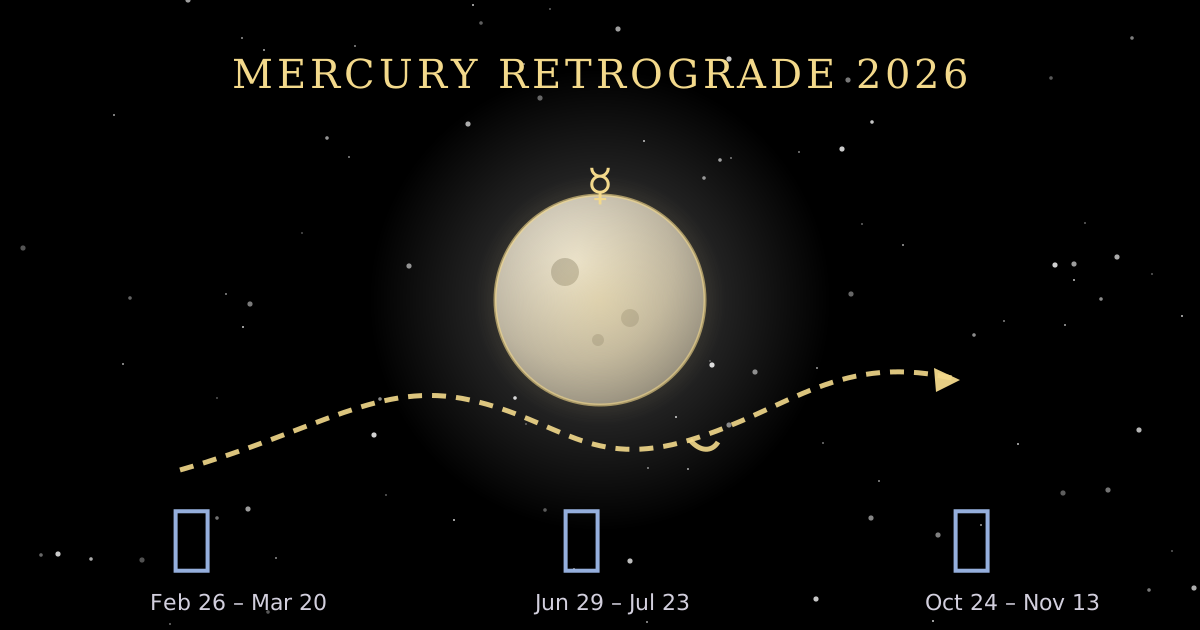
Mercury Retrograde 2026: All Dates, Signs & What Each Cycle Means
Mercury retrograde 2026: Feb 26–Mar 20 in Pisces, Jun 29–Jul 23 in Cancer, Oct 24–Nov 13 in Scorpio. Shadow periods, water-sign themes, Cazimis, and a game plan for the upcoming Scorpio cycle.
Read the meaning →
What Not to Do During Mercury Retrograde (Honest Guide)
What not to do during Mercury retrograde: contracts, purchases, launches, exes & more. Honest nuance over fear — the cautions that actually matter.
Read the meaning →