
Mercury Retrograde in Aries: Meaning, What It Stirs Up & How to Handle It
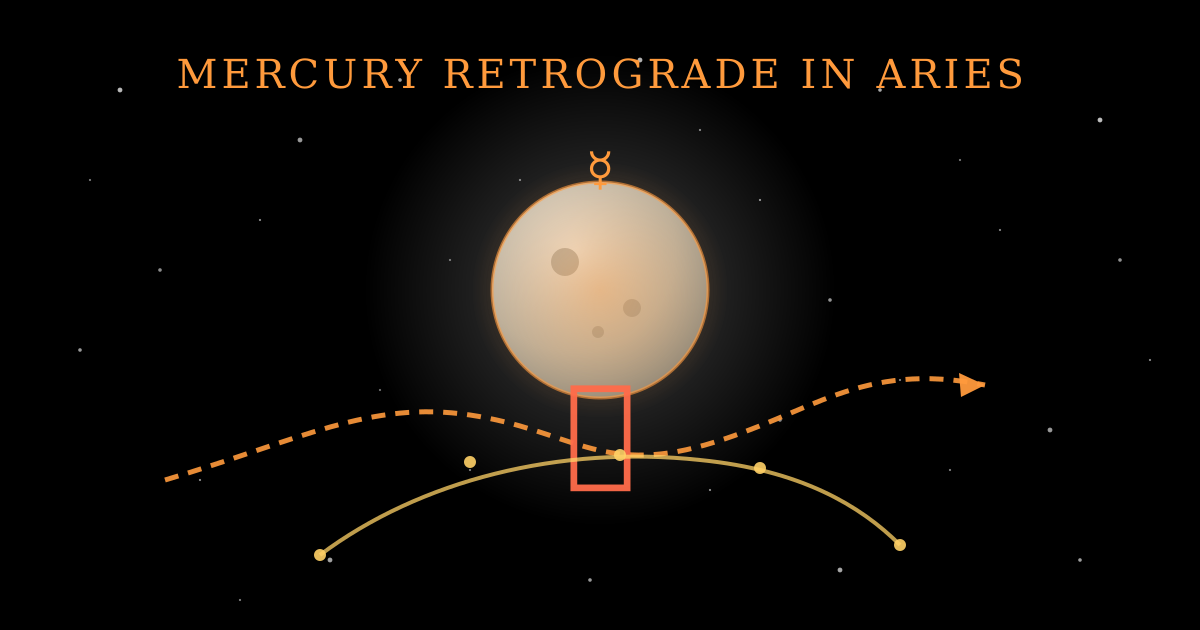
The Fire-Sign Retrograde: Why Aries Changes Everything
Every Mercury retrograde scrambles communication, travel, and technology — that part is the baseline. But the sign Mercury backspins through flavors the whole cycle, the way a spice changes a dish. A retrograde in Pisces dissolves boundaries; one in Scorpio digs up secrets. And a retrograde in Aries? It sets the toaster on fire.
Aries is the zodiac's first sign: the spark, the starter, the warrior. It rules impulse, initiative, competition, and the raw nerve of "I want this and I want it now." Mercury rules the mind, the mouth, and the message — how we think, speak, write, and connect the dots. When the planet of communication appears to reverse through the sign of impulse, the lore's headline writes itself: the thought becomes a sentence before you decide it should be one.
The classic Aries-retrograde symptoms, according to astrology tradition: words that escape before your better judgment arrives, arguments that ignite over trivia, decisions made in a flash of frustration, messages fired off in anger, and a hair-trigger impatience with anything — and anyone — that moves too slowly. The group chat gets spicy. The road feels personal. The "are you serious right now" text gets typed at least once.
The Anatomy of an Aries-Retrograde Argument
It is worth understanding the anatomy of the Aries-flavored fight, because this is the retrograde where relationships take the hits. In the lore, most retrogrades cause misunderstandings; the Aries retrograde causes combustion. Someone misreads a text. Someone answers too fast. Someone hears criticism in a neutral sentence. Ten minutes later, two people who love each other are arguing about the dishes, when neither of them cares about the dishes.
Honestly, the psychology is plain even without the planets: stress shortens fuses, frustration with delays puts everyone on edge, and cultural narratives give people permission to act on feelings they would normally sit with. Astrology calls it Mars-ruled fire (Aries is Mars's sign); psychology calls it ego depletion and displaced aggression. Either way, the prescription is identical: slow down the response chain. Draft the message. Walk around the block. Ask "are you upset with me?" before assuming it. The ten minutes you spend not reacting are the whole game.
There is a second, quieter pattern too: the old argument that resurfaces. Retrogrades are review seasons, and the lore says Aries retrogrades drag up conflicts you thought were settled — the disagreement with the sibling, the slight from the coworker, the thing your partner said six months ago that you swallowed at the time. If it comes back around, the invitation is to finish it properly: calm, direct, and curious rather than loaded for bear.
Impulse Decisions: The Double-Edged Sword
Here is where the Aries retrograde gets genuinely interesting, because it is not all cautionary. Aries is the sign of beginnings — new ventures, bold moves, first steps — and even in reverse, that energy leaks through. The lore says Aries retrogrades spark a restless, almost physical urge to start something: quit the job, launch the project, text the person, book the ticket, finally have the talk.
The problem is only the timing mechanism. An Aries retrograde hands you the ignition key before the engine is built. So the tradition draws a careful line: plan boldly, execute patiently. This is an excellent retrograde for drafting the business plan, researching the move, rehearsing the conversation, building the prototype, and signing up for the course. It is a risky retrograde for irreversible leaps made in a single afternoon of frustration — the resignation sent at 4:47 p.m., the lease signed sight unseen, the investment wired on a hunch.
One practical ritual from the lore: the "three-day rule" for big Aries-retrograde urges. When the urge to do something dramatic arrives, write it down in detail, wait three days, and revisit. If it still feels right — and the research checks out — proceed with a second pair of eyes on it. If the fire was only frustration, it will have cooled into something clearer, which is exactly the retrograde doing its job.
Tech, Travel & the Fast-Moving Glitch
Standard retrograde folklore says technology misbehaves and travel goes sideways. In Aries, the lore adds a signature twist: the glitches are fast-moving and self-inflicted. Booking the wrong dates because you rushed the form. Hitting "send" on the half-finished email. Agreeing to the plan before reading the itinerary. The Aries retrograde's tech disasters, astrologers joke, are the ones where you are both the victim and the perpetrator.
Road travel gets special mention in the Aries lore, because Aries rules speed and Mercury rules the commute. Honking, tailgating, road rage, the infuriatingly slow driver in front of you — the tradition advises treating every commute during an Aries retrograde like a meditation exercise with a steering wheel. Leave earlier than you think you need to. Assume the GPS will reroute you. And when someone cuts you off, practice the radical retrograde sport of letting it go.
The Hidden Gift: Courage, Honesty & the Cazimi
Now the part the fear-mongering skips. Aries retrogrades are also, in the lore, the retrogrades of courage. The same fire that starts arguments also burns through avoidance. This is the cycle when people finally say the thing they have been rehearsing for months — setting the boundary, naming the price, asking for the raise, ending the arrangement that stopped working, admitting what they actually want.
The tradition even has a designated day for it: the Cazimi, the midpoint of the retrograde when Mercury sits at the heart of the Sun. Astrology lore treats the Cazimi as the single clearest day of the cycle — a window of unusual clarity when the fog lifts and the right words arrive. During an Aries retrograde, that clarity tends to be bold clarity: the honest conversation, the brave restart, the decision you have been circling finally landing. If there is one day to have the big talk, the lore says this is it.
And then there is the restart energy. Retrogrades are ruled by the re-words — revisit, repair, renew — and Aries adds reignite. The abandoned project that suddenly calls to you again, the hobby you dropped, the friendship you let drift, the version of yourself you shelved: the Aries retrograde is the lore's favorite season for picking it back up. Just build the engine before you turn the key.
The Aries Retrograde Do / Don't List
Honest guidance, no fear-mongering:
- Do slow your response chain — draft the spicy message, then sleep on it. The feeling is information; the send button is a decision.
- Do channel the restlessness into research and rehearsal: plans, drafts, prototypes, and practice runs. Bold preparation now becomes bold action later.
- Do revisit the unfinished: the stalled project, the drifted friendship, the conversation you swallowed. Aries retrogrades favor reigniting.
- Do save the Cazimi — the retrograde's clarity midpoint — for the honest conversation you have been rehearsing.
- Do double-check anything you do quickly: forms, bookings, sends, signings. The Aries glitch is the rushed one.
- Don't make irreversible decisions in a flash of frustration — resignations, breakups, big purchases, and angry texts all get the three-day rule.
- Don't start arguments you cannot finish, or finish arguments someone else started while you are heated. Walk first, talk second.
- Don't treat the lore as law — no planet has ever been proven to cause a fight, and no retrograde is a substitute for an apology, a contract read twice, or a real conversation.
Closing: Fire Is a Tool, Not a Verdict
An Aries retrograde feels like driving with the parking brake of your patience half-engaged: everything is slightly too slow, everyone is slightly too much, and your own mouth keeps volunteering opinions your mind has not finished. But the same fire that scorches also forges. The lore's final word on Mercury retrograde in Aries is that it is a tool retrograde — it shows you exactly where your impulses run you, and exactly where your courage could take you if you aimed it.
So review, don't rush. Revisit, don't reignite the fight. And when the bold urge arrives — and it will — write it down, give it three days, and see what is left when the smoke clears. Usually, what remains is the true thing: the restart worth making, the truth worth telling, the beginning worth beginning. Fire, handled well, is just energy. Handle it well.
Frequently asked questions
What does Mercury retrograde in Aries mean?
In astrology lore, Mercury retrograde in Aries is the fire-sign retrograde: impulsive words, quick decisions, heated arguments, and bold restarts. Aries is the sign of action and initiative, so when the planet of communication backspins through it, the lore says conversations speed up, tempers shorten, and long-postponed bold moves suddenly feel urgent. Read it as reflection material, not prediction.
Is Mercury retrograde in Aries bad?
Astrology lore does not call any retrograde good or bad — it calls them review seasons. An Aries retrograde is traditionally seen as chaotic for impulsive decisions (signed in haste, sent in anger) but supportive for honest conversations, restarting abandoned projects, and reclaiming initiative. The risk is speed without thought; the gift is courage with reflection.
What should you not do during Mercury retrograde in Aries?
The lore's Aries-specific cautions: do not send the angry message in the moment, do not make irreversible decisions in a flash of frustration, do not start arguments you cannot finish, and do not rush a launch or signing without a second pair of eyes. Draft, sleep on it, revisit — the retrograde motto is review, not rush.
Why do arguments happen more during Mercury retrograde in Aries?
Astrologers say Aries rules the impulse to act and Mercury rules how we speak, so the combination produces unfiltered speech — the thought that becomes a sentence before you decide it should. Psychologically, the lore lines up with real patterns: frustration with delays, permission-giving cultural narratives about retrogrades, and the fact that stress shortens everyone's fuse.
How long does Mercury retrograde in Aries last?
Every Mercury retrograde lasts about three weeks, regardless of sign, with roughly two-week shadow periods on either side when the same themes preview and linger. So an Aries retrograde is really a two-month season: warm-up, backspin, and cool-down.
Keep exploring
Mercury Retrograde in Scorpio: Meaning, Dates & Survival Guide (2026)
Mercury retrograde in Scorpio (Oct 24–Nov 13, 2026): the deepest retrograde of the year — secrets surfacing, trust tests, transformation — plus the honest psychology and a calm survival game plan.
Read the meaning →
Mercury Retrograde Survival Guide: Stay Calm Through Any Cycle
The complete survival guide for any Mercury retrograde: what to back up, how to communicate, when to act, and the calm mindset that turns chaos into review season.
Read the meaning →
Mercury Retrograde & Technology: Why Devices Go Haywire
Mercury retrograde and technology: why phones, laptops, and Wi-Fi seem to rebel — the lore, the honest psychology, and a practical backup checklist before the next cycle.
Read the meaning →
Why Your Ex Texts You During Mercury Retrograde (Explained)
The lore behind the "hey" text, the honest psychology of nostalgia and priming, the 5 classic ex scenarios — and whether you should reply.
Read the meaning →