
Buck Moon Meaning: Why July's Full Moon Is Called the Buck Moon
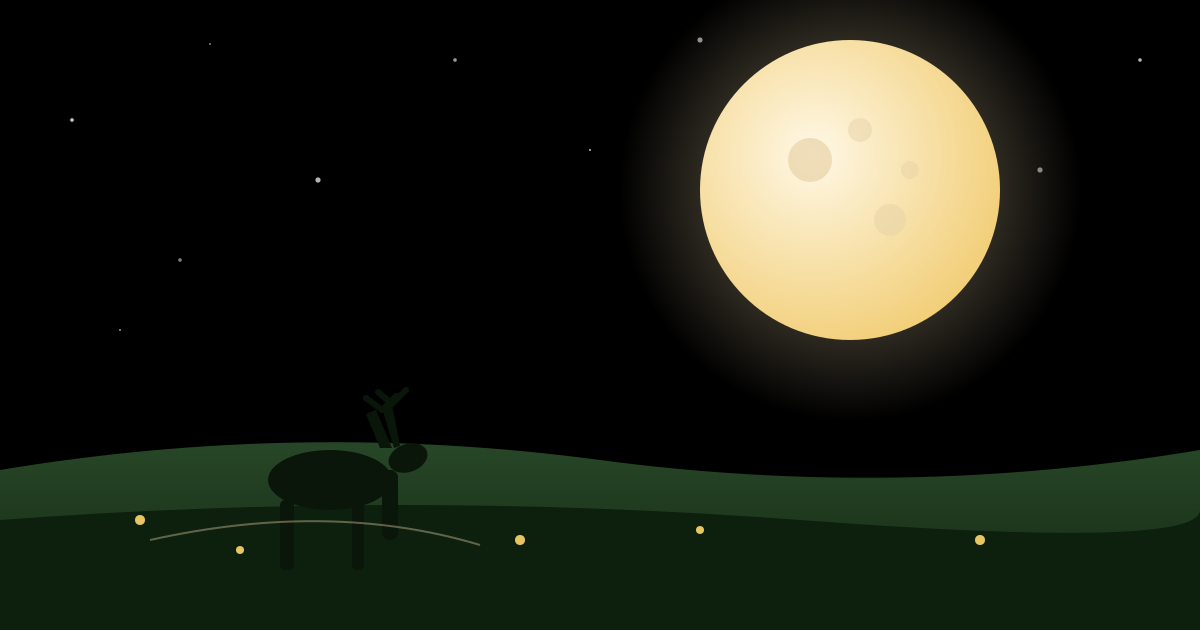
Why Is July's Full Moon Called the Buck Moon?
The named full moons of North American folk tradition were popularized by the Old Farmer's Almanac, which drew on Algonquin and other Indigenous naming traditions tied to the seasonal calendar. July's entry is one of the most literal of the whole list, and it needs no metaphor to explain it: July is when bucks grow new antlers. Each spring, male deer shed the previous year's antlers, and through the summer they grow a new set, bone growing at a remarkable pace, covered in a soft, blood-rich skin called velvet that nourishes the bone underneath. By July, that growth is well underway and plainly visible — the new antlers are unmistakable against a summer skyline, still soft, still growing, still unfinished.
That timing is the whole name. The people who named the moons watched the animals around them, and the most conspicuous animal change of July was the buck's regrowing crown. A buck in July is an animal visibly in the middle of remaking itself: last year's antlers gone, this year's not yet finished, the new growth tender and vulnerable and yet already impressive. The full moon of that season became the Buck Moon, and the name has stuck for centuries, long after most people stopped watching deer closely enough to notice.
There is a second, quieter layer to the name that the folklore keeps returning to. Antlers are one of the fastest-growing tissues in the animal kingdom, and they are also entirely temporary: grown, used for a single rutting season, shed, and grown again. The buck does not keep its crown. It earns it anew every year, at real metabolic cost, and then lets it go. The Buck Moon's lore treats that cycle as its central image: strength is not a possession you accumulate once and keep, but a seasonal practice you renew, year after year, at cost, on schedule.
One common expectation is worth correcting early. The Buck Moon is not golden, antler-colored, or deer-shaped. It is an ordinary full moon, the same silver disk as any other month's. July's full moon can look warm and amber near the horizon, because in summer the full moon rides low across the sky and its light passes through more atmosphere, but that golden tint is optics, not identity. If you go out to see the Buck Moon, expect a beautiful ordinary full moon hanging low over summer fields — which, on a warm July night, is beautiful enough.
The Other Names for July's Full Moon
Like most named moons, July's full moon carries a family of alternate names from different traditions, and together they describe the same high-summer moment from several angles. One of the best known is the Thunder Moon, for the thunderstorms that roll through July afternoons — the season's heat breaking into sudden, dramatic storms. Another is the Hay Moon, marking the hay harvest, when fields are cut and stored for the winter ahead. In some traditions it is the Salmon Moon, for salmon returning to spawn, and in others the Mead Moon, for the honey and mead-making season.
Other names include the Ripe Corn Moon in a few folk lists, though that name more often belongs to September, and the Sturgeon Moon in some older calendars, though that name is now firmly attached to August. The through-line across all of them is unmistakable: whatever you call it, July's full moon is the moon of high summer at full tilt — growth at its fastest, storms at their loudest, harvests beginning, and the year's energy peaking before the long turn toward autumn.
The Spiritual Meaning of the Buck Moon
Named moons carry emotional weather in the folklore, and the Buck Moon's weather is warm, vigorous, and forward-leaning: growth, strength, and renewal. Three themes dominate the spiritual reading of this moon.
Growth
The buck's lesson is the most obvious and the most comforting: growth is supposed to look unfinished. A buck in July does not have a finished set of antlers, and nobody mistakes that for failure — the velvet-covered growth is the point, not a problem to solve. The lore of this moon frames personal growth the same way: the skill you are still learning, the habit that is still shaky, the version of yourself that is still forming are not evidence that you have failed to grow. They are evidence that you are growing, right now, in season. The reflective prompt is not why are you not finished yet, but what is growing in you that deserves protection while it is still soft?
Strength
The second theme is the buck's famous strength, and the folklore treats it with more nuance than the cliché. A buck's antlers are not weapons it keeps; they are strength grown on a schedule, used for one season, and then shed. The lore's instruction is to distrust the idea of permanent toughness and trust seasonal strength instead: the strength you need for this season is the strength you are growing now, and it does not have to look like last year's strength to count. The reflective question: what strength are you growing this summer that looks nothing like the strength you relied on last year?
Renewal
The third theme is the one that gives the moon its staying power. Renewal, in the buck's version, is not a dramatic reinvention — it is a quiet annual cycle: shed what is dead, grow what is needed, use it, let it go, and begin again. The folklore frames the Buck Moon as the time to notice which parts of your life are still carrying last year's antlers — the finished project you keep polishing, the role you have outgrown, the grievance you keep wearing — and to ask whether this is the season to shed them. Renewal is not starting over from nothing. It is the same animal, growing a new crown.
Buck Moon vs. the Other Summer Full Moons
Summer's named moons read like a three-act story of the year's peak, and the Buck Moon is the vigorous middle act. The Strawberry Moon (June) is the moon of ripening and sweetness — the first fruits of the year, the reward of spring's work, gratitude for what has come to bear. The Buck Moon (July) is the moon that comes after the first harvest: the growth continuing, the strength building, the year's energy still rising rather than spent. The Sturgeon Moon (August) is the moon of late summer's abundance — the great fish, the full nets, the year's plenty made visible before the turn.
The difference matters. The Strawberry Moon is about enjoying what has ripened, the Sturgeon Moon about gathering what is abundant, and the Buck Moon about becoming what is still growing. A buck in July is not harvesting and not resting — it is building, in velvet, in public, at full speed. If you track the named moons as a yearly story, July is the chapter where the protagonist is visibly mid-transformation: not the seed of spring, not the harvest of autumn, but the growing animal in between, antlers half-grown and rising.
One astronomical note worth knowing: July's full moon rides low in the Northern Hemisphere sky, because the full moon sits opposite the high summer sun. That low arc is why July moonrises can look so large and golden near the horizon — the famous moon illusion, plus the warm scattering of low light. It is, in a sense, the moon of the year's longest days reflected back at night: low, warm, and close to the fields where the bucks are actually growing.
What the Buck Moon Means for You: Three Reflection Themes
If you want to work with the moon's symbolism rather than just admire it, the lore suggests three questions, one for each theme. These are journaling prompts, not cosmic instructions — the moon will do whatever it does regardless, and the value is in the ten minutes of honesty.
The growth audit. What has grown in you since spring? Not in general, but specifically: the skill, the boundary, the friendship, the habit, the piece of work. Write the list, then circle the one growth that is still soft — the velvet growth — and ask what would protect it this month. The Buck Moon's lore says unfinished growth is the most valuable kind, and the most easily trampled.
The strength check. What strength are you growing this season, and does it look like last year's? The lore's instruction is to stop comparing your current strength to a finished version of yourself and start noticing the new growth: one conversation handled better, one limit held, one run finished. Strength grown this season counts even before it hardens.
The renewal review. What are last year's antlers in your life — the thing you have finished using but keep carrying? A finished role, a settled argument, an old version of the story you tell about yourself. The Buck Moon's lore says shedding is not loss; it is the precondition for new growth, and the buck sheds without ceremony, every year, on schedule.
A Simple Buck Moon Ritual: The Antler Check
July folklore pairs the full moon with a growth review, and the Buck Moon's ritual is exactly that: fifteen minutes, a pen, one honest list, and one small act of protection. You will need paper, a pen, and a cool drink on a warm night.
First, draw a simple pair of antlers on the page: a central beam with branching tines. Label each tine with something that has grown in you since spring — a finished project, a repaired relationship, a habit that held, a fear faced. Bucks grow antlers with what the season gives them, and so have you; the point of the drawing is to see the growth you already have, not only the growth you still want.
Then, on the other side of the page, write the one velvet growth: the thing still forming that most needs protecting this month. Pick one concrete step that protects it before the evening ends — send the message, block the time, say the no, book the session. The folklore says the taken step completes the ritual; the psychology says that a small protected action beats a long perfect plan. Then finish the drink, look at the moon if the sky is clear, and let July be what it is: the season of growing, in public, unfinished and unashamed.
The Honest Fine Print
This is a mystical-entertainment site, and the usual honesty applies: the Buck Moon will not make you stronger, your growth faster, or your renewal arrive on schedule. Named moons are folklore, and folklore is a storytelling technology, not a force of nature. The bucks that gave this moon its name are growing antlers with no opinions about your personal growth. July's full moon exerts no special influence on human affairs beyond the ordinary full moon's light — and even that influence is mostly about visibility and sleep disruption, not destiny.
What the Buck Moon genuinely offers is the year's best-timed excuse to notice your own growth. It arrives exactly when the year is at full tilt, and a named, storied moon is a better journaling prompt than a blank page. Take the symbolism, leave the superstition, and protect the velvet growth while it is still growing. The autumn is real regardless of what the moon was doing.
Your Buck Moon Game Plan
The next Buck Moon rises with July's full moon — the moon of the buck's antler-growing season, and the full moon of high summer at its peak. If you want to catch it:
- When to look: the night of July's full moon, right at moonrise — it rises as the sun sets, and July's full moon arcs low across the sky, often looking large and golden near the horizon.
- Where to look: anywhere with a clear eastern horizon at dusk; a meadow or field edge is ideal, for obvious reasons, but any open sky works.
- The ritual night: do the fifteen-minute antler check on the full moon night itself, or any evening in the week around it — the folklore is generous about timing.
- The follow-through: the lore's real assignment comes after: the velvet growth you protect, the strength you keep growing, the old antlers you finally shed. A moon is a prompt; the month after is the answer.
The Buck Moon has been rising over summer meadows and growing antlers for as long as there have been people to name it. Go look at it, check your own growth, and let July be what it is: the season of becoming, before the harvest.
Frequently asked questions
What is the Buck Moon?
The Buck Moon is the traditional name for July's full moon. The name comes from Algonquin and colonial-era tradition, popularized by the Old Farmer's Almanac: July is when male deer, or bucks, grow new antlers, covered in soft velvet, after shedding the previous year's set.
Will the Buck Moon look any different from other full moons?
No. The Buck Moon looks like an ordinary full moon. Its name describes the season, not the moon's color or size. July's full moon can look golden or orange near the horizon because it rides low in the summer sky, but that is atmospheric, not part of the name.
What is the spiritual meaning of the Buck Moon?
In spiritual folklore, the Buck Moon symbolizes growth, strength, and renewal. It is the moon of becoming: the new antlers are still growing, still soft, still unfinished, and the lore frames that unfinished state as the whole point — growth in progress, not growth completed.
What should I do during the Buck Moon?
July folklore pairs the full moon with a growth audit. A simple Buck Moon practice: list what has grown in you since spring, name the one strength you are still growing into, and take one concrete step that protects that growth. The practice is reflective entertainment, not a guaranteed result.
When is the next Buck Moon?
The Buck Moon rises with July's full moon each year. The next Buck Moon falls in July 2027. Each July full moon is traditionally called the Buck Moon, regardless of the exact calendar date.
Keep exploring
Strawberry Moon Meaning: Why June's Full Moon Is Called the Strawberry Moon
Why is June's full moon called the Strawberry Moon? The Algonquin strawberry-harvest folklore behind the name, its spiritual symbolism of ripening, sweetness and gratitude, and a simple 15-minute berry gratitude ritual.
Read the meaning →
Full Moon Ritual Guide: Release & Manifest Under the Full Moon
Learn exactly how to perform a powerful full moon ritual for release, gratitude, and renewal — step-by-step guide with supplies, timing, and intention ideas.
Read the meaning →
Harvest Moon Meaning: Spiritual Significance & Folklore
What does the harvest moon mean? Discover the spiritual significance of the golden autumn full moon — abundance, gratitude, and reaping what you sow.
Read the meaning →
Corn Moon Meaning: Why September's Full Moon Is Called the Corn Moon
Why is September's full moon called the Corn Moon? The corn-harvest folklore behind the name, how it differs from the Harvest Moon, its spiritual symbolism of harvest, gratitude and storing for winter, and a simple 15-minute harvest inventory ritual.
Read the meaning →