
Chaldean Numerology Explained: Ancient Numbers, Meanings & How to Calculate Yours
What Is Chaldean Numerology?
Most numerology articles you will find online use the Pythagorean system: A equals 1, B equals 2, C equals 3, and so on up to I equals 9, then the cycle repeats. It is tidy, easy to learn, and it powers the Life Path, Destiny, and Soul Urge numbers covered elsewhere on this site. Chaldean numerology is older, stranger, and less tidy — and its fans argue that is exactly why it is more accurate. The system is traced to the Chaldeans of ancient Mesopotamia, the astronomer-priests of Babylon whose star knowledge shaped astrology itself. Where Pythagoras built a system from mathematics and philosophy, the Chaldeans built theirs from sound. Each letter, they taught, carries a vibration — a hum you can almost hear when the letter is spoken — and numbers were assigned to match that vibration, not to march in alphabetical order.
That single idea explains almost everything unusual about the system. A is 1, as you would expect, but B is 2, C is 3, and then D is 4 — so far, so familiar. But then E is 5, F is 8, G is 3, and H is 5, and the pattern breaks wide open. The letters were not lined up and numbered; they were listened to and weighed. Two letters that sound alike in the tradition share a value, while letters that look like neighbors in the alphabet may sit far apart numerically. The result is a chart that has to be memorized or looked up, because you cannot derive it from the alphabet alone.
The second great difference is what the system does with compound numbers. In Pythagorean practice, a total like 23 is almost always reduced at once: 2 plus 3 equals 5, and you read the 5. Chaldean practitioners pause at the 23. The compound number, they say, has its own character — its own story — and reducing it too fast throws that story away. A Chaldean reading therefore gives you two layers: the compound number, which describes the flavor and the hidden influences of the name, and the single digit it reduces to, which describes the outward expression. Reading both is the whole art.
The framing worth keeping, as with all numerology on this site: this is entertainment and self-reflection, not a verdict. No study shows that a name number predicts career success, love, or fortune, and a name reading should never decide a legal name change, a business name, or a financial choice. What it can do — and what millions of people use it for — is offer language for patterns you already feel, and a playful lens for thinking about identity.
The Chaldean Chart: Letters 1 to 8
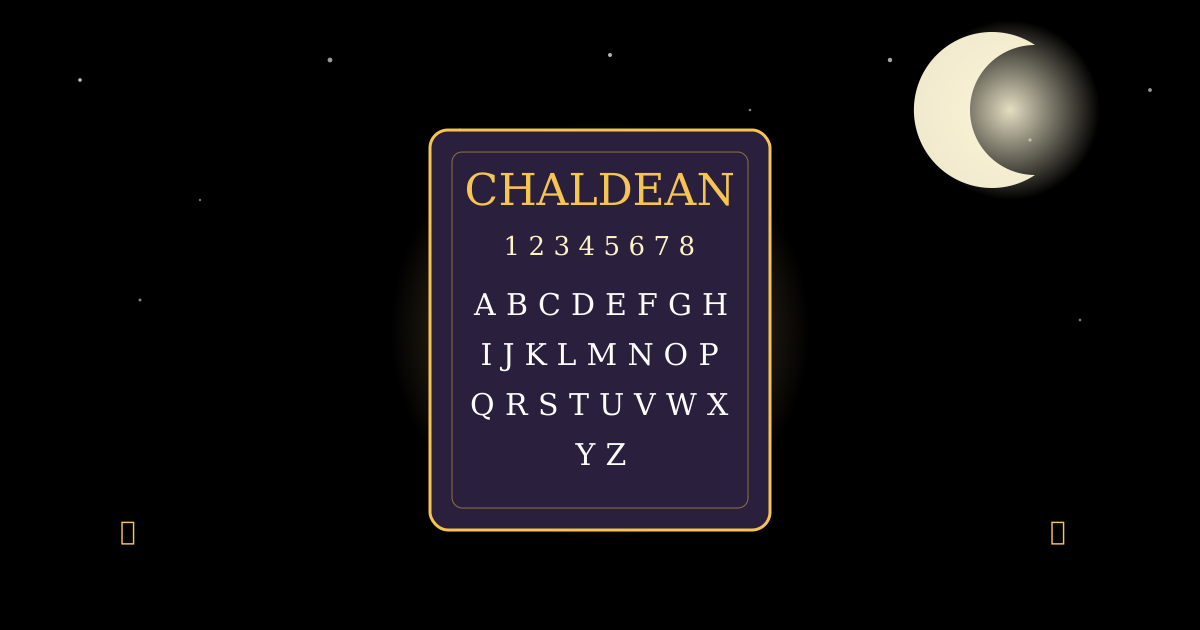
Here is the full Chaldean letter chart. Note two things at once: the values run only from 1 to 8, and the letters are scattered, not sequential.
1: A, I, J, Q, Y. 2: B, K, R. 3: C, G, L, S. 4: D, M, T. 5: E, H, N, X. 6: U, V, W. 7: O, Z. 8: F, P. There is no letter worth 9. In the Chaldean tradition, 9 is holy and complete — the number of endings, of spiritual attainment, of the divine itself — and so it is kept apart, never pinned to a single letter. It appears only as a result, when a name or a date reduces to 9, and practitioners read that appearance as especially weighty: a number you arrive at, not one you start from.
The chart also explains why Chaldean readings insist on the name you actually use. Your birth certificate name and the name your friends call you can produce different numbers, and the tradition sides with the living name: the vibration, it says, is the one spoken aloud every day. A person born Elizabeth who has been Liz since childhood would be read, in strict Chaldean practice, as Liz first, with Elizabeth as a secondary, deeper layer. The same logic extends to business names and pen names, which is why the system remains popular among people choosing a brand or a stage name — they are choosing, in this view, the vibration they will live under in public.
How to Calculate Your Chaldean Name Number
The calculation is simple once you have the chart. Write the name exactly as it is commonly used, convert each letter to its Chaldean value, add the values, and keep both the compound total and the single digit it reduces to. Worked example: the name Maya. M is 4, A is 1, Y is 1, A is 1. The total is 7, a single digit already, and the tradition reads 7 as the thinker and the seeker — analytical, spiritual, private. A second example with a compound total: the name Sara. S is 3, A is 1, R is 2, A is 1. The total is 7 again — but watch what happens with a longer name. Take Daniel: D is 4, A is 1, N is 5, I is 1, E is 5, L is 3. The total is 19, which reduces to 10 and then to 1. The Chaldean reading keeps the 19 in view: 19 is traditionally called the Prince of Heaven, a compound associated with victory after struggle, and the 1 gives the outward drive and independence. The compound colors the single digit; the single digit does not erase the compound.
A fuller example shows why practitioners love the double layer. The name Alexander: A is 1, L is 3, E is 5, X is 5, A is 1, N is 5, D is 4, E is 5, R is 2. The total is 31, which reduces to 4. The 31 is traditionally read as the Hermit, a compound of solitude, wisdom, and self-reliance, while the 4 gives the outward shape of order, discipline, and building. A reader would say Alexander carries a 4's outer discipline powered by a 31's inner solitude — a very different portrait from a flat reading of 4 alone. Whether you find that persuasive or merely poetic, it is the reason the system has kept its followers for centuries: it tells a richer story.
What Each Single Digit Means in Chaldean Numerology
1 — The Leader. Linked in the tradition to the Sun. Independence, originality, ambition, and the drive to pioneer. The shadow is stubbornness and a reluctance to ask for help.
2 — The Diplomat. Linked to the Moon. Sensitivity, cooperation, intuition, and peacemaking. The shadow is over-sensitivity and indecision when harmony matters more than honesty.
3 — The Creator. Linked to Jupiter. Expression, imagination, humor, and social warmth. The shadow is scattering energy across too many projects and talking instead of finishing.
4 — The Builder. Linked to Uranus in the Chaldean tradition. Order, discipline, reliability, and hard work. The shadow is rigidity and a suspicion of anything unplanned.
5 — The Adventurer. Linked to Mercury. Change, freedom, versatility, and quick thinking. The shadow is restlessness and the urge to escape the moment things get dull or hard.
6 — The Nurturer. Linked to Venus. Love, responsibility, home, and harmony. The shadow is worry, control disguised as care, and giving until empty.
7 — The Seeker. Linked to Neptune. Analysis, spirituality, research, and inner life. The shadow is withdrawal and suspicion of anything that cannot be proved or felt deeply.
8 — The Power. Linked to Saturn. Authority, material mastery, judgment, and endurance. The shadow is the system's most warned-about: ambition that hardens into control, and a life measured only in results.
9 — The Humanitarian. Appearing only as a reduction, never as a letter value. Linked to Mars in the Chaldean tradition. Compassion, endings, and service to humanity. The shadow is martyrdom and the inability to let go of what has already ended.
Compound Numbers: The Chaldean Secret Layer
The compound numbers from 10 to 52 each carry a traditional name and story in Chaldean literature, and a full treatment of all of them would fill a book. A few of the most cited give the flavor. The number 10 is the Wheel of Fortune, read as success that depends on how its power is used. The number 11 is the Lion, strength tested by adversity. The number 13 is upheaval and regeneration, feared in folklore but read by practitioners as destruction that clears ground for rebuilding. The number 19, the Prince of Heaven, promises victory after struggle. The number 23 is the Royal Star of the Lion, one of the tradition's most fortunate compounds, associated with help from people in high places. The number 24 is gain through love and cooperation, a compound of Venusian warmth. The number 29 is trial and treachery in the older books, a compound of testing that asks for caution in trust. And the number 33, which also appears as a Master Number in Pythagorean practice, is read in Chaldean terms as the compound of healing service and spiritual teaching.
The honest way to use this layer is as a prompt, not a prediction. If your name totals 23 and the Royal Star description makes you think about the mentors who have helped you, that reflection has value regardless of whether the number caused anything. If your name totals 29 and the old warnings make you more careful about whom you trust, that caution may serve you — as caution, not as fate. The compound layer works best as a mirror with more facets, not as a fortune told in advance.
Chaldean vs Pythagorean: Which Should You Use?
The practical answer is that most modern readers use both, for different questions. Pythagorean numerology, with its clean alphabetical chart and its Life Path, Destiny, and Soul Urge numbers, is the better tool for a birth-date reading and for a quick, structured chart. Chaldean numerology, with its sound-based chart and its compound numbers, is the better tool for a name reading — especially for the name you actually go by, a business name, or a name you are choosing. Many practitioners calculate both and compare: where the two systems agree, they treat the theme as confirmed; where they differ, they treat the difference as a conversation between your birth identity and your lived identity.
There is also a cultural honesty to note. The Chaldean system as sold today is a reconstruction passed through 19th and 20th century occult writers, not a tablet dug up in Babylon with a letter chart on it. Its history is real — Babylonian star wisdom genuinely shaped the Western mystical tradition — but the specific chart is a later synthesis, refined by writers like Cheiro, whose books popularized it in the English-speaking world. Knowing that does not spoil the system; it places it correctly, as a living tradition rather than an archaeological artifact, and it keeps the reading in the register where it belongs: reflection, not revelation.
Try This: Your Chaldean Name Reading in 10 Minutes
Tonight, take a pen and the chart above and work through three names: your full birth name, the name you are called every day, and one name you wish you were called, even privately. Calculate each compound total and its reduction, then read the single-digit meanings and the compound notes for each. Ask three questions of the results. First, which reading feels most like you right now, and which feels like an older version of you? Second, where do the birth name and the daily name disagree, and does that disagreement describe a real tension in your life — the private self versus the public self? Third, what does the wished-for name reveal about what you are reaching toward, rather than what you already are? Write the three numbers on a card and keep it for a month. Notice whether the themes show up in your choices — not as fate steering you, but as language helping you notice yourself. That noticing is the oldest use of numerology there is, and it is the one that needs no belief at all.
Frequently asked questions
What is Chaldean numerology?
Chaldean numerology is an ancient name-based number system traced to Babylon and Chaldea. It assigns each letter a value from 1 to 8 based on sound vibration rather than alphabetical order, and it treats compound numbers like 23 or 29 as meaningful in their own right, not just as steps toward a single digit.
How is Chaldean numerology different from Pythagorean numerology?
Pythagorean numerology assigns letters values 1 to 9 in alphabetical order and usually reduces everything to a single digit. Chaldean numerology assigns values 1 to 8 by sound, leaves 9 as a sacred number not assigned to any letter, uses the name you are actually called by, and keeps compound numbers in the reading.
How do you calculate a Chaldean name number?
Write the full name as it is commonly used, look up each letter in the Chaldean chart, add the values, and note both the compound total and its single-digit reduction. For example, a name totaling 23 is read as both the compound 23 and the reduced 5.
Why is there no 9 in the Chaldean letter chart?
In the Chaldean tradition, 9 is treated as holy and complete, the number of endings and of the divine, so it is not assigned to any letter. It appears only as a result, when a name or date reduces to 9, and practitioners read that appearance as especially significant.
Should I change my name to get a better Chaldean number?
Traditional Chaldean practice sometimes suggests spelling adjustments, but there is no evidence that changing a spelling changes your life outcomes. Treat any such suggestion as entertainment and personal reflection, not as a decision to make about legal documents, business names, or money.
Keep exploring

How to Calculate Your Life Path Number
Calculate your Life Path number step by step from your birth date, with worked examples and the Master Numbers explained.
Read the meaning →
Destiny Number Meaning: Your Life Purpose in Numerology
Destiny Number meaning: calculate your Expression number from your full birth name and discover what each number reveals about your purpose.
Read the meaning →
Soul Urge Number Meaning: How to Calculate Your Heart's Desire
Soul Urge Number meaning: calculate your Heart's Desire number from the vowels in your birth name, what each Soul Urge 1-9 (and 11, 22) reveals, and how to honor it.
Read the meaning →
Numerology Love Compatibility: Find Your Number Match
Numerology love compatibility guide: Life Path pairings, harmonious matches, growth combinations, and practical relationship advice by the numbers.
Read the meaning →