
Master Number 33 Meaning: The Master Teacher & the Healer
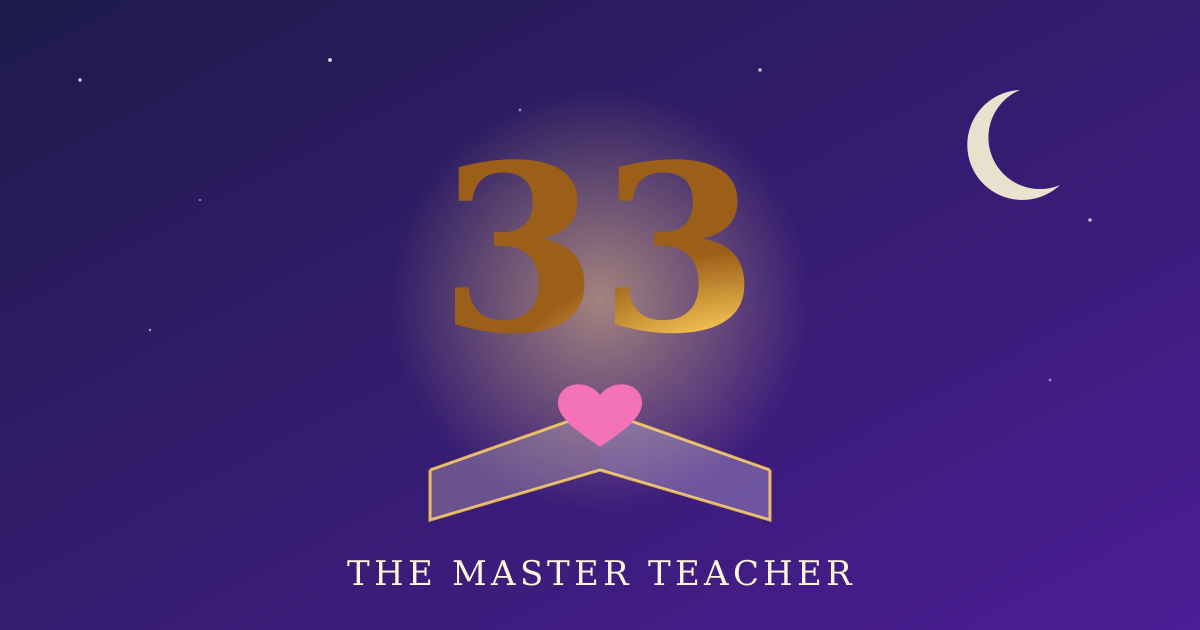
What Is Master Number 33?
In numerology, most numbers reduce to a single digit. A few do not. The Master Numbers — 11, 22, and 33 — are traditionally left unreduced when they appear during a calculation, because the lore treats them as higher-octave versions of their roots: 11 as a heightened 2, 22 as a heightened 4, and 33 as a heightened 6. Of the three, 33 is the one most numerologists describe with a touch of awe, and also the one most often misunderstood. It is not a prize for being good. It is, in the tradition's language, a responsibility: a life organized around healing and teaching at a scale larger than one household.
The name gives the game away. The Master Teacher is not the person with the most knowledge. It is the person whose life becomes the lesson. In the lore, 33 combines everything the earlier Master Numbers promise: 11 contributes vision, intuition, and spiritual insight; 22 contributes the discipline to turn vision into something real and lasting; and the reduction to 6 contributes the motive, which is love in service. Inspiration without a structure stays a dream. A structure without love stays a machine. The 33, the tradition says, is the one who inspires, builds, and then gives the result away.
That is why 33 is often described as the number of the healer rather than the helper. A helper fixes the immediate problem. A healer, in this symbolic language, addresses the pattern underneath it — and then teaches others to do the same for themselves. The 33 who writes honestly about grief, the counselor who turns a personal recovery into a practice, the artist whose work helps strangers feel less alone: the lore reads all of these as 33 in action, because the teaching is not delivered from a podium. It is lived in public, with the scars showing.
The framing worth keeping: numerology is a mirror, not a verdict. Having 33 in your chart does not guarantee a life of saintly service, and lacking it does not limit your capacity to help. What the number offers is language for a pattern you may already feel — the pull toward other people's pain, the sense that your own hardest chapters were somehow preparation, the quiet conviction that your life is supposed to be useful to more people than just yourself. If that recognition lands, the number has done its job.
How Does 33 Appear in Your Chart?
The most talked-about placement is the Life Path, calculated from your full birth date. Add the month, day, and year, reducing each part to a single digit — but stopping when a part, or the total, lands on 11, 22, or 33. A Life Path 33 is rare by the math of the system: the parts must sum to 33 before the final reduction, which happens far less often than the combinations that yield 11 or 22. One example: someone born on a day and in a month and year whose reduced parts are 9, 9, and 15 (which reduces to 6) totals 24, not 33 — so most dates simply never get there. The combinations that do arrive at 33 are narrow, which is why many numerologists treat a genuine Life Path 33 as the rarest placement in the system.
More commonly, 33 shows up elsewhere in the chart. As a Destiny or Expression number, it comes from the letters of the full birth name, where the longer string of values gives 33 more chances to appear before reduction. As a Soul Urge number, it comes from the vowels of the birth name and describes an inner drive toward healing and service, even when the outer life looks ordinary. As a Maturity number, it is said to emerge later in life, when the Life Path and Destiny numbers combine — the lore's version of a second act, in which a person who spent decades building a life turns toward teaching what the building taught them.
There is also the everyday experience of seeing 33 repeatedly — on clocks, receipts, addresses, and page numbers. Numerologists read repeated 33 as a nudge rather than a verdict: a reminder to teach what you have learned, to offer the help you needed once, or to stop hiding the part of your story that could help someone else. Psychologists would add a plainer explanation, which is worth holding alongside the mystical one: once a number matters to you, your brain starts noticing it everywhere, a well-documented pattern called frequency illusion. Both readings can be true at once. The number can be meaningful to you because you decided it was, and that decision can still change what you do next.
One caution the tradition itself repeats: a 33 that is not lived consciously is often read simply as a 6. The person still cares, still nurtures, still holds the home together — but the wider teaching never quite happens. Numerologists describe this not as failure but as a choice the number keeps offering. The 6 is the foundation; the 33 is the 6 deciding to build on it in public.
The Master Teacher Archetype
If every number were a character in a novel, the 33 would be the one who survived the fire and came back to show others the way out — not as a hero on a stage, but as the neighbor who leaves the door open and the light on. The 33 archetype carries a quality that is easy to admire and hard to live with: a presence that steadies a room. People tell a 33 things they have not told anyone else. Strangers ask a 33 for directions, for advice, for a minute of their time, as if some part of them recognizes a safe harbor before a word is exchanged.
The core 33 traits read like the description of a born counselor: compassion that does not flinch from pain, a gift for putting hard truths into words people can actually hear, patience with slow growth, and a relationship with service that the tradition politely calls total. The 33 is the friend who becomes a confidant, the teacher whose students stay in touch for decades, the writer whose readers write back to say the book arrived exactly when they needed it. The scale changes; the devotion is the devotion.
There is also a creative streak that runs through the 33's lore, and it is not decorative. The tradition treats art, music, writing, and craft as the 33's teaching tools — the way a lesson too painful to say plainly can be sung, painted, or told as a story instead. A 33 who turns grief into a song, or a hard-won recovery into a memoir, is teaching in the register the lore considers highest: not instruction, but example. The lesson lands because the teacher has the scar to prove it.
The 33's Gifts: Healing at Scale
A presence that heals. The classic 33 gift is not a technique but a quality of attention: the ability to sit with another person's pain without rushing to fix it, minimize it, or make it about yourself. People describe feeling truly heard by a 33 in a way they rarely experience elsewhere. The tradition says the 33's heart is a clinic, not a stage: it does not perform compassion, it practices it, quietly, until the other person can breathe again.
Teaching through example. The 33 teaches less by telling and more by showing. The recovery lived openly, the boundary held kindly, the apology made without excuses — these are the 33's curriculum. Students of a 33 rarely remember a lecture. They remember the moment the teacher said, in effect, I have been where you are, and here is the road I found. That is why the lore insists the 33 must do its own inner work first: you cannot teach a road you have not walked.
Compassion with range. Where the 6's compassion centers on the household, the 33's is said to widen to the community, the cause, or the generation. The 33 is the one who starts the support group, writes the guide, founds the charity, or speaks the uncomfortable truth in public so that private sufferers feel less alone. The tradition reads this as the 6's love, amplified: the same hearth, but with the doors thrown open.
Vision turned into service. The 33 inherits 11's vision and 22's building power, and the lore credits it with the rare ability to hold both at once: to see what a community needs and to build the thing that meets it. The school, the clinic, the book, the movement — the 33's projects tend to outlive their founder, because they were built to serve rather than to impress. A 33's legacy, in this reading, is not a monument. It is a room full of people who learned to help each other.
The Shadow Side: The 33's Heavy Lessons
Every number has its undertow, and the 33's shadows are the quiet kind — which is both the blessing and the curse. Everyone benefits from the 33's giving; only the 33 knows what it costs.
The martyr's bargain, at scale. The most common 33 wound is the 6's martyr pattern writ large: giving until empty, then quietly resenting the people who let you. The difference is the audience. A 6 burns out for a family; a 33 can burn out for a community, a readership, or a cause, and call the exhaustion proof of devotion. The lore's exam for the 33 is the same as for the 6, only louder: care given from emptiness curdles, and a rested teacher helps more than a depleted one.
Perfectionism disguised as service. The 33's high standards are also its tax. Because the teaching is personal — the lesson is the life — the 33 can polish the message until the life goes out of it: the book endlessly revised, the talk never given because it is not yet perfect, the help withheld until it can be flawless. The tradition calls this the 33's gilded-cage problem: the fear that an imperfect offering disqualifies the teacher. It does not. An honest, imperfect lesson helps more people than a perfect one nobody ever hears.
Control disguised as care. The 33's devotion can curdle into management, just as the 6's can — only the 33 manages at scale. The support group run like a fiefdom, the advice that must be followed exactly, the student kept dependent rather than set free: these are the lore's warnings that the teaching has become ownership. The test the tradition offers is simple and brutal: a true teacher measures success by students who no longer need them.
Fear of visibility. The strangest 33 shadow is the reluctance to be seen. A number built for public teaching can spend years hiding its light — the healer who never hangs out a shingle, the writer who never publishes, the speaker who never takes the stage — because visibility feels like vanity. The lore treats this as the 33's final exam: the teaching that stays private helps one room; the teaching offered openly can help a thousand. Visibility, in this reading, is not ego. It is distribution.
Master Number 33 in Love & Relationships
In love, the 33 is the partner of the long haul, raised to a higher key — devoted, attentive, and genuinely delighted by a partner's growth. Partners who have been loved by a 33 describe it as being truly seen: not just comforted, but understood at a level that feels almost uncanny. The 33 remembers the wound behind the story, the fear behind the joke, the dream behind the practical plan, and loves the whole person, not just the presentable parts.
The friction is the same pattern as in the rest of the 33's life, wearing a wedding ring. The 33's love needs to be needed, and not every partner needs in the same way. A 33 can experience healthy independence as rejection — the partner who wants a solo trip, the grown child who stops calling daily, the friend who solves their own problem — and respond by giving harder instead of asking for what they need. Partners, in turn, can experience this as pressure: the care is real, but is the freedom real?
The other classic tension is the 33's relationship with sacrifice itself. Because the 33 is wired to serve, some 33s confuse the fading of appreciation with the fading of love, and double down on giving until resentment arrives wearing devotion's clothes. The healthiest 33 partnerships share an understanding that devotion is not a ledger to be balanced but a rhythm to be shared — and that the bravest thing a 33 can do is ask to be cared for, too, in plain words, before the tank is empty.
Compatibility-wise, the tradition pairs the 33 most easily with numbers that share its heart-first values — 2, 6, and 9 — and with the other Master Numbers, 11 and 22, who understand the weight of a larger calling. The famous caution pairings are 33 with 5 or 7: the 5's love of freedom can feel like flight to a 33, and the 7's need for solitude can read as distance. But the honest truth applies here as everywhere in numerology: the numbers describe weather, not fate, and any pairing can work when both people show up honestly.
Master Number 33 in Career & Money
This is the number's natural habitat: the lore gives the 33 enormous capacity for work that heals and teaches at scale. The 33's traditional fields are the ones that never stop needing a steady, compassionate hand: counseling and therapy, teaching and mentoring, medicine and nursing, spiritual guidance, writing and the arts used for uplift, humanitarian and community leadership, and any craft that turns personal experience into a lesson others can use. The pattern is the same in every field: the 33 does the inner work first, then teaches it by living it openly.
With money itself, the 33's pattern is provision raised to a principle. The 33 often earns steadily — the reliability and devotion translate — and then the money flows toward the people and causes they love: the family supported, the project funded, the stranger helped quietly. The caution in the tradition is the mirror image: some 33s develop a give-it-all-away rhythm that makes their own security feel like somebody else's problem, or feel guilty charging fairly for healing work. The lore's corrective is blunt: a teacher who cannot pay rent stops teaching. Charging fairly for real help is not a betrayal of service; it is what keeps the service running.
One honest note about the saintly reputation: the lore promises the capacity for service, not the absence of ambition. Plenty of 33s spend long stretches in demanding, high-profile careers — authors, founders, clinicians, public speakers — and the tradition treats this not as contradiction but as the number's integration work. A 33 running a thriving practice with a waiting room full of people is practicing the same circuitry as the 33 with a full dinner table. The vehicle changes; the direction is the direction.
If you are a 33 in a conventional role, the traditional advice is to find the people inside it. The team that needs mentoring, the client who needs reassurance, the project with a human outcome — the 33's energy needs someone to serve like it needs air. Parked in pure abstraction, the number's energy tends to turn into worry, perfectionism, and the quiet suspicion that there is something more human to be doing.
33, 11, 22 & 6: How the Master Numbers Differ
It helps to see the three Master Numbers side by side. The 11 is the visionary: intuition, inspiration, spiritual insight, the flash of light. Its shadow is anxiety and self-doubt, the vision too bright to hold. The 22 is the builder: discipline, systems, turning dreams into institutions. Its shadow is overwhelm, the building too big to finish. The 33 is the teacher: it takes the 11's light and the 22's structure and aims them at other people's healing. Its shadow is martyrdom, the teaching that costs the teacher everything.
The relationship to 6 deserves its own note, because it confuses more readers than any other point. Every 33 reduces to 6, and every 6 is not a 33. The lore's distinction is scale and visibility: the 6 serves the home, the 33 serves the world, and the 6 becomes a 33 when its care steps into public. That is why many numerologists say you do not find out you are a 33 from a calculation alone. You find out when your private healing starts helping strangers — and you decide, on purpose, to let it.
Across cultures, 33 carries its own symbolic weight, which is worth noting because these traditions were built independently. In Vedic tradition, 33 devas are counted among the divine. In Christian lore, tradition holds that Jesus lived 33 years, which is why the number is sometimes called the age of the master teacher. In Sufi practice, prayer beads often number 33. In the human spine, there are 33 vertebrae in the classic count — a coincidence anatomists would shrug at and symbolists would underline twice. Whether you read these as cosmic hints or coincidence depends on your worldview, but the pattern is the pattern: across continents and centuries, humans have independently assigned 33 the job of mastery in service.
Living the 33: 5 Practices
The 33's energy without practice is just depletion at a larger scale. These are the traditional exercises numerologists recommend for 33s — less mystical than managerial, which is exactly the point.
1. The service budget. Give the 33's hunger to help a scheduled, bounded outlet — one act of service a day, one big favor a week, one public offering a month. Bounded is the operative word. This is not about taming the 33; it is about feeding it on purpose so it stops grazing on your own reserves. A 33 with a service budget stops breaking itself just to feel useful.
2. Receive one thing weekly. Once a week, let someone do something for you — the cooked meal, the offered ride, the compliment — and accept it without returning it immediately. The 33's martyr problem is a practice deficit, not a character flaw. Each received gift rewires the reflex that says worth is measured only in giving.
3. Teach one small thing. Once a month, teach something you have actually lived — not a theory, a road you walked — to one person or a small group. A conversation counts. A letter counts. The practice is not the size of the audience but the honesty of the lesson. This is how a private 6 starts becoming a public 33, one small teaching at a time.
4. Audit the control. Once a quarter, review the places where your care has become management: which students did you keep dependent, which decisions did you take over, which loved ones did you keep a little too close? The 33's shadow is help disguised as ownership. Anywhere the pattern shows up is exactly where the number is trying to teach you something about letting go.
5. Anchor one joy. Pick one pleasure — a hobby, a walk, a silly show, a meal cooked only for yourself — and give it scheduled, unglamorous consistency: the weekly hour, the monthly outing, the showing up when it is inconvenient. The 33's devotion is real; the practice is proving it in the register the 33 finds hardest, which is toward itself. Self-care is the 33's final frontier, and it is where the number becomes its best self.
Try This: The Teacher's Audit
Tonight, give your inner teacher thirty minutes and one honest list:
- Column one — the lessons lived: write down the three hardest chapters of your life and one thing each one taught you that you did not know before. Be specific — this is the curriculum only you can teach.
- Column two — the students waiting: write down who might need each lesson: the friend going through it now, the stranger you keep meeting in different faces, the younger self you wish someone had warned. One page, unedited, honest.
- The audit: draw a line from each lesson to one person who needs it, then pick the smallest one — the tiniest lesson — and offer it this week. One honest conversation. One letter. One post that says, I have been there, and here is the road I found.
Stand for a moment in the difference between the columns. The 33's whole teaching fits inside that gap: a wound kept private is only a scar, but a wound offered honestly becomes a map — and the teacher only becomes a master when the map leaves their hands and helps someone else find their way home. The wheel keeps turning; the teacher knows this. The practice is knowing it on purpose.
Frequently asked questions
What does Master Number 33 mean in numerology?
In numerology lore, 33 is the Master Teacher: the rarest of the three Master Numbers, blending the inspiration of 11 and the building power of 22 into the service of 6, raised to a larger scale. Where 6 cares for a home, 33 is said to care for a community, a cause, or a generation. Its themes are healing, compassion, teaching through example, and lifting others by living the lesson yourself.
Is Master Number 33 rarer than 11 and 22?
Yes, by the math of the system. A Life Path 33 requires a birth date whose parts add to 33 before the final reduction, which happens far less often than the combinations that yield 11 or 22. Many numerologists also note that 33 appears more often as a Destiny or Expression number, from a full birth name, than as a Life Path. Rarity, in the lore, is not a ranking: it describes how seldom the pattern shows up, not how important the person is.
What is the difference between Master Number 33 and Life Path 6?
They share a root, since 33 reduces to 6, but the lore treats them as different scales of the same energy. Life Path 6 is the nurturer of the home and family: devotion close at hand. Master Number 33 is the 6 widened to the world: healing and teaching at community scale, where the care is offered through a practice, a work, a movement, or a public example rather than only through one household.
What careers suit Master Number 33?
The tradition points 33 toward work that heals and teaches at scale: counseling, teaching, medicine and nursing, spiritual guidance, writing, the arts used for uplift, humanitarian and community leadership, and any craft that turns personal experience into a lesson others can use. The pattern is the same in every field: the 33 does the inner work first, then teaches it by living it openly.
Why is 33 called the Master Teacher?
Because in the lore, 33 combines the two earlier Master Numbers: 11 supplies the vision and intuition, 22 supplies the ability to build it into something real, and the reduction to 6 supplies the motive, which is love in service. A teacher who only inspires is an 11; a builder who only builds is a 22. The 33, the tradition says, is the one who inspires, builds, and then gives the result away in service to others.
Keep exploring

Master Number 11 Meaning: The Intuitive Illuminator
Master Number 11 meaning in numerology: the intuitive illuminator — vision, inspiration, and the spiritual path of the first Master Number.
Read the meaning →
Master Number 22 Meaning: The Master Builder
Master Number 22 meaning in numerology: the master builder — turning big visions into lasting structures.
Read the meaning →
Life Path 6 Meaning: The Nurturer & the Harmonizer
Life Path 6 meaning in numerology: the nurturer number of love, responsibility & home — the 6's gifts, shadow side, 6 in love and career, and how to care for others without losing yourself.
Read the meaning →
Soul Urge Number Meaning: How to Calculate Your Heart's Desire
Soul Urge Number meaning: calculate your Heart's Desire number from the vowels in your birth name, what each Soul Urge 1-9 (and 11, 22) reveals, and how to honor it.
Read the meaning →