
Personal Year Number Meaning: How to Calculate & Use Yours
What Is a Personal Year Number?
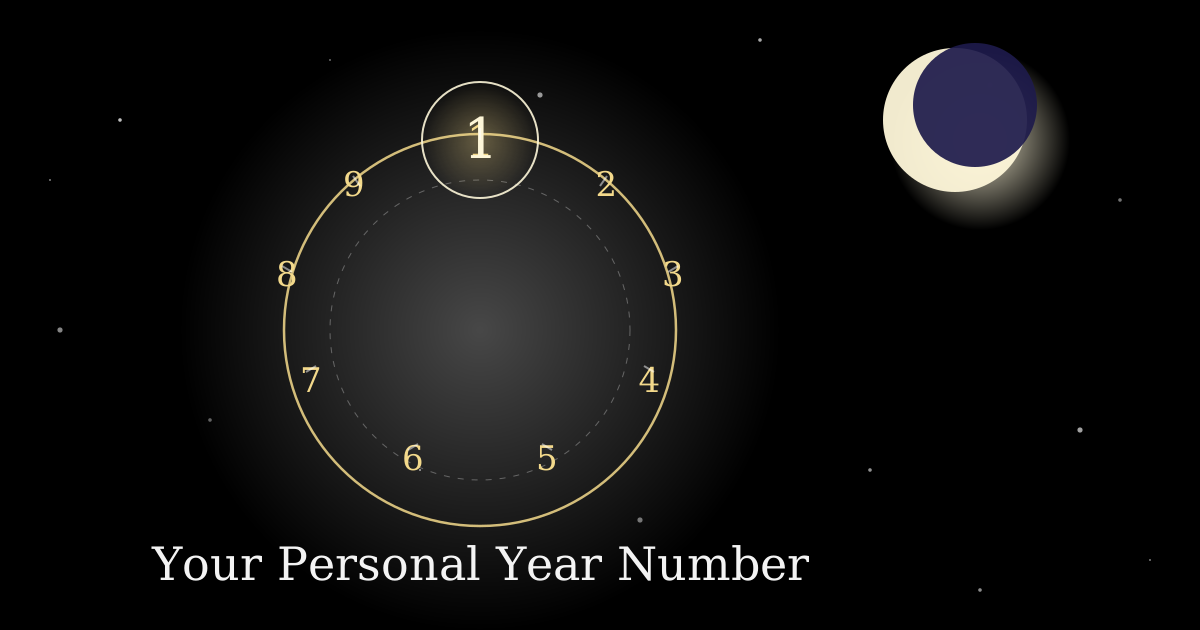
If your Life Path number is the climate of your whole life, your Personal Year number is the weather report for right now. It describes the themes, opportunities, and growth edges of the current calendar year — a single digit from 1 to 9 that changes every January 1st. Numerologists have tracked these nine-year cycles for over a century, and whether you treat them as cosmic timing or as a poetic mirror for self-reflection, they have a strange way of matching the year's texture.
The cycle works like seasons. Year 1 plants the seed. Years 2 through 8 tend the garden — nurturing, pruning, harvesting. Year 9 composts the remains so the soil is ready for the next planting. Most people can look back across nine years and see this rhythm in their own lives: a burst of new beginnings, a long middle of building and consolidating, and a closing year where things naturally wound down or fell away. The Personal Year number simply names the season you're in — and seasons, handled wisely, make every task easier.
Why bother? Because timing matters, and self-awareness makes timing visible. Knowing you're in a 1 year explains why you feel restless to launch things; knowing you're in a 7 year explains why you'd rather research than network. The number doesn't decide anything for you — it just helps you read the room of your own life, so you can move with the year's grain instead of against it.
How to Calculate Your Personal Year Number
The formula is simple: add your birth month + birth day + the current calendar year, then reduce the total to a single digit. Note that you use the current year — not your birth year. That's the only twist.
Step-by-step method:
- Step 1: Write your birth month as a number (January = 1 ... December = 12).
- Step 2: Write your birth day as a number (1–31).
- Step 3: Write the current year — for example, 2026.
- Step 4: Add all the digits together.
- Step 5: Reduce to one digit by adding the digits of the total (repeat if needed).
Worked example: born March 14, calculating for 2026. Month 3 + day 14 → reduce the day first: 1+4 = 5. So 3 + 5 + 2026. Reduce the year: 2+0+2+6 = 10 → 1+0 = 1. Total: 3 + 5 + 1 = 9. A March 14 birthday is in a Personal Year 9 in 2026 — a year of completion and release.
Another example: born November 28, calculating for 2026. Month 11 → reduce: 1+1 = 2. Day 28 → 2+8 = 10 → 1+0 = 1. Year 2026 → 1. Total: 2 + 1 + 1 = 4. November 28 is in a Personal Year 4 in 2026 — a year of work, structure, and laying foundations.
One common question: does the year change on January 1st or your birthday? The overwhelmingly standard modern method uses the calendar year — January 1st. Some older traditions count from the birthday, but if you're reading numerology books, apps, or calculators, they're using January 1st. Stick with that and your number will line up with every other reference.
Your Personal Year 1–9: The Meanings
Year 1 — The Seed (New Beginnings). The first year of the cycle is the green light. Initiative, independence, fresh starts. This is the year to launch the thing: the business, the move, the project, the new identity. Energy favors courage over caution. The temptation is to stay comfortable in the old — the task is to step into the new, even before you feel ready. Ask: what wants to be born?
Year 2 — The Sprout (Patience & Partnership). After the 1 year's bold planting comes the slow work of tending. Year 2 favors cooperation, diplomacy, relationships, and quiet detail. It's the year of the seed beneath the soil — invisible progress. Rushing it ruins it. Ask: what needs gentle tending, and who should I tend it with?
Year 3 — The Bloom (Expression & Joy). The social, creative year. Year 3 favors self-expression, visibility, art, humor, and friendship. Promote, publish, perform, play. It's also the year of emotional honesty — what you don't express in a 3 year leaks out sideways. Ask: what wants to be said, made, or celebrated?
Year 4 — The Roots (Work & Structure). The builder's year. Year 4 favors discipline, organization, health routines, finances, and fixing what's broken. Unsexy and indispensable: this is where the harvest gets secured. The 4 year rewards effort and punishes shortcuts. Ask: what needs strengthening so it lasts?
Year 5 — The Wind (Change & Freedom). The pivot year. Year 5 favors travel, new experiences, flexibility, and breaking ruts. Plans change, doors open (and close), and the schedule gets creative. Resist clinging — the 5 year's medicine is adaptability. Ask: where has life gone stale, and what adventure is calling?
Year 6 — The Hearth (Love & Responsibility). The domestic year. Year 6 favors home, family, relationships, caregiving, and beauty. Commitments deepen — engagements, moves, renovations, reconciliations. It also surfaces duty: the 6 year asks who depends on you. Ask: who and what deserves my devotion?
Year 7 — The Well (Reflection & Study). The inward year. Year 7 favors research, learning, rest, spiritual practice, and honest self-inventory. External momentum slows — not as punishment, but as invitation. Great year for study, writing, therapy, and nature. Ask: what do I actually believe, and what do I need to learn?
Year 8 — The Harvest (Power & Reward). The year of return. Year 8 favors career, money, recognition, and reaping what was sown across the cycle. Effort compounds visibly. It's also the karma year — consequences, good and otherwise, tend to land. Ask: what have I built, and what is it worth now?
Year 9 — The Compost (Completion & Release). The ending year. Year 9 favors forgiveness, letting go, finishing projects, and clearing space — physically, emotionally, and practically. Don't force new beginnings here; clear the ground so the next 1 year has somewhere to plant. Ask: what is finished, and what am I still carrying that I can set down?
How to Actually Use Your Personal Year
Knowing your number is trivia; working with it is the point. Three practical habits make the cycle useful:
- Set intentions to match the theme. In a 1 year, list what you'll start. In a 4 year, list what you'll systematize. In a 9 year, list what you'll release. One page, January.
- Time decisions to the season. Big launches fit 1 and 3 years; big commitments fit 6; deep research fits 7; big asks and negotiations fit 8. This isn't superstition — it's aligning effort with the year's natural emphasis.
- Review at year's end. In December, read the next year's theme and look back: did the 9-year rhythm show up? Most people find at least one "oh, of course" moment — and that recognition is what builds trust in the pattern.
You can layer finer cycles too. Each calendar month has a Personal Month number (Personal Year + calendar month, reduced), and each day a Personal Day. A Personal Year 8 with a Personal Month 2 might mean a lucrative year where this month favors patience and partnership. The yearly theme is the headline; months and days are the weather within it.
Mistakes People Make With Personal Years
Using the birth year instead of the current year. The most common calculation error. Your birth year got you your Life Path; the Personal Year always uses this year.
Treating the number as a verdict. A 5 year doesn't force chaos; a 9 year doesn't doom your plans. The numbers describe themes, not fates. People in "bad" years build great things, and people in "great" years waste them. You remain the author.
Reading only your own number. The cycle is a story in nine chapters — the 8 year means more when you know the 7 that preceded it. Read the whole arc; your current year is a sentence in a paragraph.
Forcing the theme. If your 3 year finds you quiet and inward, that's data, not failure. The cycle describes tendencies in the year's events; your inner life keeps its own schedule. Notice, don't perform.
Try This: Your Year in One Evening
Tonight, do a one-hour personal-year audit:
- Minutes 0–10: calculate your Personal Year number with the formula above.
- Minutes 10–30: read the meaning for your year, then list three things happening in your life right now that fit the theme. (There will be three.)
- Minutes 30–45: write one intention aligned with the year's energy — something you'll start, tend, finish, or release.
- Minutes 45–60: glance at next year's number and note one thing to prepare. Then close the notebook. The cycle does the rest.
This small ritual turns a piece of numerology trivia into a genuine planning tool — one that you'll revisit each January with growing curiosity about what the new season holds.
Frequently asked questions
Does my Personal Year change on January 1st or on my birthday?
Most modern numerologists use the calendar year: your Personal Year number changes on January 1st. Some older traditions start the personal year at your birthday. The January 1st method is far more common in books, calculators, and apps today, so if you're comparing notes with anyone, assume the calendar year. Numerology is a reflective framework rather than a science, so treat either version as a lens for reflection, not a switch that flips your fortunes.
Is a Personal Year 9 a bad year?
A 9 year is an ending-and-clearing year, which can feel uncomfortable if you fight it — but it isn't bad. It's the natural completion of the nine-year cycle: a time to release what has run its course, forgive old debts and grudges, and make space before a new cycle begins. People who use 9 years well report feeling lighter by December, even if the year asked hard questions. Think of it as composting: messy in the moment, fertile in hindsight.
Can I have Master Number Personal Years like 11 or 22?
In most reduction methods, Personal Years are single digits 1 through 9 — an 11 would simply reduce to 2. Some numerologists keep the double-digit before reducing (for example, noting that your 2 year came from an 11), and treat it as a 2 with extra intensity or spiritual undertone. Either way, the base year's themes apply; the Master-Number note is seasoning, not a different dish.
Should I delay a big decision because of my Personal Year number?
No — your Personal Year number is a reflection tool, not a permission slip or a veto. Numerology can suggest themes to be aware of (a 1 year favors fresh starts, a 7 year favors research), which may help you plan with more intention, but it shouldn't override real-world factors like your finances, health, or readiness. Big decisions deserve real-world reasoning; let the number add perspective, not make the call.
What's the difference between a Life Path number and a Personal Year number?
Your Life Path number is permanent — calculated from your birth date, it describes your life's overall journey and stays the same forever. Your Personal Year number is temporary — calculated from your birth date plus the current calendar year, it changes every January and describes the themes of just that one year. Think of Life Path as the climate you live in and Personal Year as the season you're in right now.
Keep exploring

How to Calculate Your Life Path Number: Step-by-Step
How to calculate your Life Path number in numerology: the step-by-step method with worked examples, Master Numbers 11/22/33, and mistakes to avoid. now.
Read the meaning →
Life Path 4 Meaning: The Builder's Complete Guide
Life Path 4 meaning in numerology: traits, strengths, shadow side, love, career & spiritual path of the Builder. The complete guide to this grounded number.
Read the meaning →
Life Path 7 Meaning: The Seeker's Complete Guide
Life Path 7 meaning in numerology: traits, strengths, shadow side, love, career & spiritual path of the Seeker. The complete guide to this deep number.
Read the meaning →
Master Number 11 Meaning: The Illuminator Explained
Master Number 11 meaning in numerology: the Illuminator's gifts, challenges, love, career, 11:11 synchronicity, and grounding practices for sensitivity.
Read the meaning →