
Yes-or-No Oracle Card Readings: How to Get Clear Answers
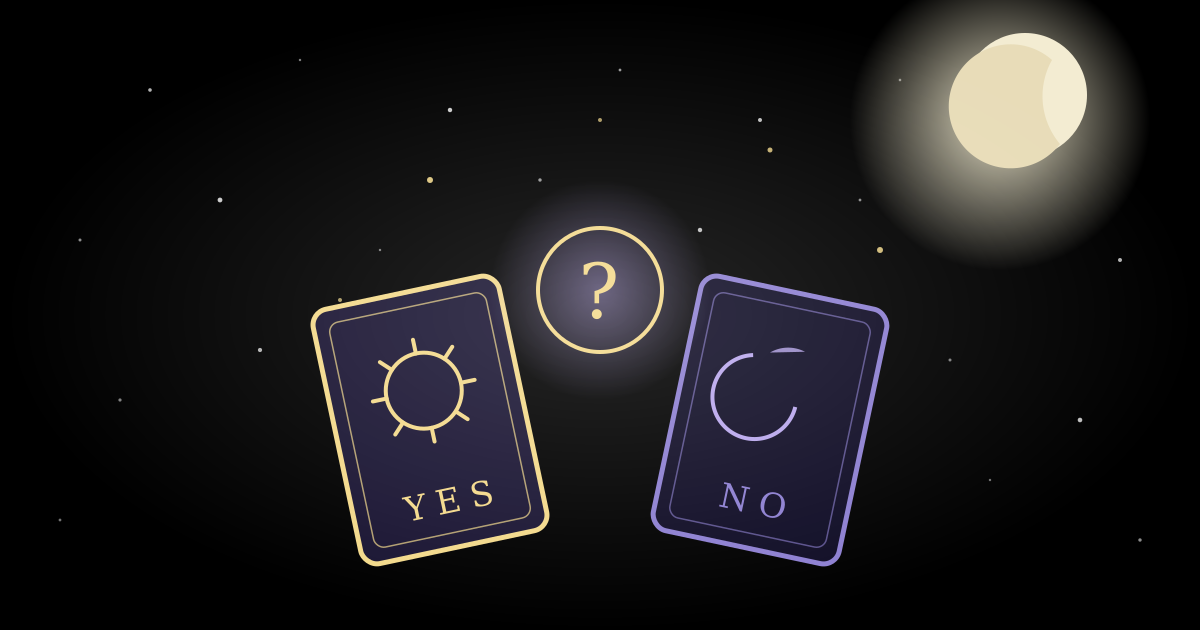
Some questions can't wait for a twelve-card life audit. You're staring at a job offer that expires Friday. You're wondering whether to text him back. You're holding two apartment leases and a deadline, and your brain is going in circles. This is exactly where yes-or-no oracle readings shine: a fast, honest, two-word answer — yes or no — delivered in under a minute.
Oracle cards are especially good at this. Unlike tarot's fixed 78-card system with its court cards and suit hierarchies, most oracle decks speak in moods — encouragement, warning, patience, release — which makes them wonderfully easy to read as yes, no, or not yet. You don't need to memorize anything. You need one clear question, a shuffle, and the willingness to hear the answer.
How Yes-or-No Oracle Readings Actually Work
Before the methods, a quick reframe that will save you disappointment: a yes-or-no pull is a clarity tool, not a crystal ball. The card you draw reflects the energy and likely momentum around your question as things stand right now — which means the answer can shift as you take action, change your mind, or as circumstances move.
Here's the part experienced readers swear by: your first reaction to the answer is half the reading. Draw a "no" card and feel a wave of relief? You probably wanted no all along. Draw a "yes" and feel your stomach sink? That's your intuition talking, and it's worth more than the card. Many readers quietly admit they do yes-or-no pulls mainly to hear what their gut says about the result — and that makes the reading a success either way.
Framing the Question: The Make-or-Break Step
Nine out of ten muddy yes-or-no readings come from muddy questions. The cards can only answer what you asked, so make the question worthy of a clean answer. Three rules:
1. One question at a time. "Should I take the job and move cities?" is two questions wearing a trench coat. Split it: "Is this job right for me?" and "Is this move right for me?" — two pulls, two answers.
2. Make it actually answerable with yes or no. "What about my relationship?" isn't a yes-or-no question — no wonder the card feels vague. Try "Should I give this relationship more time?" instead.
3. Add a timeframe when timing matters. "Is buying this car a good idea?" gets a clearer answer as "Is buying this car a good idea this month?" Without a timeframe, the cards answer for "ever," which is rarely what you meant.
A few good examples to steal: "Is this offer aligned with where I'm headed?" — "Would reaching out to her serve us both right now?" — "Is this the right apartment for me?" Notice each one is simple, direct, and time-bound where it counts.
Method 1: The Single Card Pull
The classic, and honestly all you need most of the time. Shuffle while holding your question in mind, then draw one card. Read its mood:
Yes cards feel like an open door — joyful imagery, forward-motion keywords (growth, abundance, beginnings, flow, trust), bright colors. In your gut, they lift.
No cards feel like a closed door — heavy or cautionary imagery, keywords like endings, release, wait, boundaries, surrender. They land with a thud.
Maybe / not-yet cards feel like fog — neutral imagery, themes of patience, timing, reflection, or transition. Neither a green light nor a red one: a yellow light. We'll deal with these below.
Check your deck's guidebook for the card's keyword if you're unsure — but trust your gut first. If the card feels like a yes before you read the book, it is a yes.
Method 2: The Three-Card Yes-or-No
For questions where one card feels too thin, pull three. The traditional approach: shuffle, draw three, and read the balance. Two or three yes-leaning cards = yes. Two or three no-leaning = no. One of each plus a maybe = the situation is genuinely unresolved, and the maybe card names what's in the way.
A sharper variation gives each card a job: card one answers the question itself (yes/no), card two shows what supports a yes, card three shows what blocks it. This turns a binary answer into a mini-action plan — and it answers the "okay, but now what?" feeling that follows a lonely single card.
Method 3: Reversals as No (or Maybe)
If your deck works with reversals, they make a beautifully simple yes-or-no system: upright = yes, reversed = no. Some readers soften it — upright is yes, reversed is no, and cards that are unreadable reversed (most oracle cards are) count as maybe. The beauty here is speed: the answer is instant, before you even process the imagery.
One honest caveat: oracle decks aren't designed around reversals the way tarot is, so forcing them can feel awkward. If reversals don't click for your deck, skip this method entirely. It's a tool, not a requirement.
Method 4: The Odds Pull
A fun method for the chronically stuck: fan the deck face down and pull one card for each option you're weighing. "Should I stay?" gets one pull; "Should I go?" gets another. Then compare the two cards' energy side by side. This works especially well for either/or decisions, because you're not asking the cards to pick — you're asking them to show you each path's current weather, and the difference is usually stark.
Method 5: The Timing Pull
When the question is really "when," ask that directly. Pull one card for each timeframe you care about: "this week," "this month," "within three months." A strong yes-card in a slot suggests the momentum peaks then. Alternatively, ask "Is this a yes for now?" — if the answer is no, follow up with "Is this a yes for later this year?" Sometimes the cards aren't rejecting your plan; they're rescheduling it.
Reading the Maybe: What "Not Yet" Actually Means
Maybe cards frustrate beginners, but experienced readers love them — they're the most honest answer the cards give. A maybe means one of three things:
The situation has moving parts. Other people, undecided outcomes, information you don't have yet. The cards can't answer what reality hasn't decided.
The question needs rephrasing. Try flipping it to its opposite and pulling again — "Is this the wrong move?" sometimes clears what "Is this the right move?" couldn't. Or add a timeframe, narrow the scope, or ask about the next step instead of the final outcome.
It's a "yes, but" in disguise. Pull one clarifier card and ask: "What would turn this into a clear yes?" The clarifier names the work, the condition, or the timing. This is where a maybe becomes genuinely more useful than a plain yes.
Questions Yes-or-No Readings Are Bad At
Honesty matters here: some questions deserve a bigger reading, or no cards at all.
Third-party questions. "Will she call me?" centers someone else's choices. Reframe around yourself: "Would reaching out to her help?"
Health, legal, and financial decisions. Cards are a reflection tool, not a doctor, lawyer, or accountant. If the answer matters in the real world, pair your pull with professional advice — the cards can help you hear your own gut, but they can't replace expertise.
Questions you've already answered. If you've drawn three "no" cards in a row and you're still pulling, the cards aren't the problem. Sit with the answer, journal about why you resist it, and move on. The cards said what they said.
A 60-Second Yes-or-No Ritual
Here's the whole practice in its simplest form: hold the deck, take three slow breaths, and say your question out loud (saying it makes vagueness audible). Shuffle until it feels done — usually when a card jumps out or your hands slow down. Draw, and notice your body's reaction before your brain's. Log the question, the card, and your first feeling in a journal or notes app. A month later, read back through your log: you'll learn which deck "voice" you trust, how your maybes resolved, and — most valuable of all — how often your gut knew the answer before the cards said it.
Frequently asked questions
Are yes-or-no oracle card readings accurate?
Think of them as a clarity tool, not a prediction machine. A yes-or-no pull reflects the energy and likely momentum around your question as things stand right now — and your gut reaction to the answer often tells you what you really wanted. Use the cards to get unstuck, not to outsource decisions.
How do you phrase a yes-or-no question for oracle cards?
Ask one clear question at a time, in simple words, with a timeframe if one matters. Good: "Is this job offer aligned with me right now?" Weak: "What about my career and should I move?" The cleaner the question, the cleaner the answer.
What if I get a maybe or unclear card in a yes-or-no reading?
Treat it as "not yet" — a sign the situation still has moving parts, or the question needs rephrasing. Common fixes: add a timeframe ("Is this the right move this month?"), flip the question to its opposite and re-pull, or pull one clarifier card asking "What would make this a clear yes?"
Can I do a yes-or-no reading with any oracle deck?
Yes, though some decks suit it better. Decks with short, decisive guidebook keywords or strong positive/negative card tones (like light-versus-shadow decks) make yes/no pulls easy. Highly abstract or one-word-affirmation decks work too — you simply read the card's mood as yes, no, or maybe.
Should I ask the same question twice if I don't like the answer?
Resist the re-pull. Asking again until you get the answer you want trains you to ignore the cards entirely. If the answer truly feels wrong, sit with it for a day — your reaction is information. The only good reason to re-ask is a genuinely different question, like adding a timeframe or asking about the alternative.
Keep exploring

How to Read Oracle Cards: A Beginner's Guide
How to read oracle cards: a complete beginner's method — asking questions, the 3-card spread, developing intuition, and building a daily practice.
Read the meaning →
Oracle Card Spreads & Daily Draws: Simple Layouts That Work
Oracle card spreads for beginners: the daily draw, 5 easy spreads (past-present-future, year ahead), lunar layouts & reading for others.
Read the meaning →
How to Cleanse Your Oracle Cards: 7 Simple Methods That Work
How to cleanse oracle cards: smoke, moonlight, selenite, knocking, sound & breath resets — plus when to cleanse and how to reconnect with your deck.
Read the meaning →
Oracle Cards vs Tarot: What's the Difference?
Oracle cards vs tarot: what's the difference? Compare structure, learning curve, reading style & cost to choose the right divination deck for you.
Read the meaning →