
Fate Line Meaning: How to Read Your Line of Destiny & Career
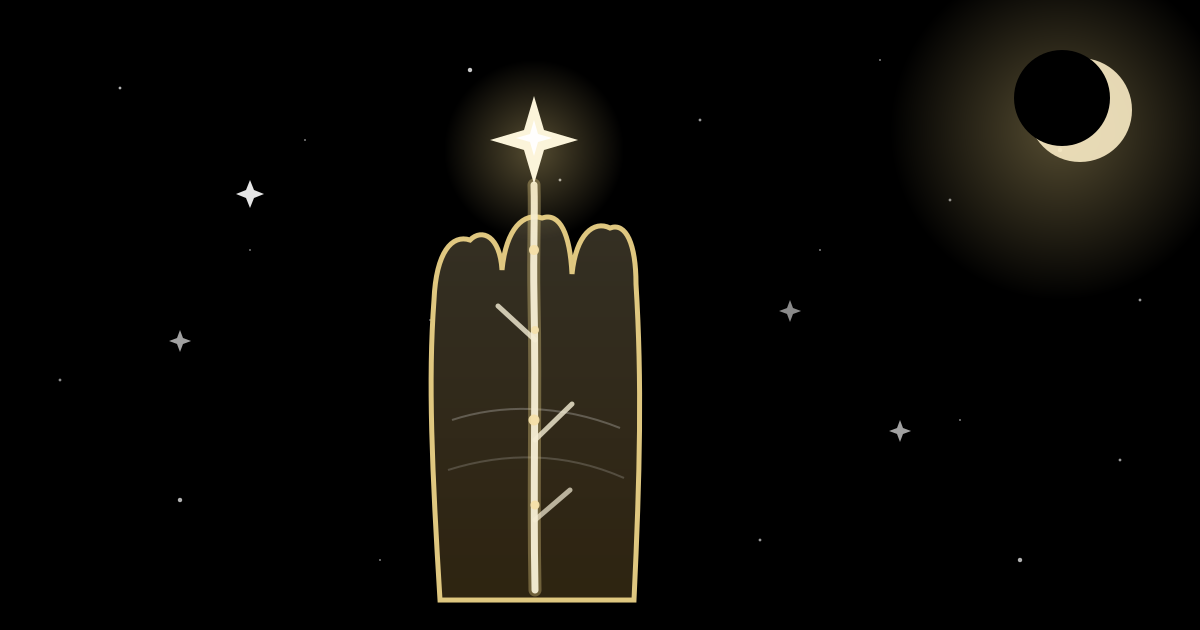
The heart line speaks of love, the head line of thought, the life line of energy — and the fate line speaks of direction. Also called the line of Saturn or the line of destiny, it is the great vertical running from the lower palm upward toward the middle finger, and tradition reads it as the biography of your ambition: how stable your path has been, where your drive comes from, and whether your career has followed a straight road, a winding trail, or a route you built yourself with no map at all.
One honest framing before we begin, because this line tempts people to look for guarantees: palmistry is a folk art for reflection and entertainment, not a fortune guarantee. No line on your hand decides your career — your choices do. What the fate line offers is a mirror for thinking about your working life: the patterns of drive, change, and timing that have shaped you so far, and the ones you might choose next. Read it as a story about yourself, not a script.
Finding Your Fate Line
Hold your dominant hand palm-up under good light. The heart, head, and life lines all run roughly horizontally or curve across the palm — the fate line is the one that runs vertically, from the bottom of the palm (near the wrist or the life line) upward toward the Mount of Saturn, the padded area beneath the middle finger. It is often the faintest of the major lines, and on some hands it appears only in segments, like a dotted road on an old map.
Not everyone has one, and that is not a defect — we will come back to that, because the missing fate line is one of palmistry's most misunderstood readings. First, trace whatever vertical line you can find. Note four things: where it begins, how deep and clear it is, whether it breaks or branches, and where it ends. Those four qualities are the fate line's entire vocabulary.
Where It Begins: Four Classic Starting Points
The fate line's starting point is traditionally read as the source of your drive — what launched your working life and what has fueled it since.
A fate line that begins at the wrist or the very bottom of the palm suggests a career path shaped by circumstance, tradition, or expectation — the family business, the obvious next step, the path that was there before you chose it. People with this start often describe their early working years as something that happened to them, and their later years as the process of making it their own. The reading here is not passivity; it is inheritance, in the widest sense.
A fate line that begins on the Mount of Luna — the outer edge of the palm near the wrist — is traditionally the mark of a public or creative career: work that involves audiences, imagination, or being seen. Writers, performers, designers, and anyone whose career lives in the public eye often carry this start. Tradition also reads it as a career influenced by other people — mentors, chance meetings, the right introduction at the right time.
A fate line that begins inside the life line, near the Mount of Venus (the thumb's fleshy base) suggests a path supported by family — financial help, connections, or simply the confidence that comes from a strong home base. The reading is one of being backed: your beginnings were resourced, and your career grew from solid ground rather than from scratch.
And a fate line that begins at the head line, well up the palm, is traditionally read as success that arrives after roughly age thirty-five — the self-made arc. These are the late bloomers: people whose twenties were exploration and whose thirties and beyond brought focus. If your fate line seems to start halfway up your palm, tradition says your real career story began when you finally knew what you wanted.
Depth and Clarity: How Loud Is Your Line?
A deep, clear fate line running unbroken up the palm traditionally indicates a stable, strongly directed career — a person who knows what they are about and pursues it with unusual consistency. These are the lifers: the teacher who always knew, the craftsperson who never wavered. The shadow side of such clarity is rigidity; a path this straight can make detours feel like failures instead of information.
A faint or wavering fate line suggests a career shaped by exploration, flexibility, or circumstance — portfolio careers, pivots, periods of freelancing, the modern working life in miniature. Tradition reads this not as weakness but as adaptability: the ability to rebuild, re-skill, and begin again. In an economy that reinvents itself every decade, the faint line may be the most future-proof marking of all.
Pay attention to whether the line strengthens as it rises. A fate line that starts faint and deepens toward the top is traditionally read as growing confidence and commitment — the story of someone who found their footing over time. A line that fades as it climbs suggests the opposite season: a career in questioning, a path being reconsidered. Both are chapters, not conclusions.
Breaks, Islands, and Branches: The Career Plot Twists
This is where the fate line stops describing your nature and starts narrating your history. A break in the fate line — a clean gap in its run — is traditionally read as a career interruption or redirection: a job loss, a voluntary pivot, a period of unemployment, a decision to walk away. When the two broken ends overlap, tradition reads a smooth recovery — the new chapter picked up before the old one fully closed, the way a trapeze artist catches the next bar mid-swing. A break with no overlap suggests a chapter that ended before the next began: the gap year, the sabbatical, the honest pause.
Islands — small ovals sitting on the line — are read as periods of struggle or stagnation within the career: the difficult boss, the stalled promotion, the years of going through the motions. A chain of islands suggests a longer stretch of friction. Tradition's counsel here is practical rather than mystical: islands mark where energy leaked, and naming the leak is the first step to sealing it.
Branches tell the happier part of the story. Upward branches rising from the fate line toward the fingers are traditionally read as successes, promotions, and moments of recognition — the line reaching for more and finding it. Downward branches are read as setbacks or sacrifices made for the career: the opportunity declined, the project that cost more than it paid. And a fate line crossed by many small horizontal lines is read as a career full of other people's opinions — interference, in the old books; in modern terms, a highly collaborative (or highly political) working life.
The Missing Fate Line: Why Absence Is Not a Verdict
Some palms show no fate line at all — or only the faintest ghost of one. Beginners sometimes read this as a bad omen, and it is nothing of the kind. Tradition reads the missing fate line as the self-made path: a life shaped less by circumstance, inheritance, or expectation than by personal choice. Entrepreneurs, freelancers, career-changers, and people who simply never fit a ladder often carry this palm.
The reading is freedom, with its honest price. Without a strong fate line, tradition says, there is less external structure to lean on — no obvious track, no inherited momentum. What replaces it is self-direction: the person decides, again and again, who to become. If your palm shows no fate line, palmistry's message is not that you lack destiny. It is that you write your own, in pencil, revising as you go.
Reading Time Along the Line
Traditional palmists divide the fate line into an approximate age scale, reading upward from youth to maturity. The bottom of the line — near the wrist — represents the teens and early twenties. The midpoint, where the line crosses the head line, is read as roughly age thirty-five. The top, approaching the Mount of Saturn, represents the fifties and beyond.
This is the fate line's most practical feature: you can locate your own history on it. Find the breaks, islands, and branches, and estimate where they fall on this scale. Many readers report an uncanny correspondence — the career crisis at thirty landing exactly where the line breaks, the promotion at forty where the branch rises. Treat these correspondences as what they are: prompts for reflection, not proof of prediction. The value is in the review, the way rereading an old diary clarifies the present. Where did your path bend, and what did the bend teach you?
Endings: Forks, Tridents, and the Mount of Saturn
Where the fate line ends adds the final nuance. A line that reaches the Mount of Saturn beneath the middle finger is traditionally read as a career that arrives — ambition fulfilled, the long game won. A line that stops at the head line suggests a career interrupted or redirected by a decision — sometimes a chosen one, the person who walked away on purpose.
A fork at the end — the line splitting into two — is read as a late-career choice between two paths, or a second act: the executive who becomes a teacher, the specialist who goes broad. A trident (three prongs) at the ending is considered one of the luckiest markings in palmistry: success recognized on multiple fronts, the rare career that pays in money, meaning, and reputation at once.
If the fate line ends in a star — several short lines crossing at a point — tradition reads a moment of extraordinary recognition, for better or worse: fame, a windfall, a scandal survived. And if it ends in a square, the old books promise protection: a career that weathers its crises, the person who lands on their feet.
A Fate-Line Exercise for Tonight
Here is a practice that turns the fate line from a curiosity into a tool, and it takes ten minutes. Draw a vertical line down a sheet of paper and mark it as your own career timeline: bottom for your teens, the middle for thirty-five, the top for where you are now and beyond. Then mark your real history on it — every job, every pivot, every break and branch — as honestly as you can.
Now look at your actual palm beside your paper timeline. Where do they rhyme? Where do they differ? The exercise's power is not in the matching but in the mismatches: the break on your hand you forgot to draw, the upward branch you never credited yourself for. Finally, extend both lines a little into the future and sketch — lightly, in pencil — what you want the next chapter to look like. The fate line cannot predict it. But the act of drawing it is the first draft of making it true.
A Final Thought on Destiny
Whatever your fate line looks like — deep or faint, straight or broken, present or beautifully absent — meet it the way you would meet an old map: with interest in where you have been and no obligation to follow it further. The line records your relationship with direction so far — how you have chosen, endured, pivoted, and persisted. It does not choose for you.
Palmistry's oldest insight about the fate line is also its kindest: the line of destiny is drawn in the most changeable medium imaginable — skin, which renews itself constantly. Your path is not engraved. It is being written, right now, by the hand that holds this page. The fate line can show you the pen. What you write with it has always been up to you.
Frequently asked questions
What is the fate line in palmistry?
The fate line — also called the line of Saturn or the line of destiny — is the vertical line running from the lower palm toward the middle finger. Tradition reads it as a map of career, ambition, and life direction: how stable your path has been, where your drive comes from, and how your work life unfolds over time.
What does it mean if I have no fate line?
A missing fate line is common and is traditionally read as a self-made, self-directed path — a life shaped more by personal choice than by circumstance or expectation. Many entrepreneurs, freelancers, and career-changers have faint or absent fate lines. It is read as freedom, not failure.
Does a broken fate line mean career failure?
No. Breaks in the fate line are traditionally read as career changes, interruptions, or redirections — a job change, a pivot, a period of rethinking. When the broken ends overlap, tradition reads adaptation and a smooth recovery; the line describes chapters, not verdicts.
Which hand do I read the fate line on?
Read your dominant hand for the career path you are actively living, and compare it with the other hand for the path you were inclined toward. Right-handed readers check the right hand; left-handed readers check the left. Differences between the hands are read as the gap between inclination and reality.
Can the fate line change over time?
Tradition holds that palm lines deepen, fade, and shift as life changes — the fate line especially so, since careers evolve. A line that strengthens after a career change is read as commitment consolidating; one that fades during uncertainty is read as a period of open questions. Palmistry treats the hand as a living record, not a fixed script.
Keep exploring

Head Line Meaning: How to Read the Line of Your Mind
Your head line maps how you think: logic versus intuition, focus, creativity, and decision style. Learn to read its length, slope, depth, breaks, and the famous writer's fork.
Read the meaning →
Life Line Meaning: What Your Life Line Really Reveals
Your life line reveals vitality, energy and major life chapters, not lifespan. Learn to read its length, depth, breaks, branches and markings with our guide.
Read the meaning →
What Does It Mean to Dream About Flying?
Flying dreams rank among our happiest. Discover what dreaming about flying means — freedom, ambition, confidence — and what turbulence reveals.
Read the meaning →
Sagittarius Zodiac Sign: Personality, Traits & Compatibility
Sagittarius (Nov 22–Dec 21) is an adventurous fire sign ruled by Jupiter. Discover Sagittarius traits, strengths, love compatibility, and career paths in this guide.
Read the meaning →