
Fingers Meaning in Palmistry: What Each Finger Reveals
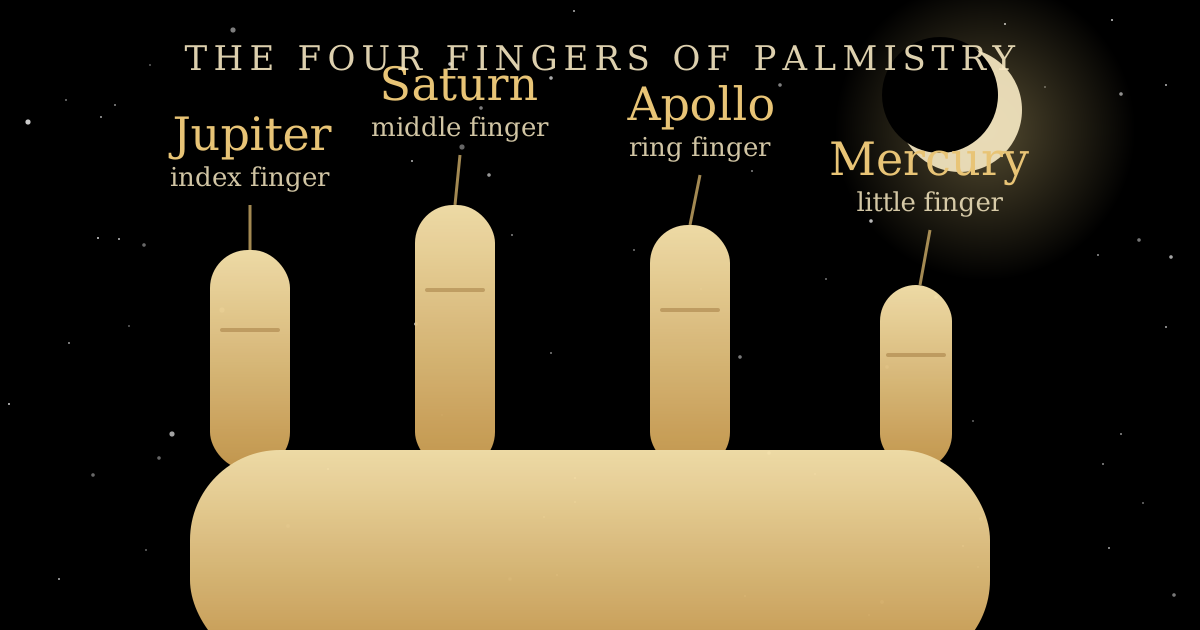
Hold your hand up and look at it like a palmist does — not at the famous lines, but at the four fingers standing above the palm. In palmistry tradition, those fingers are far more than tools for gripping: each one is the ambassador of a planet, carrying its own temperament, talents, and temptations. The index finger speaks for Jupiter, the middle for Saturn, the ring for Apollo (the Sun), and the little finger for Mercury. Together, they form a four-person committee that runs your personality.
This planetary assignment is one of the oldest layers of hand reading, shared across Greek, Indian, and Chinese traditions. It sounds fanciful, but the method behind it is wonderfully practical: you compare the fingers against each other, note which ones dominate, and ask what that emphasis says about the person. No equipment needed, no hour-long session — just your eyes and someone willing to show you their hand. Let us meet the four committee members.
The Index Finger: Jupiter — Ambition and Leadership
The index finger is the finger of Jupiter, the planet of expansion, authority, and confidence — and in palmistry it is read as the seat of ambition, leadership, and self-belief. This is the finger you point with, the finger that takes charge of the room. A long, straight, well-formed index finger traditionally marks a natural leader: someone comfortable with responsibility, driven to achieve, and confident in their own judgment.
But Jupiter's energy has a shadow side, and palmists read the extremes honestly. An index finger that towers over the middle finger — or dominates the hand — is read as pride and dominance: ambition curdling into arrogance, the need to be right, the habit of pulling rank. A short index finger, barely reaching its neighbor, traditionally suggests hesitation and low self-confidence: a person who defers to others and struggles to assert themselves, though often with a gentle, unassuming charm. The sweet spot — an index finger in graceful proportion — is read as healthy self-belief: ambition with enough humility to learn. If you are wondering where your own drive comes from, start here.
The Middle Finger: Saturn — Responsibility and Balance
The middle finger is the finger of Saturn, the planet of time, discipline, and consequence — and it is read as the hand's center of gravity. Because it stands tallest at the middle of the hand, palmistry casts it as the symbol of balance, responsibility, and sober judgment. This is the finger of the planner, the accountant, the one who reads the terms and conditions.
A long, straight middle finger is read as strong Saturn energy: seriousness, reliability, organizational talent, and a deep sense of duty. These are the people who finish what they start and show up on time. When Saturn dominates — a middle finger dramatically longer than its neighbors — the tradition warns of its shadow: gloominess, rigidity, excessive caution, the person who says no before hearing the proposal. A short middle finger suggests a lighter, more spontaneous temperament: someone who lives in the moment and chafes at routine, though they may need external structure to thrive. Saturn is neither reward nor punishment in this reading — it is simply the part of you that takes life seriously.
The Ring Finger: Apollo — Creativity and Expression
The ring finger belongs to Apollo, the Sun — the planet of creativity, beauty, self-expression, and the joy of being seen. This is the finger of the artist, the performer, the romantic. A ring finger that reaches well up its neighbor, approaching the middle finger's height, is read as strong Apollo energy: expressiveness, charm, aesthetic sense, and a hunger for recognition.
Palmists have long associated a prominent ring finger with risk-taking and competitive drive — the person who bets on themselves. In the old texts this was the finger of gamblers and lovers of pleasure, but modern readers translate it more generously: vitality, warmth, and the courage to be visible. A short or weak ring finger suggests a quieter relationship with self-expression: the person may be deeply creative privately but shy of the spotlight, or simply less motivated by applause. And here is a charming detail the tradition loves — the ring finger is also the finger of the wedding band, linking Apollo's energy to devotion and partnership. Creativity and love, palmists say, are the same fire in different fireplaces.
The Little Finger: Mercury — Communication and Business
The little finger is the finger of Mercury, the planet of words, wit, and commerce — and it is read as the measure of your communication skills and business instinct. This is the finger of the storyteller, the negotiator, the networker. A long, straight little finger that reaches the top joint of the ring finger is traditionally read as the mark of an eloquent, persuasive mind: someone quick with words, sharp in a deal, and socially agile.
Mercury's shadow is as well documented as its gift. An overly long or prominent little finger is read as the silver-tongued extreme: talkativeness, scheming, the person who could sell sand in a desert but may not always tell you it is sand. A short little finger suggests shyness in self-expression or naivety in business — someone who may be taken advantage of in negotiations and who benefits from bringing a sharper friend to the table. The little finger also sits atop the Mount of Mercury, and palmists read the two together: a strong little finger over a full mount is the classic signature of the born communicator, from teachers to traders.
Finger Length: Reading the Hand as a Whole
Individual finger meanings are only half the story — palmists always read the fingers against the palm and against each other. Hold your hand flat and compare your fingers' total length to your palm's length (wrist to the base of the fingers). Long fingers relative to the palm are traditionally read as the mark of the analyst: detail-oriented, careful, patient, someone who notices everything and finishes the research. The shadow is overthinking — analysis that never becomes action.
Short fingers relative to the palm suggest the opposite temperament: quick, intuitive, action-oriented. These people decide fast, improvise well, and get impatient with long processes. Their shadow is impatience with detail — they may miss the fine print. Average-length fingers, in balance with the palm, are read as the adaptable middle: enough patience for detail, enough drive for action. And always compare the two hands — a dominant hand showing longer, more developed fingers than the passive hand is read as a life that has trained the mind, whatever the starting material was.
Finger Spacing: How the Fingers Sit Together
Now spread your fingers wide and look at the gaps between them — palmistry reads the spaces as eloquently as the fingers themselves. Fingers held close together traditionally suggest caution, discretion, and self-containment: the person who keeps their cards close and their circle small. Fingers spread wide apart suggest openness, independence, and self-confidence: the person who takes up space comfortably and trusts their own judgment.
The tradition even reads individual gaps. A wide space between the index and middle fingers is read as independence of thought — the person who forms their own opinions rather than inheriting them. A gap between the middle and ring fingers suggests a free spirit, someone who resists being boxed in by convention. And the little finger standing apart from the ring finger is read as the classic mark of the independent thinker — the person who is happy to be the odd one out. None of these are compliments or criticisms in the tradition; they are simply notes on how you relate to the crowd around you.
Phalanges and Fingertip Shapes
Each finger has three phalanges (segments), and palmistry assigns each a layer of meaning: the tip phalange (with the nail) represents the intuitive, spiritual, or idealistic side; the middle phalange represents the practical, businesslike, intellectual side; the base phalange (nearest the palm) represents the material, physical, instinctive side. A well-developed tip segment suggests the finger's energy flows toward ideals; a heavy base segment, toward appetite and practicality. Glance at your own fingers: which segment dominates on each?
The fingertip shape adds another layer, echoing the thumb system. Square tips suggest order and method; conic (rounded) tips suggest artistic feeling and tact; spatulate (spade-like) tips, wider at the end, suggest originality and restless energy; pointed tips suggest intuition and quickness of mind. Knotty, prominent finger joints — the "philosophic hand" of the old books — are read as the mark of the deep thinker: someone who analyzes before acting and values truth over comfort. Smooth joints suggest intuition and quick, impressionistic judgment.
Bent, Twisted, and Leaning Fingers
Few hands have perfectly straight fingers, and palmistry reads the imperfections as some of the most telling details. A finger that bends toward its neighbor is traditionally read as borrowing that neighbor's qualities — an index finger leaning toward Saturn suggests ambition disciplined by caution, while a ring finger leaning toward the little finger suggests creativity expressed through communication. A finger bending away from its neighbor suggests independence from that influence, sometimes to the point of tension with it.
Twisted fingers — fingers that rotate along their axis — are read as the mark of unconventional, idiosyncratic thinking: the person whose mind takes routes nobody else would think of. The old texts associated very twisted fingers with cunning, but modern readers treat it more kindly, as originality that does not fit standard molds. And the classic crooked little finger, bending noticeably, is traditionally read as diplomatic talent — the person who can navigate social situations with tact — with the honest footnote that extreme crookedness was once read as dishonesty. As always in palmistry, the gentle reading applies to gentle bends; only dramatic features earn dramatic interpretations.
Read Your Fingers in Two Minutes
Now put the committee to work. First, name each finger's planet: Jupiter (index) for ambition, Saturn (middle) for responsibility, Apollo (ring) for creativity, Mercury (little) for communication. Second, compare their lengths — which planet dominates your hand? Third, spread your fingers and read the gaps: are you open or guarded, independent or tribal? Fourth, check the tips and joints for your thinking style.
Then do what palmists have always done: read the hand of someone you know well and test your reading against reality. You will be surprised how often the fingers get the person right — not because the stars ordained it, but because the hand is a record of how you have used it, and you have used it to be yourself. The lines may tell your story and the mounts may color your temperament, but the fingers, raised like four flags above the palm, announce to the world who is in charge of the committee. And now you can read the announcement.
Frequently asked questions
What does each finger mean in palmistry?
In traditional palmistry each finger is linked to a planet: the index finger is Jupiter (ambition, leadership, confidence), the middle finger is Saturn (responsibility, discipline, caution), the ring finger is Apollo or the Sun (creativity, self-expression, charm), and the little finger is Mercury (communication, business sense, wit).
What does a long ring finger mean in palmistry?
A ring finger that reaches or passes the middle of the middle finger's top segment is read as strong Apollo energy: creativity, expressiveness, charm, and a taste for beauty and risk. Tradition links it to performers, artists, and people who shine in the spotlight.
What does it mean if your middle finger is much longer than the others?
A notably long middle finger emphasizes Saturn: seriousness, responsibility, organization, and caution. It is read as the mark of the planner and the dutiful one — with the traditional shadow side being gloominess or rigidity when the Saturn energy dominates.
Which finger is associated with wealth in palmistry?
The little finger (Mercury) is the traditional finger of commerce — a long, straight, well-formed Mercury finger is read as business acumen and a gift for deals. The index finger (Jupiter) is the finger of leadership and position, traditionally linked to prosperity through authority and ambition.
What do bent or crooked fingers mean in palmistry?
A finger that bends toward its neighbor is traditionally read as borrowing that neighbor's qualities — for example, an index finger leaning toward Saturn suggests ambition tempered by caution. A finger bending away suggests independence from that influence. Very crooked fingers are simply read as unconventional, idiosyncratic thinking.
Keep exploring
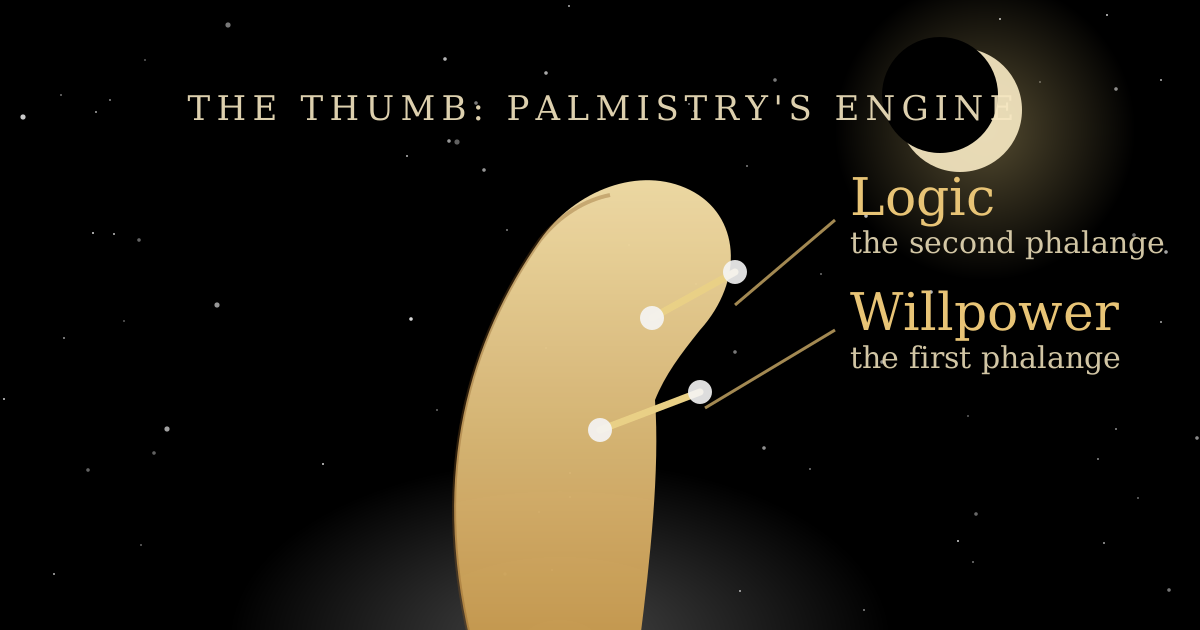
Thumb Meaning in Palmistry: Willpower, Logic & Thumb Shape
Your thumb is palmistry's engine of willpower and logic. Learn to read thumb length, shape, flexibility, the two phalanges, and what a high-set or low-set thumb means.
Read the meaning →
Mounts of the Palm: A Complete Guide to the 7 Mounts
The 7 mounts of the palm, Venus, Jupiter, Saturn, Apollo, Mercury, Moon and Mars, reveal your drives and talents. Learn to read every mount, step by step.
Read the meaning →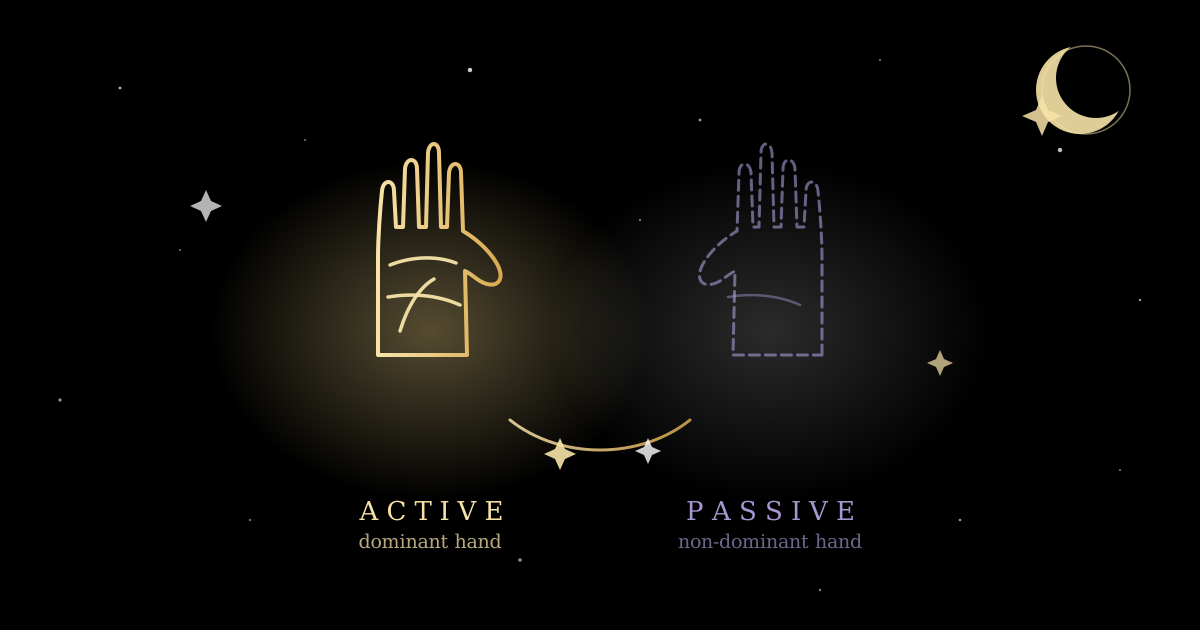
Which Hand Do You Read in Palmistry? Dominant vs Passive Hand
Which hand do you read in palmistry? Learn the dominant vs. passive hand tradition, the old men-and-women rules, why palmists read both hands, and how to compare yours.
Read the meaning →
What Does It Mean to Dream About Being Chased?
Being chased in a dream is frightening but meaningful. Learn what chase dreams reveal about stress, avoidance, and the fears you keep running from.
Read the meaning →