
Mount of Mercury in Palmistry: Communication, Wit & What Its Shape Really Means
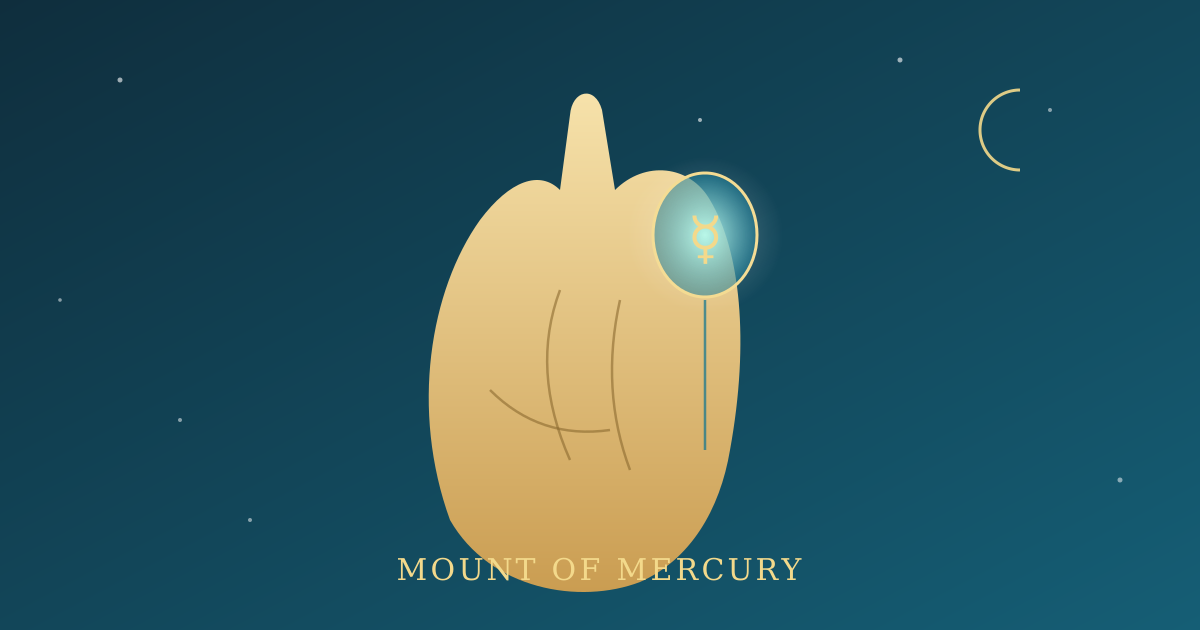
If the mounts of the palm were a dinner party, Mercury would be the guest who keeps the conversation moving. Named for the Roman messenger god, swift-footed, quick-tongued, and fond of trade, Mercury governs everything that travels between people: words, jokes, deals, messages, and ideas. Its mount sits beneath the little finger, on the outer edge of the upper palm, and traditional readers treat that position as telling. Mercury is the hand's messenger, the place where thought turns into speech and speech turns into action.
That reputation for cleverness gives Mercury a complicated image. People hear "quick-witted" and picture either a sparkling conversationalist or a slippery dealer, and the old books contain both portraits. The fairer reading is broader. Mercury's gift is adaptability. Where other mounts hold steady, Mercury adjusts: it finds the right word, the workable compromise, the angle nobody else saw. In a world that runs on communication, that flexibility is a genuine strength, and learning to read this mount is learning to notice how you and the people around you actually get heard.
Where Is the Mount of Mercury?
Hold your hand open and find your little finger, the smallest finger on the hand. Slide straight down from its base into the palm and you are standing on the Mount of Mercury. It sits on the outer edge of the palm, above the Mount of Moon, and just beyond the end of the heart line, which often runs toward it and stops nearby. Unlike Venus, which announces itself as a big pad at the thumb, Mercury is usually modest. On many hands it is a gentle rise rather than a dramatic mound, and beginners sometimes overlook it entirely, especially if the neighboring Mount of Apollo beneath the ring finger is prominent and crowds it.
Its most important neighbor is not another mount but a line: the Mercury line, also called the health line, which often runs upward from the wrist area toward this mount. When the health line reaches Mercury cleanly, traditional readers see a person whose energy and communication feel in balance. When it is faint, broken, or missing, they read a different story, one that is about rest and balance rather than failure, as our guide to the health line explains. The mount and the line are separate features, but they tell one story together, which is why no careful reader judges Mercury's pad without glancing at the line approaching it.
A Prominent, Well-Formed Mount of Mercury
A Mount of Mercury that rises clearly and evenly from the palm, firm to the touch and in proportion with its neighbors, is the classic picture of the communicative temperament in the old books. Traditionally, it marks a person who is quick-thinking without being careless: articulate, witty, curious, and good at explaining complicated ideas in plain words. These are the friends who can talk their way through a travel mix-up, who write the email that finally settles an argument, who spot the detail in a contract everyone else skimmed. Their cleverness is not a trick. It is simply how they are built.
The tradition also links a strong Mercury to a talent for business and exchange. A prominent Mercury often belongs to people who enjoy negotiation, who understand value, who are comfortable with numbers, markets, and the give-and-take of trade. This is not greed in the old sense. It is the pleasure of a fair deal well made, and of a system that works because everyone understood the terms. Mercury's wisdom, the old texts insist, is practical, and the mount's prominence suggests someone who learns by doing, talking, and trying again.
An Overdeveloped Mount of Mercury
As with every mount, Mercury has a shadow side when it dominates the hand. A very large, hard, or bulging Mercury, especially one that towers over Apollo beside it, is traditionally read as quickness tipping into restlessness: talking too much, thinking too fast to listen, or a tendency to treat every conversation as a negotiation to win. The old books describe such hands as belonging to people who can argue any side of a question, who grow bored quickly, and who sometimes value a clever line over an honest one. It is a recognizable portrait, and most of us know someone who fits parts of it on a busy day.
The honest reading, though, is gentler than the old warnings. An overdeveloped Mercury often appears during periods of genuine pressure: a job that demands constant communication, a season of selling, persuading, or explaining yourself. The hand reflects the season, and seasons change. The tradition's practical advice for a heavy Mercury is delightfully concrete rather than mystical: listen one full beat longer before answering, write the thought down before saying it, and spend time with people who reward quiet honesty over wit. Mercury does not need to be silenced. It needs balance, and Apollo's warmth and Saturn's patience, sitting nearby, are exactly the neighbors meant to provide it.
A Flat or Underdeveloped Mount of Mercury
Now look for the opposite pattern. A flat Mount of Mercury, one that barely rises from the palm, traditionally suggests a quieter, more deliberate relationship with speech. These readers are not unintelligent people, and the better palmistry books are careful to say so. They are simply more thoughtful before they speak, more comfortable with silence, and less inclined to think out loud than the strong-Mercury type. They may dislike small talk, prefer written words to spoken ones, and make their best points after a pause, and that deliberation is a genuine strength in careful work, deep study, and conversations where accuracy matters more than speed.
A flat Mercury can also mean that a person's confidence in speaking is still forming, which is normal at many ages and stages. The tradition notes that Mercury tends to develop with practice, as a person finds audiences, roles, and subjects that reward their voice. A young hand with a quiet Mercury may belong to someone whose Mercury chapter simply has not arrived yet. Readers who revisit the same hand over years often find Mercury rising as a person learns to teach, present, sell, or advocate, which is a good reminder to read the hand as a story in progress rather than a final grade.
Firmness, Color, and Texture
Size is only the first chapter. Press the mount gently and notice how it responds. A firm, resilient Mercury that springs back is traditionally read as balanced quickness: wit that supports life rather than exhausting it. A very hard, tense Mercury suggests a mind held too tightly, a person always ready with the next argument, while a very soft, yielding Mercury suggests a quickness that tires easily, or a thoughtful nature that struggles to turn thought into words under pressure. None of these is a diagnosis of any kind. They are traditional metaphors for temperament, best treated as prompts for honest self-reflection rather than facts about the body.
The old books also mention color, though it should be read with even more caution, since skin tone and circulation vary widely. A healthy, even tone on Mercury is traditionally linked to steady energy, while unusual paleness or mottling is simply noted as a sign to rest and take care of yourself. If anything about your hands ever worries you physically, a doctor, not a palm reader, is the right person to ask. Mercury's real value is symbolic: it gives you a vocabulary for noticing how clearly, quickly, or patiently you communicate, and that noticing is useful in itself.
Lines and Marks on the Mount of Mercury
Mercury's markings are read with special care because the health line ends here, and the mount often carries small signs of its own. A single clear vertical line rising into Mercury is traditionally read as strong communication ability, a gift for speaking or writing that feels natural rather than forced. A cross on Mercury has a mixed reputation in the old books, sometimes linked to a period of worry or a sharp tongue, and modern readers tend to treat it gently, as a sign of a chapter when words caused trouble and taught a lesson. A star on Mercury is one of the more debated marks in palmistry: some old texts read it as a warning about dishonesty or sudden change, while others read it as a mark of exceptional talent in speech, writing, or business, and the disagreement itself is a useful lesson in how little weight a single mark should carry.
A grille, a crisscross lattice of fine lines, is traditionally read as nervous energy concentrated in Mercury's territory: a mind talking too fast, even to itself. A square is read as protection, a kind of shelter around one's words and dealings, while an island in a line approaching Mercury is read as a period of uncertainty or divided effort. As with every mark in palmistry, one sign is a whisper. A star on an otherwise calm, well-formed Mercury means far less than a star combined with a broken health line and a chained head line. Patterns across the hand are the conversation; single marks are only words.
Mercury, the Health Line, and the Little Finger Together
The most useful Mercury reading comes from combining three features. First, the mount itself: its size and firmness sketch the temperament, the raw material of wit and communication. Second, the health line: its clarity, breaks, and branches describe the energy that temperament has to work with, including the seasons when rest mattered more than speed. Third, the little finger: a long, straight little finger beside a strong Mercury is the traditional picture of communication expressed openly, while a short or bent little finger suggests a Mercury nature that expresses itself more privately, through writing, humor, or one-to-one conversation rather than public speaking.
Read together, these features sketch a communication style rather than a destiny. Two people can share a prominent Mount of Mercury and communicate entirely differently, one as a lively public speaker and one as a sharp, funny writer, depending on what the rest of the hand says. That is why experienced palmists resist judging a hand from one feature. Mercury tells you how much quickness and verbal ease are in the tank. The health line tells you how much energy is behind them. The little finger tells you how visibly they show.
Mercury in Work and Daily Life
For career questions, Mercury is the first place traditional readers look after the head line itself, but the honest reading is broader than any job title. A strong Mercury suggests a person who thrives where communication is rewarded: teaching, writing, sales, media, medicine, law, or any work where explaining well changes the outcome. A flat Mercury suggests someone who thrives where depth and accuracy are rewarded: research, craft, analysis, or roles where the work speaks before the worker does. Neither is a verdict on worth. The world needs both the person who presents the idea and the person who quietly makes it true.
One caution belongs in every Mercury chapter. No mount, line, or mark can predict whether a career will succeed, and no hand can tell you to take a job or turn one down. Palmistry tradition itself, at its most thoughtful, treats the hand as a portrait of tendencies, and tendencies can be worked with. If your Mercury reading resonates, use it as a conversation starter with yourself: where am I speaking too fast to listen, where could I say the true thing more plainly, and what conversation deserves my full attention right now? That question is worth more than any prediction.
How to Read Your Mount of Mercury in 60 Seconds
Try it now. Hold your dominant hand open, palm up, fingers relaxed. Find the pad beneath your little finger and notice its size relative to Apollo beside it: prominent, moderate, or flat? Press it gently: firm and springy, hard, or soft? Glance for a clear line rising into it, a cross, or a grille. Then trace your health line upward and see whether it reaches Mercury cleanly, and compare both hands, dominant and passive, for differences.
Finally, do the exercise that makes palmistry worth learning: check your reading against someone you know well. Does the quick-witted friend with the strong Mercury actually listen as well as she talks, or does she surprise you? Does the quiet colleague with the flat Mercury write the sharpest messages in the group? The hand is at its best when it teaches you to notice people more carefully, and the Mount of Mercury, sitting brightly at the edge of the palm, is the liveliest place to start.
Frequently asked questions
Where is the Mount of Mercury on the palm?
The Mount of Mercury is the fleshy pad directly beneath the little finger, on the outer edge of the upper palm above the Mount of Moon. It sits opposite the Mount of Jupiter and just above where the heart line ends.
What does a prominent Mount of Mercury mean?
A prominent, well-formed Mount of Mercury traditionally suggests quick thinking, clear communication, wit, and a talent for business or trade. It is linked to people who think on their feet and explain ideas well.
What does a flat Mount of Mercury mean?
A flat Mount of Mercury traditionally suggests a quieter, more deliberate communication style. It is often read as thoughtfulness and honesty in speech rather than a lack of intelligence or ability.
What is the difference between the Mount of Mercury and the Mercury line?
The Mount of Mercury is a pad of flesh beneath the little finger, while the Mercury line, also called the health line, is a crease that often runs upward toward it from the wrist. The mount is traditionally read as communication temperament, and the line as energy and balance.
Can the Mount of Mercury change over time?
Yes, like all mounts, Mercury's pad changes with age, hand use, weight, and general condition. Traditional readers expect mounts to shift across a lifetime and read the hand as a living record, not a fixed verdict.
Keep exploring

Mounts of the Palm: A Complete Guide to the 7 Mounts
The 7 mounts of the palm, Venus, Jupiter, Saturn, Apollo, Mercury, Moon and Mars, reveal your drives and talents. Learn to read every mount, step by step.
Read the meaning →
Health Line in Palmistry: The Mercury Line, Vitality & What It Really Means
The health line, also called the Mercury line, runs from the wrist toward the pinky. Learn where to find it, what a clear, faint, broken or missing health line traditionally means, and why it is about energy and balance, not diagnosis.
Read the meaning →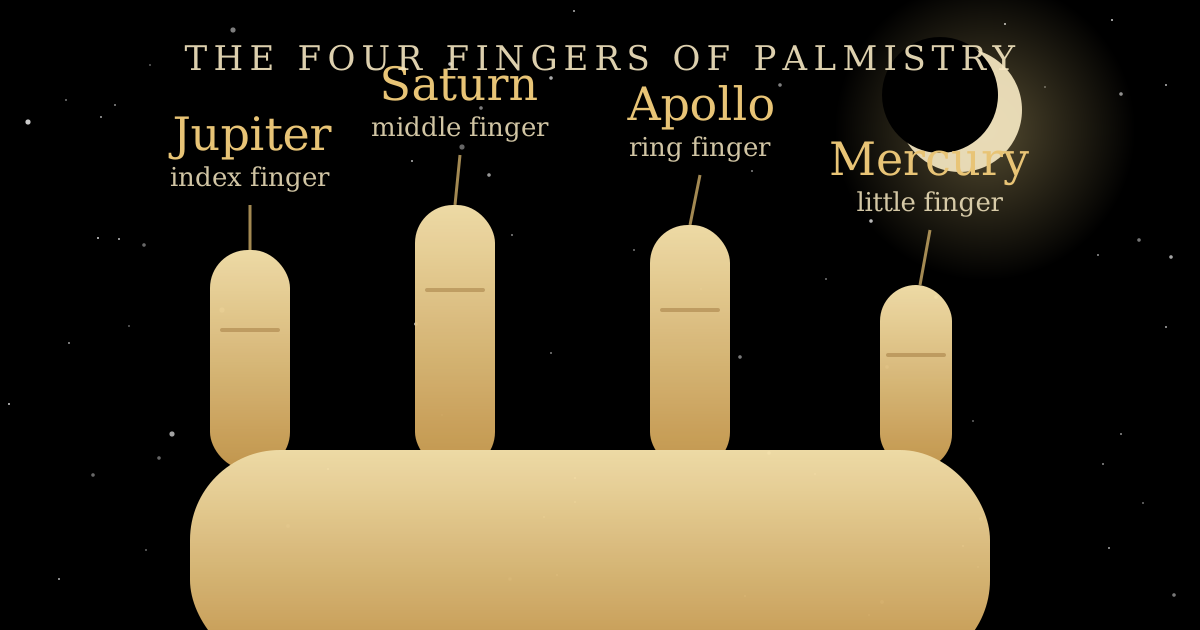
Fingers Meaning in Palmistry: What Each Finger Reveals
Each finger carries a planet's story — index for Jupiter's ambition, middle for Saturn's responsibility, ring for Apollo's creativity, little for Mercury's communication. Learn to read every finger's length, spacing, and shape.
Read the meaning →
Mount of Saturn in Palmistry: Discipline, Responsibility & What Its Shape Really Means
The Mount of Saturn sits beneath your middle finger and governs discipline, responsibility, and patience. Learn to read its size, firmness, and marks — and what a prominent, flat, or overdeveloped mount traditionally reveals.
Read the meaning →