
Mount of Venus in Palmistry: Love, Vitality & What Its Size Really Means
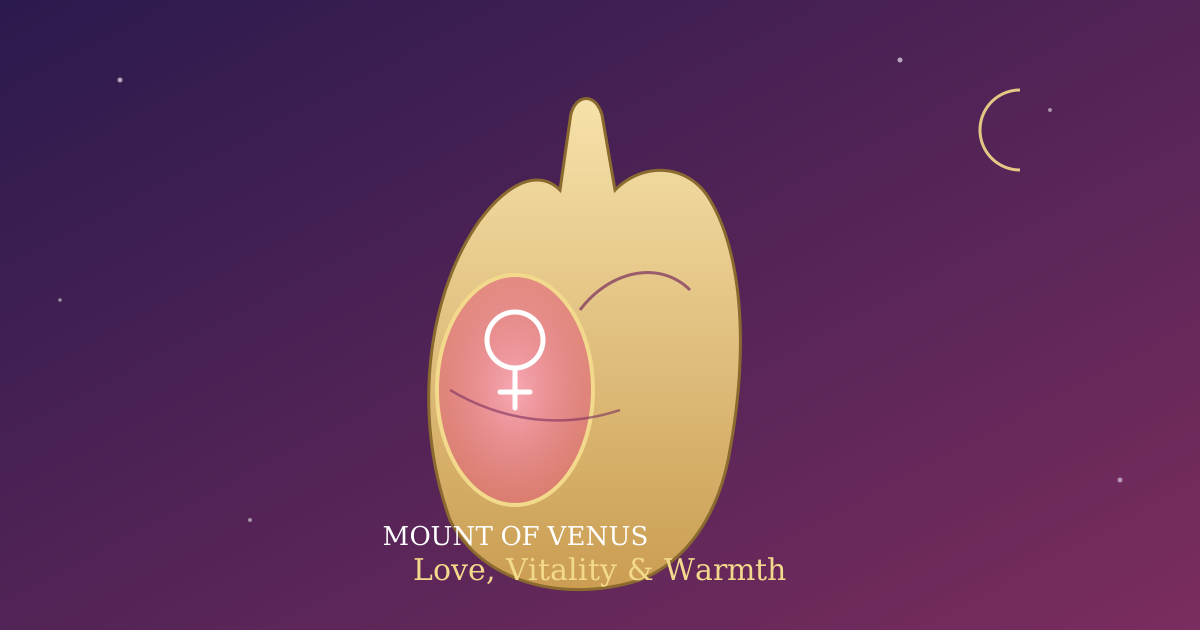
Open your hand and look at the base of your thumb. That soft, raised pad swelling beneath it is the Mount of Venus, named for the Roman goddess of love and beauty, and in palmistry tradition it is the seat of everything warm in a person: affection, sensuality, enthusiasm for life, and the energy to enjoy it. It is also, conveniently, the easiest mount to find. While the smaller mounts under the fingers can take practice to locate, Venus announces itself the moment you spread your hand.
That prominence is no accident in the old system. The mounts are the fleshy pads of the palm, and each is linked to a planet and a quality. Venus governs love and vitality, so its mount is read as a kind of emotional engine room. A full, springy Venus suggests a person who loves generously and lives vividly. A quieter Venus suggests someone whose affection runs cooler, steadier, and more private. Neither is better, and neither is a verdict. Palmistry, at its best, is a language for noticing temperament, not a fortune-telling machine, and Venus is one of its most forgiving chapters to learn.
Where Is the Mount of Venus?
Find your thumb, then slide down to where it meets the palm. The Mount of Venus is the broad pad filling that whole lower-thumb region. On its inner side it is bordered by the life line, which sweeps around it in a curve from between the thumb and index finger down toward the wrist. On its outer side it fades into the edge of the hand. If you press it gently, you will feel muscle: the thenar muscles that power your thumb's grip, which is why this mount is usually the largest and firmest on the hand.
Its size is partly set by the life line's sweep. A life line that curves widely around the palm gives Venus a broad territory, while a life line that hugs the thumb closely leaves Venus narrow. Traditional readers therefore never judge Venus alone; they read it together with the life line, the thumb, and the heart line. Think of Venus as the fuel tank and the life line as the road it runs along. The two stories rhyme, and the richest readings come from hearing both at once.
A Large, Full Mount of Venus
A large Mount of Venus, one that rises proudly from the palm and springs back when pressed, is the classic picture of warmth in the old books. Traditionally, it marks a person who loves with their whole heart: affectionate, generous, tactile, and enthusiastic about the pleasures of life, from good food and music to deep friendship and romance. These are the people who hug on greeting, who remember birthdays, who throw themselves into a new hobby with joyful abandon. Their emotional energy is visible, and it tends to draw people toward them.
But the tradition also names the shadow side, and it is worth hearing honestly. A very large, overly soft or puffy Venus is read as passion without a governor: intensity that can tip into possessiveness, jealousy, or a hunger for constant stimulation. The old texts are blunt about it, because the same fire that warms a room can scorch it. The practical reading is not a warning but a balance check. If your Venus is large, the tradition suggests your work is channeling that warmth, giving it form through loyalty, creativity, and care for others, rather than letting it burn as restlessness. A big Venus paired with a strong, straight head line is the traditional picture of passion guided by judgment, and it is considered one of the most attractive combinations in the hand.
A Flat or Underdeveloped Mount of Venus
Now look for the opposite pattern. A flat Mount of Venus, one that barely rises from the palm and feels thin or hollow, traditionally suggests a cooler emotional temperature. These readers are not cold people, and the better palmistry books are careful to say so. They are simply more reserved, more selective, and more comfortable with quiet affection than with grand displays. They may show love through practical help, loyalty, and steady presence rather than through words and touch, and their partners sometimes have to learn that language before they recognize it as love at all.
A flat Venus can also pair with a strong sense of independence. Where a full Venus seeks closeness, a flat Venus guards its space, and that independence is a strength in work that demands focus and self-reliance. The tradition also notes a nuance worth remembering: Venus changes with life. Weight, age, hand use, and health all shape the pad's fullness, so a Venus that looks flat during an exhausted season may look fuller in a happier one. Readers who check the same hand over years often find Venus swelling and settling with the chapters of a life, which is a good reminder to read the hand as a living document, not a fixed label.
Firmness, Color, and Texture
Size is only the first chapter. Press the mount and notice how it responds. A firm, elastic Venus that springs back is traditionally read as healthy, balanced vitality: energy that is available and well-regulated. A very hard, tense Venus suggests willpower crowding out tenderness, a person who holds themselves tightly. A very soft, yielding Venus suggests sensitivity and impressionability, a heart that takes in everything around it. None of these is a diagnosis of any kind; they are traditional metaphors for temperament, best treated as prompts for self-reflection rather than facts about the body.
Color gets a mention in the old books too, though it should be read with even more caution, since skin tone and circulation vary widely. A warm, rosy tint on Venus is traditionally linked to lively affection, while unusual paleness or mottling is simply noted as a sign to rest and care for yourself. If anything about your hands ever worries you in a physical sense, a doctor, not a palm reader, is the right person to ask. The mount's real value is symbolic: it gives you a vocabulary for noticing how warm, guarded, or tired you feel, and that noticing is useful in itself.
Lines and Marks on the Mount of Venus
Venus often carries its own small markings, and these are where readings get specific. Fine vertical lines running across the mount from the life line toward the thumb are traditionally called influence lines, and old texts link them to important relationships and attachments, with deeper lines read as stronger influences. A grille, a crisscross lattice of fine lines covering the mount, is traditionally read as restless emotional energy: passion seeking an outlet, sometimes expressed as anxiety or intensity in love. A cross on Venus has a mixed reputation in the old books, sometimes linked to a single deep attachment, sometimes to a disappointment in love, and modern readers tend to treat it gently, as a sign of a love that mattered deeply, whatever its outcome.
A star on the Mount of Venus is one of the happier marks in the tradition, read as success through charm, affection, or a fortunate relationship. A square is read as protection, a kind of shelter around the heart, while an island, a small loop in a line, is read as a period of emotional difficulty or divided attention. As with every mark in palmistry, one sign is a whisper. A grille on an otherwise calm, well-formed Venus means far less than a grille combined with a chained heart line and a restless thumb. Patterns across the hand are the conversation; single marks are only words.
Venus, the Life Line, and the Heart Line Together
The most useful Venus reading comes from combining three features. First, the life line's sweep: a wide sweep gives Venus room and is traditionally linked to an expansive, adventurous approach to life, while a narrow sweep suggests a more contained, focused energy. Second, the thumb: a strong, flexible thumb beside a full Venus is the traditional picture of willpower in service of love, someone who acts on their affections. Third, the heart line: a long, curved heart line above a full Venus suggests open, expressive emotion, while a short, straight heart line with a flat Venus suggests affection that is real but sparingly shown.
Read together, these features sketch an emotional style rather than a destiny. Two people can share a full Mount of Venus and love entirely differently, one through grand gestures and one through quiet devotion, depending on what the rest of the hand says. That is why experienced palmists resist the party trick of judging a hand from one feature. Venus tells you how much warmth is in the tank. The lines tell you how it gets driven. The thumb tells you who is holding the wheel.
Venus in Love and Relationships
For relationship questions, Venus is the first place traditional readers look, but the honest reading is broader than romance. A full Venus suggests a person who brings warmth to every bond, friendships included, while a flat Venus suggests someone who bonds slowly and deeply, with few people rather than many. In a partnership, comparing two people's Venus mounts is a classic exercise: similar fullness often means similar appetites for closeness, while a large mismatch can simply mean two different love languages, one expressive and one practical, that need translation rather than repair.
One caution belongs in every Venus chapter. No mount, line, or mark can predict whether a relationship will last, and no hand can tell you to stay or leave. Palmistry tradition itself, at its most thoughtful, treats the hand as a portrait of tendencies, and tendencies can be worked with. If your Venus reading resonates, use it as a conversation starter with yourself or your partner: how do I actually show love, how do I like to receive it, and where could I be clearer about both? That question is worth more than any prediction.
How to Read Your Mount of Venus in 60 Seconds
Try it now. Hold your dominant hand open, palm up, fingers relaxed. Find the pad at the base of your thumb and notice its size relative to the rest of your palm: full and proud, moderate, or flat? Press it gently: firm and springy, hard, or soft? Glance for lines, a grille, or a clear mark. Then check your life line's sweep and your thumb's strength, and compare both hands, dominant and passive, for differences.
Finally, do the exercise that makes palmistry worth learning: check your reading against someone you know well. Does the warm friend with the full Venus actually love the way the tradition describes, or does she surprise you? Does the reserved colleague with the flat Venus show love in quiet ways you had missed? The hand is at its best when it teaches you to notice people more carefully, and the Mount of Venus, sitting right there at the base of the thumb, is the warmest place to start.
Frequently asked questions
Where is the Mount of Venus on the palm?
The Mount of Venus is the large, fleshy pad at the base of the thumb, bordered on the inside by the life line. It is usually the biggest mount on the hand and the easiest to find.
What does a large Mount of Venus mean in palmistry?
A large, firm Mount of Venus traditionally suggests warmth, affection, strong vitality and a love of life's pleasures. The tradition reads it as generous emotional energy, not a guarantee about any relationship.
What does a flat Mount of Venus mean?
A flat or underdeveloped Mount of Venus traditionally suggests a cooler, more reserved emotional style. It often pairs with independence and a preference for calm, low-drama affection rather than intensity.
What do lines on the Mount of Venus mean?
Fine lines across the Mount of Venus are traditionally called influence lines, while a grille pattern suggests restless or intense emotional energy. A single clear line is read more strongly than a tangle of faint ones.
Is the Mount of Venus related to the life line?
Yes, the life line curves around the Mount of Venus, so the two are always read together. A wide sweep of the life line gives Venus more room, while a tight curve narrows it, which traditional readers link to how freely a person expresses warmth and energy.
Keep exploring
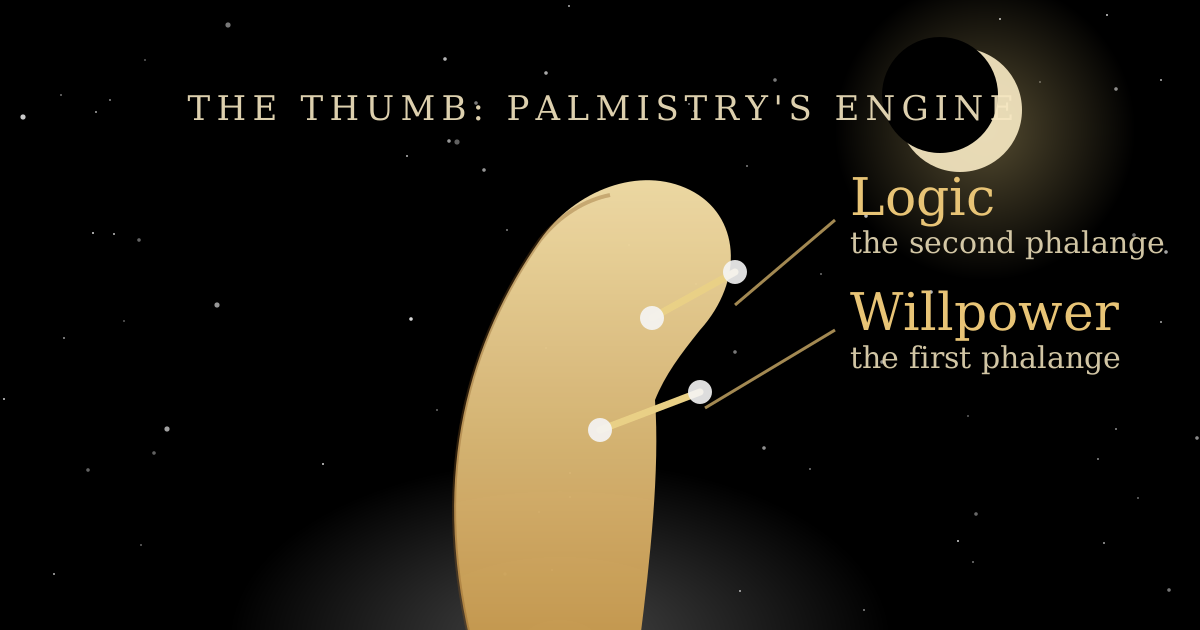
Thumb Meaning in Palmistry: Willpower, Logic & Thumb Shape
Your thumb is palmistry's engine of willpower and logic. Learn to read thumb length, shape, flexibility, the two phalanges, and what a high-set or low-set thumb means.
Read the meaning →
Mounts of the Palm: A Complete Guide to the 7 Mounts
The 7 mounts of the palm, Venus, Jupiter, Saturn, Apollo, Mercury, Moon and Mars, reveal your drives and talents. Learn to read every mount, step by step.
Read the meaning →
Heart Line Meaning: What Your Heart Line Says About Love
Your heart line maps your emotional nature: how you love, attach and heal. Learn to read its length, curve, breaks and forks, and what each marking reveals.
Read the meaning →
Life Line Meaning: What Your Life Line Really Reveals
Your life line reveals vitality, energy and major life chapters, not lifespan. Learn to read its length, depth, breaks, branches and markings with our guide.
Read the meaning →