
Palm Shape Meaning: The 4 Hand Types in Palmistry (Fire, Earth, Air & Water)
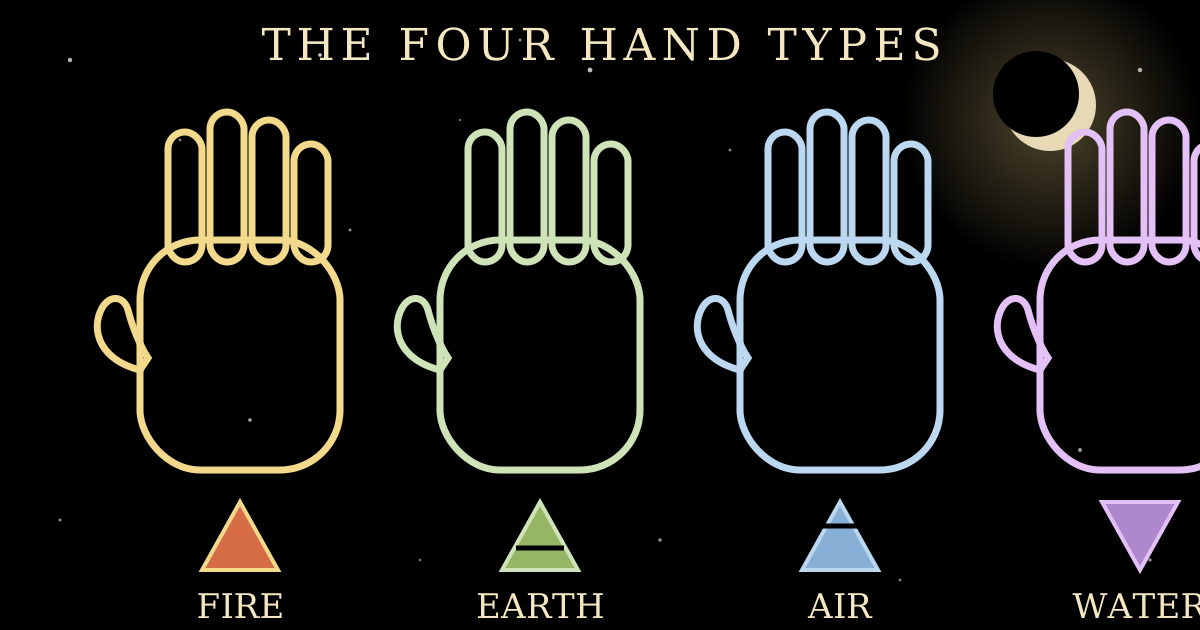
Every beginner in palmistry reaches for the lines. But traditional readers start earlier — with the shape of the hand itself. Long before anyone looks at your heart line or life line, your palm's proportions and your fingers' length already sketch a portrait of your temperament. This is the system of the four elemental hand types: fire, earth, air, and water.
The system works by analogy with the four classical elements, and each element carries a bundle of personality traits that palmists have used for centuries as a quick character read. It is not a fortune-telling device — no hand shape can predict your career or your love life — but as a mirror of temperament, many readers find it strikingly useful. Think of it the way you'd think of any personality framework: entertainment with genuine self-reflection inside.
How to Find Your Hand Type
The whole system hangs on one comparison: palm length versus finger length. Hold your dominant hand flat, fingers together, palm facing you. Mentally (or with a ruler) compare two measurements:
1. Palm length — from the base of your wrist to where your fingers begin (the top of the palm). 2. Finger length — from where the fingers begin to the tip of your middle finger.
Then note the palm's overall shape: is it broad and square, or long and narrow? The four combinations give you your type:
Long palm + short fingers = Fire. Broad, square palm + short fingers = Earth. Square or rectangular palm + long fingers = Air. Long, narrow (oval) palm + long fingers = Water.
Most people fall clearly into one camp; some are hybrids, and we'll get to those. Take a look at your hand now — then read your type below.
Fire Hands: The Passionate Achievers
Fire hands have a long, full palm with relatively short fingers. The overall impression is of a hand built for action — strong, warm, and direct. Ruled by the element of fire, these are the hands of enthusiasm, instinct, and motion.
Fire-hand people are the doers and the sparks. They're energetic, optimistic, and led by gut feeling; they love excitement, variety, and being in the thick of things. Routine bores them, and they tend to act first and analyze later — which makes them thrilling company and occasionally impulsive decision-makers. In traditional readings, a fire hand marks someone who leads with the heart and charges toward what they want.
In love, fire hands are passionate and warm but can burn out fast — they fall hard and get restless when the spark dims. They do best with partners who match their energy without trying to cage it. In work, they shine in dynamic, people-facing, fast-moving fields: leadership, entrepreneurship, performance, anything where momentum matters. Their growth edge is patience: learning to sit with a plan instead of racing past it.
Earth Hands: The Grounded Builders
Earth hands pair a broad, square, sturdy palm with short fingers — a hand that looks like it was made for solid work. This is the hand type of reliability, practicality, and physical energy, and it tends to belong to people who value what is real, tangible, and lasting.
Earth-hand people are the anchors of every group. They're loyal, steady, and grounded; they think in concrete terms and trust experience over theory. They work hard, keep promises, and build things that endure — careers, homes, relationships. The trade-off is a comfort with routine that can slide into stubbornness, and a suspicion of the abstract or unproven that can close doors. Traditional palmistry calls this the most "physical" hand type, strongly connected to the body and the material world.
In love, earth hands are devoted and dependable — the partners who show up, fix things, and remember everything. Romance may arrive as practical devotion rather than grand gestures. In work, they excel where persistence pays: trades, craft, management, finance, anything built brick by brick. Their growth edge is flexibility: letting a little uncertainty in without reaching for control.
Air Hands: The Analytical Thinkers
Air hands combine a square or rectangular palm with long fingers — a hand that looks precise, elegant, and made for fine work. Ruled by the element of air, these are the hands of intellect, communication, and curiosity.
Air-hand people live in their heads, and happily so. They're analytical, articulate, and endlessly curious — the ones who need to understand how everything works. They love ideas, conversation, and mental puzzles, and they tend to process emotions by talking them through. The shadow side is overthinking: analysis paralysis, restlessness when the mind has nothing to chew on, and a tendency to intellectualize feelings they'd rather not feel. Traditional palmistry sees air hands as the communicators and the thinkers of the hand types.
In love, air hands connect through conversation and shared ideas — they fall for minds. They need partners who engage them intellectually and give them room to talk things out. In work, they thrive in knowledge fields: writing, teaching, research, strategy, technology, anything where thinking is the product. Their growth edge is embodiment: trusting the body and the heart as sources of knowledge too.
Water Hands: The Intuitive Feelers
Water hands have a long, narrow, often oval-shaped palm with long fingers — the most delicate-looking of the four types. This is the hand of feeling, intuition, and imagination, and traditional palmistry treats water hands as the most psychically sensitive of the four.
Water-hand people are the empaths and the dreamers. They're emotionally deep, highly intuitive, and attuned to atmospheres — they walk into a room and know the mood instantly. They're creative, compassionate, and drawn to meaning, beauty, and the inner life. The cost of this sensitivity is emotional weather: water hands can absorb other people's feelings, get overwhelmed by harsh environments, and retreat into fantasy when reality feels too sharp. Readers often say these are the hands most drawn to palmistry itself.
In love, water hands love profoundly and need emotional safety above all — they read their partner's feelings like weather and wither without tenderness. In work, they flourish in creative, caring, and healing fields: art, music, counseling, design, spiritual work. Their growth edge is boundaries: learning that feeling everything doesn't mean carrying everything.
Hybrids and Secondary Types
Not every hand is a clean example of one type, and traditional palmistry doesn't pretend otherwise. Many hands blend two elements — most often, one dominant type with a secondary flavor. A long palm with moderately long fingers sits between fire and water; a square palm with medium fingers leans earth-air.
When your hand blends, read the dominant type first — it describes your baseline temperament — then layer in the secondary type as your modifier. A fire-dominant hand with water-length fingers might be the passionate achiever with an unexpectedly tender inner life. An earth-dominant hand with air fingers: the reliable builder who is secretly an analyst. This blending is actually the norm rather than the exception, and it's where the system gets genuinely interesting.
Also note: hand flesh changes. Weight, muscle tone, and age can soften the reading of a hand's shape, but the underlying proportions — bone length ratios — stay constant. Palmists treat the type as stable for life even as the hand itself ages.
What Your Hand Type Says About Love, Career, and Growth
The real value of the four types is as a quick temperament lens. Before a reading gets into the specifics of lines and mounts, the hand type sets expectations: a fire hand's heart line will be read through the lens of passion and impulse; a water hand's through the lens of sensitivity and depth. The type colors everything.
For self-reflection, try this: identify your dominant type, then ask which element you need more of. Fire hands often need earth's steadiness and water's tenderness. Earth hands often need air's curiosity and fire's daring. Air hands need water's emotional honesty and earth's grounding. Water hands need fire's courage and air's clarity. Traditional palmistry pairs each element with its opposite as a balancing prescription — a genuinely useful exercise regardless of whether you believe in the metaphysics.
Pair your hand type with the rest of your hand for a fuller picture: the mounts add your drives and talents, the major lines (heart, head, life) add your emotional and mental story, and the minor lines add texture. Hand shape is the headline; the lines are the article.
Frequently asked questions
What are the 4 hand shapes in palmistry?
The four hand types are fire hands (long palm, short fingers), earth hands (broad square palm, short fingers), air hands (square palm, long fingers), and water hands (long oval palm, long fingers). Each type is linked to an element and a temperament profile.
How do I know my hand type?
Compare palm length to finger length: hold your hand flat and look at whether the palm (wrist to finger bases) or the fingers dominate. A long palm with short fingers is fire; broad square palm with short fingers is earth; square palm with long fingers is air; long narrow palm with long fingers is water.
Which hand type is the rarest?
Tradition often treats water hands as the least common of the four, since the combination of a long, narrow palm with long fingers appears less frequently. There is no scientific census of hand types, so rarity claims are folklore, not statistics.
Can your hand type change over time?
Your underlying hand shape is set by your bone structure and does not fundamentally change, though fleshiness, muscle tone, and flexibility can shift with age, work, and habits. Palmistry treats the hand type as your lifelong baseline temperament.
Is hand shape palmistry real or scientific?
Hand-type reading is part of traditional palmistry, an interpretive practice rather than a science. Think of it as a personality reflection tool — entertaining and sometimes insightful, but not a reliable predictor of your future, health, or relationships.
Keep exploring

Life Line Meaning: What Your Life Line Really Reveals
Your life line reveals vitality, energy and major life chapters, not lifespan. Learn to read its length, depth, breaks, branches and markings with our guide.
Read the meaning →
Mounts of the Palm: A Complete Guide to the 7 Mounts
The 7 mounts of the palm, Venus, Jupiter, Saturn, Apollo, Mercury, Moon and Mars, reveal your drives and talents. Learn to read every mount, step by step.
Read the meaning →
Heart Line Meaning: What Your Heart Line Reveals About Love
Your heart line traces your emotional style and approach to love. Learn to read its shape, length, branches and markings — and what they traditionally reveal.
Read the meaning →
What Does It Mean to Dream About Being Chased?
Being chased in a dream is frightening but meaningful. Learn what chase dreams reveal about stress, avoidance, and the fears you keep running from.
Read the meaning →