
Ring of Solomon Meaning in Palmistry: Wisdom, Intuition & the Jupiter Arc
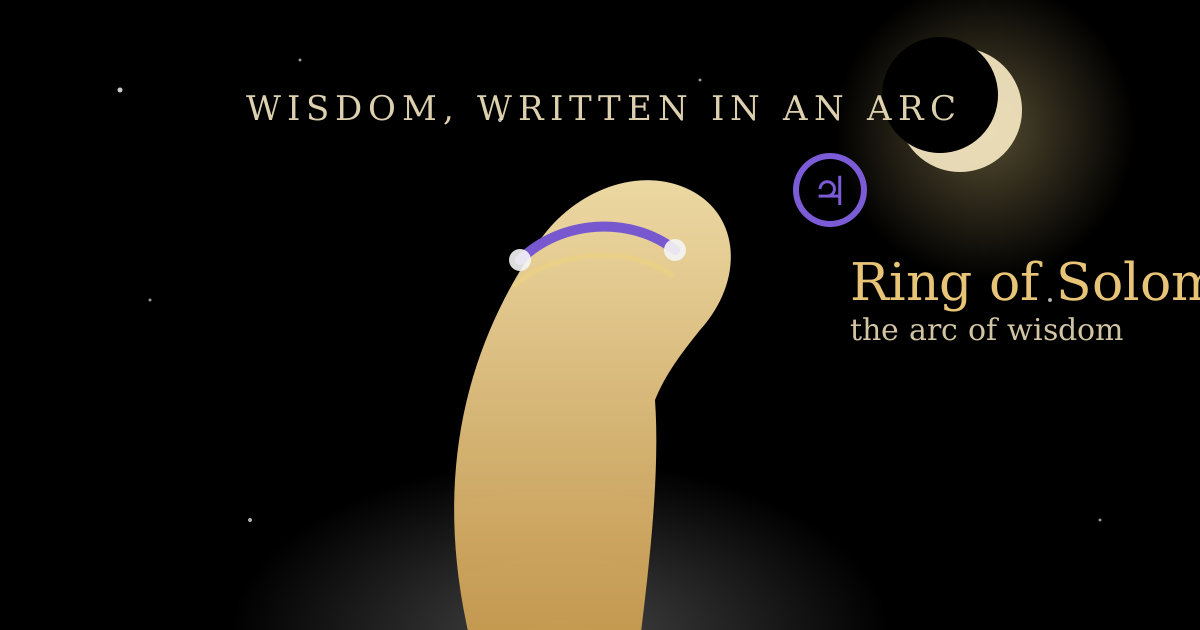
Most palmistry marks are lines that run somewhere: up the palm, across it, or down toward the wrist. The Ring of Solomon is different. It does not travel. It circles. A curved line that arcs around the base of your index finger, it encloses the fleshy pad beneath that finger — the Mount of Jupiter — like a crown around a small kingdom. And in the old tradition, that is exactly what it crowns: the qualities of the wise ruler.
The ring takes its name from King Solomon, the biblical figure famed above all for wisdom and judgment — the king who could settle a dispute between two mothers, who spoke with animals in legend, and whose name became shorthand for discernment itself. Palmists borrowed the name deliberately. To carry the ring, they said, was to carry something of Solomon's gift: the ability to see clearly, judge fairly, and understand people at a depth that surprises them. It is one of the most flattering marks in the whole hand — and, fittingly, one of the rarest.
Where to Find the Ring of Solomon
Hold your dominant hand up, palm facing you, fingers relaxed. Look at the base of your index finger, where it joins the palm. The pad directly below it is the Mount of Jupiter. The Ring of Solomon, when present, is a curved line that sweeps around that mount — usually starting on the outer edge of the palm, near the side of the hand, and curving up and over toward the gap between the index and middle fingers. Think of it as a half-circle hugging the finger's base, open at the bottom.
It is easy to confuse with two neighbors, so check carefully. The Girdle of Venus also arcs, but it sits higher up the palm, above the heart line, and spans toward the middle and ring fingers — it is a mark of sensitivity, not wisdom. The Ring of Saturn circles the middle finger's base instead, and carries a very different traditional meaning, closer to solitude and seriousness. The Ring of Solomon belongs to the index finger alone. If the arc you found wraps the index finger's mount, you have found Solomon's ring.
Lighting helps. Tilt your hand under a bright lamp and look with a magnifier or your phone's camera zoomed in. Faint lines that vanish in ordinary light often appear clearly this way. Check both hands, too: the ring may appear on one hand and not the other, and traditional readers note which hand carries it, just as they do with every other marking.
What the Ring of Solomon Traditionally Means
In classical palmistry, the Ring of Solomon is read as a sign of wisdom, intuition, and psychological insight. People with the ring are traditionally said to understand others almost before they speak — to sense motives, read a room, and give advice that lands. This is why the old books link the ring to teachers, counselors, healers, and spiritual guides: people whose work depends on seeing into others and being trusted with what they see.
There is a leadership thread, too. The index finger is Jupiter's finger, and Jupiter in palmistry governs ambition, authority, and the drive to lead. A ring around Jupiter's mount is traditionally read as ambition refined by wisdom — leadership that listens before it commands. Where a strong Jupiter mount alone might suggest raw dominance, the ring suggests the rarer combination: power tempered by judgment. The legendary Solomon did not merely rule; he understood. That is the distinction the ring is said to mark.
Intuition is the third strand. Traditional readers describe the ring as a channel between the conscious mind and a deeper knowing — the kind of person who says "I just knew" and is right more often than chance would explain. Modern readers, translating the symbolism into psychological language, would call this pattern recognition plus empathy: a mind that notices small cues — tone, hesitation, body language — and assembles them unconsciously. Either way, the practical advice is the same: trust the first impression, then verify it.
Complete, Broken, Faint, or Double: Reading the Variations
Not all rings are equal, and the variations carry the detail of the reading. A complete, clear ring — one unbroken arc sweeping cleanly around the mount — is the classic form and the rarest. Tradition reads it as fully developed wisdom and steady intuition: the person whose judgment others seek out, and who rarely regrets following their instincts. If you have this form, the old books would call you a natural counselor, whether or not counseling is your profession.
A broken or fragmented ring is far more common. The arc appears in pieces, or fades in the middle. Traditionally this suggests wisdom still in development — intuition that arrives in flashes rather than as a steady signal, or insight that the person has not yet learned to trust. Readers often pair a broken ring with the head line: a strong, clear head line alongside it suggests the insight is there but filtered through logic, while a chained or wavering head line suggests the intuition gets drowned out by worry. The encouraging traditional note is that rings, like all lines, are read as tendencies that can deepen with attention.
A faint ring — barely visible, more a suggestion of an arc than a line — is traditionally read as latent potential: the qualities are present but quiet, perhaps unexercised. Many readers tell clients with faint rings that the mark tends to strengthen when they start using the gift deliberately: listening closely, studying people, or taking up teaching, mentoring, or counseling work. A double ring — two arcs circling the mount, one inside the other — is the intensified form: unusually strong intuition, a deep pull toward spiritual or philosophical study, and a talent for guiding others through their own questions. In the old texts, double rings were associated with mystics, philosophers, and those who teach teachers.
The Ring on Each Hand, and With Other Marks
As with every palmistry mark, the ring is read on both hands. On the dominant hand, it traditionally reflects the wisdom you have developed through life — earned judgment, the insight you use daily. On the passive hand, it reflects inborn inclination: the intuitive child, the young person others confided in before they understood why. A ring on both hands is traditionally read as the strongest form, suggesting the gift is both innate and developed.
The ring also gains meaning in combination. Paired with a well-developed Mount of Jupiter — full, firm, and raised — it suggests wisdom backed by genuine leadership presence: people follow this person because they trust the judgment behind the authority. Paired with a long, straight head line, it suggests wisdom grounded in clear thinking, the counselor who reasons as well as intuits. Paired with a Girdle of Venus, it suggests a rare blend of wisdom and deep feeling — the empath who also knows, which is why the two marks together were traditionally prized in healers. And paired with a strong fate line, the ring suggests a life path shaped by guiding others: teaching, advising, or leading through insight rather than force.
Conversely, a ring on a hand with a flat, underdeveloped Jupiter mount is traditionally read as wisdom without the platform to use it — insight the person keeps private. The old advice for that combination was practical rather than mystical: find one person to advise, one room to speak in, and let the gift find its audience.
What If You Do Not Have the Ring?
Most people do not — and that is entirely normal. The Ring of Solomon is a bonus mark, not a requirement, and its absence says nothing negative about your wisdom or intuition. Traditional palmistry is explicit on this point: the major lines and the mounts carry the core reading, and special marks like the ring add emphasis, not verdicts. Some of the wisest counselors in the old casebooks had no ring at all; their wisdom showed in a strong head line, a balanced Jupiter mount, and a clear fate line instead.
It is also worth remembering that hands change. Lines deepen, fade, and occasionally appear over years as habits and life circumstances shift, and palmists have always treated the hand as a living record rather than a fixed sentence. If you go looking for the ring and find only a fragment, you are in the majority — and if you find nothing, you have simply confirmed that your particular story is written elsewhere on the hand. The value of palmistry was never in collecting rare marks; it was in the attention it teaches you to pay to yourself and to others.
How to Use This Reading
Whether or not you carry the ring, its lesson is portable. The Ring of Solomon celebrates a specific kind of intelligence: not the fastest mind or the loudest voice, but the quiet ability to understand people and judge well. You can practice it directly. The next time someone tells you a problem, resist the urge to answer immediately; listen for what they are not saying. Notice the pause before the difficult sentence, the topic they circle back to, the feeling behind the facts. That attention — sustained, unhurried, nonjudgmental — is the skill the ring symbolizes, and it can be learned by anyone.
And if you do carry the ring, traditional advice is equally practical: use it in service of others. The old books warned that wisdom hoarded curdles into judgment — the person who sees clearly but uses the sight to condemn rather than help. The ring's gift, they said, is fulfilled only when it is given away: in advice offered gently, in a friend steadied, in a room made calmer by someone who understands it. Solomon's wisdom was famous not because he kept it, but because he used it to settle what others could not. However you read your own hand, that is a standard worth keeping.
Frequently asked questions
What is the Ring of Solomon in palmistry?
The Ring of Solomon is a curved line that arcs around the base of the index finger, circling the Mount of Jupiter. Traditional palmistry reads it as a mark of wisdom, intuition, and a natural gift for understanding people.
Is the Ring of Solomon rare?
A clear, complete Ring of Solomon is uncommon. Many hands show only a faint fragment of the arc, or none at all. Its absence means nothing negative in traditional readings — it is read as a bonus mark, not a requirement.
What does a broken Ring of Solomon mean?
A broken or fragmented ring traditionally suggests wisdom that is still developing, or intuition that works in flashes rather than steadily. Readers often pair it with the head line and the Mount of Jupiter for the full picture.
What does a double Ring of Solomon mean?
A double ring — two arcs circling the base of the index finger — is traditionally read as an intensified mark: unusually strong intuition, deep interest in spiritual or philosophical subjects, and a talent for teaching or counseling.
How is the Ring of Solomon different from the Girdle of Venus?
The Ring of Solomon circles the base of the index finger under Jupiter, while the Girdle of Venus arcs above the heart line. The ring is read as wisdom and leadership; the girdle is read as sensitivity, emotion, and creativity.
Keep exploring
Girdle of Venus in Palmistry: Meaning, Location & What It Reveals
The Girdle of Venus is the arc above your heart line. Learn where to find it, what a complete, broken, double, or missing girdle traditionally means for sensitivity, love, and creativity.
Read the meaning →
Mounts of the Palm: A Complete Guide to the 7 Mounts
The 7 mounts of the palm, Venus, Jupiter, Saturn, Apollo, Mercury, Moon and Mars, reveal your drives and talents. Learn to read every mount, step by step.
Read the meaning →
Fingers Meaning in Palmistry: What Each Finger Reveals
Each finger carries a planet's story — index for Jupiter's ambition, middle for Saturn's responsibility, ring for Apollo's creativity, little for Mercury's communication. Learn to read every finger's length, spacing, and shape.
Read the meaning →
Thumb Meaning in Palmistry: Willpower, Logic & Thumb Shape
Your thumb is palmistry's engine of willpower and logic. Learn to read thumb length, shape, flexibility, the two phalanges, and what a high-set or low-set thumb means.
Read the meaning →