
Which Hand Do You Read in Palmistry? Dominant vs Passive Hand
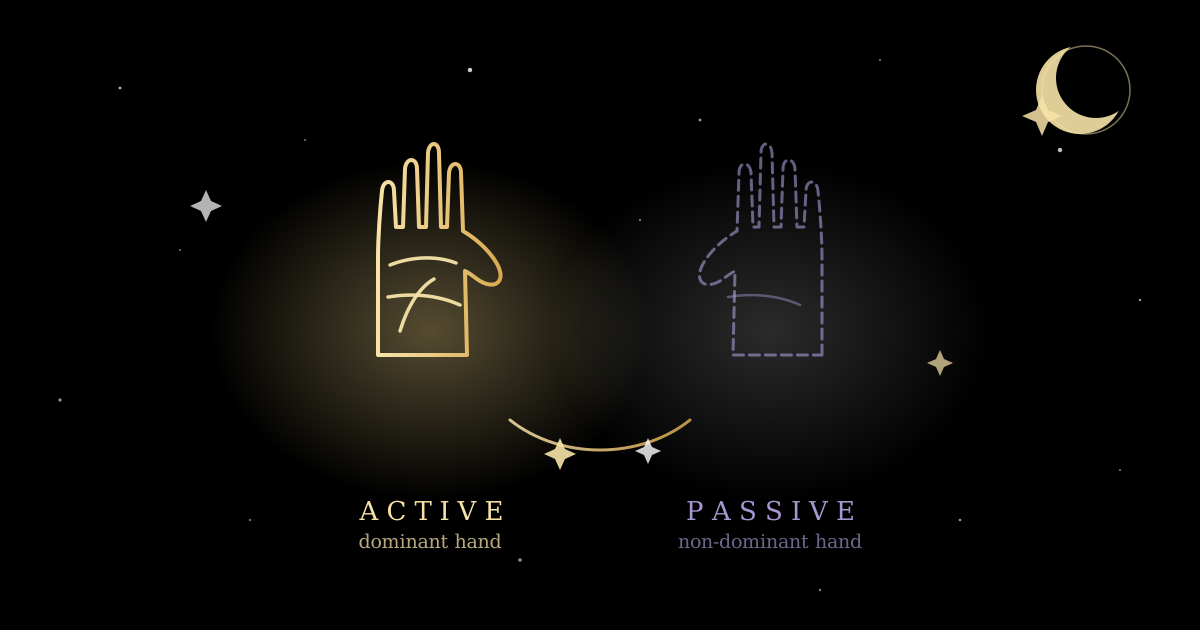
Every palmistry reading begins with the same deceptively simple question: which hand? You hold both hands up to the light, and they are not identical — the lines differ, sometimes a little, sometimes dramatically — and suddenly one palm is not enough. Tradition has an answer, and it is more elegant than you might expect: you read both hands, but you read them differently. One hand is your biography. The other is your birthright.
The convention most palmists use today is the dominant-hand rule. If you write with your right hand, your right hand is your active or dominant hand, and your left is your passive hand. If you write with your left hand, the roles reverse. The dominant hand is read as the story of what you are doing with your life — your choices, your habits, your public self. The passive hand is read as the story you were given — your temperament, your inherited tendencies, the raw material you started with. Put them together and you have not just a snapshot but a narrative: where you began, and where you have taken yourself.
The Short Answer: Start With Your Dominant Hand
If you want the thirty-second version, here it is: hold up the hand you write with. That is the hand a modern palmist reaches for first, and for a good reason — it is the hand that has lived your life most visibly. It gripped the steering wheel, signed the contracts, held the children, did the work. Tradition reads it as the record of your choices and actions: the self you have been actively building, day by day, whether you noticed the construction or not.
The dominant hand is also, in most people, the hand with the deeper, busier, more developed lines. Years of expressive use leave their mark, or so tradition holds. Your dominant heart line is read as how you actually love in practice; your dominant head line as how you actually think under pressure; your dominant life line as the energy and vitality you have cultivated rather than the one you were handed. If palmistry is a diary, the dominant hand is the entries you wrote yourself.
The Passive Hand: Your Blueprint and Inner Life
Your passive (non-dominant) hand is the quieter, more mysterious of the two — and in some traditions, the more revealing. It is read as your potential: the temperament you were born with, the family patterns you inherited, the inner life that not everyone sees. Some palmists call it the hand of the subconscious, or the hand that shows what you could have been — the unmodified draft of you.
Here is where the comparison becomes genuinely interesting. Many people find that their passive hand tells a softer, older story: lines that speak of inherited caution or a family gift for worry, a head line that dreams bigger than their dominant hand's pragmatism, a heart line that is more guarded or more open than the one they live by. Tradition does not read this as hypocrisy — it reads it as humanity. We are not our starting conditions. We are the negotiation between our starting conditions and our choices, and the two hands are the two parties to that negotiation.
There is also a practical reading habit worth knowing: palmists often check the passive hand for what is incoming or latent, and the dominant hand for what is expressed. A faint branch on the passive hand that has not appeared on the dominant hand might be read as a potential not yet acted on — a possibility rather than a prediction. Remember the entertainment framing: these are reflections for self-knowledge, not guarantees about tomorrow.
The Dominant Hand: What You Do With the World
Look again at your dominant hand with fresh eyes. The old palmistry books call it the hand of expression — how you meet the world and what the world has made of you in return. Its lines are read as the more "real" in the sense that they describe your lived pattern: the heart line shows your practiced way of loving (which may be braver or more guarded than the one you were born with), the head line shows the thinking style you have trained, the fate line shows the direction you have actually pursued.
This is why experienced palmists spend more time on the dominant hand. It answers the question most people actually bring to a reading: where am I in my life right now? The passive hand tells you where you came from; the dominant hand tells you where you are. And here is the quietly empowering part of the tradition: the dominant hand is the one you have been authoring all along. Every decision that shaped your heart line's curve, your head line's slope, your fate line's branches — you made those, whether you remember making them or not.
Men, Women, and the Old Rules
You may have heard a different rule: read the right hand for men and the left hand for women. This convention is real, and it is old — it comes from Chinese palmistry and from Vedic (Indian) tradition, where the left side of the body was associated with yin, receptivity, and the feminine, and the right side with yang, activity, and the masculine. In those systems, a man's right hand showed his outer, active life while his left showed his inner one; for women the assignment flipped.
Most modern Western palmists have retired this rule in favor of the dominant-hand convention, which applies the same logic to everyone regardless of gender: the hand you favor is the hand of action. If you visit a reader trained in a traditional Chinese or Indian school, though, do not be surprised if they reach for a different hand than you expected — they are working from an older map of the same territory. The maps disagree on which hand is which, but they agree on the essential point: both hands matter, and one shows the inner story while the other shows the outer one.
Reading Both Hands Together: The Comparison That Matters
Here is the part beginners miss: the master move in palmistry is not reading one hand well. It is reading the gap between the hands. Sit down with both palms up, side by side, and compare the same line on each. The differences are where the story lives.
When the two heart lines differ, tradition reads a love life that diverged from its beginnings — perhaps you learned to guard a naturally open heart, or learned to open a naturally cautious one. When the two head lines differ, it suggests a mind that developed beyond its first habits: the dreamer who trained themselves into discipline, or the rigid thinker who learned to imagine. When the two fate lines tell different stories, the old books see a person who changed direction — sometimes by choice, sometimes by necessity — and built a different road than the one they started on.
And when the two hands look very similar? Tradition reads that as a life lived in alignment with its origins — someone whose choices have deepened rather than diverted their nature. There is no better or worse here. A small gap means coherence; a large gap means transformation. Both are honest biographies.
Why Your Lines Change: Palms Are Living Documents
One of the most startling things about palmistry, once you start checking, is that lines change. Not overnight, and not usually the big four — the heart, head, life, and fate lines are remarkably stable, like the main roads on a map. But the minor lines deepen, fade, sprout branches, and occasionally vanish over the course of years. A new small branch appears after a major life change. A faint line grows bolder during an intense chapter. An old marking softens as a wound heals.
Tradition reads this as evidence that the palm is a living record, not a fixed script — and this is worth holding onto, because it is the antidote to the fatalistic version of palmistry you see in movies. Nothing in the hand is a verdict. The lines describe patterns and tendencies as they stand today; the same tradition that says a marking can appear says a marking can fade. Your hands are not fortune's press release. They are your diary, and the entries are still being written.
This is also why a reading is a moment in time rather than a permanent ruling. A palmist reading your dominant hand today is reading the choices you have made so far — which is a fundamentally hopeful thing, because "so far" always leaves room for the next chapter.
A Two-Hand Exercise for Tonight
Here is a practice that takes ten minutes and needs no expertise — just your two hands and honest attention. Place both palms flat on a table, side by side. Choose one line — the heart line is a good first candidate — and trace it on your passive hand, then trace the same line on your dominant hand. Ask one question: what changed between these two versions?
Now write for five minutes about the difference. If your dominant heart line is deeper or more guarded than your passive one, what taught it to be? A relationship? A loss? A slow learning? If your dominant head line runs straighter than your passive one, when did your thinking become more practical — and what did you trade for it? The point is not to diagnose yourself from your palms. The point is that the palms give your memory a place to start. The two hands, held together, are a before-and-after photograph of your becoming.
Try the exercise's second half tomorrow: ask someone whose hands you know well — a partner, a parent, a close friend — to show you both of theirs, and notice one difference without interpreting it aloud. You will start to see, physically, how differently two versions of the same person can look. It is the best lesson palmistry has to teach: nobody is one story. Everyone is at least two.
A Final Thought: Two Hands, One Story
So which hand do you read in palmistry? The honest answer is the one the old readers give with a smile: both. The passive hand is where you came from — the temperament, the inheritance, the unwritten draft. The dominant hand is where you have gone — the choices, the practice, the life as lived. Neither one is the "true" you and the other false. They are the two volumes of the same memoir.
The next time someone holds out a single palm and asks what it says, you will know better than to answer from that hand alone. Ask for the other one. Hold them together in the light. The lines on each are interesting — but the distance between them is the real reading, and it is a distance only you could have traveled. Nobody else's hands have walked it. That is, in the end, the whole point of reading palms: not to predict the person, but to witness how they became themselves — twice over, once in each hand.
Frequently asked questions
Which hand do you read in palmistry?
Tradition says start with your dominant hand — the hand you write with. The dominant hand is read as your active story: what you are doing, choosing, and expressing. The passive (non-dominant) hand is read as your inner story: potential, inherited patterns, and temperament. Palmists then compare both for the full reading.
Why do some traditions read the left hand for women and the right hand for men?
The men-right, women-left convention comes from old Chinese palmistry and Vedic tradition, where the left side was considered yin (receptive) and the right side yang (active). Most modern Western palmists have replaced this with the dominant-hand rule, which applies the same way to everyone.
What does it mean if the lines on my two hands look very different?
A big difference between hands is traditionally read as a life shaped by your own choices rather than your starting conditions. The passive hand shows your temperament and potential; the dominant hand shows what you have done with them. Diverging lines suggest a person who has actively developed, adapted, or redirected themselves.
Do palm lines actually change over time?
Minor lines deepen, fade, branch, and sometimes appear or disappear over years, and tradition interprets these changes as reflecting shifts in your life. The major lines — heart, head, life, and fate — are far more stable and rarely change dramatically. No line is considered a fixed prediction; palmistry treats them as a living record, not a verdict.
Which hand do I read if I am ambidextrous?
If you use both hands equally, tradition suggests reading the hand that feels more 'you' — or simply reading both as equal partners rather than assigning one to active and the other to passive. Compare them line by line and let the differences tell the story.
Keep exploring

Heart Line Meaning: What Your Heart Line Says About Love
Your heart line maps your emotional nature: how you love, attach and heal. Learn to read its length, curve, breaks and forks, and what each marking reveals.
Read the meaning →
Life Line Meaning: What Your Life Line Really Reveals
Your life line reveals vitality, energy and major life chapters, not lifespan. Learn to read its length, depth, breaks, branches and markings with our guide.
Read the meaning →
What Does It Mean to Dream About Being Chased?
Being chased in a dream is frightening but meaningful. Learn what chase dreams reveal about stress, avoidance, and the fears you keep running from.
Read the meaning →
Scorpio Zodiac Sign: Personality, Traits & Compatibility
Scorpio (Oct 23–Nov 21) is an intense water sign ruled by Pluto and Mars. Explore Scorpio personality traits, strengths, love compatibility, and caree
Read the meaning →