
Déjà Vu and Past Lives: Why New Places Feel Strangely Familiar
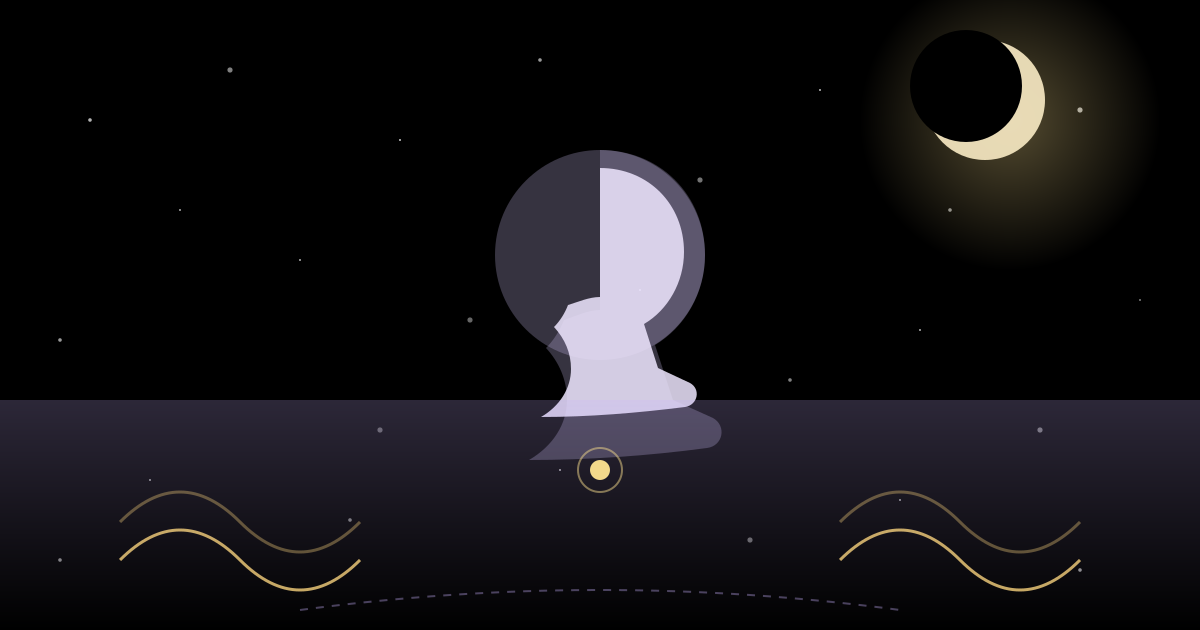
You step off the train into a town you've never visited. The curve of the street, the angle of the awning, the particular slant of the afternoon light — it all lands with a jolt of recognition. Not a guess. Not "this reminds me of somewhere." A bone-deep certainty: I've been here before. You haven't. Your brain knows you haven't. And yet the feeling is so vivid it stops you mid-step.
This is déjà vu — French for "already seen" — and it happens to most people. Surveys consistently find that around 60 to 70 percent of us have experienced it, most often between our teens and mid-twenties. It's one of the strangest ordinary experiences a mind can have: absolute certainty, zero evidence. Is it a hiccup in the machinery of memory — or a whisper from a life you lived before this one? Both readings are worth your time.
What Déjà Vu Actually Is
At its core, déjà vu is a mismatch. Your brain runs two systems that usually agree: one that records experiences, and one that judges whether something feels familiar. In déjà vu, the familiarity detector fires at full volume while the recollection system comes up empty. You feel certain you've lived this moment — and you can summon no memory of it, because there is none to summon.
The experience has a distinct signature. It arrives suddenly, lasts seconds (rarely more than a minute), and carries a peculiar emotional charge — a mix of wonder and disorientation that people describe almost identically across cultures. Crucially, it tends to strike in novel situations: a new restaurant, a first trip, an unfamiliar street. That's the paradox that makes it so haunting — it happens most in the places we could least have been before.
Frequency follows a pattern too. Déjà vu peaks in young adulthood and declines with age. It favors travelers, students, and people under stress or sleep-deprived — in other words, people whose brains are processing a lot of novelty on tired hardware. That demographic pattern is a clue: whatever déjà vu is, it seems tied to how the brain handles newness, not to how it stores the past.
The French Vocabulary of "Already"
Déjà vu is the famous one, but the French gave names to the whole family of false familiarity — and the distinctions are genuinely useful when you're trying to describe what happened to you.
- Déjà vu ("already seen"): the classic — a new situation feels lived-before.
- Déjà vécu ("already lived"): a stronger variant, sometimes described as living the same minute twice, with a feeling of being able to predict what happens next.
- Déjà visité ("already visited"): the traveler's version — arriving somewhere for the first time with a sense of prior familiarity with the place itself.
- Jamais vu ("never seen"): the mirror image — a familiar word, face, or place suddenly feels strange and unreal, as if you've never encountered it.
Researchers now study these as a family, because they're all about the same underlying system: the brain's judgment of familiarity can be turned up, turned down, or set adrift from reality. When you read past-life interpretations of déjà vu, notice that most of them are really about déjà visité — the uncanny familiarity of a place.
What the Science Says: Your Brain's Honest Glitches
Neuroscience doesn't need reincarnation to explain déjà vu — it has several testable mechanisms, and the evidence for them is surprisingly good.
The split-second delay. Your brain processes a scene in parallel — one stream for perception, one for memory. Normally the memory stream lags a fraction of a second behind. If the memory signal arrives late or the perception signal gets a head start, the brain can misread the current moment as one it has just processed a moment ago — and label it a memory. You've experienced the present twice in quick succession, and the second pass feels like a rerun.
Split perception. You glance at a scene, look away, look back. The first glance was so brief it never registered consciously — but the second one triggers familiarity. Your brain registered the place once already, just not in a way you noticed. This is why déjà vu loves interruptions: a blink, a phone buzz, a distraction.
Implicit familiarity. This is the big one, and it's been demonstrated in experiments. Psychologist Anne Cleary and colleagues showed volunteers virtual-reality scenes that secretly shared geometry — the same spatial layout with different surface details — and the volunteers reported déjà vu when the layout matched a scene they'd seen before, even though they couldn't recall the earlier scene. A staircase, a particular corner, the arrangement of furniture: a new place can be structurally identical to an old one you've seen in a film, a photo, or a dream, and your brain flags the match without handing you the source.
None of this makes déjà vu less interesting. If anything, it's remarkable that a few milliseconds of neural timing can produce one of the most mystical-feeling experiences humans have.
The Spiritual Reading: Déjà Vu as Soul Memory
Now the other side — the one this site's readers are really here for. If reincarnation is real, déjà vu is exactly what you'd expect it to feel like: a moment when the soul recognizes something the mind can't place.
In this reading, déjà vu is soul memory — not the brain's autobiographical system misfiring, but the soul's older archive briefly surfacing. The street you've never walked in this life may be one you walked in another. The sensation of being able to predict what happens next (déjà vécu) reads, in this framework, like a page you once read being glimpsed again. The emotions that accompany it — the wonder, the ache, the certainty — are taken as the texture of genuine recognition, not noise.
Spiritual traditions offer several flavors of this interpretation. Some describe déjà vu as a karmic checkpoint: a sign you're re-encountering a theme or relationship from a previous life, and the moment carries an invitation to handle it better this time. Others treat it as soul alignment — confirmation that you're on the path your soul planned, like a landmark recognized on a long hike. A third reading sees it as bleed-through from the Akashic record, the supposed cosmic archive of every soul's journey: a page glimpsed out of order.
Take these as contemplative tools, not facts. They can't be verified, and believing them doesn't change what déjà vu is neurologically. But for reflective entertainment — for the imaginative work of wondering who you might have been — they're genuinely rich. The traditions don't demand you choose between the two stories; many people hold both comfortably, finding the brain explanation fascinating and the soul explanation meaningful.
Déjà Vu vs Past-Life Dreams: Telling Them Apart
It's worth distinguishing déjà vu from the other uncanny familiarity people report, because they behave differently. A past-life dream delivers narrative — a scene, a century, costumes, a death. You wake up with content: details to examine, symbols to interpret, a story that feels borrowed. Déjà vu delivers no content at all. It offers only a feeling — pure familiarity, empty of any specific memory.
That difference matters for how you work with each. Dreams can be journaled, researched, meditated on; they give you threads to pull. Déjà vu gives you nothing to pull — it's a flash, a ripple. The spiritual traditions that take both seriously tend to treat dreams as the soul's library and déjà vu as its alarm bell: one you read, the other you notice.
When Déjà Vu Deserves a Doctor, Not a Journal
Most déjà vu is harmless — a few episodes a month, gone in seconds. But the brain mechanism behind it sits close to real neurology, and changes in the pattern are worth taking seriously.
See a clinician if your déjà vu becomes frequent (daily, or many times a day), prolonged (minutes rather than seconds), or comes with company: confusion, strange smells or tastes, déjà vu followed by disorientation, lip-smacking, or a sense of lost time. Frequent déjà vu is associated with temporal-lobe activity, and in some cases it's part of how temporal lobe epilepsy announces itself. This isn't a diagnosis and it isn't meant to frighten you — most frequent déjà vu still turns out benign — but it's the one part of this phenomenon where a professional's eyes are better than a journal's pages.
Ordinary déjà vu, though — the occasional shiver of the already-seen in a new café — asks for nothing but your attention.
What to Do When It Hits
If you're not worried about frequency and you'd like to get something out of the experience, the traditions and the researchers agree on the playbook — oddly enough, it's the same one.
- Freeze and notice. Don't chase it away. Stand still for a moment and absorb the scene — the light, the sounds, the exact arrangement. Researchers say the details are often the clue to what triggered the familiarity; spiritual readers say the details are what the soul is pointing at.
- Journal it immediately. Where were you? What were you doing? What did it feel like? Over months, a déjà vu journal reveals patterns — certain places, certain moods, certain life chapters — that are interesting whether you read them psychologically or spiritually.
- Look for the echo. Ask yourself what this scene might resemble: a movie set, a photograph, a dream, a video game level. More often than you'd expect, you'll find the match — and the mystery dissolves into the satisfaction of a solved puzzle.
- Ask the reflective question. If you lean spiritual: is there anything about this moment — the people, the place, the choice you're facing — that feels like a chapter you've read before? Treat the answer as reflection, not prophecy.
- Don't force it. Trying to manufacture déjà vu doesn't work, and chasing the feeling can make ordinary moments feel staged. Let it come when it comes.
Keep both readings alive, too. You can journal the geometry of the street and meditate on what it means that this street moved you. The brain's explanation and the soul's explanation aren't actually in conflict — one describes the mechanism, the other describes the meaning. A sunset is still beautiful after you learn about atmospheric scattering.
A Skeptic's Honest Take
Let's keep the cards on the table, as always. Déjà vu is one of the best-explained "mystical" experiences in science — the familiarity-without-recall model fits the evidence well, and the VR experiments that reproduce it are genuinely convincing. There is no scientific support for the past-life interpretation, and a history of real déjà vu doesn't predict anything about your soul, your future, or your choices.
But here's the honest counterweight: an experience can be fully explained and still be meaningful. Knowing the chemistry of tears doesn't make grief less real, and knowing the neurology of familiarity doesn't erase the shiver when a strange street feels like home. Déjà vu is one of the rare phenomena where science hands you a good answer and the wonder survives intact. Enjoy the mechanism — and enjoy the mystery.
Frequently asked questions
Is déjà vu proof that past lives are real?
No — déjà vu is not scientific proof of reincarnation. Researchers explain it as a mismatch in the brain's memory systems: a strong feeling of familiarity without any actual recollection to back it up. Many people who believe in past lives, however, experience déjà vu as a personal sign of soul memory — an interpretation that is meaningful as spiritual reflection, not as evidence.
Why do I get déjà vu in places I know I've never been?
The leading explanation is implicit familiarity: some detail of the new place — its layout, lighting, or geometry — matches something you've seen before, maybe only in a photo or on a screen, and your brain flags the resemblance without recalling the original. The result is a powerful sense of 'I've been here' with no memory attached, because there is no memory — only a resemblance.
What does it mean spiritually when déjà vu keeps happening?
In spiritual traditions, recurring déjà vu is often read as soul recognition: a sign you're on the right path, revisiting a karmic theme, or brushing against a past-life memory. Many readers journal each episode to look for patterns. This is a contemplative interpretation for personal reflection, not a prediction or a diagnosis of anything.
When should I worry about déjà vu?
Occasional déjà vu — a few times a month — is considered normal and common. If episodes become frequent (daily or several times a day), last minutes instead of seconds, or come with confusion, strange smells, lip-smacking, or loss of awareness, see a clinician. Frequent déjà vu can occasionally be associated with temporal-lobe activity, so persistent changes deserve a professional evaluation.
Keep exploring
Who Was I in a Past Life? Clues & How to Explore
Who was I in a past life? Explore the clues — affinities, dreams, fears — plus detective methods, regression & meditation for past-life discovery.
Read the meaning →
Signs of Past-Life Dreams: 7 Clues You've Lived Before
Signs of past-life dreams: vivid historical dreams, déjà vu, unexplained phobias & affinities. Learn the signs and what to do with them.
Read the meaning →
Past-Life Regression: A Complete Beginner's Guide
Past-life regression guide: what happens in a session, professional vs self-guided methods, a complete script & what people experience.
Read the meaning →
Akashic Records Explained: How to Read Your Soul's Library
Akashic Records explained: the cosmic library said to hold every soul's past-life story — what it is, how readers access it, and a self-guided meditation to explore.
Read the meaning →