
Birthmarks and Past Lives: Do Old Wounds Leave Their Mark?
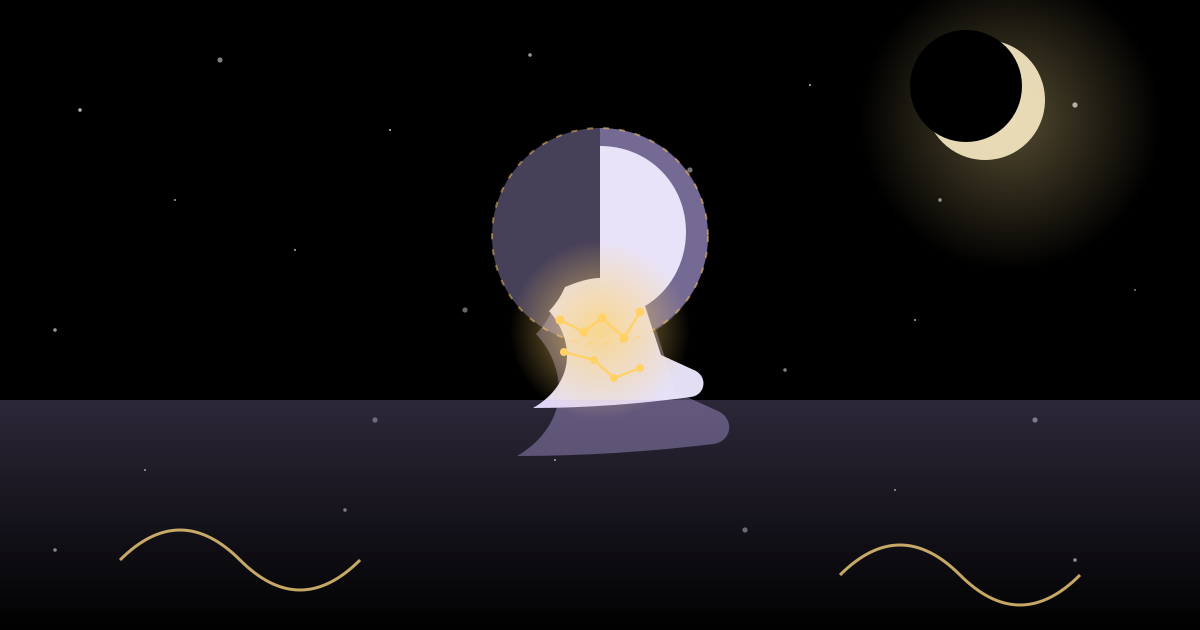
Almost everyone carries one: a cafe-au-lait splash on a shoulder, a strawberry-red port-wine stain, a mole in the exact center of the back that you cannot see without two mirrors. Birthmarks are ordinary — dermatologists will tell you they are nothing more than variations in pigment or blood vessels, as unremarkable as freckles. But look at yours in the mirror for a moment and ask the older question: why there? Of all the skin you have, why did the mark land in exactly that spot, in exactly that shape? It is a small question, and some traditions have a very large answer.
The answer is the old-wounds theory: the idea that a violent or traumatic death leaves an imprint that travels with the soul, surfacing in the next life as a birthmark — a scar you arrived with. A mark on the neck is read as a blade's memory; one on the chest, an arrow or a bullet's; a jagged pale line, a wound that once bled. It is one of the oldest ideas in reincarnation lore, and unlike most of them, it comes with a shelf of case files collected by a serious researcher at a serious university. This is that story — told the way this site always tells them: the folklore, the research, and the honest skeptic's case, side by side.
The Old-Wounds Theory: A Scar You Arrived With
Strip it to its essentials and the theory is elegant in its strangeness. The soul, it says, does not enter a new body as a blank slate. A life that ended suddenly and violently — the kind of death that leaves no time to process, grieve, or let go — leaves a kind of energetic wound. When the soul incarnates again, that unresolved injury expresses itself physically at the corresponding place on the new body. The birthmark is not a wound; it is the memory of one.
The theory has deep roots. In parts of South and Southeast Asia, where belief in reincarnation is mainstream, grandparents have read children's birthmarks this way for centuries — a pale patch on a grandson's chest explained as the spear wound of an ancestor, a reddish stain as a burn. It also appears in West African traditions, where marks are sometimes read as the signature of how a soul departed and why it came back. In these cultures the reading is not treated as superstition to be embarrassed about; it is folk wisdom, part of the ordinary language a family uses to make sense of its newest member.
The Western version of the idea crystallized in the 20th century, and its most famous champion was a man in a tweed jacket who kept meticulous files at the University of Virginia.
Stevenson's Birthmarks: The UVA Case Files
Ian Stevenson was a psychiatrist — chair of the psychiatry department at the University of Virginia, no less — who spent the last decades of the 20th century traveling the world to interview children who claimed to remember past lives. Over his career he documented more than 2,500 such cases. The detail that made his work extraordinary, and that drew the most scrutiny, was the physical evidence: in a significant number of cases, the child bore a birthmark or congenital defect at the location of the fatal wound described in the claimed previous life.
The pattern was striking in its consistency. A boy in India recalled being a man shot in the chest; he was born with a pair of birthmarks, entry and exit, matching the wounds recorded in the man's autopsy report. A child in Lebanon remembered a life ended by a blow to the head and carried a prominent birthmark exactly there. Stevenson and later his colleague Jim Tucker published analyses finding that in many cases the correspondence between claimed wound and birthmark was precise enough that coincidence felt like a stretch — and they went further, checking hospital and autopsy records to confirm the wounds independently of the families' testimony.
Tucker's book Life Before Life summarizes the UVA team's conclusion with characteristic care: the cases suggest that something is going on that current models of consciousness cannot fully explain. The researchers stopped short of declaring proof of reincarnation — Stevenson always insisted he was collecting evidence, not verdicts — but the birthmark cases remain the hardest part of their archive for skeptics to wave away, precisely because a mark on the skin can be photographed, measured, and matched against a medical record.
Be clear about what this is and is not. It is a body of documented cases compiled by serious researchers. It is not a controlled experiment, and it is not scientific proof of reincarnation. The children in most of these cases came from cultures where reincarnation is the default explanation for the unusual — which raises real questions about suggestion, family coaching, and selective memory. Hold both thoughts: the cases are genuinely strange, and strange is not the same as settled.
Reading Your Marks: Birthmark Folklore by Shape and Place
Setting the research aside, folklore has been reading birthmarks far longer than any university — and its readings are meant for exactly what you're doing right now: standing in front of the mirror, wondering. Traditional interpretations pair shape with position, and the game is played lightly, the way you read a horoscope: for reflection, not for orders.
By shape. A round mark is read as wholeness — a completed chapter, a life that ended naturally and well, its circle closed. A star-shaped or jagged mark suggests a dramatic exit, the old-wounds reading in its purest form. A long, pale streak is sometimes called a "traveler's mark," read as a soul that moved a great deal in its previous life. Marks that resemble objects — a heart, a crescent, a key — are treated as symbols first and wounds second: the heart marking a love that mattered, the key an unsolved mystery the soul is still working on.
By position. The forehead is read as insight carried over — a mind that remembers. Marks on the chest point to the heart: emotional wounds, deep attachments, unfinished loves. The back suggests burdens carried, or things the previous self could not face. Hands and wrists are read as skill — a talent you may find comes to you unnaturally easily this time around. The legs and feet belong to journeys: a soul that walked far, or ran. The neck, in the old-wounds telling, is the most literal of all — a mark of sudden endings.
Scars with no story. Some people carry thin pale scars they cannot account for — no memory of an injury, no accident on record. Folklore has a ready answer: these are the oldest wounds of all, marks whose story is two lives deep. Dermatology has a readier one: childhood is long, skin is forgetful, and many small scars simply outlive our memory of acquiring them. Both explanations are, in their way, about how much of our own history we carry without knowing it.
Treat all of this as contemplative play. The point of birthmark folklore is not to diagnose your past — it is to give you a lens for wondering about yourself. If the reading on your shoulder mark makes you think about courage, the exercise worked, whatever the truth about your previous lives.
Birthmarks in Regression and Meditation
For readers who work actively with past-life material — through regression sessions or guided meditation — birthmarks sometimes enter the practice as anchors. The technique is simple and entirely a matter of imagination: in a relaxed state, you visualize your birthmark as it might have looked in the act of being made, and let the scene build itself. Practitioners describe arriving at a place, a century, a scene — a market square, a battlefield, a sickbed — with the mark as the doorway.
Does it reveal anything real? There is no way to know, and honest practitioners will tell you so: the material that comes up in such exercises is imagined material, and its value is therapeutic and creative, not evidential. A meditation that brings you a vivid story about your mark has given you something genuine — a narrative about your fears, your longings, your sense of your own resilience — even if it has told you nothing about an actual past life. Regression therapists who work ethically make this distinction their first sentence with every client: we are exploring your inner landscape, not exhuming your history.
If you want to try it, the shape of the practice is well established: a quiet room, an unhurried hour, and a simple guided imagery — picture the mark glowing gently, imagine yourself stepping through it like a doorway, and notice what the other side looks like. Write down whatever comes without editing. Then read it back as you would read a dream: not as a fact about who you were, but as a document of who you are.
What the Skeptics Say: Skin Is Skin
Now the other side of the table, and it is a strong one. Dermatology does not need past lives to explain birthmarks, because birthmarks are common, varied, and well understood as developmental phenomena. Pigmented marks come from clusters of melanocytes; vascular marks like port-wine stains from capillaries that formed slightly differently in the womb. They appear where they appear for the same reason freckles cluster where they cluster: biology is lumpy, and the body is full of small accidents of development.
The Stevenson cases have been criticized on several grounds that deserve a hearing. The first is base rates: birthmarks are extremely common, and so are violent deaths in the historical record — with enough cases, some marks will land near some reported wounds by chance alone. The second is cultural shaping: in families that believe in reincarnation, a child's birthmark can become the seed around which a past-life narrative grows, with the details sharpening over years of retelling. The third is verification asymmetry: families are far more likely to report and remember the matches than the far more numerous cases where a child's marks matched nothing at all.
And then there is the simplest skeptical point, which no case file can answer: a birthmark's meaning is assigned after the story is told. A round mark on a chest becomes a bullet wound only once someone has decided the story involves a gun. The mark itself says nothing; the story does all the talking.
This is the honest shape of the evidence: an intriguing body of case reports on one side, and solid developmental biology plus real methodological questions on the other. It is, in other words, exactly the kind of question where believing either way with total confidence would be premature — which makes it perfect material for reflection and terrible material for certainty.
A Note on the Medical Side
One boundary matters here, and this site will always draw it plainly: birthmarks are medical phenomena first. Most are harmless and permanent, a normal part of how skin develops. But any mark that changes — grows, darkens, bleeds, itches, or changes shape — deserves a dermatologist's eyes, promptly. That is not a spiritual event; it is a medical one. The old-wounds reading is entertainment and reflection for the marks that have always been there and never changed. The changing mark is a question for a clinician, full stop.
How to Work With Your Marks
If the folklore has caught your imagination — and it probably has, or you wouldn't still be reading — here is the reflective playbook, borrowed from the traditions and the regression rooms alike.
- Map your marks. Literally: stand in front of the mirror and make a small sketch of every birthmark and unexplained scar, noting shape and position. Folklore readers start here because the pattern is often more interesting than any single mark.
- Try the shape-and-place reading. Use the folk interpretations above as prompts, not verdicts. A star-shaped mark on your hand: what skill came to you with suspicious ease? A streak on your leg: where do you feel called to go? The questions matter more than the answers.
- Journal the resonance. Write for ten minutes about the mark that fascinates you most. Don't aim for a past life; aim for honesty — what does this mark feel like it means? You may be surprised what surfaces when you give a small mystery your full attention.
- Do the doorway meditation. In a relaxed state, visualize the mark as a glowing doorway and step through. Write down the scene that builds itself, then read it as you would a dream: a story your mind made about your mark, worth its weight in insight.
- Keep the boundary. Reflection is reflection. No mark predicts your future, diagnoses your health, or obligates you to any belief. And again: changing marks go to a dermatologist, not to a journal.
And if you find you carry none of this — no birthmarks, no mysterious scars, skin like a blank page? The traditions have an answer for you too: some souls, they say, arrive with their history stored elsewhere — in dreams, in déjà vu, in the unshakable feeling of having been somewhere before. The marks are only one way a past might knock. There are others, and this site has a guide for every one of them.
Frequently asked questions
Do birthmarks have anything to do with past lives?
There is no scientific evidence linking birthmarks to past lives. The idea comes from reincarnation traditions and from case research by psychiatrist Ian Stevenson, who documented children whose birthmarks matched the wounds of deceased people they claimed to remember being. Mainstream dermatology explains birthmarks as normal variations in skin pigmentation or blood vessels, often present at birth or appearing in early childhood.
What is the old-wounds theory of birthmarks?
The old-wounds theory holds that a fatal or severe injury in a previous life can imprint itself on the next body, appearing as a birthmark or congenital scar at the corresponding location. It is most associated with the research of Ian Stevenson at the University of Virginia, who reported cases where a child's birthmark corresponded to the recorded fatal wound of a person who died before the child was born. It remains a spiritual interpretation, not an established medical fact.
What do different birthmark shapes mean in folklore?
Folk traditions read birthmarks by shape and position: round marks suggest wholeness or a completed life chapter; star-shaped marks are read as signs of distinction; marks on the forehead are linked to insight; on the chest to emotional memory; on the hands to skill carried over. These are playful folklore readings for entertainment and reflection, not predictions or diagnoses.
Can a birthmark tell me how I died in a past life?
No mark can tell you that for certain. In spiritual circles, some readers associate a mark's location and shape with the kind of wound it resembles, but this is imaginative interpretation, not evidence. If a birthmark or mole changes in size, shape, or color, that is a medical matter — see a dermatologist — not a spiritual message.
Keep exploring
Past-Life Karma Explained: What Karmic Debt Is & How to Clear It
Past-life karma explained: what karmic debt really means, the signs you may be carrying it, karmic relationships & lessons — plus spiritual practices for clearing it.
Read the meaning →
Signs of Past-Life Dreams: 7 Clues You've Lived Before
Signs of past-life dreams: vivid historical dreams, déjà vu, unexplained phobias & affinities. Learn the signs and what to do with them.
Read the meaning →
Past-Life Regression: A Complete Beginner's Guide
Past-life regression guide: what happens in a session, professional vs self-guided methods, a complete script & what people experience.
Read the meaning →
Children Who Remember Past Lives: The Most Astonishing Cases Explained
Children who remember past lives: the Stevenson & Tucker research at UVA, the most astonishing cases, the signs parents notice & a calm guide for families.
Read the meaning →