
South Node Past Life Meaning: Your Karmic Story in Astrology
There are things you have always been good at without quite knowing why. The friend who has never studied music but can harmonize on first hearing. The colleague who walks into chaos and calmly organizes it, as if she has run this meeting a hundred times before. The person who feels at home in a foreign city on the first afternoon, navigating streets they have never walked. Karmic astrology has a name for this kind of easy mastery, and a place for it in your birth chart: the South Node.
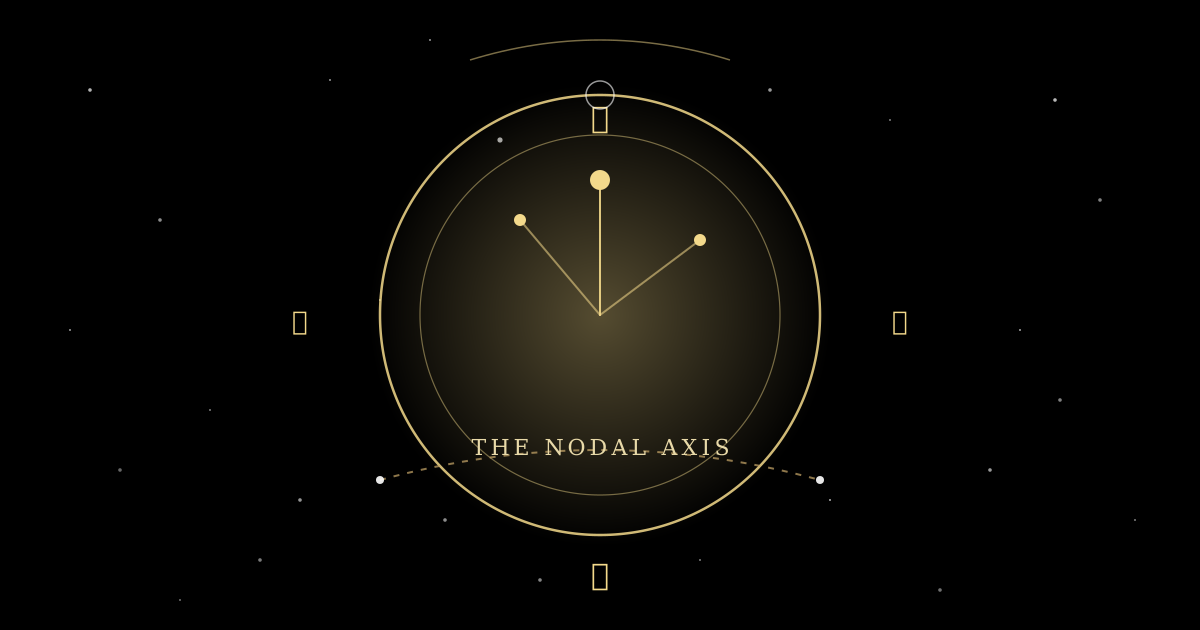
Unlike the planets, the lunar nodes are not physical bodies. They are the two points where the Moon's orbit crosses the Sun's apparent path — the North Node, where the Moon ascends, and the South Node, where it descends. They always sit exactly opposite each other, forming an axis across your chart. If that image feels like a seesaw, that is exactly how astrologers read it: one end weighted with everything you already know, the other pointing toward everything you are here to learn.
What Is the South Node, Exactly?
In Vedic astrology, the nodes are called Rahu (North) and Ketu (South), and they carry a myth: a demon who stole a sip of the nectar of immortality was beheaded, and its head and body became the two nodes, forever chasing the Sun and Moon. Western karmic astrology, popularized in the twentieth century by writers like Martin Schulman, kept the symbolism but softened it into a story of growth: the South Node is your past, the North Node your future, and your life is the journey between them.
In this reading, the South Node's sign describes the qualities you perfected in earlier lives — or, in a less literal framing, the patterns laid down so early and so deeply that they feel innate. A South Node in Virgo, for example, suggests a soul well practiced in order, service, and precision; a South Node in Leo suggests one practiced in applause, performance, and being seen. Neither is good or bad. Both are simply familiar.
The South Node's house adds the setting: the area of life where those patterns play out. A South Node in the 4th house points to deep roots in home and family; in the 10th, to a long history of public responsibility. Together, sign and house paint a portrait of the person you were before this life began — or, if you prefer a psychological reading, the person you were trained to be before you had a choice.
South Node vs. North Node: The Axis of Growth
The most common mistake in reading the nodes is treating the South Node as something to escape. Astrologers who work with the axis will tell you the opposite: the South Node is your toolkit. The point is not to abandon it but to stop living inside it exclusively. Think of it as your home town. You can love it, visit it, draw on everything it taught you — but if you never leave, you never grow.
Your North Node sits in the opposite sign, and it describes the qualities that feel awkward, unfamiliar, and slightly frightening — which is precisely why they matter. A South Node in Aries, used to charging ahead alone, pairs with a North Node in Libra, asking for partnership, compromise, and genuine listening. A South Node in Cancer, fluent in caretaking, pairs with a North Node in Capricorn, asking for structure, ambition, and public achievement. The axis always asks for balance, not replacement: the goal is a person who can do both, leaning on the South Node's gifts while practicing the North Node's lessons.
This is why the nodes are often described as a soul's curriculum. Your South Node shows the classes you have already passed; your North Node shows the ones you signed up for this time around. The tension between them is not a flaw in the chart — it is the chart's engine.
How to Find Your South Node Sign
Generate a free birth chart using your date, time, and place of birth — the time matters, because the nodes move slowly but the houses shift with it. Look for the South Node symbol, which looks like a horseshoe opening downward, or the labels South Node, Ketu, or the descending node. Many charts list it alongside the planets. If your chart shows only the North Node, take the sign exactly opposite it: North Node in Taurus means South Node in Scorpio, North Node in Gemini means South Node in Sagittarius, and so on around the wheel.
Note the sign first, then the house, then any planets sitting close to the node — a planet conjunct your South Node is read as a talent or theme woven tightly into your past-life story. A Venus near the South Node, for instance, is often read as a history of artistry, romance, or diplomacy that comes easily now. None of this requires belief in literal reincarnation to be useful: even as pure symbolism, the axis is a sharp tool for spotting which strengths you overuse and which growth edges you avoid.
South Node Through the Signs: Gifts and Traps
South Node in Aries (North Node in Libra). Gift: courage, independence, and the ability to act decisively alone. Trap: charging ahead without consulting anyone, mistaking speed for strength, and turning every disagreement into a contest. Growth looks like partnership — learning that asking for help is not surrender.
South Node in Taurus (North Node in Scorpio). Gift: patience, steadiness, and a craftsman's feel for the material world. Trap: clinging to comfort, routine, and possessions long past their usefulness, and avoiding any change that threatens security. Growth looks like letting go — trusting that depth matters more than stability.
South Node in Gemini (North Node in Sagittarius). Gift: quick thinking, curiosity, and the gift of gab. Trap: skimming everything and mastering nothing, collecting facts instead of convictions, and talking to avoid deciding. Growth looks like meaning — choosing a bigger story and standing inside it.
South Node in Cancer (North Node in Capricorn). Gift: emotional intelligence, memory, and the ability to make anyone feel at home. Trap: retreating into the past or the family nest whenever life gets hard, and caretaking others to avoid your own ambitions. Growth looks like structure — building something in the world that outlasts a mood.
South Node in Leo (North Node in Aquarius). Gift: warmth, creativity, and a natural stage presence. Trap: needing applause to feel real, and making every room about your performance. Growth looks like the collective — contributing to something bigger than your own spotlight.
South Node in Virgo (North Node in Pisces). Gift: precision, discernment, and genuine usefulness. Trap: perfectionism that never ships, criticism that masquerades as help, and anxiety dressed up as diligence. Growth looks like surrender — trusting intuition and accepting that some things are beyond fixing.
South Node in Libra (North Node in Aries). Gift: diplomacy, taste, and the ability to see every side. Trap: peacekeeping at your own expense, endless indecision, and disappearing into other people's needs. Growth looks like selfhood — stating what you want before asking what everyone else wants.
South Node in Scorpio (North Node in Taurus). Gift: psychological depth, resilience, and comfort with life's darker rooms. Trap: intensity as a habit — crisis, secrecy, and control as the only ways to feel alive. Growth looks like simplicity — pleasure, patience, and the quiet life, chosen rather than feared.
South Node in Sagittarius (North Node in Gemini). Gift: philosophy, breadth of vision, and a restless love of truth. Trap: preaching instead of listening, and mistaking a grand theory for lived experience. Growth looks like detail — conversations, facts, and the humble work of learning from one person at a time.
South Node in Capricorn (North Node in Cancer). Gift: discipline, responsibility, and the ability to carry heavy loads without complaint. Trap: defining yourself by achievement, and treating feelings as inefficiencies to be managed. Growth looks like tenderness — home, vulnerability, and rest that is not earned.
South Node in Aquarius (North Node in Leo). Gift: originality, principle, and loyalty to ideas bigger than yourself. Trap: detachment disguised as objectivity, and belonging to causes while avoiding closeness with actual people. Growth looks like the heart — creating, loving, and being seen as yourself, not just as a viewpoint.
South Node in Pisces (North Node in Virgo). Gift: compassion, imagination, and a porous, mystical sensitivity. Trap: dissolving — escapism, boundarylessness, and rescuing others to avoid your own practical life. Growth looks like craft — daily routines, useful skills, and help that is concrete rather than cosmic.
South Node in the Houses: Where the Story Plays Out
The sign describes how your past-life patterns feel; the house describes where they show up. A South Node in the 1st house suggests an old identity worn like a second skin — people may sense you have always been this way. In the 7th, the patterns live in relationships: you may keep choosing the same kind of partner, or the same kind of dynamic, until you notice the repetition. In the 10th, the story is public — career, reputation, and the roles you slip into without trying. In the 12th, the most hidden house, the patterns are the ones you can barely name: private fears, secret strengths, and the sense of carrying something you cannot quite place.
Reading house and sign together is what turns a generic description into something personal. South Node in Leo in the 2nd house is a different story from South Node in Leo in the 9th: the first ties the performance theme to money and self-worth, the second to belief, travel, and teaching. If a description of your sign feels only half true, the house usually explains the other half.
The Nodal Return: When the Past Knocks
The nodes take about 18.6 years to circle the zodiac, so they return to their birth positions around ages 18 to 19, 37, and 55 to 56. Astrologers call these nodal returns, and they are often described as crossroads: periods when old patterns resurface loudly and a new direction starts to take shape. The first return, near age 19, often coincides with leaving home or choosing a path; the second, near 37, with the classic midlife reassessment; the third, near 56, with a redefinition of purpose.
You do not need to believe in astrology to notice that these ages are, in fact, common turning points — and that is rather the point. Whether you read the nodal return as a cosmic clock or as a useful story for a natural life transition, it offers the same practical question: what am I repeating, and what am I ready to choose instead?
How to Work With Your South Node
Start by naming the gift without apology. Write down what comes easily to you — the skills people praise you for, the roles you fall into, the environments where you relax instantly. That list is your South Node in action, and it is real capital. Then notice the trap: where does the gift become a rut? The organizer who cannot delegate, the peacemaker who cannot say no, the adventurer who cannot stay — the trap is always the gift, overused.
Then look at your North Node sign and ask one small, concrete question: what is one thing that sign would do this week that I would normally avoid? Not a life overhaul — a single act. A South Node in Virgo with a North Node in Pisces might skip the spreadsheet one evening and paint, or meditate, or simply rest without justifying it. A South Node in Cancer with a North Node in Capricorn might send the pitch, apply for the role, or set one boundary at work. Small acts, repeated, are how an axis shifts.
Finally, keep the framing honest. The South Node is a story about your patterns, not a verdict on your soul, and no chart can tell you what you must do. Treat it as entertainment and reflection first — a mirror, not a map. If a reading of your nodes stirs recognition, use it. If it stirs dread, or if someone charges you for certainty about your past lives, walk away. The best use of any past-life idea is the same as the best use of any memory: to live this life a little better.
The Honest Caveats
Reincarnation and karmic astrology are matters of faith and philosophy, not established science, and the lunar nodes themselves are mathematical points, not physical bodies — their meaning comes entirely from the traditions that interpret them. No placement can prove a past life, predict your future, or excuse a present choice. The value of the South Node lies in what it reveals about the present: the strengths you lean on too hard, the comforts you mistake for identity, and the growth that keeps asking for your attention.
Used that way, the South Node is less like a fortune and more like a familiar road. You know every turn of it. You could drive it in your sleep — and sometimes, that is exactly what you have been doing. The invitation of the axis is simple: enjoy the road you know, and still, now and then, take the unfamiliar turn.
Frequently asked questions
What does the South Node mean in astrology?
The South Node is the point in your birth chart opposite the North Node. In karmic astrology it is read as your past-life story: the talents, habits, and comfort zones you arrive with, already mastered. It is not a weakness to fix but a foundation to draw on — the trap is only in staying there and never moving toward the North Node.
How do I find my South Node sign?
Generate a free birth chart with your date, time, and place of birth, and look for the South Node symbol, a horseshoe opening downward, or the label South Node or Ketu. Its sign is always exactly opposite your North Node sign, so if your North Node is in Taurus, your South Node is in Scorpio.
Is the South Node bad?
No. The South Node holds your natural gifts — skills that come easily because, in the karmic reading, you practiced them before. It only becomes a problem when it turns into a rut: repeating the same patterns because they are comfortable, even when they no longer serve you. Used consciously, it is the toolkit you carry into your North Node growth.
What is a nodal return?
A nodal return happens roughly every 18.6 years, when the transiting lunar nodes return to their birth-chart positions — around ages 18 to 19, 37, and 55 to 56. Astrologers read these as crossroads periods when old patterns resurface and a new life direction often takes shape.
Keep exploring
Past-Life Connection to Places: Why Some Places Feel Like Home
Past-life connection to places explained: why a town, country, or landscape can feel like home on your first visit — the 7 forms it takes, the honest psychology behind each one, and how to explore the feeling.
Read the meaning →
Reincarnation Signs in Everyday Life: 12 Clues You May Have Lived Before
Reincarnation signs in everyday life: déjà vu, instant recognition, past-life dreams, unlearned talents, and fears with no origin — the 12 classic clues, plus the honest psychology behind each.
Read the meaning →
Old Soul Signs: 12 Traits That Suggest You've Lived Many Lives Before
Old soul signs: the 12 classic traits — feeling out of place in your own era, deep empathy, solitude, meaning over money — plus the honest psychology behind them.
Read the meaning →
Past-Life Karma Explained: What Karmic Debt Is & How to Clear It
Past-life karma explained: what karmic debt really means, the signs you may be carrying it, karmic relationships & lessons — plus spiritual practices for clearing it.
Read the meaning →