
Dagaz Rune Meaning: Breakthrough, Daylight & the Dawn After Darkness
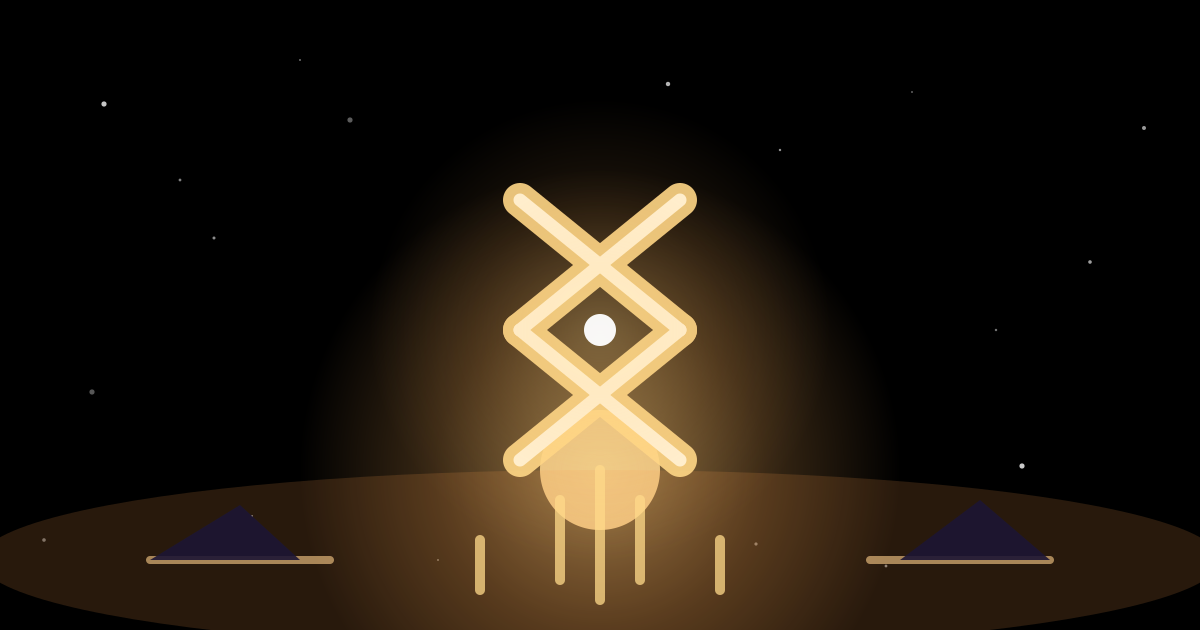
Every darkness ends, and the runes have a glyph for the ending. Dagaz (ᛞ) is that glyph — the rune of day, of daylight, of the dawn breaking over a long night. Its name comes straight from the Proto-Germanic word for day, and its shape tells the story in one image: two triangles meeting at a point, like a bowtie or an hourglass, like the sun itself balanced on the horizon line. The twenty-third rune of the Elder Futhark sits second to last in the futhark's journey, and that placement is no accident. Dagaz is the payoff — the arrival after Hagalaz's storm, Nauthiz's need, and Perthro's night of not knowing. Where other runes describe the struggle, Dagaz describes the morning after.
The Old English rune poem gives Dagaz one of the shortest and most radiant entries in the whole sequence: day is "the glory of men" and "the joy of the light of the Creator." There is no shadow in the poem's reading of this rune. Daylight is simply good — the time when people can see, work, travel, and live fully. Drawing Dagaz in a reading carries that same uncomplicated brightness. Whatever you asked about, the night is ending. The light is coming on.
Dagaz's Core Meaning in Divination
In a rune casting, Dagaz is the sign of breakthrough and clarity. It appears when a situation is turning — when the confusion, delay, or darkness around a question is lifting and the path forward is becoming visible. A diagnosis finally explained. A plan that suddenly clicks into place. A conversation that clears months of fog. Dagaz does not describe the struggle; it describes the release from it. The rune says: look up, the horizon is brightening.
Dagaz is also the rune of awakening and new phases. It marks beginnings that feel different from ordinary fresh starts — they carry the quality of emerging from something. A person who comes through burnout, grief, or a long failure and starts again is living a Dagaz moment: not naive, not untouched, but awake. The dawn it promises is deeper because of the night that came before it. If you draw Dagaz while starting something new, the rune suggests you carry your hard-won wisdom into the new phase rather than leaving it behind.
The rune carries clarity as a discipline, too. Daylight reveals things — including things we might prefer not to see. Dagaz's brightness is honest light: it can show you a relationship clearly for the first time, expose a bad habit, or make an unavoidable decision unavoidable. The rune's optimism is never about pretending. It is about seeing things as they are and finding that the view is better than the dark suggested. Clarity, even hard clarity, is Dagaz's gift.
Does Dagaz Have a Reversed Meaning?
Here is one of Dagaz's most delightful facts: it cannot be reversed. The bowtie shape is perfectly symmetrical — turn ᛞ upside down and it looks exactly the same. Unlike most runes, Dagaz has no merkstave form, no shadow position that flips its meaning. The rune simply refuses to go dark. Readers treat this as meaningful in itself: Dagaz's message survives every angle. There is no perspective from which the dawn is bad news.
That said, Dagaz has a blocked or dimmed expression. When this rune appears in a difficult casting, readers interpret it as daylight delayed rather than denied: the breakthrough is coming but is being held up, the clarity you need is available but you are not looking at it, or a new phase is visible on the horizon while you keep staring at the ground. The sunrise has not been canceled. You are just not facing east.
Blocked Dagaz often points to resistance to awakening. Sometimes we cling to the night because the dawn asks something of us — to forgive, to change, to start again, to admit we were wrong. If Dagaz appears alongside a situation that refuses to move, the rune's question is gentle but direct: what are you protecting by staying in the dark? The day is here either way. Dagaz is asking whether you will meet it.
Dagaz in Love and Relationships
Dagaz in love is the sunrise after a long night. It describes relationships emerging into a new and brighter phase: the fog of a rough patch lifting, a long-distance relationship moving into the same city, partners finally understanding each other after months of miscommunication. The rune does not promise perfection — it promises visibility. You can now see the relationship clearly, and what you see is worth working with.
For singles, Dagaz often means seeing yourself clearly first. Many people draw this rune when they have just come through a hard breakup or a long stretch of loneliness and are beginning to feel like themselves again. That returning aliveness — the interest in mornings, the capacity to imagine a future — is Dagaz in action. New love tends to follow people who have found their own daylight again, and the rune marks that inner dawn before the outer one arrives.
For couples, Dagaz can mark reconciliation and honest beginnings: a fresh chapter written on clean paper, old grievances finally named and set down, the discovery of something new to love in a long-known partner. It also governs the beautiful ordinary magic of routines made new — a relationship that feels exciting again because both people decided to wake up to it. Like the sun, love rises daily if you look at it.
Dagaz in Career, Money, and Goals
Dagaz's career face is the turning point. It appears when professional darkness is ending: the job search finally producing interviews, the failing project finding its rescue, the skills you built in obscurity suddenly becoming exactly what the moment needs. The rune is especially associated with recognition — daylight is when people are seen. Work done faithfully in the dark has a way of being noticed at dawn.
With money, Dagaz is the rune of financial morning. It can describe debts finally clearing, income stabilizing after a precarious stretch, or a money pattern that was slowly sinking now reversing. The rune does not promise lottery-style windfalls — that is more Perthro's territory. Dagaz's abundance is steadier: the honest day's work paying off, the budget finally balancing, the emergency fund beginning to grow. Sunrise wealth is built, not won.
For personal goals, Dagaz is the breakthrough rune par excellence. It favors the long effort that is about to crest: the fitness routine that suddenly feels easy, the language that starts flowing, the creative project that finds its voice. Researchers call this the plateau of latent potential — progress invisible for months, then sudden. Dagaz is the rune of that sudden. If you draw it while working toward something, the rune's message is simple: keep going, you are closer than the darkness makes it look.
The Mythology and Symbolism Behind Dagaz
Dagaz's roots run into the deepest layer of Norse myth: Dagr, the personification of day. In the Poetic Edda, Dagr is the son of Nótt (night) and the god Dellingr — dawn itself is described as the child of night and shining one, the daily birth of light out of darkness. Dagr rides across the sky each morning, his horse Skinfaxi ("shining mane") lighting the air and earth with the glow from its mane. The rune Dagaz is that myth compressed into a glyph: light born from dark, the child of night, the shining mane crossing the sky.
The rune's bowtie shape carries the symbolism of balance and convergence. Two triangles meet at a single point — night and day touching at dawn, the two halves of the day balanced at the equinox, opposites reconciled. Some readers see in it the meeting of the conscious and unconscious, the visible and hidden, the effort and the reward. Dagaz is where things come together. The hourglass reading adds another layer: time itself, the turning of the day, the reminder that every night is temporary because the hourglass always runs out.
As the twenty-third rune, Dagaz sits in Tyr's aett, the final family of runes, and its near-final position gives it a valedictory quality — the rune of culmination and resolution. It is followed only by Othala, the rune of home and inheritance. The futhark's story ends, in other words, with daylight and then homecoming: the journey through struggle resolves into clarity, and clarity resolves into belonging. Few alphabets end so hopefully. Drawing Dagaz is drawing near the end of a hard story — and discovering it ends well.
How to Work With Dagaz: A Simple Practice
The classic Dagaz practice is the sunrise five minutes. For one week, spend five minutes at or near dawn — outside if you can, at a window if you cannot — simply watching the light change. Name one thing in your life that is becoming clearer, brighter, or easier. Do not force the answer; let it surface as the light does. People who do this practice report an odd and lovely effect: by Friday, the thing they were worrying about on Monday looks different, and not just because of the exercise. Daylight does actual work on the mind.
For decisions wrapped in fog, try drawing the rune. Sketch ᛞ on paper and write the situation beside it. Then write two lists: what the daylight shows (the facts, free of fear and fantasy) and what the night is adding (the worries, the catastrophizing, the what-ifs). The exercise borrows Dagaz's gift of separating light from dark. Most people find the daylight list shorter, kinder, and more actionable than they expected — and the night list embarrassingly loud.
Dagaz also invites a breakthrough journal. Each evening, note one thing that became clear that day — a realization, a resolved question, a moment the fog thinned. Over weeks, the journal becomes a personal atlas of dawns: proof that confusion is a phase, not a condition. On hard days, reading back through it is a Dagaz working in itself — yesterday's clarity lighting today's dark.
For a deeper working, meditate with the bowtie balance. Sit quietly and picture ᛞ glowing gold before you. Imagine one triangle as everything you have survived — the night — and the other as everything becoming possible — the day. Breathe at the point where they meet: this present moment, the dawn line. Rest there for ten minutes. The rune's teaching is that you do not have to erase the night to enter the day. You only have to step across the line.
Dagaz and the Other Runes
Dagaz's pairings are stories of darkness ending and light beginning. With Perthro (chance, the unknown), it is the dice finally landing at sunrise — the long uncertainty resolving into a new day. Perthro is the night of not knowing; Dagaz is the morning after, when the outcome is visible and the game is over.
With Hagalaz (disruption, hail), Dagaz is the calm after the storm in its purest form: whatever broke is done breaking, and the rebuilding can begin in clear light. This pairing often appears after genuine upheaval — it is the rune of the first good morning after the worst week. Beside Sowilo (the sun, victory), the light doubles: triumph that is complete and visible, success stepping out of the shadows into full daylight.
With Nauthiz (need, endurance), Dagaz honors survival rewarded — the need that taught you is over, and the lesson remains as strength. And near Othala (home, inheritance), the futhark's final pair tells a whole story: breakthrough leading to homecoming, clarity resolving into belonging, the dawn leading at last to the door of your own house.
As always, remember that the runes are a spiritual and cultural tradition to explore for reflection and entertainment — not a guarantee of outcomes. Treat Dagaz as a mirror for your own turning points rather than a prediction engine: it will not schedule your sunrise, but it will teach you to recognize the first light.
Frequently asked questions
What does the Dagaz rune mean?
Dagaz (ᛞ), the twenty-third rune of the Elder Futhark, means day or daylight. It is the rune of breakthrough, clarity, and awakening — the moment the night ends and things become visible. In readings it signals a turning point: confusion clearing, a new phase beginning, and optimism grounded in real change.
Does Dagaz have a reversed meaning?
Dagaz is perfectly symmetrical — the bowtie shape looks the same upside down — so it has no reversed or merkstave form. Its shadow side is expressed as blocked or dimmed daylight: the dawn that is delayed, clarity you are resisting, or a breakthrough you can see but are not stepping into. The rune stays positive; the challenge is in your response to it.
Is Dagaz a good omen?
Dagaz is one of the most positive runes in the Elder Futhark. It is the rune of the dawn — clarity, breakthrough, healing, and new beginnings. Readers treat it as a green light: the night of a problem is ending. Explore it as reflection and entertainment, not as a guarantee of outcomes.
What does Dagaz mean in love?
Dagaz in love is the sunrise after a long night: clarity between partners, a relationship moving into a new and brighter phase, or a fresh connection arriving after a hard season. For singles it can mean finally seeing your own worth clearly. For couples it often marks reconciliation, honesty, and the fog lifting.
How do I work with Dagaz in daily practice?
Try the Dagaz sunrise practice: spend five minutes at dawn, or visualize the sunrise, naming one thing that is becoming clear to you. Draw ᛞ on paper and write the situation you want clarity on beside it, then list what the daylight reveals — the facts, free of fear. Dawn meditations and gratitude lists are classic Dagaz workings.
Keep exploring

Perthro Rune Meaning: Chance, Fate & the Mystery of the Lot Cup
Perthro (ᛈ) is the Elder Futhark rune of the lot cup — chance, fate, mystery and the joy of not knowing. Learn its upright and reversed meanings for love, career, risk and daily practice.
Read the meaning →
Jera Rune Meaning: The Harvest, Patience & Reaping What You Sow
Jera (ᛃ) is the Elder Futhark rune of the harvest, the year, and natural cycles — patience, lawful reward, and results arriving in their proper season.
Read the meaning →
Sowilo Rune Meaning: Victory, the Sun & Life Force
Sowilo (ᛋ) is the Elder Futhark rune of the sun — victory, vitality, and unstoppable life force. Learn its meanings in readings, love, career and daily practice.
Read the meaning →
Fehu Rune Meaning: Wealth, Abundance & New Beginnings
Fehu, the first rune of the Elder Futhark, means wealth, abundance and new beginnings. Discover its meanings for love, career, money and spiritual growth.
Read the meaning →