
Eihwaz Rune Meaning: Endurance, the Yew Tree & Transformation
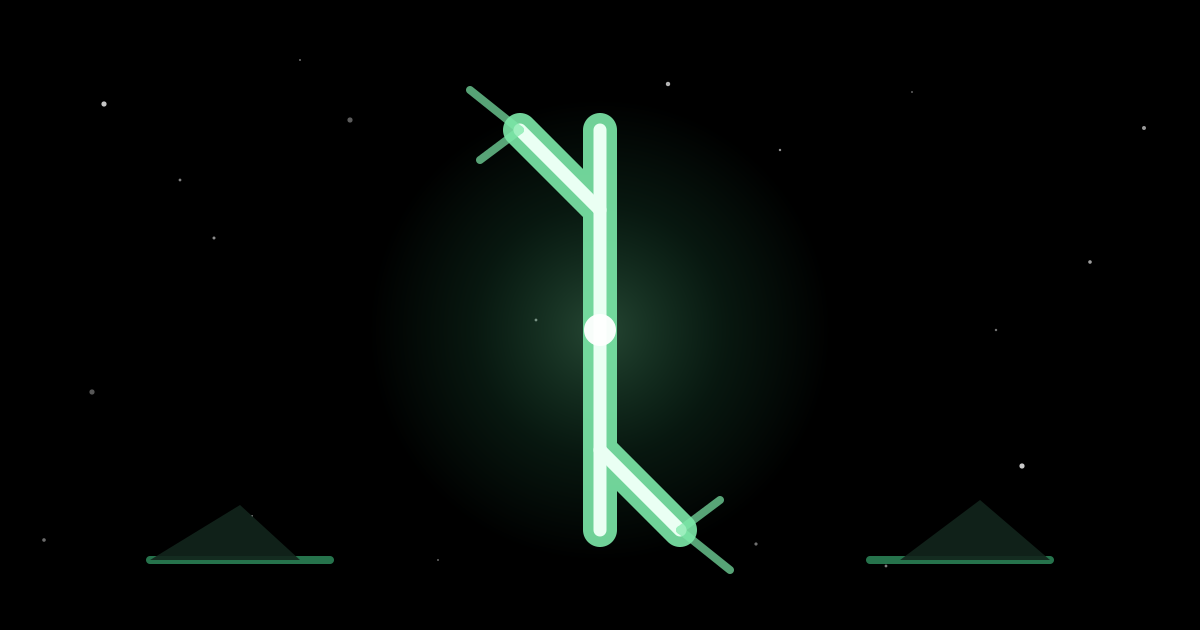
Some trees drop their leaves and wait out winter. The yew does something stranger: it stays green through the coldest months, lives for thousands of years, and grows new trunks from inside its own hollow heart. Eihwaz (ᛇ) is that tree carved into a single stroke — a tall staff with two angled branches, like a spine holding earth and sky together. Its name comes from the Proto-Germanic word for yew, and its position at the exact center of the Elder Futhark — the thirteenth of twenty-four runes — gives it a hinge quality. Eihwaz is the rune you meet halfway through the journey, at the moment the path stops being easy and starts asking what you are made of.
The yew was never an ordinary tree to the Germanic peoples. Its wood was so springy and strong that it became the longbow, the weapon that could send an arrow farther than any other. Its shade was so deep that yews were planted in churchyards and burial grounds, where they still stand today, some of them older than the churches beside them. And its berries were famously poisonous — a tree that could kill as well as protect. Eihwaz carries all of this at once: the weapon and the graveyard, the defense and the danger, the evergreen that survives winter by being itself, unchanging, year after year. Drawing this rune is rarely about a quick win. It is about the long game.
Eihwaz's Core Meaning in Divination
In a rune casting, Eihwaz is first and foremost the sign of endurance. It appears when a situation demands staying power rather than speed: a long recovery, a difficult project, a relationship in a hard season, a grief that will not be rushed. The rune does not promise that the difficulty will lift tomorrow. It promises something quieter and more useful — that you have the roots to stand through it. Like the yew, you are built for long winters. Eihwaz asks you to stop measuring progress in days and start measuring it in seasons.
Eihwaz is also the rune of defense and healthy boundaries. The yew's wood made bows, and its poison guarded churchyards; the tree defends itself. When Eihwaz appears, readers often ask what needs protecting in your life right now: your time, your energy, your peace, a project still too young to be judged. Defense here is not aggression. It is the quiet act of drawing a line and holding it — saying no to one more obligation, closing the door on a draining relationship, or keeping a new idea private until it is strong enough to survive daylight.
The rune's deepest face is transformation through death and rebirth. The yew renews itself from within: old trunks hollow out, and new growth rises through the hollow center. Eihwaz therefore governs the kind of change that is not an addition but a replacement — an old identity, job, or version of a relationship dying so that something truer can grow in its place. This is why Eihwaz sits at the center of the futhark and at the center of so many difficult readings. It marks the threshold: what you were is ending, what you will be has not yet arrived, and the work is to stand steady in between.
Does Eihwaz Have a Reversed Meaning?
Most rune readers treat Eihwaz as a rune without a true reversed form. Its shape — a vertical staff with angled branches — reads much the same upside down, and the tradition generally gives it no merkstave meaning. That is fitting: endurance does not flip into its opposite the way a promise can flip into a lie. It either holds or it does not, and the rune's message survives the turning.
What Eihwaz does have is a blocked or misused expression. Endurance curdles into stubbornness when you keep standing in a place that no longer deserves you — a job that has hollowed you out, a relationship that ended months ago in everything but name. Defense curdles into isolation when boundaries become walls and you keep out the help, love, and good news along with the harm. And transformation curdles into stagnation when you refuse the death the rune is pointing to, clinging to an old form because the hollow middle feels frightening. If Eihwaz appears in a difficult casting, the question is rarely whether you are strong enough. It is whether your strength is pointed at the right thing.
Blocked Eihwaz also warns against mistaking endurance for virtue. Not every hard season deserves to be endured. Sometimes the yew's lesson is not to stand longer but to notice that you have been standing in poisoned ground. The rune's gift is discernment: the wisdom to know which difficulties are winters to survive and which are doors to walk out of.
Eihwaz in Love and Relationships
Eihwaz in love is the relationship that survives a hard season. It describes couples who choose each other through difficulty rather than only in ease: the long-distance stretch, the illness, the financial strain, the year when everything felt thin. The rune honors that kind of love — not the fireworks kind, but the evergreen kind, still green in February. If you draw Eihwaz while partnered, it often means the relationship is being tested, and the test itself is the point: what survives this will be stronger for having been tested.
For singles, Eihwaz often means becoming steady before seeking a partner. The yew does not chase spring; it outlasts winter. Readers see this rune when someone is doing the slow work of becoming whole — healing from a breakup, building a life they actually like, learning to be alone without being lonely. That rootedness is what makes later love possible. A tree with shallow roots falls in the first storm; a person with deep ones does not need a partner to hold them upright.
For couples, Eihwaz can also mark boundaries that protect the bond: the agreement to keep phones out of the bedroom, the decision to say no to family interference, the hard conversation that finally names what is not acceptable. Boundaries are not the opposite of love in Eihwaz's world. They are the fence around the yew grove — the thing that lets something sacred grow undisturbed. But the rune is honest about the other possibility too: sometimes the transformation it signals is a relationship ending, and the endurance it asks for is the courage to let it end well.
Eihwaz in Career, Money, and Goals
Eihwaz's career face is the long apprenticeship. It appears when professional progress is slow, unglamorous, and real: the years of building skill before recognition, the business surviving its third lean year, the craftsperson still practicing while others chase trends. The yew grows slowly — a few millimeters a year — and yet outlives empires. Eihwaz favors that arithmetic. If you draw it while building something, the rune's message is to protect the work from premature judgment and keep going through the unphotogenic middle.
With money, Eihwaz is the rune of financial defense. It governs emergency funds, insurance, the unsexy habit of saving during good months so the bad ones do not break you. It also warns against the slow poison of the yew's berries: debts, subscriptions, and obligations that look harmless in small doses and accumulate into something dangerous. Eihwaz's money advice is almost boring, and that is the point — boring is what survives. Build the fence before the storm, not during it.
For personal goals, Eihwaz is the plateau rune. It shows up when effort has stopped producing visible results and quitting starts to look rational. The yew's teaching here is that growth in winter is invisible: roots deepen while nothing shows above ground. If you draw Eihwaz while working toward something, ask whether the plateau is a real dead end or just the season when the work goes underground. Most plateaus, the rune suggests, are the latter — and the people who outlast them are the ones who were never really stuck at all.
The Mythology and Symbolism Behind Eihwaz
Eihwaz's roots run into the deepest myth of the Norse world: Yggdrasil, the world tree. Scholars have long debated whether the world tree was an ash or a yew, and the yew's case is strong — evergreen, ancient, poisonous, planted over graves, its wood made into weapons. Yggdrasil's trunk is the axis that holds the nine worlds together, and Eihwaz's straight staff is that axis in miniature: the line between below and above, between the roots of the dead and the branches of the living. To draw Eihwaz is to touch the spine of the world.
The Old English rune poem gives Eihwaz one of the futhark's most unsettling entries: the yew is described as a tree that is rough on the outside and rooted firm, a joy and a guard in the homestead, and a source of fire — its wood burned hot and clean. The poem holds the paradox without resolving it: the same tree shelters and burns, protects and poisons. That is Eihwaz's whole teaching in one stanza. Strength is never one-sided. Anything powerful enough to defend you is powerful enough to harm you, and wisdom is knowing which way the edge is facing.
The rune's shape carries the symbolism of the threshold. A vertical staff with one branch reaching up and one reaching down is a picture of a person standing between worlds: roots in the underworld of endings, branches in the sky of beginnings, the present moment as the trunk between them. Some readers see in it a spine, others a bow drawn and waiting, others the yew itself — trunk, root, and branch in a single gesture. As the thirteenth rune, Eihwaz sits at the futhark's exact middle, and that placement gives it a hinge quality: everything before it leads here, everything after it flows from here. It is the still point of the turning alphabet.
How to Work With Eihwaz: A Simple Practice
The classic Eihwaz practice is the standing tree. For five minutes, stand tall with your feet planted and your arms relaxed, imagining roots growing from your feet into the earth and branches from your crown into the sky. Name one thing you will endure this season and one thing you will release. Do not force the answers; let them surface as the stillness does. People who do this practice report a specific effect: the situation stops feeling like an emergency and starts feeling like a season — something with an end, even if the end is not visible yet.
For decisions wrapped in pressure, try drawing the rune. Sketch ᛇ on paper and write the situation beside it. Then write two lists: what is worth defending here (the roots) and what has already died and needs releasing (the hollow trunk). The exercise borrows Eihwaz's gift of separating endurance from stubbornness. Most people find one list surprisingly short — and that shortness is the answer.
Eihwaz also invites a winter walk. Walk among evergreen trees — yews if you can find them, any evergreen if you cannot — and notice what stays green when everything else has let go. The practice is less about the trees than about the question they ask: what in your life is evergreen, and what have you been treating as evergreen that is actually seasonal? On hard days, the walk itself is a Eihwaz working — proof, in green, that winter is a season and not a verdict.
For a deeper working, meditate with the axis image. Sit quietly and picture ᛇ glowing deep green before you. Imagine one branch reaching down into everything you have lost or left behind, and the other reaching up into everything not yet arrived. Breathe at the staff between them: this present moment, the trunk. Rest there for ten minutes. The rune's teaching is that you do not have to resolve the ending and the beginning at the same time. You only have to stand steady where they meet.
Eihwaz and the Other Runes
Eihwaz's pairings are stories of standing through change. With Isa (ice, stillness), it is endurance doubled: the frozen winter and the evergreen within it, patience as a complete strategy. This pairing often appears when the only right move is to wait well — to hold position while the season does its work.
With Hagalaz (disruption, hail), Eihwaz is the tree that survives the storm: whatever breaks around you does not break you, because your roots go deeper than the hail reaches. Beside Algiz (protection, the elk), the defense doubles: guarded on every side, the sanctuary holding. And near Perthro (chance, the unknown), Eihwaz steadies the dice cup — the mystery is real, but so is your footing, and the unknown is less frightening when you are rooted.
With Dagaz (daylight, breakthrough), the futhark tells a whole story of endurance rewarded: the long night of Eihwaz resolving into the dawn of Dagaz, the yew's winter ending in daylight. And beside Othala (home, inheritance), Eihwaz is the ancestral tree itself — the roots that hold a family, a lineage, a home across centuries. Few pairings speak so plainly: what endures becomes what is inherited.
As always, remember that the runes are a spiritual and cultural tradition to explore for reflection and entertainment — not a guarantee of outcomes. Treat Eihwaz as a mirror for your own staying power rather than a prediction engine: it will not shorten your winter, but it will teach you to recognize the evergreen in yourself.
Frequently asked questions
What does the Eihwaz rune mean?
Eihwaz (ᛇ), the thirteenth rune of the Elder Futhark, means yew tree. It is the rune of endurance, defense, and transformation — the strength to stand through a hard season and come out changed rather than broken. In readings it signals a test of staying power, a need for healthy boundaries, and a turning point where letting go of an old form makes room for a new one.
Does Eihwaz have a reversed meaning?
Most readers treat Eihwaz as a rune without a true reversed form — its staff shape reads much the same either way — so its shadow side is expressed as blocked or misused endurance: stubbornness that has become rigidity, defenses that now keep out the good as well as the bad, or a transformation you are resisting. The rune still points to endurance; the question is whether that endurance is serving you.
Is Eihwaz a good omen?
Eihwaz is a strong and reassuring rune, though not a soft one. It does not promise that things will be easy; it promises that you can endure them and be transformed by them. Readers treat it as a sign of resilience: the yew bends in storms for centuries without breaking. Explore it as reflection and entertainment, not as a guarantee of outcomes.
What does Eihwaz mean in love?
Eihwaz in love is the relationship that survives a hard season: a couple choosing each other through difficulty, boundaries that protect rather than punish, or a person learning to stand on their own before loving well. For singles it often means the work of becoming steady and whole first. For couples it can mark a trial that deepens the bond — or reveals that it has already ended.
How do I work with Eihwaz in daily practice?
Try the Eihwaz standing practice: stand tall for five minutes, feet rooted, imagining yourself as a yew tree — roots below, branches above — and name one thing you will endure and one thing you will release. Drawing ᛇ on paper beside a decision, or walking among evergreen trees in winter, are classic Eihwaz workings for patience and perspective.
Keep exploring
Dagaz Rune Meaning: Breakthrough, Daylight & the Dawn After Darkness
Dagaz (ᛞ) is the Elder Futhark rune of daylight — breakthrough, clarity, awakening, and the dawn after darkness. Learn its meanings for love, career, readings and daily practice.
Read the meaning →
Algiz Rune Meaning: Protection, Intuition & Spiritual Defense
Algiz is the Elder Futhark rune of protection, intuition and spiritual defense. Learn its meanings in readings, love, career and daily protective practice.
Read the meaning →
Hagalaz Rune Meaning: Hail, Disruption & Unavoidable Change
Hagalaz (ᚺ) is the Elder Futhark rune of hail — sudden disruption, natural change, and the forces beyond human control. Learn its meanings for love, career, and rune readings.
Read the meaning →
Perthro Rune Meaning: Chance, Fate & the Mystery of the Lot Cup
Perthro (ᛈ) is the Elder Futhark rune of the lot cup — chance, fate, mystery and the joy of not knowing. Learn its upright and reversed meanings for love, career, risk and daily practice.
Read the meaning →