
Ingwaz Rune Meaning: The Seed, Inner Growth & Quiet New Beginnings

Not every beginning announces itself. Some of the most important ones happen underground, in the dark, where nobody is watching — and the runes have a glyph for exactly that kind of beginning. Ingwaz (ᛜ) is that glyph. Its name comes from Ing, an old Germanic god of fertility and peace, and its shape is a simple, perfect diamond: a seed, a womb, a closed room where something precious is kept safe until it is ready. The twenty-second rune of the Elder Futhark sits near the end of the futhark's journey, in the family of Tyr, and its placement tells its story. After the storms, the needs, the mysteries and the harvests of the earlier runes, Ingwaz is the pause before the ending — the seed stored over winter, holding next year's life in a handful of quiet matter.
Where Fehu is wealth you can count and Jera is the harvest you can carry in, Ingwaz is the part of the cycle you cannot see at all. A seed looks like nothing. It is small, hard, and still. Yet everything a plant will ever become — the roots, the stem, the leaves, the fruit — is already written inside it, waiting for soil, water, and time. Drawing Ingwaz in a reading carries that same paradox. Something in your life is already complete in potential, even if nothing has sprouted yet. The rune does not ask you to force it into the light. It asks you to protect it, feed it quietly, and trust that growth is happening precisely because you cannot watch it happen.
Ingwaz's Core Meaning in Divination
In a rune casting, Ingwaz is the sign of inner growth and gestation. It appears when a situation is ripening out of sight — a skill deepening through practice nobody applauds, a decision settling in the back of your mind, a relationship growing roots before it grows flowers. The rune says the work is not stalled; it is subterranean. Like a seed in winter soil, the most important growth is happening where the eye cannot follow it, and disturbing it to check on progress would do more harm than good.
Ingwaz is also the rune of completion and stored potential. The diamond is a closed shape, and readers have long associated it with things brought to fullness within: a pregnancy, a project finished in draft, a period of healing that has done its deep work, a person who has finally become ready. Ingwaz marks the moment when the inner work is done and the only remaining task is to wait for the right season to release it. It is the rune of the held breath before the exhale, the kept promise before the announcement.
The rune carries fertility in its broadest sense, too. Ingwaz governs not only children and crops but creativity, ideas, and new ventures — anything that begins as a small living thing and needs tending. It is the patron of beginnings that start small on purpose: the first page of a book, the first honest conversation in a relationship, the first saved coin toward a larger goal. Ingwaz teaches that smallness is not a flaw in a beginning. It is the nature of one. Every oak was once an acorn that looked like nothing at all.
Does Ingwaz Have a Reversed Meaning?
Here is one of Ingwaz's most satisfying facts: it cannot be reversed. The diamond is perfectly symmetrical — turn ᛜ upside down, or sideways, and it looks exactly the same. Like Dagaz, Ingwaz has no merkstave form, no shadow position that flips its meaning. The seed does not become a different thing when you look at it from another angle. Readers treat this as meaningful in itself: Ingwaz's message survives every perspective. Potential is potential, however you hold it.
That said, Ingwaz has a blocked or impatient expression. When this rune appears in a difficult casting, readers interpret it as growth interfered with: the seed dug up to check whether it has sprouted, the beginning announced before it is strong enough to survive scrutiny, the potential hoarded in a drawer instead of planted in soil. A seed that is never planted stays a seed forever — safe, but sterile. Blocked Ingwaz asks whether you are protecting something or merely postponing it.
Blocked Ingwaz often points to impatience with invisible progress. Modern life trains us to expect visible results on a schedule, and Ingwaz refuses that schedule. If this rune appears alongside frustration about slow progress, its question is gentle but direct: would you dig up a garden every morning to measure the roots? The growth you cannot see is not the growth that is not happening. Ingwaz asks you to measure by faithfulness — did you water it today — rather than by visible height.
Ingwaz in Love and Relationships
Ingwaz in love is the seed of a relationship. It describes attraction or commitment forming quietly, below the level of declarations: the friendship that is slowly becoming something more, the couple that has stopped performing their love and started living it, the private understanding that deepens while nobody is watching. This is not the rune of grand gestures or dramatic romance. It is the rune of roots — of two people becoming part of each other's daily soil.
For singles, Ingwaz often means becoming ready from the inside out. Many people draw this rune during a season of deliberate solitude, when they are healing, learning, or simply growing into the person who can hold the relationship they want. That inner ripening is not wasted time. It is the seed phase of love itself: the work that makes a future partnership possible before any partner has appeared. Ingwaz suggests that readiness is grown, not found.
For couples, Ingwaz can mark fertility and settled contentment: shared plans taking root, a home becoming a true home, the quiet phase after the excitement when a relationship proves it can last. It also governs the private, unglamorous work that keeps love alive — the apologies, the patience, the daily tending nobody posts about. Like a garden, a relationship is mostly what happens when no one is looking. Ingwaz honors that unseen labor and promises it is not in vain.
Ingwaz in Career, Money, and Goals
Ingwaz's career face is the project in gestation. It appears when professional growth is happening out of sight: the skills built in evening hours, the reputation growing through quiet reliability, the business plan drafted in notebooks before it is ever pitched. The rune is especially associated with the phase before launch, when a venture is complete in potential but not yet public. Ingwaz advises keeping it close until it is strong enough to survive the weather outside.
With money, Ingwaz is the rune of stored wealth and patient accumulation. It can describe savings quietly compounding, an investment maturing in its own season, or a financial habit — a small automatic transfer, a side income tended weekly — that looks insignificant until one day it is not. Ingwaz does not promise sudden windfalls. Its abundance is the seed kind: small, regular, protected, and eventually unrecognizable from where it started. The rune rewards the saver who can leave the seed alone.
For personal goals, Ingwaz is the becoming rune. It favors the long, invisible middle of any transformation: the months of training before the race, the drafts before the book, the practice before the performance. If you draw Ingwaz while working toward something, the rune's message is reassuring and precise: you are not behind. You are underground. The sprout breaks the surface last, not first, and its lateness is not failure — it is the order of nature.
The Mythology and Symbolism Behind Ingwaz
Ingwaz's roots run into the figure of Ing, the god of fertility and peace. The Old English rune poem describes Ing as a hero who was first seen among the East Danes, traveling in a wagon across the waves, before departing back over the sea — a god who arrives, brings prosperity, and leaves as mysteriously as he came. Later tradition identifies Ing with Freyr, the Vanir god of fertility, sunshine, and good harvests, whose wagon processions blessed the fields. The rune Ingwaz is that wandering blessing compressed into a glyph: fertility that visits quietly, prosperity that arrives without fanfare, a god who works in the soil rather than on the battlefield.
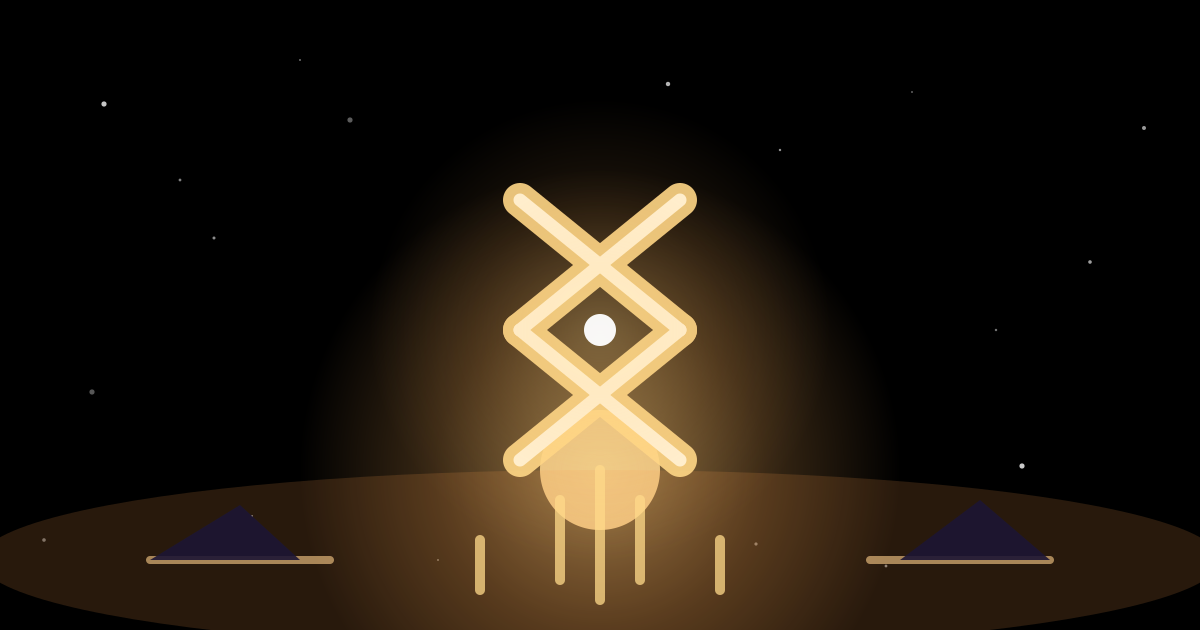
The rune's diamond shape carries layers of symbolism. It is a seed, of course, but also a womb, a storehouse, and a closed door — every image of protected interior life. Some readers see in it the meeting of two triangles, one pointing up toward aspiration and one pointing down toward grounding, joined into a single balanced form. The diamond holds opposites together: potential and patience, inner and outer, the finished and the not-yet-begun. Ingwaz is where those tensions rest without needing to resolve yet.
As the twenty-second rune, Ingwaz sits in Tyr's aett, the final family of runes, and its near-final position gives it a valedictory quality — the rune of ripeness before homecoming. It is followed only by Dagaz, the dawn, and Othala, the home. The futhark's story ends, in other words, with a seed, then daylight, then belonging: first the potential is stored, then it is revealed, then it is brought home. Few alphabets end so hopefully. Drawing Ingwaz is drawing near the end of a hard story — and discovering that something new has been growing inside it all along.
How to Work With Ingwaz: A Simple Practice
The classic Ingwaz practice is the seed intention. Write one intention on a small piece of paper — a goal, a hope, a quality you want to grow — fold it away somewhere private, and tend it with one small daily action for a month without checking for results. Do not announce it, do not measure it, do not dig it up. At the end of the month, unfold the paper and take honest stock. People who do this practice report an odd and lovely effect: the intention has usually grown more than they expected, precisely because they stopped staring at it.
For decisions still forming, try drawing the rune. Sketch ᛜ on paper and write the situation inside the diamond. Then write two lists: what is already complete in potential (the skills, the readiness, the resources you already hold) and what still needs quiet time (the healing, the learning, the season that has not arrived). The exercise borrows Ingwaz's gift of separating readiness from ripeness. Most people find the first list longer than they feared — and the second list shorter, and kinder, than they expected.
Ingwaz also invites a gestation journal. Each evening, note one thing that grew in you that day without anyone noticing — a moment of patience, a small discipline kept, an idea that clarified itself while you were doing something else. Over weeks, the journal becomes a personal atlas of underground growth: proof that becoming is a daily event, not a single dramatic moment. On discouraged days, reading back through it is an Ingwaz working in itself — yesterday's seeds reminding you that today's soil is still fertile.
For a deeper working, plant something real. Sow seeds in a pot or a garden bed, draw ᛜ on a small marker beside them, and tend them daily as a meditation on your own intention. The plant will teach the rune better than any book: some days nothing happens, and that nothing is the work. When the first sprout breaks the soil, you will understand Ingwaz in your hands in a way no reading can give. The rune's teaching is that growth keeps its own calendar, and the gardener's job is faithfulness, not force.
Ingwaz and the Other Runes
Ingwaz's pairings are stories of potential meeting its season. With Jera (the harvest, the year), it is the full cycle in two glyphs: Ingwaz the seed sown, Jera the harvest reaped, the promise and the payoff held together. This pairing often appears when a long effort is about to complete its circle — the seed you planted seasons ago is finally ready to be gathered.
With Perthro (chance, the unknown), Ingwaz is potential meeting mystery: the seed whose fruit cannot be predicted, the beginning whose outcome belongs partly to fate. Perthro is the cup of lots; Ingwaz is the seed in the hand before the throw. Beside Fehu (wealth, beginnings), the growth doubles: stored potential becoming visible abundance, the seed breaking into the wealth it always contained.
With Dagaz (daylight, breakthrough), Ingwaz tells the futhark's own ending in miniature: the seed and then the dawn, the hidden growth and then the revelation. And near Othala (home, inheritance), the pair speaks of what is passed down and planted anew — the family seed, the inherited gift, the belonging that grows from what was stored by those who came before. Ingwaz is the quiet promise that nothing truly good is ever lost; it is only waiting for its season.
As always, remember that the runes are a spiritual and cultural tradition to explore for reflection and entertainment — not a guarantee of outcomes. Treat Ingwaz as a mirror for your own quiet growth rather than a prediction engine: it will not schedule your sprouting, but it will teach you to trust the dark soil where becoming happens.
Frequently asked questions
What does the Ingwaz rune mean?
Ingwaz (ᛜ), the twenty-second rune of the Elder Futhark, means the seed — more precisely, the god Ing and the fertile potential held inside a seed. It is the rune of inner growth, gestation, and completion: the quiet stage when something is fully formed inside but not yet visible outside. In readings it signals a new beginning growing in private, a project or feeling ripening in its own time.
Does Ingwaz have a reversed meaning?
Ingwaz is a diamond, perfectly symmetrical, so it has no reversed or merkstave form — turn it upside down and it looks exactly the same. Its shadow side is expressed as blocked or impatient growth: a seed dug up too early, a beginning rushed before it is ready, or potential hoarded instead of planted. The rune stays positive; the challenge is trusting the timing.
Is Ingwaz a good omen?
Ingwaz is a quietly positive rune. It promises fertility, completion, and new life — but on the seed's timetable, not yours. Readers treat it as a green light with a condition: protect what is growing, give it time, and do not demand the harvest before the sprouting. Explore it as reflection and entertainment, not as a guarantee of outcomes.
What does Ingwaz mean in love?
Ingwaz in love is the seed of a relationship: attraction or commitment forming quietly, a bond deepening out of sight, or a partnership entering a fertile, settled phase. For singles it can mean becoming ready for love from the inside out. For couples it often marks contentment, shared plans taking root, and the private work that makes a relationship last.
How do I work with Ingwaz in daily practice?
Try the Ingwaz seed practice: write one intention on paper, fold it away somewhere private, and tend it with one small daily action for a month without checking for results. Draw ᛜ and meditate on what is ripening in you. Planting real seeds, keeping a gestation journal, and protecting rest are classic Ingwaz workings.
Keep exploring
Dagaz Rune Meaning: Breakthrough, Daylight & the Dawn After Darkness
Dagaz (ᛞ) is the Elder Futhark rune of daylight — breakthrough, clarity, awakening, and the dawn after darkness. Learn its meanings for love, career, readings and daily practice.
Read the meaning →
Jera Rune Meaning: The Harvest, Patience & Reaping What You Sow
Jera (ᛃ) is the Elder Futhark rune of the harvest, the year, and natural cycles — patience, lawful reward, and results arriving in their proper season.
Read the meaning →
Perthro Rune Meaning: Chance, Fate & the Mystery of the Lot Cup
Perthro (ᛈ) is the Elder Futhark rune of the lot cup — chance, fate, mystery and the joy of not knowing. Learn its upright and reversed meanings for love, career, risk and daily practice.
Read the meaning →
Fehu Rune Meaning: Wealth, Abundance & New Beginnings
Fehu, the first rune of the Elder Futhark, means wealth, abundance and new beginnings. Discover its meanings for love, career, money and spiritual growth.
Read the meaning →