
Isa Rune Meaning: Ice, Stillness & the Quiet Strength of Waiting
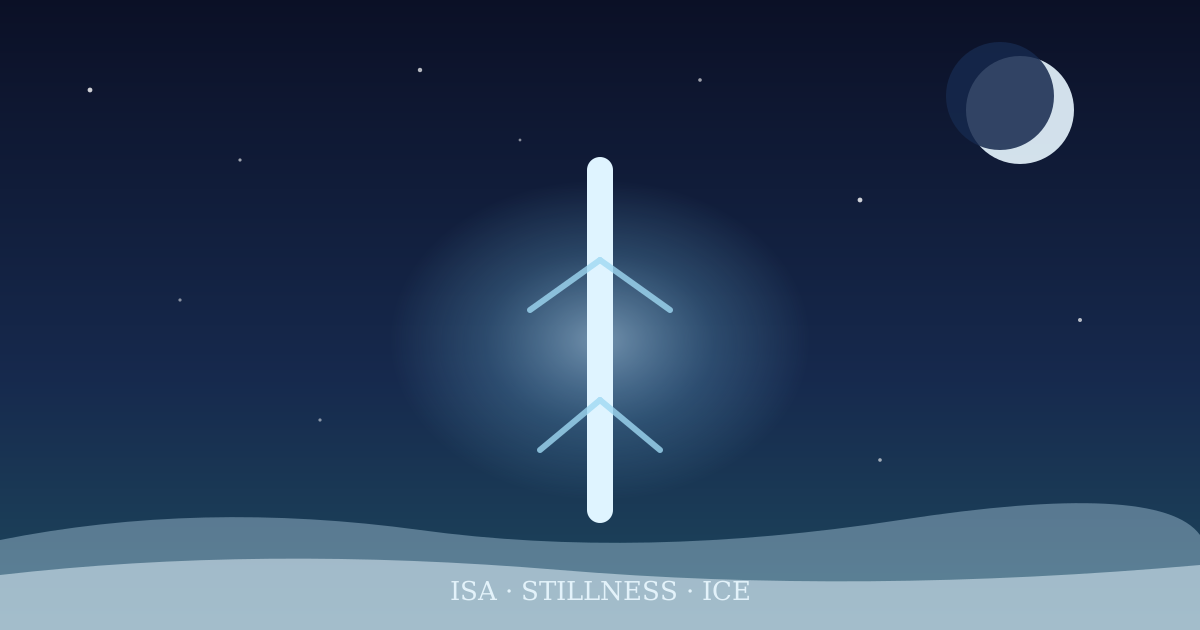
Every alphabet has its loud letters, and every rune row has its restless ones — the journey rune, the storm rune, the sun rune racing across the sky. Isa is none of those. Isa (ᛁ) is a single vertical line, nothing more, and that simplicity is the whole teaching. Its name is the Proto-Germanic word for ice, and in the Old English rune poem ice is described as exceedingly cold and slippery, glittering like glass, a gem among gems, a floor wrought by frost, fair to look upon. The poem captures the paradox at the heart of this rune: ice is beautiful and dangerous, still and powerful, a surface you can walk on and a surface you can fall on. Isa asks you to respect the pause rather than rush through it.
To the Norse world, ice was not an abstraction. It was the winter that closed the roads, the frozen sea that halted ships, the long darkness in which a community lived off stored food and waited for the light to return. A culture that survived northern winters understood something modern life tends to forget: stillness is not the absence of life. It is one of life's seasons. Beneath the ice, the water still moves. Beneath the snow, the seed still waits. Isa is the rune of that hidden continuation — the work that goes on precisely because everything on the surface has stopped.
Isa's Core Meaning in Divination
In a rune casting, Isa is the sign of stillness and delay. It appears when a situation has frozen in place: the decision that will not resolve, the project stalled in approvals, the conversation that keeps circling without landing. The rune's advice is counterintuitive and often unwelcome — do not push. Force applied to ice only cracks it, and a cracked surface helps no one cross. Isa says the timing is not yet right, and that pushing now would cost more than waiting will.
Isa is also the rune of concentration and self-containment. Ice gathers scattered water into a single solid form, and Isa does the same to attention. When this rune appears, it often marks a moment to draw inward, to narrow your focus to one thing, to stop scattering energy across ten half-finished efforts. Writers call it writer's block; Isa calls it gathering. The frozen lake looks empty, but it is holding everything beneath it in perfect, cold order. Sometimes the most productive thing you can do is sit still long enough for your own thoughts to settle into that same clarity.
The rune carries patience as a discipline, too. Not the passive patience of waiting for someone else to decide, but the active patience of the farmer in winter, the sailor watching the thaw, the craftsperson letting glue set. Isa honors the pause that protects: the relationship given space instead of an ultimatum, the investment left alone instead of traded in panic, the grief allowed its own season instead of being hurried along. In a culture obsessed with momentum, Isa is the rune that dares to say that standing still can be the bravest move available.
Isa's Shadow: When Stillness Hardens
Isa has no reversed form — a single line looks the same turned upside down — so its shadow lives inside the rune itself. Frozen Isa is stillness that has gone too far: rigidity, emotional numbness, a life locked in a pattern that no longer serves it. The person who will not change their mind, the relationship kept alive only by habit, the routine that has become a rut. Ice preserves, but it also traps. A river frozen all winter is beautiful; a river that never thaws is dead. Isa asks you to tell the difference in your own life.
This shadow often shows up as avoidance dressed as patience. There is a real difference between waiting for the right moment and refusing to act at all, and Isa, honestly read, refuses to bless the second one. If you have been telling yourself you are being patient about a conversation, a decision, or a departure for months — or years — while nothing changes, that is not Isa's stillness. That is fear wearing patience's coat. The rune's gift is the pause; its warning is the pause that becomes a prison. The thaw always comes, and the question is whether you will be ready for it or still pretending winter is a choice.
Isa's shadow can also be coldness toward others. The ice rune governs emotional distance: the silent treatment, the withheld affection, the heart that has gone quiet not from peace but from self-protection. If Isa appears beside runes of relationship, it may be asking whether stillness has become withdrawal. There is a difference between giving someone space and going cold on them. One is generous; the other is a wall. Isa's wisdom is knowing which one you are building, and being honest about why.
Isa in Love and Relationships
Isa in love describes a cooling or a quiet season. It can mark a relationship in which passion has gone still — not necessarily ended, but paused, like a lake under ice. Couples in long partnerships know this season well: the weeks when conversation is practical, affection is routine, and the spark feels distant. Isa does not panic at this. It says the bond is preserved beneath the surface, and that a quiet season is not the same as a dead one. Many relationships survive precisely because they can endure winter without mistaking it for the end.
For singles, Isa often means not yet, and that is all right. It can appear when someone is pushing hard for a relationship — swiping, dating, striving — and the rune gently suggests stopping the chase. Desire frozen is not desire killed; it is desire held still long enough to become clear about what it actually wants. Isa's advice to the single seeker is to spend the winter well: build the life, tend the friendships, learn the shape of your own company. The thaw brings its own meetings, and they tend to find people who are no longer frantic.
For couples in difficulty, Isa counsels stillness without ultimatums. When a hard conversation keeps freezing over, the instinct is to force a resolution — to demand an answer tonight, to issue the final word. Isa suggests the opposite: let the question rest, sleep on it, give both people a week of ordinary kindness before returning to it. Some truths only become speakable after a pause. And if, after the pause, the ice is still there, that too is information — the honest kind, earned by waiting rather than by forcing.
Isa in Career, Money, and Goals
Isa's career face is the stalled project and the frozen market. It appears when a promotion is delayed, a launch is postponed, a client goes quiet, or an industry cools for a season. The rune's counsel is practical rather than mystical: do not make a dramatic move from frustration. Do not quit in the freeze, do not spend to prove you are still moving, do not sign the desperate deal. Use the pause the way winter workers do — maintain the tools, deepen the skill, keep the relationships warm. When the thaw comes, and it does, the prepared person moves first.
With money, Isa is the rune of holding rather than spending or risking. It favors the emergency fund left untouched, the investment not traded in a panic, the purchase postponed until the need is clear. This is not miserliness; it is the cold logic of winter stores. A household that spends its stores in autumn starves in February. Isa blesses the person who can look at a tempting opportunity during a frozen season and say, not yet. Financial patience is unglamorous, and it is also the habit that separates people who survive downturns from people who are consumed by them.
For personal goals, Isa is the plateau rune. Every long pursuit has a stretch where progress seems to stop: the language learner who cannot advance past a level, the athlete whose times will not budge, the musician practicing the same passage for weeks. Isa reframes the plateau as part of the training, not a failure of it. Beneath the ice of apparent stillness, consolidation is happening — the skill is sinking from effort into instinct. The plateau breaks, usually suddenly, and the breakthrough belongs to the person who kept showing up while nothing seemed to move.
The Mythology and Symbolism Behind Isa
Isa's roots run into the oldest Norse image of all: the frozen beginning of the world. In the creation stories, the universe begins between fire and ice — Muspelheim's heat meeting Niflheim's cold, the frozen mists from which the first being emerges. Ice is not the villain of that story; it is half of the origin. Without the cold, there is no meeting, no steam, no world. Isa carries that dignity. Stillness is not the opposite of creation. In the oldest story the Norse told, stillness is one of creation's parents.
The rune's single vertical line is the simplest shape in the futhark, and readers have found a lifetime of meaning in its plainness. Some see a pillar of ice, standing alone and self-sufficient. Some see a person standing upright in a storm, refusing to bend. Some see the icicle itself — water that has stopped flowing and become a weapon of stillness, beautiful and sharp. The shape's refusal to decorate itself is the point: Isa does not perform, does not branch, does not reach out. It stands, and standing is enough.
As the eleventh rune, Isa opens Hagal's aett, the second family of runes, and its position sets the tone for everything that follows. The second aett is the family of disruption, necessity, and transformation — hail, need, harvest, the yew tree — and it begins with ice, as if to say that before transformation comes the freeze that makes it necessary. Every change in the second aett grows out of a stillness first. Isa is the quiet before the breaking, the winter before the work, and the rune row honors it by placing it at the threshold.
How to Work With Isa: A Simple Practice
The classic Isa practice is the stillness sit. Each morning for one week, sit for five minutes with no phone, no music, no task, and no goal beyond noticing what is present — the temperature of the room, the sounds outside, the thoughts that pass without being chased. The exercise sounds almost too simple, and that is the point: modern life trains constant motion, and five honest minutes of stillness can feel harder than an hour of work. People who keep the sit report an odd and useful effect: by the end of the week, the urge to force outcomes loosens, and decisions that felt urgent start to reveal their real timing.
For a situation that feels frozen, try the deliberate pause. Choose one thing you will consciously not force today — one email you will not chase, one decision you will let rest until tomorrow, one conversation you will not reopen until next week. Write it down, with the date you will return to it. The written pause matters: it turns waiting from avoidance into a decision with a deadline. Isa's patience is never open-ended. It is a pause with a thaw date, and the date is what keeps it honest.
Isa also invites a winter inventory. Once a season, list what you are preserving — the relationships, skills, savings, and projects worth keeping through a cold stretch — and what you are merely storing out of habit. Ice preserves indiscriminately; wisdom does not. Prune one stored thing that has outlived its purpose, and protect one preserved thing that deserves more care. The inventory turns Isa from a season you endure into a season you use, and that shift, from endured to used, is the rune's deepest teaching.
For a deeper working, meditate with the frozen lake. Sit quietly and picture a lake in deep winter, its surface smooth, blue-white, and utterly still. Beneath the ice, picture the water moving slowly, dark and alive, fish gliding in the cold current. Rest in that image for ten minutes. The rune's teaching is that stillness and life are not opposites; the deepest life often moves where no one can see it. Trust the water under your own ice, and let the thaw come in its season.
Isa and the Other Runes
Isa's pairings are stories of stillness meeting its neighbors. With Nauthiz (need, constraint), it is the hard winter made conscious: necessity accepted rather than fought, the lean season endured with dignity. This pairing often appears around genuine hardship, and its message is endurance without self-pity — the freeze acknowledged, the stores counted, the spring trusted.
With Hagalaz (hail, disruption), Isa is the storm held in check: the disruption frozen before it breaks, or the aftermath in which everything is quiet and waiting to be rebuilt. Beside Laguz (water, flow), the contrast is the teaching itself — water frozen versus water flowing, the same element in two seasons, reminding the reader that stillness and movement are phases, not identities. And near Dagaz (daylight, breakthrough), Isa is the night before the dawn: the last frozen hour before the light breaks, the pause that makes the breakthrough visible when it comes.
As always, remember that the runes are a spiritual and cultural tradition to explore for reflection and entertainment — not a guarantee of outcomes. Treat Isa as a mirror for your own winters rather than a prediction engine: it will not schedule your thaw, but it will teach you to wait well, to hold steady, and to trust the water moving beneath your own ice.
Frequently asked questions
What does the Isa rune mean?
Isa (ᛁ), the eleventh rune of the Elder Futhark, means ice. It is the rune of stillness, patience, and concentration — the pause between movements, the frozen moment when nothing appears to change and yet everything is being preserved. In readings it signals a time to wait, to hold steady, and to let a situation settle rather than forcing it forward.
Does Isa have a reversed meaning?
No. Isa is a single vertical line, so it looks the same upright and reversed, and readers traditionally do not read a reversed Isa. Its shadow side is already built into the rune itself: stillness that hardens into rigidity, patience that becomes avoidance, and a pause that goes on too long. The surrounding runes in a cast show which side of Isa is speaking.
Is Isa a bad rune to draw?
Isa is not a bad omen, though it is rarely the answer people hope for. It does not promise disaster; it advises delay. Like winter itself, Isa can feel unwelcoming, but winter is also the season that protects seeds, rests the land, and makes spring possible. Explore it as reflection and entertainment, not as a guarantee of outcomes.
What does Isa mean in love?
Isa in love describes a cooling or a pause: a relationship in a quiet season, feelings that need time rather than pressure, or a connection that is frozen in place while both people decide what they truly want. It counsels patience and honest stillness — not chasing, not withdrawing in anger, simply giving the bond room to show what it is.
How do I work with Isa in daily practice?
Try the Isa stillness sit: for five minutes each morning, sit without phone, music, or task, and simply notice what is present. Then choose one thing you will deliberately not force today — one email you will not chase, one decision you will let rest until tomorrow. Isa teaches that waiting, done consciously, is an action in its own right.
Keep exploring

Nauthiz Rune Meaning: Need, Constraint & the Strength Found in Hard Times
Nauthiz (ᚾ) is the Elder Futhark rune of need — constraint, endurance, and the strength found in hard times. Learn its upright and reversed meanings for love, career, readings and daily practice.
Read the meaning →
Hagalaz Rune Meaning: Hail, Disruption & Unavoidable Change
Hagalaz (ᚺ) is the Elder Futhark rune of hail — sudden disruption, natural forces beyond human control, and the storm that clears the air. Learn its meanings in readings, love, career and practice.
Read the meaning →
Laguz Rune Meaning: Water, Intuition & the Flow of the Unseen
Laguz (ᛚ) is the Elder Futhark rune of water — intuition, emotion, dreams, and going with the flow. Learn its upright and reversed meanings for love, career, readings and daily practice.
Read the meaning →
Eihwaz Rune Meaning: Endurance, the Yew Tree & Transformation
Eihwaz (ᛇ) is the Elder Futhark rune of the yew tree — endurance, defense, and transformation through hard seasons. Learn its meanings for love, career, readings and daily practice.
Read the meaning →