
Kenaz Rune Meaning: The Torch, Knowledge & Creative Fire
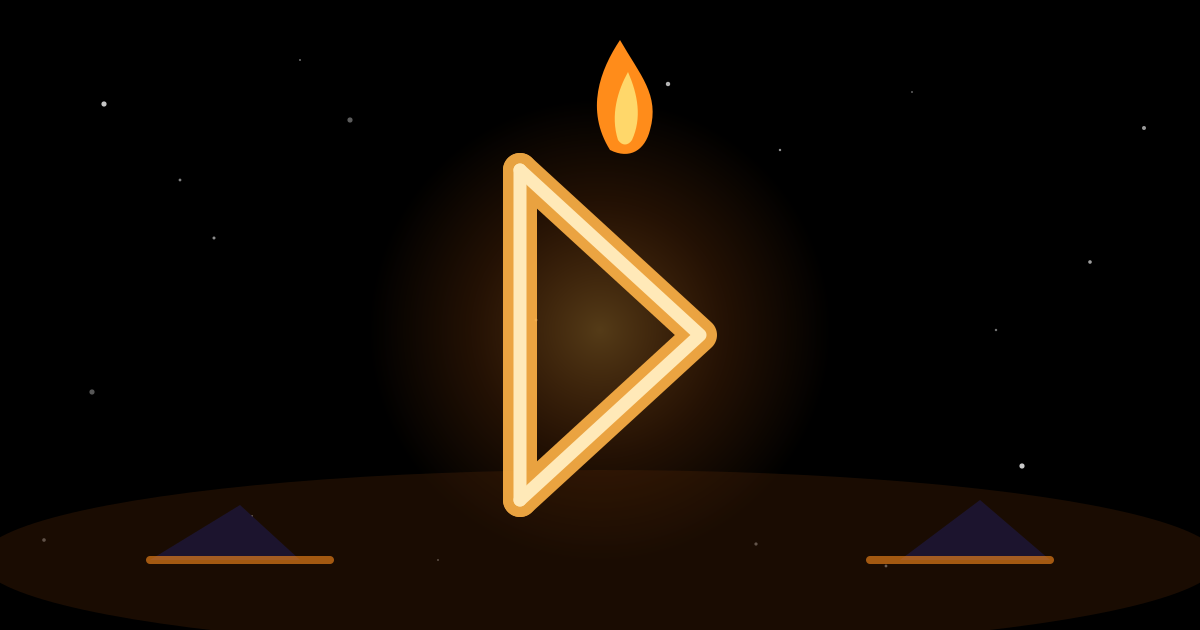
Every culture has a story about the first fire. Someone, somewhere, coaxed a spark out of wood and stone, and suddenly the night was no longer absolute. The runes remember that moment in a single glyph. Kenaz (ᚲ) is that glyph. Its name comes from an old Germanic word for torch, and its shape is a flame caught mid-flicker: a straight staff with an angle opening outward, like a hand cupped around a candle or a torch held aloft. The sixth rune of the Elder Futhark sits in the family of Freyr, among the runes of beginnings and material life, and its placement is no accident. After Fehu, the wealth, and Uruz, the raw strength, and Thurisaz, the thorn of challenge, and Ansuz, the god's mouth and the spoken word, comes Kenaz — the moment raw power learns a craft. Wealth becomes a workshop. Strength becomes skill. The word becomes knowledge.
Fire is the oldest technology and the oldest metaphor, and Kenaz holds both at once. A torch is not a wildfire. It is fire that has agreed to be useful: carried in the hand, sheltered from the wind, pointed where it is needed. That distinction is the heart of the rune. Kenaz does not promise that inspiration will strike like lightning. It promises something better and more reliable — that understanding can be built, tended, and carried, the way a craftsperson builds skill one day at a time. Drawing Kenaz in a reading is less like finding a lucky coin and more like being handed a lamp. The light is real. What you do with it is yours.
Kenaz's Core Meaning in Divination
In a rune casting, Kenaz is the sign of knowledge and illumination. It appears when something hidden is about to be understood — a motive that finally explains a confusing situation, a piece of information that reframes a decision, a truth you have been circling that is ready to be faced in plain light. Readers often describe Kenaz as the rune of the aha moment, but that undersells it. An aha moment is sudden; Kenaz is usually the reward for sustained attention. The student who has read the same passage five times and suddenly sees it. The friend who has listened long enough to finally understand. The light arrives, but only because someone kept carrying the torch toward it.
Kenaz is also the rune of creativity and craft. The old word behind it connects not only to torches but to the verb for knowing how to do something — the knowledge that lives in the hands. The smith knows iron the way the poet knows words: not as facts memorized, but as a feel earned through practice. When Kenaz appears around a creative project, it blesses the workbench rather than the daydream. It favors the person who sits down, lights the lamp, and makes something — even something imperfect — over the person waiting for perfect inspiration. The torch does not care whether the first draft is beautiful. It only asks that you begin.
The rune carries controlled passion, too. Fire warms and fire burns, and Kenaz knows the difference. It governs desire that has been given a hearth: attraction shaped into devotion, ambition shaped into discipline, anger shaped into honest speech. Kenaz appears when a raw feeling is ready to be transformed into something useful — when heat becomes light instead of smoke. It is the rune of the forge, where the same fire that could destroy is used, carefully, to make a blade.
What Does Kenaz Reversed Mean?
Unlike the symmetrical runes, Kenaz can be reversed, and its merkstave form is the dimmed torch. Reversed Kenaz describes blocked creativity, confusion, or knowledge that is missing, ignored, or misused. The writer staring at a blank page for the third week. The student who has stopped asking questions. The relationship where nobody will say the honest thing, so everyone guesses in the dark. Reversed Kenaz is not a curse; it is a diagnostic. Something that should be giving light is not, and the rune asks why.
One common reversed-Kenaz pattern is burnout. A torch burned at both ends goes out twice as fast, and readers see reversed Kenaz when someone has been running their creative or emotional fire too hot for too long — the passion project that became an obligation, the helper who never rests, the perfectionist polishing one paragraph until the whole chapter dies. The remedy Kenaz offers is counterintuitive: stop feeding the fire for a while. Bank the coals. Rest is not the opposite of creativity; it is how the flame survives to burn another day.
Reversed Kenaz can also point to light pointed in the wrong place. A torch is only useful if you aim it where you need to see. Shining it into someone else's business, obsessing over a detail while the real problem sits in shadow, or using knowledge as a weapon in an argument — these are all ways of holding the torch backwards. When this rune appears reversed, its question is practical: what are you actually trying to illuminate, and is your light aimed there at all?
Kenaz in Love and Relationships
Kenaz in love is illumination between two people. It describes the moment a partner is truly seen: the honest conversation that replaces months of guessing, the attraction sparked not by mystery but by understanding, the feeling of being known rather than merely admired. Many relationships run on a pleasant half-light, where each person loves a version of the other. Kenaz brings the lamp closer. That can be startling — real light shows flaws as well as beauty — but readers treat it as the rune of relationships that survive being truly seen.
For singles, Kenaz often means clarity about what you actually want. After a string of confusing attractions, this rune appears when someone finally names their own pattern: the type they keep choosing, the need they keep ignoring, the standard they keep lowering. That self-knowledge is Kenaz at its most practical. A torch does not find you a partner; it helps you stop walking into the same dark room. Singles who draw Kenaz are often advised to write down, plainly and without romance, what a good relationship would actually look like — and then to measure new attractions against that light.
For couples, Kenaz can mark passion rekindled by curiosity. Long relationships cool not because love dies but because attention wanders; partners stop studying each other. Kenaz suggests the remedy is not grand romance but renewed interest: asking a question you have never asked, learning something new together, seeing a familiar person in a new light. It also governs the warm, steady fire of a shared home — the hearth kept lit by daily kindnesses, the small rituals that say this place, and this person, are worth tending.
Kenaz in Career, Money, and Goals
Kenaz's career face is the mastered skill. It appears when professional growth comes through learning: the certification pursued, the craft refined, the mentor finally sought out. The rune is especially associated with teaching and mentoring — knowledge passed like a flame from one torch to another, undiminished by the sharing. If you draw Kenaz while considering a career move, it often points toward the path that teaches you something real, even if it pays less at first. Skill compounds; a torch lit properly lights many rooms.
With money, Kenaz is the rune of informed decisions. It favors the person who reads the fine print, learns how the investment actually works, and budgets by understanding rather than by fear or wishful thinking. Kenaz does not promise windfalls — that is Fehu's territory — but it does promise that light beats luck over time. A financial plan examined in full daylight, with its risks named honestly, is a Kenaz working. So is learning a marketable skill: the torch you carry yourself can never be taken away.
For personal goals, Kenaz is the craftsman's rune. It favors the long, lit middle of any project: the practice sessions, the revisions, the study that nobody applauds. If you draw Kenaz while working toward something, the rune's message is encouraging and specific: you do not need a bigger fire. You need a steadier one. An hour a day, protected and regular, will outshine a weekend of frantic effort every time. The torch rewards faithfulness, not frenzy.
The Mythology and Symbolism Behind Kenaz
Kenaz's roots run into the old Germanic word kaunan, meaning torch, and the rune poems give it a second, stranger face. The Old English rune poem says the torch is known to every living thing by its pale, bright flame, and that it blazes where princes sit within — a hall-light, a light of gathering and counsel. The Norse poem, meanwhile, calls it an ulcer or sore: fire as wound, the burn that teaches respect. Together the poems hold Kenaz whole. Fire is the light of the hall and the burn on the hand. Knowledge illuminates and it stings. Anyone who has ever learned a hard truth recognizes both verses at once.
The rune's angled shape carries its own symbolism. Readers see in it a torch held up, a flame leaning, a hand cupped to shelter a spark from the wind. Some see the meeting of the vertical staff — the human standing upright — with the diagonal of aspiration reaching outward. The shape is open, not closed: unlike the diamond of Ingwaz, Kenaz does not contain its fire. It offers it. That openness is the rune's ethic. Knowledge hoarded is a torch under a basket; knowledge shared lights the whole hall.
As the sixth rune, Kenaz sits in Freyr's aett, the first family of runes, among the foundations of human life: wealth, strength, challenge, speech, and now light. The futhark's story begins with what people have, what they can do, what resists them, what they can say — and then, crucially, what they can know. Kenaz is the moment the alphabet stops describing the world and starts describing understanding itself. It is followed by Gebo, the gift, and Wunjo, joy — as if to say that knowledge, rightly carried, becomes generosity, and generosity becomes joy.
How to Work With Kenaz: A Simple Practice
The classic Kenaz practice is the torch hour. Light a candle before a work session, name one thing you want to understand or make — one thing, not five — and work in focused blocks until the candle is done. No phone, no wandering tabs, just the flame and the task. When the session ends, blow out the candle and write one sentence about what you learned. People who keep this practice report a quiet shift: work stops feeling like a performance and starts feeling like a craft. The candle marks the time as sacred without making it solemn.
For a blocked project, try drawing the rune. Sketch ᚲ on paper and write the project inside the angle. Then write two lists: what you already know about it (the skills, the material, the first steps you have already taken) and what you still need to learn (the one question you keep avoiding, the skill you need a teacher for). The exercise borrows Kenaz's gift of separating light from shadow. Most people find the first list longer than they feared — and the second list shorter, and more actionable, than they expected.
Kenaz also invites a craft journal. Each evening, note one thing you made or learned that day, however small — a sentence revised, a chord practiced, a fact that clicked into place. Over weeks, the journal becomes a record of your own growing light: proof that mastery is a daily event, not a single dramatic breakthrough. On discouraged days, reading back through it is a Kenaz working in itself — yesterday's sparks reminding you that today's torch is still lit.
For a deeper working, teach something you know. Find one person — a friend, a student, a stranger online — and explain a skill you have, simply and patiently, without showing off. Teaching is Kenaz's oldest ritual: the torch passed hand to hand, the flame doubled rather than divided. You will discover, as every teacher does, that explaining a thing teaches it to you a second time, more deeply. The rune's promise is literal here. The light you give away is the light you keep.
Kenaz and the Other Runes
Kenaz's pairings are stories of light meeting its purpose. With Ansuz (the god's mouth, communication), it is knowledge finding words: the insight that can finally be spoken clearly, the teaching that lands. This pairing often appears when someone is ready to speak a truth they have long understood in silence. Beside Fehu (wealth, beginnings), the growth doubles: knowledge becoming livelihood, the skill that earns its keep, the torch carried into the marketplace.
With Gebo (the gift), Kenaz is knowledge shared: the mentor and student, the open hand, the understanding given freely and returned in kind. Beside Dagaz (daylight, breakthrough), the light widens from a torch to a dawn — a private understanding becoming a whole new outlook. And near Ingwaz (the seed), the pair speaks of the inner fire: the seed kept warm in dark soil by a light nobody else can see, the potential ripening in private before it is ready to be shown.
As always, remember that the runes are a spiritual and cultural tradition to explore for reflection and entertainment — not a guarantee of outcomes. Treat Kenaz as a lamp for your own learning rather than a prediction engine: it will not hand you answers, but it will teach you to carry your light steadily, aim it honestly, and share it generously.
Frequently asked questions
What does the Kenaz rune mean?
Kenaz (ᚲ), the sixth rune of the Elder Futhark, means the torch — knowledge, creativity, and illumination. It is the light carried into a dark place: the moment of understanding, the skill mastered, the creative spark that turns raw material into something made. In readings it signals clarity, learning, and the controlled fire of craft.
What does Kenaz reversed mean?
Reversed Kenaz is the dimmed torch: blocked creativity, confusion, ignorance, or a skill left unpracticed. It can mean burnout, a light shining in the wrong place, or knowledge withheld. The reversal does not mean darkness forever — it asks what is blocking the flame and what small, steady tending would relight it.
Is Kenaz a good omen?
Kenaz is a warmly positive rune, but it is a working light rather than a lucky charm. It favors study, honest effort, and creative courage — the torch rewards the person willing to carry it. Explore it as reflection and entertainment, not as a guarantee of outcomes.
What does Kenaz mean in love?
Kenaz in love is illumination between two people: honest conversation, attraction sparked by genuine understanding, and passion kept warm by attention. For singles it can mean becoming clear about what you truly want. For couples it often marks a relationship rekindled by curiosity — seeing a familiar partner in a new light.
How do I work with Kenaz in daily practice?
Try the Kenaz torch practice: light a candle before a work session, name one thing you want to understand or make, and work in focused blocks until the candle is done. Drawing ᚲ, keeping a craft journal, and studying one skill a little every day are classic Kenaz workings.
Keep exploring
Ingwaz Rune Meaning: The Seed, Inner Growth & Quiet New Beginnings
Ingwaz (ᛜ) is the Elder Futhark rune of the seed — inner growth, gestation, and quiet new beginnings. Learn its meanings for love, career, readings and daily practice.
Read the meaning →
Fehu Rune Meaning: Wealth, Abundance & New Beginnings
Fehu, the first rune of the Elder Futhark, means wealth, abundance and new beginnings. Discover its meanings for love, career, money and spiritual growth.
Read the meaning →
Dagaz Rune Meaning: Breakthrough, Daylight & the Dawn After Darkness
Dagaz (ᛞ) is the Elder Futhark rune of daylight — breakthrough, clarity, awakening, and the dawn after darkness. Learn its meanings for love, career, readings and daily practice.
Read the meaning →
Perthro Rune Meaning: Chance, Fate & the Mystery of the Lot Cup
Perthro (ᛈ) is the Elder Futhark rune of the lot cup — chance, fate, mystery and the joy of not knowing. Learn its upright and reversed meanings for love, career, risk and daily practice.
Read the meaning →