
Raidho Rune Meaning: Journeys, Movement & Life's Path
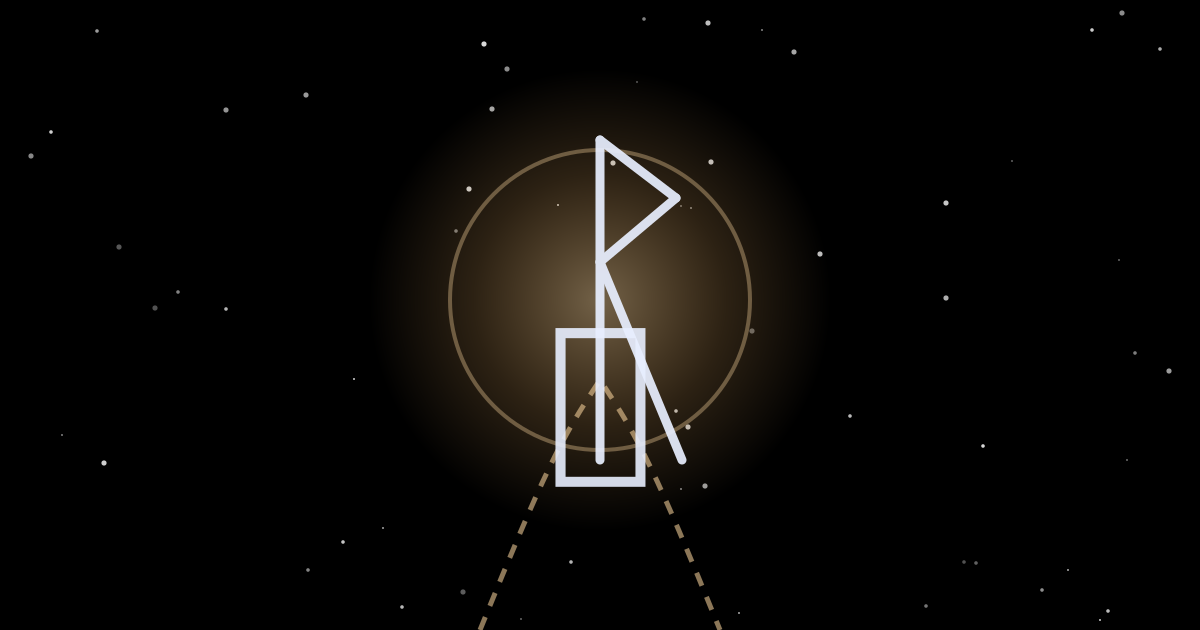
Every rune is a snapshot of the world that carved it. Some runes freeze a single treasure — wealth, victory, protection. Raidho (ᚱ) does something rarer: it captures motion itself. Its Old Norse name, reið, means riding — the horse under you, the wagon-wheel turning, the road unspooling toward the horizon. When Raidho appears in a reading, something is moving. The question is only whether you are moving with it.
Raidho is the fifth rune of the Elder Futhark and the final rune of Freyr's aett, the first family of eight. Look at its shape and you can almost see the subject: a vertical staff with a wheel-like bow, as if a rider were frozen mid-gallop. The ancient Germanic peoples were people of roads — trade roads, war roads, the roads between farmsteads and thing-places — and their alphabet kept a rune for the journey the way a modern toolkit keeps a compass. This is that rune.
Raidho's Core Meaning in Divination
In a casting, Raidho upright is the signal of forward motion. A journey is beginning, a plan is rolling, a life is changing address — literally or figuratively. The rune's oldest sense is physical travel: setting out, relocating, the commute that carries you toward something better. But the Norse understood, as we do, that every road has a metaphorical twin. Raidho also governs the inner journey: the career path, the spiritual road, the slow work of becoming someone new. It is the rune of process — not the destination, but the honest, step-by-step business of getting there.
The rune's second great theme is rhythm and right timing. A rider cannot gallop every mile of a long road; the horse breaks, or the rider does. Raidho teaches pace — the walk that lasts, the canter at the right moment, the halt when the trail is unclear. Drawing this rune often means the timing is right if you match the rhythm of the thing: not too fast, not too slow, in step with the road itself. Readers call this the rider's wisdom, and it is one of the most practical pieces of guidance any rune offers.
Raidho also speaks of order and the turning wheel. The rune shares deep roots with words for the proper course of things — the cosmic order, the way the world turns when it is working right. When Raidho appears, life's wheel is moving in your favor. Doors that were stuck are swinging open. What was stalled begins to roll. The rune does not promise the destination, but it promises this: the road is open, the wheels are greased, and forward is a real direction now.
Raidho Reversed: When the Road Gets Rough
Turn Raidho upside down and the wheel jams. Reversed Raidho — the shadow reading — is the rune of delays, detours, and bad timing. The journey stalls: the flight is canceled, the move falls through, the plan that looked so smooth develops a crack at exactly the wrong moment. Sometimes the trouble is mechanical — literal breakdowns, lost luggage, the car that dies on the highway. Sometimes it is directional: you are moving, but toward the wrong horizon, with growing speed and shrinking certainty.
The reversed rune is especially sharp around timing. Its counsel is rarely dramatic. More often it is mundane and wise: wait. The departure you are rushing is not ready. The relationship you are hurrying is still at the trailhead. The deal you want to force needs another season. Raidho reversed is the universe's way of saying that the road will still be there tomorrow — and that arriving late beats never arriving at all.
There is also a subtler warning in merkstave Raidho: movement without meaning. Busy is not the same as traveling. If you are spinning the wheel faster and faster while the scenery never changes, the rune is asking whether you are on a journey or a treadmill. The cure is a full stop: park the wagon, check the map, and ask the oldest question on any road — where am I actually trying to go?
Raidho in Love and Relationships
Every relationship is a journey, and Raidho reads it like a road map. In love readings, this rune describes two people traveling the same direction — not standing still admiring each other, but moving together toward a shared horizon. It favors the partnership with momentum: the couple that plans trips, talks about the future, and grows in the same direction. The rune's core question in love is a simple one: are you and this person on the same road?
For new relationships, Raidho often marks pace as the decisive factor. Moving too fast breaks things; moving too slow lets them stall. The rune asks whether both people are comfortable with the speed — and honors the answer either way. It can also mark literal milestones on the relationship road: moving in together, relocating for love, the first long trip taken side by side. Journeys shared early tell you more than months of texting.
In established partnerships, Raidho speaks of progress and pilgrimage. Couples that travel together — even on small roads, even on ordinary weekends — tend to find their way back to each other. And when the rune appears reversed in a relationship reading, its message is about drift: one partner galloping ahead while the other walks, or both walking in different directions and calling it togetherness. The fix is the rider's fix — slow down, ride side by side, and make sure the destination is still shared.
Raidho in Career, Money, and Goals
Raidho is a working rune, and in career readings it reads like a travel itinerary. Upright, it favors motion in your professional life: the new role, the transfer, the business trip that opens a door, the project finally rolling after months of planning. It is especially strong around anything involving relocation or travel for work — the interview in another city, the remote job that lets you move, the contract that takes you somewhere new. When Raidho appears before a career decision, forward motion is favored over standing still.
The rune's counsel on pacing applies to ambition as much as to horses. Some careers are sprints; most are journeys. Raidho asks whether your pace is sustainable — whether you are galloping toward burnout on a road that requires a steady walk. The readers who trust this rune watch for its rhythm advice in every professional reading: push when the road is smooth, rest when it climbs, and never confuse speed with progress.
With money, Raidho governs flow. Wealth that moves — invested, circulating, working — is Raidho's kind of wealth; wealth hoarded under a mattress is a wagon parked in the barn. The rune favors transactions, negotiations in motion, and the honest commerce of the road: buy low where the harvest is plentiful, sell where it is scarce, and keep the wheels turning. It is also the rune of the working traveler — the freelancer, the consultant, the merchant whose office is wherever the road happens to be.
For goals of any kind, Raidho offers the oldest strategy in the book: start walking. The rune has little patience for the traveler who studies the map forever and never leaves the inn. A single real step beats a year of planning. And once you are moving, the rune asks for one thing only — keep moving. The destination takes care of those who honor the road.
The Mythology Behind Raidho: The Horse, the Chariot, and the Wagon-Road
Raidho's story is told by the medieval rune poems, three short verses that preserve how the Viking Age understood each rune. The Anglo-Saxon poem says that riding seems easy to every warrior while he is indoors, and very courageous to him who traverses the high-roads on the back of a stout horse — a small masterpiece of understatement, and a reminder that every journey looks simple from the armchair. The Old Norwegian poem is blunter: riding is hard on horses. The Icelandic poem calls the ride blessed sitting, and the journey swift. Together they frame Raidho exactly as the Norse saw it: the road is real, the horse is tired, and the journey is worth it anyway.
The Norse imagination filled the sky with riders. The sun itself was drawn across the heavens in a chariot — the famous Trundholm sun chariot, a bronze horse pulling a gilded disc, is one of the great artifacts of the Bronze Age north. Thor rode a wagon pulled by goats; the goddess Sunna drove her chariot by day; even the dead rode to the afterlife on horseback. Raidho is the rune of all of them: movement as the fundamental condition of the cosmos, everything on a road from somewhere to somewhere.
The rune's name reaches into our own language, too. Raidho is the ancestor of the English word road — and, by a longer route, of raid, once a journey by armed horsemen. Every time you say either word, you are speaking a little of this rune's language. That is the quiet power of Raidho: it is not exotic. It is the most ordinary magic there is — the road you take every day, the wheels you ride, the journey you are already on.
And there is one more layer that scholars love. The wheel at the heart of Raidho's meaning echoes the ancient idea of the world turning in order — the proper course of things, the cosmos as a well-oiled wagon. When the rune appears, the world is not random. It is a road, and it has a direction, and for once you get to travel with the grain of it rather than against it.
How to Work With Raidho: A Simple Practice
Raidho is not a sitting-still rune, so its practices are not sitting-still practices. The simplest and oldest is the walking question: take a question you cannot answer at your desk, and walk with it. Twenty minutes on foot, no phone, no destination required. The Norse would have recognized this instantly — thinking was a traveling activity, done on the road between places. Answers arrive at walking pace that never arrive at sitting pace. Try it once and the rune's logic becomes physical.
For a more deliberate ritual, try the map drawing. On paper, draw the road you are on: where you started, where you are now, where the road seems to lead. Mark the milestones behind you — every Raidho journey has them — and the next turn ahead. Draw it badly; the point is not cartography. The point is seeing your life as a road with a past and a direction, instead of a room you are stuck in. People who do this once tend to do it every season.
Raidho also rewards the practice of right-timing the small things. Leave five minutes earlier. Answer the message when the road is clear, not in the middle of the storm. Begin the hard conversation at walking pace instead of at a gallop. The rune's wisdom scales down beautifully: a life lived at the right rhythm feels like a journey, while a life lived at the wrong rhythm feels like traffic. Choose the journey.
Raidho and the Other Runes
Raidho travels well with company, and its neighbors color every road. Beside Ehwaz, the horse rune, it is at its most literal — the rider and the mount in partnership, trust between traveler and steed, a journey made together rather than alone. With Sowilo, the sun rune, the journey bends toward triumph: the road leads somewhere bright, and the travel itself is blessed.
Near Jera, the harvest rune, Raidho speaks of the season for moving — the right time to set out, the road ripening like grain. With Perthro, the rune of fate and the dice cup, the journey takes on an element of chance: the road you did not plan, the detour that becomes the destination, the gamble that pays off because the wheel was already turning your way. And beside Isa, the ice rune, Raidho learns its opposite lesson — stillness. Sometimes the wisest journey is the one you do not take yet. The road will wait. Ice melts. Wheels turn again.
As always, treat the runes as a tradition of reflection and storytelling, not a source of guarantees — entertainment and insight, never certainty. Approach Raidho with respect for its Norse roots and its central invitation, and let the journey-rune do what it has done for centuries: show you the road, match your pace to it, and walk you forward.
Frequently asked questions
What does the Raidho rune mean?
Raidho (ᚱ), the fifth rune of the Elder Futhark, means riding, the wheel, and the journey. It is the rune of movement, rhythm, and right timing — the road opening ahead, progress at the proper pace, and life moving forward as it should.
What does Raidho reversed mean?
Reversed Raidho points to delays, detours, breakdowns, and bad timing. The journey is stalled or headed the wrong way — plans hit obstacles, travel gets complicated, or you are moving when you should be waiting. It counsels patience, rerouting, or a full stop.
Is Raidho a good rune for travel?
Raidho is the classic travel rune of the Elder Futhark. Upright, it favors journeys, relocations, commutes, and trips of every kind — especially when planned with care. It is traditionally read as a green light for setting out and a protector of the road.
What does Raidho mean in love?
In love readings, Raidho describes the relationship as a shared journey — two people moving at the same pace toward the same horizon. It speaks of progress, moving in together, traveling together, and the honest question of whether you are headed the same direction.
How is Raidho connected to the horse?
Raidho is named for the horse-and-wagon age of the ancient Germanic peoples, and the medieval rune poems frame it entirely around riding — the ease of a good horse under you, the hardship of a hard road. Its wheel-like shape is sometimes read as a rider on horseback, journey in motion.
Keep exploring
Sowilo Rune Meaning: Victory, the Sun & Unstoppable Energy
Sowilo (ᛊ) is the Elder Futhark rune of the sun, victory and unstoppable life force — one of the most purely positive runes. Learn its meanings in readings, love, career and daily practice.
Read the meaning →
Algiz Rune Meaning: Protection, Intuition & Spiritual Defense
Algiz is the Elder Futhark rune of protection, intuition and spiritual defense. Learn its meanings in readings, love, career and daily protective practice.
Read the meaning →
Fehu Rune Meaning: Wealth, Abundance & New Beginnings
Fehu, the first rune of the Elder Futhark, means wealth, abundance and new beginnings. Discover its meanings for love, career, money and spiritual growth.
Read the meaning →
Bindrunes: How to Create Your Own Runic Talismans
Bindrunes fuse Elder Futhark runes into personal talismans for protection, love and strength. Learn to design, charge and use your own bindrune, step by step.
Read the meaning →