
Ace of Wands Tarot Card Meaning: New Beginnings, Inspiration & Reversed
Meet the Ace of Wands: The Spark Itself
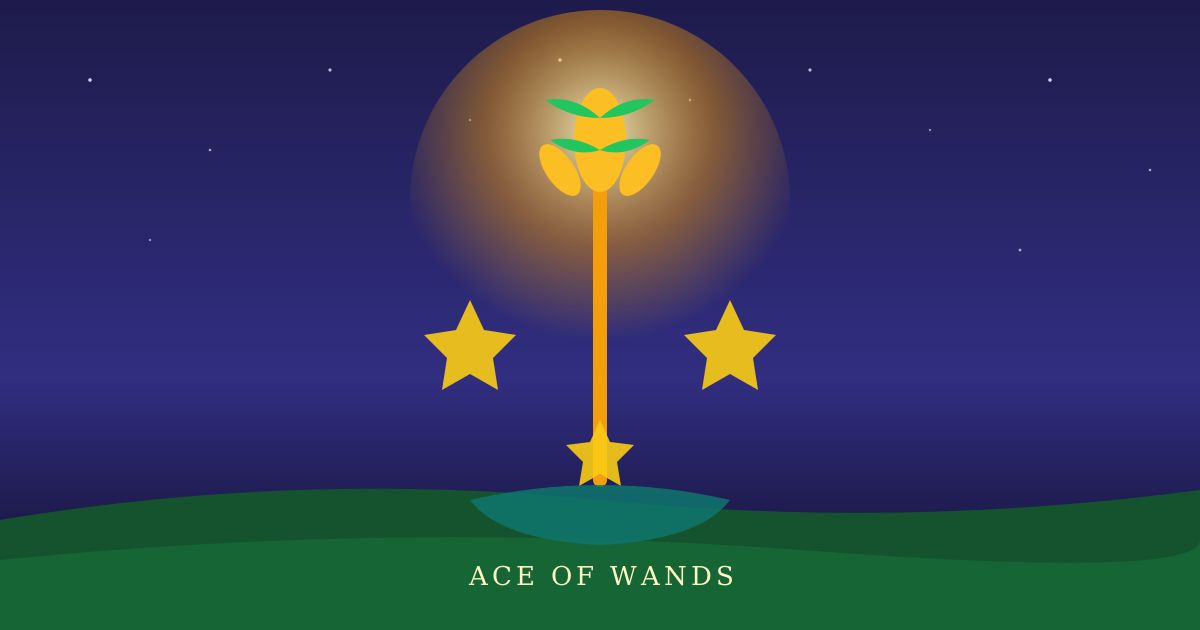
The picture is the simplest in the deck, and the most electric. A hand emerges from a cloud, holding a thick wooden wand that is already sprouting leaves. Below it, green hills and a small castle wait in the distance, and sparks fall from the wand like tiny stars. There is no person in the image, no drama, no story yet — because the Ace of Wands is the moment before the story. It is the idea before the plan, the desire before the decision, the match before the flame has decided what it will burn.
Every Ace in the tarot is a gift: a pure offering of its suit's element, handed to you from beyond the frame. The Ace of Cups offers feeling, the Ace of Swords offers clarity, the Ace of Pentacles offers material opportunity. The Ace of Wands offers fire — and fire, in tarot, is the element of will, passion, creativity, and action. This is why the card feels so urgent when it appears. It does not describe a mood or a phase. It describes a beginning that is ready now, whether or not you feel ready for it. The hand is already extended. The only question the card asks is whether you will take what it is offering.
Notice that the wand is alive. It is not a carved staff or a polished tool; it is a branch still growing, with leaves unfurling from its sides. That detail is the card's deepest teaching, and the one beginners most often miss: a true beginning already contains its own growth. You do not need to know the whole tree to plant the seed, and you do not need a finished plan to honor a real spark. The castle in the distance matters too — it is the goal the fire will eventually reach, small on the horizon, reachable only by someone willing to cross the hills between here and there. The Ace of Wands is the whole journey, compressed into a single offered branch: the spark, the growth, and the far-off castle, all in one image.
Ace of Wands Upright: Begin, Before You Feel Ready
When the Ace of Wands appears upright, it is the deck's great green light — and it usually arrives at a moment when waiting has become its own kind of avoidance. The card's first message is about inspiration: the idea that will not leave you alone, the project that keeps tapping your shoulder, the sudden clarity that this, whatever this is, is what you want to do next. Inspiration in this card is not a gentle muse. It is a surge — the kind that makes you open a document at midnight, sketch the plan on a napkin, or finally say the thing out loud. The card honors that surge as real information, not as a passing mood.
The upright card's second message is about courage: the willingness to begin before the plan is perfect. Wands energy is famously impatient with preparation, and the Ace most of all. It favors the person who sends the email, books the class, buys the domain, or has the conversation — the small, concrete first step taken while the fire is hot. This is where the card differs from its more cautious cousins. The Ace of Pentacles wants a business plan; the Ace of Wands wants a first draft. Both have their season. But when the Ace of Wands appears, the season is starting, not planning, and the card warns that a spark studied too long can cool into a regret.
There is also a third upright meaning that experienced readers treasure: the Ace of Wands as creative fertility. Not only artistic creativity, but the fertile energy of any new venture — a business idea with real legs, a passion project that could grow, a period of life when your energy returns and wants somewhere to go. People who meet this card often describe a physical sensation: restlessness that is actually readiness, boredom that is actually a beginning knocking. For entertainment and reflection: the Ace of Wands does not promise that the new thing will succeed. It promises that the new thing is alive, that the fire is real, and that the only way to find out what it becomes is to take the wand and walk toward the castle.
Ace of Wands Reversed: When the Spark Won't Catch
Reversed, the Ace of Wands describes a spark that will not catch — and the card is precise about the three ways this happens. The first is the postponed start: the idea you keep circling, the project perpetually about to begin, the conversation delayed until the perfect moment that never arrives. Reversed Wands energy in this form is not laziness. It is fear wearing preparation's clothes, and the card's counsel is blunt: the perfect moment is a story you tell to stay safe. A small, imperfect beginning today beats a flawless beginning that never comes.
The second reversed reading is creative block: the fire gone quiet. The writer staring at the blank page, the maker whose hands have forgotten their joy, the person who used to burn bright and now feels dim. This is the card's gentlest form, and its counsel is the most important thing the Ace ever teaches: a blocked spark is not a dead spark. Fire needs tending, not scolding. Rest, play, a walk, a change of scene — the small acts of care that let embers breathe — are not procrastination. They are the work of this card in its reversed form. The wand is still in your hand. It only needs air.
There is a third reversed shade worth knowing: the scattered spark — too many ideas, no single beginning. The person with five projects, three businesses, and a dozen brilliant plans, all half-started, none finished. Wands fire, unguided, spreads thin and burns out fast. Reversed, the card asks you to choose one flame and feed it. For entertainment and reflection: a reversed Ace of Wands is not a failed beginning. It is a beginning still waiting for its first honest step — and first steps, unlike grand launches, can happen today.
Ace of Wands in Love: Passion, New Chapters, and Honest Fire
In love readings, the Ace of Wands upright is one of the deck's most passionate cards — it is the card of the spark between two people, or the spark returning to a heart that had gone quiet.
For singles, the Ace of Wands describes a new attraction with real heat: a meeting that crackles, a crush that refuses to stay a crush, a season when desire wakes up and wants to be followed. The card favors boldness here — the message sent, the date asked for, the honest admission of interest — but it also carries a fair warning. Wands fire burns fast, and the Ace is the beginning of a story, not its ending. The card's counsel is to enjoy the spark without demanding that it instantly become a forever. Let the first chapter be a first chapter. The castle is in the distance for a reason.
For couples, upright Wands energy is the card of the fresh chapter: the trip planned, the project started together, the passion deliberately rekindled after a flat season. This card does not promise that every couple stays together. It promises that the relationship, honestly tended, can catch fire again — and that the tending is the point. A shared beginning — a class, a move, a creative project, a difficult conversation finally had — is the Ace's happiest form in an established relationship. For entertainment and reflection: love renewed is not love restored to what it was. It is love given a new spark, and then tended into a flame.
Reversed in love, the card describes the spark delayed or dimmed: the attraction that never quite ignites, the relationship running on routine, the passion postponed until after the busy season that never ends. In dating, reversed Wands often marks the almost-beginning — the connection that stays in messages and never becomes a meeting. The card's counsel is the same in every case: one honest step. A date proposed, a truth spoken, a small shared adventure planned. Fire does not return to a relationship by waiting. It returns by lighting.
Ace of Wands in Career and Money: The Venture, the Project, the Leap
Career-wise, the Ace of Wands upright is the card of the new venture — the project, role, or business that wants to exist. The professional who feels the pull toward a different kind of work, the founder with an idea that will not quiet down, the employee offered a role that is a genuine stretch. If you are near a career crossroads, the card's advice is the first step before the full plan: the prototype, the pitch, the application, the side project given its first real hour. The castle on the horizon is the goal; the Ace is the decision to start walking toward it.
The card also favors creative and entrepreneurial work of every kind: the book, the channel, the shop, the craft turned into a living. In negotiations and big decisions, the card suggests the option that carries real energy — the path you would choose if fear were not voting. Decisions made in Wands-light are not always safe, but they are alive, and the card trusts aliveness as a compass.
Money-wise, the Ace of Wands is the card of the seed investment: the first money put toward a real idea, the side income begun, the financial beginning that is small and full of potential. It favors the bold-but-grounded start — a modest stake, a tested prototype, a first client — over the grand gamble. Reversed in career and money, the card warns of the unstarted venture's professional form: the business plan endlessly revised, the application never sent, the idea talked about for years and never tried. For entertainment and reflection: the Ace's money advice is the oldest in the book — plant the seed, tend it daily, and let the tree surprise you.
Symbols to Notice: Reading the Picture
The Ace of Wands rewards a slow look. Here is what the details are saying:
- The hand from the cloud: the gift — the spark arrives from beyond your planning, offered rather than earned. When the hand is all you see, the message is simple: something is being given. Take it.
- The sprouting leaves: living growth — the idea already carries its own future. The wand is not dead wood. What you begin now wants to grow, and growth is part of the gift.
- The falling sparks: inspiration scattering — the energy of the card cannot be contained in one object. Sparks fall around the wand because a real beginning always lights more than one thing.
- The green hills: the journey ahead — the ground between the spark and the castle. The hills are gentle, not mountains. The path is walkable, but it must be walked.
- The distant castle: the goal — small on the horizon, reachable only by someone who starts. The castle is not a promise. It is a direction.
- The absence of a person: the moment before the story — no one holds the wand yet. That is you. The card is waiting for its hero, and the hero is the reader.
When this card appears in your reading, notice which detail your eye lands on first. Drawn to the hand? The question is about receiving — what gift are you refusing to take. To the leaves? About growth — what beginning already wants to grow in your life. To the sparks? About scattering — what energy needs focusing into one flame. To the castle? About direction — what far-off goal is worth the walk.
Try This: The Seven-Day Spark Practice
The Ace of Wands is a beginning card, so here is a beginning practice — one small act of fire per day:
- Day one — the spark (twenty minutes): write down the idea that will not leave you alone, in one paragraph, without editing. Naming the spark in your own handwriting is taking the wand.
- Day two — the first step (one act): take the smallest real step on that idea: the email, the sketch, the search, the call. A step too small to fail is still a step.
- Day three — the tending (twenty minutes): give the idea a second hour. Fire kept alive for two days is no longer a whim. It is a practice beginning.
- Day four — the telling (one act): tell one trusted person about the beginning. A spark spoken aloud burns steadier than one kept secret.
- Day five — the clearing (twenty minutes): remove one obstacle: the cluttered desk, the unfinished errand, the excuse you have outgrown. Fire needs clear ground.
- Day six — the choosing (one act): if you have five sparks, choose one and set the others aside for now. One flame fed beats five flames starved.
- Day seven — the castle (ten minutes): write one sentence about the castle — where this beginning could lead in a year if tended daily. Then take tomorrow's step. The walk is the whole teaching.
After seven days you will have something the card always offers the patient: a beginning that is no longer only an idea, a practice already two hours old, and a castle that feels closer — not because it moved, but because you did. The Ace of Wands never promised that the walk would be short. It promised that the spark was real, and that the first step is the only one you ever have to take alone.
Combinations: Ace of Wands Meets Other Cards
The Ace of Wands lends its spark — or its warning about sparks unlit — to whatever it touches:
- Ace of Wands + Magician: the spark, mastered — inspiration given skill and focus. When these two meet, the reading is telling you the idea is not only real, it is makeable. Begin, and bring your craft.
- Ace of Wands + Fool: the leap, ignited — a new journey beginning with genuine fire. Together they are the deck's bravest pair: the spark and the step, taken at once.
- Ace of Wands + Sun: joy after beginning — the Sun's daylight falling on a new venture. The happiness here is earned twice: once by daring, once by doing.
- Ace of Wands + Tower: the spark after the fall — a new beginning rising from rubble. The Ace does not deny the Tower. It answers it: after the collapse, something still wants to grow.
- Ace of Wands + Three of Swords: passion through heartbreak — the fire that returns after a wound. The spark here is not naive. It is the brave decision to begin again, knowing what endings cost.
- Ace of Wands + Lovers: desire, chosen — the spark of attraction or of a value, met with a real choice. The Lovers' choice, made with fire in hand, is the beginning this card loves best.
As always, these are starting points. Your own readings will teach you pairings no book lists — the Ace rewards the reader who learns that the most powerful spark is usually the quietest, the one that keeps returning.
Closing: Take the Wand
Here is the Ace of Wands' whole teaching in one image: a hand from a cloud, a sprouting branch, sparks falling, green hills, and a castle far away.
The hand, the leaves, the sparks, the hills, the castle: the card is a portrait of beginning as it actually looks — not a grand launch but an offered branch, taken in an ordinary moment, by an ordinary person, on an ordinary day. Every first step is the card working. Every hour tended is a leaf unfurling. Every castle reached began as a spark someone was brave enough to take.
The Ace of Wands does not ask you to be certain, prepared, or finished with becoming. It asks you to take the wand, take the first step, and let the fire teach you as you walk. The Ace never promised that the beginning would be easy. It promised that the spark was real, and that the walk toward the castle is the whole point. And the hand? The hand is still extended. The only question is whether you take it.
Frequently asked questions
Is the Ace of Wands a yes or no tarot card?
The Ace of Wands leans yes — an enthusiastic, energetic yes to beginning something new. It favors action over waiting, but it is a yes to the first step, not a guarantee of the final result. For entertainment and reflection: an Ace of Wands yes is a yes you earn by starting, not by waiting.
What does the Ace of Wands reversed mean?
Reversed, the Ace of Wands describes a spark delayed, dimmed, or scattered: creative block, a postponed start, enthusiasm that burned out, or too many ideas and no single beginning. The counsel is to shrink the first step until it is small enough to take today. For entertainment and reflection only.
What do the sprouting leaves on the wand mean?
The leaves show that the wand is alive, not just a tool: the idea already carries its own growth. In traditional imagery, the hand offers the wand from a cloud, meaning the spark arrives as a gift — but the leaves remind you that a gift still needs tending to become a tree.
What is the difference between the Ace of Wands and the Magician?
The Ace of Wands is the spark itself — the raw idea, the surge of desire to begin. The Magician is what you do with the spark: the skill, focus, and will that turn inspiration into a made thing. The Ace gives you fire; the Magician teaches you to hold it steady.
Does the Ace of Wands mean a new relationship or a new job?
It can mean either, because the card is about beginnings in general rather than one area of life. In love it often marks a passionate new connection or a fresh chapter in an existing one; in work it marks a new project, role, or venture. Context — the question and the surrounding cards — tells you which beginning is knocking.
Keep exploring

The Magician Tarot Card Meaning: Manifestation, Power & Reversed
The Magician tarot card meaning fully explained — upright & reversed symbolism, manifestation, power, skill, love, career, card combinations, and a 7-day manifestation practice.
Read the meaning →
The Fool Tarot Card Meaning: Upright & Reversed
The Fool tarot card meaning fully explained — upright & reversed symbolism, love, career, spiritual guidance, and card combinations for beginners.
Read the meaning →
The Sun Tarot Card Meaning: Joy, Vitality & Reversed
The Sun tarot card meaning fully explained — upright & reversed symbolism, joy, vitality, clarity, love, career, card combinations, and a 7-day sunlight practice.
Read the meaning →
Three of Swords Tarot Meaning: Heartbreak, Grief & Reversed
Three of Swords tarot meaning fully explained — upright & reversed symbolism, heartbreak, grief, love, career, card combinations, and a 7-day healing practice.
Read the meaning →