
The Death Tarot Card Meaning: Endings, Rebirth & Reversed
Meet Death: The Most Misread Card in the Deck
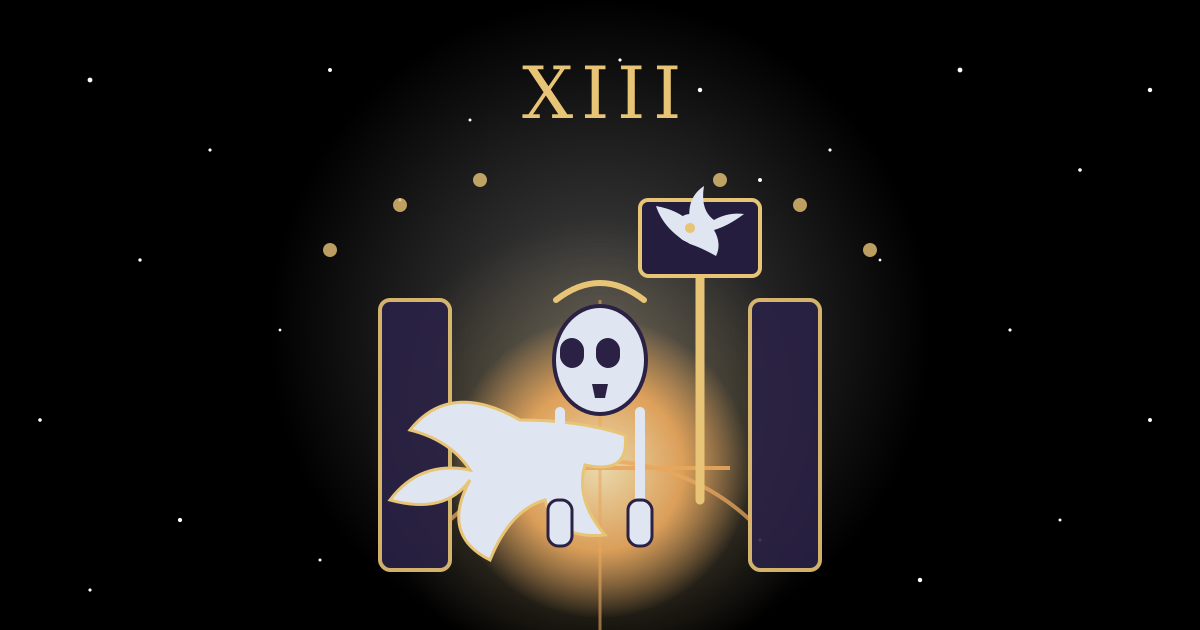
Card thirteen of the Major Arcana shows a skeleton in black armor riding a white horse, a fallen king at its hooves, a pope kneeling in the distance — and behind it all, a great sun rising between two pillars. It is the scariest card in the tarot and the most misunderstood, because the fear it causes is the first thing the card is trying to end: our confusion about what death means.
Death in the tarot is symbolic death. It is the death of a phase, not a person — the graduation, the breakup that was actually a release, the career you outgrew, the belief you finally outlived. The card's own imagery says this plainly: the skeleton is not killing the world, it is harvesting it. The black armor is the night; the white horse is the morning that rides through it. And the rising sun — the most important symbol on the card — is the proof that the card is about beginnings wearing an ending's costume.
Its number is thirteen, and the tarot means the number the way folklore means it: twelve completes a cycle (twelve months, twelve zodiac signs), and thirteen breaks the completed thing open. The Death card is the break. It is ruled by Scorpio, the fixed water sign of depth, crisis, intimacy, and regeneration — the sign whose whole mythology is the phoenix: the creature that is rebuilt from its own wreckage. Nothing in this card is about annihilation. Everything in it is about the transformation that requires an ending first.
Death Upright: The Art of the Necessary Ending
When Death appears upright, it announces that something is over — and, more importantly, that it is good that it is over. This is the card's signature move: the ending you already know is right but have been avoiding. The relationship that ended emotionally months ago but hasn't ended logistically. The job you fantasize about quitting every Sunday night. The story about who you are that stopped being true years ago but that you keep telling. Death upright is the card that names these: finished things you are still carrying.
The card's wisdom is that endings are not failures. They are completions. A harvest is not the failure of the field — it is the field's purpose. Death upright reframes every ending you have been treating as a defeat: the breakup that freed two people, the job loss that forced the pivot, the belief you dropped that was actually a cage. The card does not celebrate loss. It celebrates the honesty of loss — the moment you stop pretending something is alive and let it be what it has been for a while: finished.
Read practically, Death upright is the card of the clean break. Its advice is structural, not emotional: close the account, send the message, clear the room, sign the thing. Do not negotiate with a finished chapter. The card's warning is not about the ending — it is about the dragging: the slow, expensive, soul-taxing process of ending something by inches. Death prefers the axe to the file. One decisive cut heals faster than a thousand small ones, and the card is confident you already know which one you need.
Death Reversed: The End You Keep Postponing
Reversed, Death is the card of resistance — and the card is blunt about what resistance costs.
The first reading is the refused ending: the change that is overdue and your refusal to make it. The job you complain about but won't leave. The relationship you defend to your friends while crying about it to yourself. The version of you that doesn't fit anymore but that you keep wearing. Reversed Death says the transformation is not in question — only your cooperation is. The card's famous comfort is also its famous warning: you can be changed with your consent or without it, but you will be changed.
The second reading is the walking corpse: the part of your life that is already dead but still walking around. The project with no momentum, the friendship maintained by guilt, the identity built on a dream you no longer want. Reversed Death calls these what they are: zombies. And its counsel is the upright lesson in reverse: give them the funeral they have earned. An ending refused does not go away — it rots, and it takes the energy with it that the next chapter needs.
The third reading is fear itself: the terror of the unknown that keeps you in the known, even when the known is miserable. Sometimes reversed Death is not about a specific ending but about the idea of endings — the person who stays because leaving means uncertainty, who endures because beginning again means risk. The card's counsel here is the sunrise between the pillars: the unknown after an ending is not empty. It is lit. For entertainment and reflection: the reversed Death is never the absence of change. It is the presence of a hand held over the flame, refusing to let go.
Death in Love: Endings That Set Love Free
In love readings, upright Death is the card of the necessary transition — and its most common meaning is the most relieving one: the relationship that needs to change form, not the relationship that needs to die.
For singles, Death upright says: a pattern is ending. The pattern of choosing the same unavailable person in a new body. The pattern of keeping one foot out the door. The pattern of grief for a relationship that ended years ago but still runs your love life. Death says these patterns are expiring, and your job is to stop reviving them — to let the old love story finish so a new one can begin. This is the card of the clean emotional slate, signed in your own hand.
For couples, upright Death describes the relationship entering its next phase — and phases are how relationships survive. The honeymoon ends and the partnership begins. The couple becomes parents. The parents become empty-nesters. The card says the form is dying so the love can live — and it warns the couple that mistakes the end of a phase for the end of the love. What dies, in a healthy Death reading, is the shell. What survives is the thing the shell was protecting.
Reversed in love, the meaning hardens. Perhaps the relationship is over and both people know it — and neither will say it, so they are preserving a corpse instead of grieving a loss. Perhaps one person is trying to resurrect something the other has already buried. Perhaps the pattern is not ending: the same fight, the same breakup, the same reconciliation, the same breakup, in a loop that Death reversed calls exactly what it is — the refusal to let one thing die so something better can be born. The reversed Death in love asks the hard question: what are you keeping alive here, and at what cost to the living? For entertainment and reflection: the card never demands a breakup. It demands honesty about whether one has already happened.
Death in Career and Money: Closing Doors, Opening Floors
Career-wise, upright Death is the deck's patron of the pivot — the job that ends so the calling can begin, the layoff that becomes the launch, the career identity retired on purpose rather than by accident. When this card shows up around work, it says: a professional chapter is closing, and the strategic move is to close it on your terms. Resign before you're restructured. Pivot before you're obsolete. The card rewards the person who ends things voluntarily — the severance package you negotiate beats the one you are handed.
Its money wisdom follows the same shape: the financial pattern that is expiring. The spending identity, the debt cycle, the income source that no longer fits. Death upright says prune the finances the way a gardener prunes a rose — not as punishment, but as preparation. The budget line that dies makes room for the one that grows. The card is also the classic card of inheritance, insurance, and shared resources — the Scorpio territories — where endings and money have always been honest companions.
Reversed in career, the card shows the familiar stagnation: the job you have mentally quit but physically still attend. The business you know is failing but keep funding. The role you have outgrown, defended by the sunk cost of the years you spent earning it. The reversed Death warns professionals of the cost of a delayed ending: every month the zombie walks is a month the phoenix stays grounded. Its question is the one the card asks everywhere — what in your working life is already over, and how long will you keep it on life support? For entertainment and reflection: the card does not say quit today. It says stop pretending you haven't already decided.
Symbols to Notice: Reading the Picture
Death rewards a slow look. Here is what the details are saying:
- The skeleton in black armor: not a monster but a force — death as the impartial harvester, armored against argument. The skeleton is what remains when everything temporary is stripped away: the structure, the truth, the bone of the matter.
- The white horse: purity and forward motion. The horse of death is white because this ending is clean — the card's transformations are not corruptions, they are clarifications. The white horse also links Death to the other white horses of the deck: victory and spiritual truth.
- The rising sun between two pillars: the card's verdict, placed behind the skeleton so you have to look past the fear to see it. Every ending this card governs has a sunrise already scheduled. The pillars are the gateway — endings are doorways, not walls.
- The black banner with the white rose: the mystic rose, five-petaled, the symbol of beauty that survives transformation. Death carries the flag of rebirth. The black of the banner is the night; the rose is what the night is for.
- The fallen king: at the horse's hooves — the reminder that no status survives this card. Endings do not check your title first. The king's fall is the card's democracy: transformation comes for the powerful and the powerless alike.
- The kneeling pope: in the distance, surrendering to the skeleton — even spiritual authority bows to change. The pope's kneel is the card's instruction manual: do not fight the inevitable. Greet it with dignity.
- The child looking up: in many versions, a child gazes at the skeleton without fear — the only figure on the card who is not afraid. The child is the part of you that already knows: this ending is safe. Listen to the child.
- The river behind: flowing toward the sea — the old Hermetic image of souls returning to source. The river is the card's continuity: nothing is lost, everything flows on. What leaves your shore arrives at another.
When this card appears in your reading, notice which detail your eye lands on first. Drawn to the skeleton? The question is about the ending itself — what needs to be named. To the banner? About hope — what is already being reborn. To the sunrise? About trust — whether you believe the morning is real.
Try This: The Funeral Practice
Death is a card of the honest ending, so here is a practice in its spirit — the art of burying things well:
- Name the deceased (five minutes): write down what has ended — the relationship, the job, the belief, the version of you. Name it plainly, in one sentence. Unnamed endings linger; named ones can rest.
- Write the eulogy (ten minutes): write what it gave you. The good, the true, the lessons. Death is not ingratitude — the card insists the finished chapter be honored before it is closed. Thank it by name.
- Write the grievance (ten minutes): write what it cost you. The hurt, the waste, the parts you will not miss. A funeral that skips the grievance is a lie, and lies are what keep endings alive as ghosts.
- Burn the paper (five minutes): safely — a fireproof bowl, outdoors or by an open window. Watch the words go. The card's oldest ritual is the simplest: give the ending back to the elements. (Fire safety first: keep water nearby, never leave the flame unattended.)
- Plant the sunrise (five minutes): write one sentence about what the freed space is for. Not the whole future — one sentence. The sunrise between the pillars is not a plan. It is a direction. Point one thing at it this week.
Repeat whenever a chapter closes. The practice will not make endings painless — nothing does — but it will make them complete, and completion is what the Death card is selling: the clean break that the future can actually build on.
Combinations: Death Meets Other Cards
Death brings transformation to whatever it touches — it asks every card beside it what is ready to be composted:
- Death + Tower: the planned ending meets the sudden one — transformation arriving by force. The card of the change you wouldn't make voluntarily, arriving voluntarily's opposite. Brace, then rebuild.
- Death + Fool: the ending becomes the leap — the old life closing and the new one opening in the same motion. The card of the cleanest fresh start in the deck.
- Death + Ten of Swords (reversed nearby): the worst is over — the bottom hit, the knives removed. Recovery has already begun; the card asks you to notice it.
- Death + Hanged Man: the surrender before the rebirth — pause, see differently, then let go. The card of the ending that requires one more change of perspective first.
- Death + Six of Cups (reversed nearby): the past released — nostalgia losing its grip, old chapters finally archived. The card of the memory that stops being a residence.
- Death + Wheel of Fortune: the cycle turns on purpose — fate and decision arriving together. The card of the ending that was always going to happen, met exactly on time.
As always, these are starting points. Your own readings will teach you pairings no book lists — Death rewards the reader who stops flinching at the skeleton and starts reading the sunrise, after all.
Closing: Make Peace With the Skeleton
Here is Death's whole teaching in one line: everything that ends makes room, and the room is the gift.
The skeleton, the white horse, the black banner, the white rose, the fallen king, the kneeling pope, the fearless child: the card is a portrait of transformation doing its necessary work. Notice what is behind the skeleton — the sunrise. Nobody puts a sunrise on a card about dying. It is on a card about being reborn, and the skeleton is just the vehicle: the honest, armored, unstoppable force that carries you from the finished chapter to the next one. So when this card appears for you, receive it as the child receives it. Without fear. Name what is over. Honor what it gave. Bury it well — and turn your face toward the light between the pillars. Death does not promise the ending will be painless. It promises the sunrise will be real. Make peace with the skeleton. It is carrying your next life in.
Frequently asked questions
Does the Death tarot card mean someone will die?
No. In nearly five centuries of tarot tradition, Death has never been the card of literal dying — it is the card of endings and transformations: a chapter closing, an identity shifting, a version of life being outgrown. Readers use it for symbolic death: the death of a job, a relationship, a belief. The sunrise behind the skeleton is the card's own answer — this card is about what comes after. For entertainment and reflection: the card is the least literal in the deck.
Is the Death card a yes or no tarot card?
Death is a yes — but a yes to change, not to staying the course. If the question is "should I let this go?" or "is this phase ending?", Death is a clear yes. If the question is "will this stay the same?", it is a firm no. The card answers questions about transition, not about preservation. For entertainment and reflection: ask it about doors, not about walls.
What does the Death card reversed mean?
Reversed, Death describes the ending you keep postponing — clinging to a relationship, job, identity, or grudge that has already expired in every way except your grip on it. The card's message is not that change is coming; it is that change is overdue and your resistance is the pain. Its counsel is to release voluntarily before release is forced on you. For entertainment and reflection: the pain is in the grip, not the change.
What zodiac sign is associated with the Death card?
Death is ruled by Scorpio, the fixed water sign of depth, intensity, and regeneration — the sign whose mythology is the phoenix: rebuilt from its own wreckage. The connection is transformational rather than destructive: Scorpio governs crisis, intimacy, and shared resources, all of which require old forms to die so new ones can live. Its number is thirteen — the transformation number.
What does the white rose on the Death card's banner mean?
The skeleton knight's black banner carries a white rose with five petals — the mystic rose, a symbol of purity, new life, and the beauty that survives endings. It is the card's reassurance: Death carries the flag of rebirth. The white rose says what the card says: what ends is not destroyed — it is composted into what comes next.
Keep exploring
The Tower Tarot Card Meaning: Destruction, Truth & Rebirth
The Tower tarot card meaning — sudden change, truth & rebirth, upright and reversed. Love, career advice and a grounding practice for upheaval.
Read the meaning →
The Fool Tarot Card Meaning: Upright & Reversed
The Fool tarot card meaning fully explained — upright & reversed symbolism, love, career, spiritual guidance, and card combinations for beginners.
Read the meaning →
The Hierophant Tarot Card Meaning: Tradition, Guidance & Reversed
The Hierophant tarot card meaning fully explained — upright & reversed symbolism, love, career, tradition, card combinations, and a practice for finding your teacher.
Read the meaning →
The Lovers Tarot Card Meaning: Love, Choices & Reversed
The Lovers tarot card meaning fully explained — upright & reversed symbolism, love, soulmates, values-based choices, career, card combinations, and a practice for choosing well.
Read the meaning →