
The Justice Tarot Card Meaning: Fairness, Truth & Reversed
Meet Justice: The Card That Weighs Everything
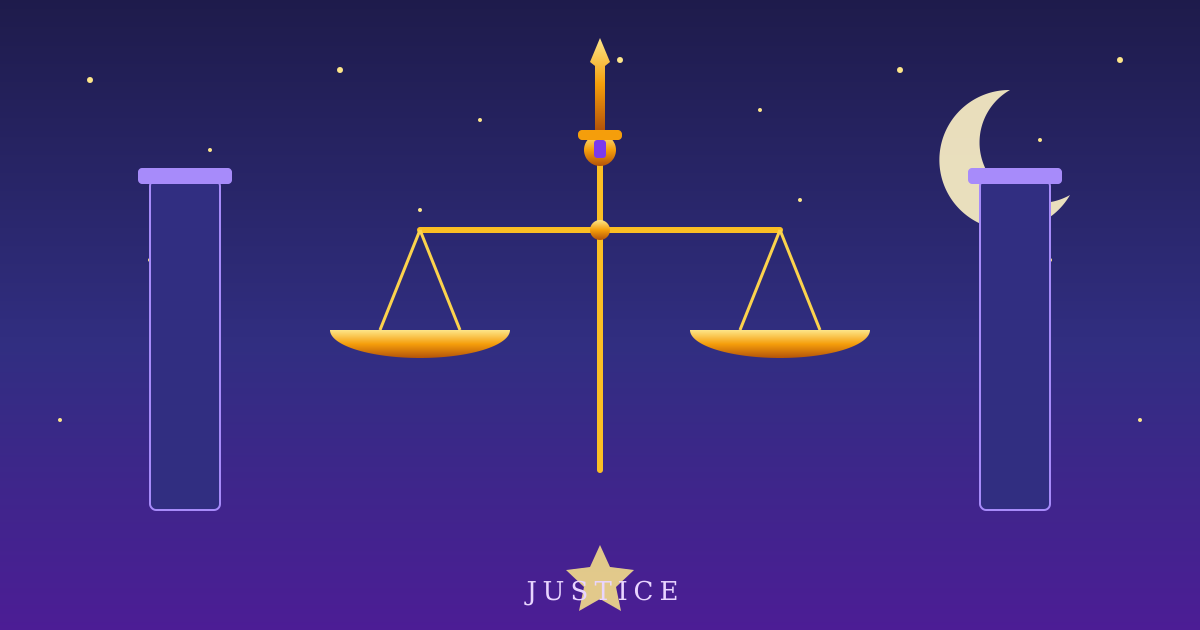
She sits between two stone pillars, perfectly still, in robes of violet and red. In her left hand she holds a pair of golden scales, level and steady. In her right hand she holds a double-edged sword, point up, ready — not raised in anger, not lowered in mercy, simply held. A crown rests on her head, and a square clasp fastens her cloak at the shoulder. Behind her hangs a veil of violet, the color of clear sight. Her gaze is direct, unflinching, and utterly without favoritism. She is not smiling. She is not frowning. She is waiting for the evidence.
This is Justice, card eleven of the Major Arcana in the Rider-Waite-Smith tradition — and it is the most misunderstood card in the deck, because most people meet it expecting a judge and find, instead, a mirror. In older Marseille decks, Justice is card eight, swapping places with Strength; the number changed, but the message did not. The card does not arrive to hand down a sentence from above. It arrives at the moment when a situation can no longer be carried on vibes, hopes, and good intentions — the moment when someone, usually you, has to sit down and weigh what actually happened.
Notice what Justice is not holding. No blindfold: unlike the classical Lady Justice of courthouses, the tarot's Justice sees clearly, eyes open. No gavel: she does not decide by authority or noise. The scales and the sword are the whole argument. The scales say: weigh both sides, with the same weights, in the open. The sword says: once weighed, cut cleanly — the double edge means the truth cuts both ways, and a verdict that only ever cuts in your favor was never a verdict at all. For entertainment and reflection: when Justice appears, the question is rarely "will I win?" It is "what is actually fair here — and am I willing to accept it?"
Justice Upright: The Fair Verdict
When Justice appears upright, the scales are level — and that is very good news, provided your case is honest. This is the card of the fair outcome: the settlement that reflects what was truly owed, the decision made on evidence rather than favoritism, the contract signed with both parties' eyes open. If you have acted with integrity, upright Justice says the record will show it. The promotion goes to the person who did the work. The dispute resolves on the facts. The apology, when it comes, is real.
The upright card's second message is about accountability, and it is the one most readers skip because it is less comfortable. Justice does not only weigh other people's behavior; it weighs yours, with the same weights. If a situation has gone wrong, the card asks for your share of it — plainly, without the softening story you have been telling yourself. This is not punishment. It is the only kind of honesty that actually clears a situation: the moment you name your part, the whole picture changes, and so does what you can do about it. Readers sometimes call Justice the card of karma, but that word is too mystical for what the card actually describes. It is simpler than karma and more practical: consequences follow actions, and the bill eventually arrives addressed to the right person.
There is a third upright meaning, quiet and useful: the invitation to decide cleanly. Justice is a card of decisions made properly — all the facts gathered, both sides heard, the choice made and then owned without endless second-guessing. If you have been postponing a decision because every option feels unfair to someone, the card's counsel is to weigh it once, thoroughly, and then let the sword fall. A clean decision, even a hard one, is kinder than a slow one: it frees everyone, including you, to move on. For entertainment and reflection: Justice upright is not a promise that you will get what you want. It is the promise that you will get what is fair — and the quiet challenge to make sure those two things are the same.
Justice Reversed: When the Scales Tip
Reversed, Justice describes a scale that will not balance — and like many reversed cards, it splits into two readings worth telling apart.
The first is the unfair outcome: a decision made on incomplete facts, a process that favored someone before it began, blame landing on the wrong person. The review that ignored your work. The split that was never equal. The rule applied to you and waived for someone else. Reversed Justice names the specific sting of unfairness — not the pain of a bad result, but the sharper pain of a result that was never honestly weighed. The counsel here is practical, not mystical: gather the evidence, name the imbalance plainly, and appeal through the proper channel. The card does not promise the verdict will change, but it insists that an unfair process be named as unfair, because unnamed unfairness is what repeats.
The second reversed reading is the avoided accounting: the truth about your own part that you are still refusing to weigh. The apology you keep drafting and never sending. The debt — of money, of honesty, of effort — that you keep rolling forward. The story in which you are entirely the wronged party, which you know, if you are honest, is not the whole story. Where the unfair outcome is about the world's scales, the avoided accounting is about yours — and it is the reading that actually frees you, because your own scales are the ones you can recalibrate. The card's question for this reading is blunt: what verdict are you afraid of, and what would change if you delivered it to yourself first? For entertainment and reflection: a reversed Justice is not a curse. It is either an unfairness to challenge or an accounting to complete — and knowing which one changes everything.
Justice in Love: Honesty as the Price of Admission
In love readings, Justice upright is the card of the fair relationship — and fairness, in love, is more specific than most people think.
For singles, Justice upright often marks a season of honest standards: you stop auditioning for people who cannot meet you, and you stop asking partners to carry what you have not owned yourself. It favors the dating decision made with eyes open — the person chosen for who they are, not for the story you wish they would star in. The card's advice is to weigh a new connection the way it weighs everything: what is actually being offered, what is actually being asked, and whether the two sides balance. Romance that cannot survive that weighing was never going to survive anything else.
For couples, upright Justice describes the relationship that gets fairer over time — and that is rarer and more valuable than it sounds. The couple that renegotiates the division of labor when life changes. The partners who keep the same rules for both people. The hard conversation held early, before resentment writes its own version of events. Justice also governs the formal side of love: commitments made in the open, agreements honored, and — when a relationship ends — separations handled with the dignity of a fair settlement rather than a scorched-earth campaign. The card's hardest love lesson is also its kindest: a fair ending is a gift to both people, and it is the only kind of ending that does not keep charging interest.
Reversed in love, the card describes the imbalance: one partner giving far more than the other, the rules that quietly apply to only one person, the double standard nobody has named. In dating, reversed Justice often marks the pattern of accepting less than you would ever ask a friend to accept — the scale tipped by loneliness rather than by love. In a partnership, it can mark the truth being dodged: the conversation about money, fidelity, or effort that keeps getting postponed until the postponement becomes the problem. The card's counsel is the same in every case: put the relationship on the scales in daylight. What you find there is the whole truth, and the whole truth is the only foundation that holds. For entertainment and reflection: love, like everything else, is weighed. The question is never whether the scales exist, but whether you are brave enough to read them.
Justice in Career and Money: Contracts, Consequences, and Fair Pay
Career-wise, Justice upright is the card of the fair deal. The negotiation where both sides leave with something real. The contract read before it is signed, not after. The promotion, raise, or recognition that matches the work actually done. If you are waiting on an official decision — a hiring panel, a review board, a settlement, a grant — upright Justice is the most encouraging card the deck can offer, with one condition attached: the case must be honest. The card favors the applicant whose record is clean and whose claims are documented. It does not favor the inflated resume.
The card also teaches the economics of fairness. Every career contains a ledger — what you gave, what you received, what you are owed, what you owe — and professionals who last are the ones who keep that ledger current. In a season of fair pay, Justice's counsel is to bank the goodwill: document the wins, honor the agreements, and keep the record clean, because a clean record is what the next decision will be made from. In a season of unfair pay, its counsel is to weigh the evidence before acting: gather the comparables, name the gap plainly, and negotiate from the documented record rather than from frustration. The card punishes only one strategy, and it punishes it reliably: the quiet resentment that never becomes a conversation.
Money-wise, Justice upright favors the honest settlement: a debt repaid, a refund granted, a division made fairly, a budget that finally tells the truth. It also governs the paperwork of money — taxes filed properly, terms read, signatures understood — and it rewards the unglamorous discipline of keeping receipts. Reversed in career and money, the card warns of the unfair deal — the contract with the hidden clause, the pay gap, the credit taken by someone else — or the accounting avoided: the budget never written, the debt never faced, the tax return never filed. Either way, the counsel is to bring the numbers into the light. For entertainment and reflection: the ledger, like the scales, does not care about your intentions. It cares about what is written on it.
Symbols to Notice: Reading the Picture
Justice rewards a slow look. Here is what the details are saying:
- The scales: balance, impartial weighing, the same weights for both sides. They hang level, not because the world is fair, but because the card insists on measuring fairly anyway. When the scales appear in your reading, ask: what am I weighing, and am I using the same weights for myself as for everyone else?
- The double-edged sword: truth that cuts both ways, held point-up in the right hand. The sword is not raised in anger; it is ready. It says that a verdict, once weighed, must be delivered cleanly — and that a truth that only ever cuts in your favor was never the truth.
- The crown: authority earned by impartiality, not by force. Its three points are sometimes read as the mind, the heart, and the will brought into agreement. Justice rules because she does not take sides — the crown is the reward for that discipline.
- The square clasp: the square at her shoulder stands for order, law, and the four elements in balance. It fastens the cloak: the card's fairness is not a feeling but a structure, something worn and kept, not improvised in the moment.
- The two pillars: duality and the law — the positive and the negative, the claim and the counterclaim, standing on either side of the seat. Like the High Priestess's pillars, they mark a threshold: judgment happens between them, in the space where both sides are heard.
- The violet veil and robes: violet is the color of clear sight and spiritual authority; the red cloak beneath it is passion and action. Together they say what the card always says: clear sight must be followed by honest action, or it is only decoration.
- The uncovered eyes: unlike the blindfolded Lady Justice of the courthouse, the tarot's Justice looks directly at you. She does not need the blindfold, because her impartiality comes from discipline, not from ignorance. She sees the whole case — including your part in it.
When this card appears in your reading, notice which detail your eye lands on first. Drawn to the scales? The question is about balance — what is out of proportion, and what would level it? To the sword? About the decision — the clean cut that needs making. To the crown? About authority — the right to judge, and whether you have earned it by being fair. To the clasp? About structure — the agreement, rule, or routine that needs fastening. To the pillars? About the two sides — the claim you have not yet heard fairly. To the eyes? About the truth — the part of the case you have been looking away from.
Try This: The Seven-Day Honest-Accounting Practice
Justice is a practice card, so here is a practice — one small daily act of weighing honestly instead of hoping vaguely:
- Day one — the ledger (twenty minutes): pick one area of life and write two columns: what I gave, what I received. No adjectives, no stories, just entries. The scales do not argue; they weigh. Let the columns speak.
- Day two — the other side (fifteen minutes): write the other person's version of the same situation as fairly as you can — the version they would recognize. If you cannot write it fairly, that is the imbalance to investigate, not the proof that you are right.
- Day three — the apology (one honest sentence): name your share of one situation, out loud or in writing, without the word "but." A sentence with "but" in it is a defense, not an apology. Justice accepts only the first kind.
- Day four — the contract (thirty minutes): read one agreement you have already signed — a lease, a subscription, a work contract — all the way through. Note anything you did not know you agreed to. The sword cuts cleanest before the signature, not after.
- Day five — the fair ask (as long as it takes): make one request you have been avoiding because it felt unfair to ask — the raise, the boundary, the renegotiated chore, the returned favor. Frame it with evidence, not emotion. Fair asks are the card's favorite kind.
- Day six — the settlement (one hour): close one open loop: repay the small debt, answer the unanswered message, return the borrowed thing, file the paper. Settlements are how scales get level again, one small weight at a time.
- Day seven — the verdict (fifteen minutes): sit quietly and deliver one verdict to yourself about the week: what was fair, what was not, and what you will do differently. Write it down. A verdict you will not write down is a verdict you have not yet made.
After seven days you will have something the card always offers the honest: a ledger, the other side's case, and one clean decision, in your own handwriting. The scales will keep weighing. That was never the problem. The question was always whether you would read them honestly or keep tipping them in your favor.
Combinations: Justice Meets Other Cards
Justice lends its weighing — or its warning about tipped scales — to whatever it touches:
- Justice + Wheel of Fortune: the turning verdict — a decision whose time has come, or a consequence arriving with the cycle. What was weighed long ago is now being paid out. The wheel turns; the scales settle.
- Justice + High Priestess: the hidden evidence — the truth that intuition already knows and the record has not yet shown. Listen before you judge; the facts are still surfacing.
- Justice + Judgement: the double verdict — an official decision and a personal reckoning at once. The court and the conscience agree. Rarely comfortable, always clarifying.
- Justice + Devil: the rigged scale — a contract, habit, or power arrangement that was never fair to begin with. The chains are the fine print. Read them.
- Justice + Lovers: the fair choice — a relationship decision made with both eyes open and both sides honored. The choice that survives the weighing is the one worth making.
- Justice + Temperance: the patient verdict — fairness achieved slowly, by blending rather than by cutting. Not every imbalance needs a sword; some need a steady hand and time.
As always, these are starting points. Your own readings will teach you pairings no book lists — Justice rewards the reader who learns that the fairest verdict is usually the one that costs you something too.
Closing: The Scales Are Always Weighing
Here is Justice's whole teaching in one image: a seated figure, perfectly still, holding level scales in one hand and an upright sword in the other.
The scales, the sword, the crown, the square clasp, the two pillars, the violet veil, the uncovered eyes: the card is a portrait of fairness as a discipline, not a gift. Every situation has a ledger. Every ledger can be read honestly or tipped quietly. And the person who reads honestly — who weighs both sides with the same weights, delivers the verdict cleanly, and accepts the cut when it falls on their own side — is the person the card calls just.
Justice does not ask you to be perfect, blameless, or above judgment. It asks you to be honest — to weigh what actually happened, to own your share of it, and to decide cleanly and then stand by the decision. Do that, and the verdict, whatever it is, will be one you can live with. That is the card's whole promise, and it is enough.
Frequently asked questions
Is Justice a yes or no tarot card?
Justice leans yes — but only for the fair outcome. It favors the question when your case is honest, your evidence is sound, and you are willing to accept the verdict whatever it is. If the question depends on cutting a corner or hiding a fact, Justice answers no. For entertainment and reflection: the card grants the fair version of your wish, not necessarily the version you pictured.
What does Justice reversed mean?
Reversed, Justice describes an unfair outcome, a biased judgment, or accountability avoided: a decision made on incomplete facts, blame shifted to the wrong person, or a truth you are refusing to face about your own part in the situation. It can also mark a legal or bureaucratic delay, or a process that was never impartial. The work is to name the unfairness plainly — or complete the accounting you have been postponing. For entertainment and reflection only.
What zodiac sign is associated with Justice?
Justice is ruled by Libra, the sign of the scales, and the element of Air. Libra gives the card its sense of balance, diplomacy, and the weighing of both sides before judgment. In the Rider-Waite-Smith deck Justice is card eleven (XI); in older Marseille decks it is card eight (VIII), swapping places with Strength. Either way, the scales are the same.
What does Justice mean in a love reading?
In love, Justice asks whether the relationship is fair: is effort equal, are the rules the same for both people, is anyone keeping a second set of books? Upright, it favors honest conversations, fair compromises, and commitments made in the open. Reversed, it warns of imbalance — one partner giving far more, a double standard nobody has named, or a truth being dodged. For entertainment and reflection only.
Does Justice mean a court case or legal trouble?
Not necessarily. Justice can point to contracts, negotiations, settlements, and official decisions — but just as often it points to a personal verdict: the moment you stop and honestly weigh what you did, what you are owed, and what you owe. Legal matters are one expression of the card, not its whole meaning. If a legal matter is genuinely pending, the card favors the side with the cleaner record and the better documentation. For entertainment and reflection only.
Keep exploring
The Wheel of Fortune Tarot Card Meaning: Cycles, Luck & Reversed
The Wheel of Fortune tarot card meaning fully explained — upright & reversed symbolism, cycles, fate, turning points, love, career, card combinations, and a 7-day turning-point practice.
Read the meaning →
The Temperance Tarot Card Meaning: Balance, Patience & Reversed
The Temperance tarot card meaning fully explained — upright & reversed symbolism, balance, patience, alchemy, love, career, card combinations, and a 7-day blending practice.
Read the meaning →
The Strength Tarot Card Meaning: Courage, Patience & Reversed
The Strength tarot card meaning fully explained — upright & reversed symbolism, courage, patience, inner power, love, career, card combinations, and a 7-day soft-strength practice.
Read the meaning →
The Lovers Tarot Card Meaning: Choice, Union & Reversed
The Lovers tarot card meaning fully explained — upright & reversed symbolism, choice, union, love, career, card combinations, and a 7-day choice practice.
Read the meaning →