
The Chariot Tarot Card Meaning: Willpower, Victory & Reversed
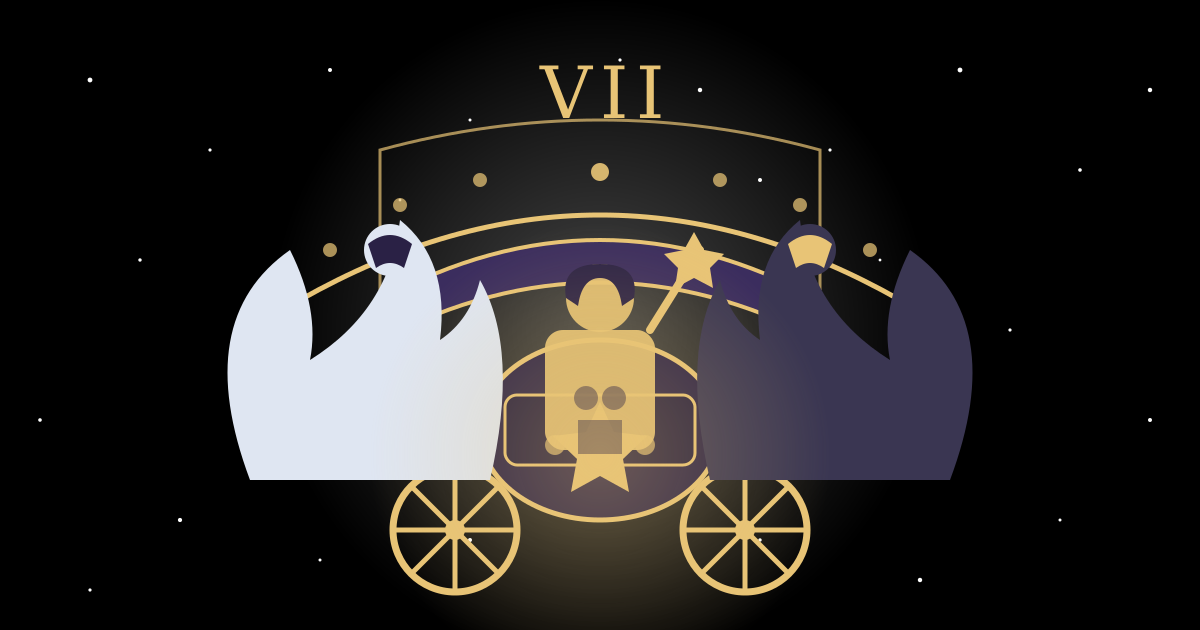
Meet the Chariot: Victory on Two Sphinxes
Card seven of the Major Arcana shows a crowned figure standing in a stone chariot, canopy of stars overhead, a city behind him, two sphinxes — one black, one white — hitched before him. He holds a wand, not reins. There are no straps in his hands at all. This is the whole teaching of the card in one image: the victory does not come from the equipment. It comes from the driver.
The Chariot is the natural sequel to the Lovers. Where card six was about the choice, card seven is about what happens after the choice: motion. Commitment made real, aimed at a destination, moving through the world. The city behind the charioteer is the life he has already conquered; the road ahead is the one he is conquering now. Nothing in this card is about luck. Every symbol is about effort converted into direction — and direction, the card insists, is the rarest resource of all.
Its number is seven, and sevens in the tarot are about triumph through testing — the victories that cost something. The Chariot is ruled by Cancer, which surprises people until they think about it: the crab advances sideways, carries its shell everywhere, and defends its soft center with absolute ferocity. The Chariot's armor is self-control; its engine is feeling, harnessed. This is not the cold victory of conquest. It is the warm victory of a person whose heart and discipline finally pull the same weight.
The Chariot Upright: Willpower in Motion
When the Chariot appears upright, the message is unambiguous and energizing: you can win this — but winning has a shape, and the shape is focus. The card does not describe the person with the most talent, the most resources, or the most luck. It describes the person who has aimed their whole self at one thing and refused to swerve. The upright Chariot is the deck's great card of the single objective: pick the target, point everything at it, and drive.
Notice the sphinxes. One black, one white — opposites, enemies in any other telling, pulling the same chariot. They are the card's portrait of the inner life: the part of you that wants comfort and the part that wants glory, the cautious voice and the daring one, discipline and desire. In the upright Chariot they are not fighting. They are harnessed. And crucially, they are harnessed without reins — by willpower alone. The card's claim is radical: you do not need to destroy your contradictions to move forward. You need to give them the same destination.
Read practically, the upright Chariot is the card of the push — the final third of the project, the training block, the debt payoff sprint, the period where effort compounds. Its advice is tactical: narrow the field. The Chariot does not multitask. It picks one road and takes it at speed. If your life currently feels like several chariots going several directions, the card says: choose the one that matters most, park the others, and drive. Victory, in this card's worldview, is just focus with momentum.
The Chariot Reversed: The Horses Scatter
Reversed, the Chariot is the image of the wheels coming off — and the card is honest about why.
The first reading is the loss of direction: charging hard with no destination. The reversed Chariot often appears for the person doing everything and arriving nowhere — maximum motion, zero navigation. The sphinxes still pull, but they pull in different directions, and no amount of speed fixes a wrong heading. The card's diagnostic question is simple: what exactly are you driving toward? If the answer takes more than a sentence, that is the problem.
The second reading is force without mastery: the aggression mistaken for discipline. Reversed, the Chariot can describe the person trying to muscle their way forward — bullying the circumstances, the people, the timeline — when what the situation needs is steering, not speed. Willpower applied badly is just force. The card distinguishes the two: discipline is direction sustained; force is direction abandoned.
The third reading is the drained driver: burnout, or the wheels spinning in mud. Sometimes the reversed Chariot is not about bad strategy but about an empty tank — the effort that used to feel victorious now feels mechanical, the sphinxes pulling because the driver is too tired to stop. The card's counsel here is the upright lesson in reverse: pull over. Rest is not surrender; it is maintenance. The chariot that never stops for the driver eventually stops for everyone. For entertainment and reflection: the reversed Chariot is never the end of the road. It is the sign that says recalibrate here.
The Chariot in Love: Driving Your Own Heart
In love readings, the upright Chariot is the card of conscious pursuit — not the spark and not the drift, but the decision to go after what you want on purpose. For singles, it says: know what you want, then move toward it like it matters. The Chariot dislikes passive romance — waiting to be chosen, hoping to be noticed, the strategy of standing still and looking available. It favors the direct approach, the clear ask, the intentional date. In the card's world, love is not found. It is pursued.
For couples, the upright Chariot describes the relationship as a shared vehicle: two people, one direction. Its great question is whether you are pulling together — same city, same timeline, same definition of the future. When the answer is yes, the card promises momentum: the couple that moves through obstacles the way the chariot moves through terrain, as a team, one destination. It also governs the long game — the relationship built over years of consistent effort rather than discovered in a flash.
Reversed in love, the warning arrives on schedule. Perhaps the relationship has a control problem: one person driving while the other is cargo, or two drivers fighting over the wheel. Perhaps the partners are pulling in opposite directions — one toward commitment, one toward freedom; one toward the city, one toward the sea — and the strain is showing. Or perhaps the pursuit has become the pressure: chasing someone who has clearly said no, pursuing a connection through persistence when the answer was disinterest. The reversed Chariot in love asks whose destination this relationship is actually heading toward — and whether both people signed up for the ride. For entertainment and reflection: the card never blesses a win that costs someone else's freedom.
The Chariot in Career and Money: Aim, Drive, Win
Career-wise, the upright Chariot is the deck's patron of ambition that works — the promotion earned through visible results, the business built by outlasting everyone, the goal that yields to sustained pressure. When this card shows up around work, it says: the strategy is effort, properly aimed. Choose the single metric that matters, commit to it publicly if you must, and let momentum do the persuading. The Chariot's money wisdom is the same shape: one financial target, attacked relentlessly — the debt snowball, the savings sprint, the raise pursued with a documented case rather than a hopeful wish.
The card also governs travel and vehicles — literally, in old readings, the journey taken and the car bought. More usefully, it governs every situation where you must keep moving through resistance: the job search that requires the fiftieth application, the negotiation where you hold your price, the creative project that demands the boring middle. The Chariot's counsel is to treat willpower as a skill, not a trait — scheduled, protected, and aimed.
Reversed in career, the card shows the familiar wreckage: the scattered ambition — five projects, zero finished. The job taken for speed rather than direction. The leader who confuses driving people with driving toward something. The reversed Chariot warns professionals of the sprint that becomes the treadmill: motion that feels like progress because it is exhausting. Its question is the same one it asks everywhere — are you driving toward something, or just driving? For entertainment and reflection: the card does not say stop working. It says pick the road first.
Symbols to Notice: Reading the Picture
The Chariot rewards a slow look. Here is what the details are saying:
- The two sphinxes, one black and one white: opposing forces — comfort and ambition, fear and desire, the head and the heart — pulling the same chariot. Victory is not their elimination; it is their alignment.
- The missing reins: the card's famous absence. The charioteer drives by willpower alone. Real control is internal — straps can be grabbed by anyone, but only the master steers without them.
- The star canopy: a baldachin spangled with stars, the heavens overhead. The goal is high; the canopy reminds the driver that victory here is measured against the stars, not the neighbors.
- The laurel and star crown: the wreath of the victor and the eight-pointed star of Venus — triumph consecrated. He is crowned before the battle, because the card believes victory is decided in the mind first.
- The crescent moons on the shoulders: Cancer's moons, riding on the charioteer's epaulettes — intuition armored. Feeling is not the enemy of discipline here; it is the padding under it.
- The square on the chest: a geometric emblem on the breastplate — the earth element, order, the foundation. The charioteer's heart is guarded by structure.
- The city behind: the conquered past. He rides away from what he has already won. The card looks forward; its gaze never goes back.
- The wand: held aloft, a scepter of command. Authority here is not over others — it is over the self, which the card considers the harder conquest.
When this card appears in your reading, notice which detail your eye lands on first. Drawn to the sphinxes? The question is about competing drives — what needs harnessing. To the missing reins? About self-mastery — what you are trying to muscle instead of master. To the canopy of stars? About ambition — whether your aim is high enough.
Try This: The Reins Practice
The Chariot is a card of willpower without equipment, so here is a practice in its spirit — the art of driving without reins:
- Name the sphinxes (five minutes): write down the two opposing forces pulling at you right now — comfort and ambition, caution and boldness, rest and the deadline. Name them honestly. They cannot pull together until they are both visible.
- Name the destination (five minutes): write the single goal in one sentence. Not the list. The sentence. The Chariot drives toward one city; if you have three, pick the one you would trade the other two to reach.
- Find the no-rein (ten minutes): identify one piece of external control you are leaning on — the accountability app, the public announcement, the deadline imposed by someone else — and plan to replace it with an internal one. The card's question: what would you do if no one were watching?
- Drive for one hour (sixty minutes): a single focused hour on the destination, no switching, no multitasking, phone in another room. One hour of reins-free driving teaches more about your willpower than a week of thinking about it.
- Review the team (five minutes): at the end, note which sphinx pulled harder. The white one — ambition, excitement? The black one — comfort, caution? Thank both. The Chariot does not starve its horses; it feeds them the same road.
Repeat weekly. The practice will not remove the opposing forces — nothing does — but it will teach you what the charioteer knows: they are not the obstacle. They are the engine.
Combinations: The Chariot Meets Other Cards
The Chariot brings focused momentum to whatever it touches — it asks every card beside it where it is going:
- Chariot + Lovers: the choice becomes the campaign — the crossroads behind you, the road ahead. Decision converted into motion.
- Chariot + Strength: willpower doubled — the inner mastery and the outer drive in perfect agreement. The card of the person who cannot be stopped politely.
- Chariot + Tower: the crash after the sprint — momentum meeting an immovable truth. Slow down and inspect the road, or the road will inspect you.
- Chariot + Fool: the leap with an engine — new beginnings taken at full speed. Exhilarating and worth checking: is there a road under those wheels?
- Chariot + Magician: capability aimed — every tool in the kit pointed at one target. The card of the plan that finally has both a driver and a destination.
- Chariot + Seven of Pentacles (reversed nearby): the harvest questioned — all this driving, but toward what yield? Pause and audit the destination before the next mile.
As always, these are starting points. Your own readings will teach you pairings no book lists — the Chariot rewards the reader who keeps driving toward the honest interpretation, after all.
Closing: Take the Reins That Are Not There
Here is the Chariot's whole teaching in one line: victory belongs to the one who aims the whole self at one thing and refuses to swerve.
The sphinxes, the canopy of stars, the city left behind, the crown worn before the battle: the card is a portrait of a person who has decided. Notice what is absent — the reins. Nobody hands you the straps to your own life. There are no straps. There is only the destination you chose and the will you bring to it, and the card's quiet confidence is that those two things are enough. So when this card appears for you, receive it as a driver would. Name the city. Harness the opposites. Point everything forward — and drive. The Chariot does not promise the road will be smooth. It promises the driver will be worthy of it. Take the reins that are not there. They were never missing.
Frequently asked questions
Is the Chariot a yes or no card in tarot?
Upright, the Chariot is a strong yes — but a conditional one. It does not say the path will be easy; it says the goal is reachable through sustained effort and self-mastery. Reversed, it leans no: the energy is scattered, the timing is off, or you are trying to force something that needs steering first. For entertainment and reflection: the card rewards the driver, not the passenger.
What does the Chariot reversed mean?
Reversed, the Chariot usually points to a loss of direction or control — burnout, competing priorities pulling you in opposite directions, trying to force progress through aggression instead of discipline, or charging ahead with no clear destination. The remedy is the upright lesson in reverse: pause, choose one direction, and let willpower replace force. For entertainment and reflection: recalibrate, don't abandon the road.
What zodiac sign is associated with the Chariot?
The Chariot is ruled by Cancer, the water sign of the crab — a sign that moves sideways to advance, protects what it loves fiercely, and carries its home with it. The connection is emotional rather than martial: the Chariot's armor is self-control, and its fuel is feeling harnessed. Its number is seven, the number of triumph earned through effort.
Why are there no reins in the Chariot card?
In the classic Rider-Waite image, the charioteer holds no reins — the two sphinxes are driven by willpower alone. This is the card's core teaching: real control is internal. Anyone can hold straps; the Chariot's master directs opposing forces — heart and head, comfort and ambition, fear and desire — through sheer focused intention. The card asks what in your life you are trying to muscle instead of master.
What does the Chariot mean in love?
Upright in love, the Chariot is the card of conscious conquest — pursuing a relationship with intention rather than drifting into one, and winning someone over through consistent effort. It can also mean overcoming obstacles together. Reversed, it warns of control struggles or two people pulling the relationship in opposite directions. For entertainment and reflection only.
Keep exploring
The Lovers Tarot Card Meaning: Love, Choices & Reversed
The Lovers tarot card meaning fully explained — upright & reversed symbolism, love, soulmates, values-based choices, career, card combinations, and a practice for choosing well.
Read the meaning →
The Emperor Tarot Card Meaning: Authority, Structure & Reversed
The Emperor tarot card meaning fully explained — upright & reversed symbolism, love, career, authority, card combinations, and a grounding leadership practice.
Read the meaning →
The Fool Tarot Card Meaning: Upright & Reversed
The Fool tarot card meaning fully explained — upright & reversed symbolism, love, career, spiritual guidance, and card combinations for beginners.
Read the meaning →
The Tower Tarot Card Meaning: Destruction, Truth & Rebirth
The Tower tarot card meaning — sudden change, truth & rebirth, upright and reversed. Love, career advice and a grounding practice for upheaval.
Read the meaning →