
The Hermit Tarot Card Meaning: Solitude, Inner Light & Reversed
Meet The Hermit: The Card of the Inner Light
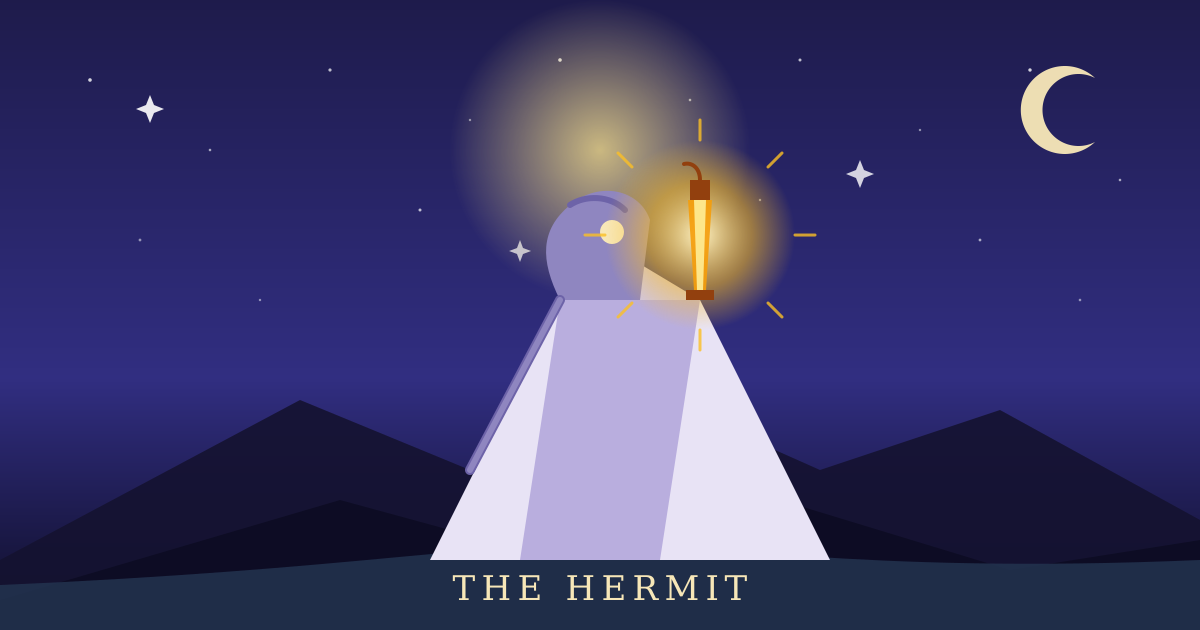
An old figure in grey robes stands alone on a snowy mountain peak, staff in one hand, lantern raised high in the other. Inside the lantern burns a six-pointed star — a small, steady light against the vast blue night. The Hermit has climbed above the noise of the valley, above the crowds and their opinions, to the one place where the inner voice can finally be heard. This is The Hermit, card nine of the Major Arcana: the quietest card in the deck, and one of the most honest.
The card's name comes from the Greek eremos — the desert, the solitary place. But the Hermit's solitude is not punishment and not escape. It is method. The figure is not lost on the mountain; the figure chose the mountain. There is a difference between being alone because life pushed you there and being alone because you walked there on purpose, lantern in hand, to find something you cannot find in a crowd. The Hermit is always the second kind. The staff is experience — every step the figure has already walked. The lantern is wisdom — not the wisdom of books or gurus, but the kind that only comes from having lived long enough to recognize your own voice.
Notice the card's place in the deck's journey. The Hermit follows Strength — and that is no accident. After the taming of the inner beast, after learning to hold the lion gently instead of fighting it, comes the quieter question: now that the beast is calm, what does the tamed self actually want? Strength teaches you to master yourself. The Hermit teaches you to listen to yourself. And listening, it turns out, requires silence — the one thing the modern world never offers for free.
The Hermit Upright: The Wisdom of Stepping Back
When The Hermit appears upright, it is an invitation, not a verdict — and the invitation is specific: withdraw, for a little while, on purpose. The card's first message is about the noise. You have been consulting everyone: friends, family, feeds, forums, the endless scroll of other people's certainty. Every voice has an opinion about your life, and every voice is louder than the one that actually lives it. The Hermit says: climb the mountain. Turn the volume down. The answer you keep outsourcing is already inside you, waiting for a quiet room.
The upright card's second message is about the lantern. Notice that it does not light the whole mountain, the whole valley, the whole road home. It lights the next few steps — and that is enough. The Hermit's wisdom is anti-grand-plan wisdom. You do not need to know where the next five years are going. You need to know the next honest step, and then the one after that. People paralyzed by big decisions are usually trying to light the whole road at once; the Hermit teaches the smaller discipline of trusting a small light. The star in the lantern is the Seal of Solomon — the union of opposites, heaven and earth, the wisdom that holds both. It burns steadily because it is not fueled by urgency. Urgency flickers. Wisdom glows.
There is also a deeper upright meaning that readers cherish: the Hermit as mentor and guide. The figure on the mountain is not only seeking; the figure is also, by standing there with the lantern raised, showing the way for others still climbing. This is why the card so often appears for teachers, therapists, writers, and anyone whose work is lighting a few steps for someone else. The Hermit's solitude is never selfish — the wisdom gathered alone is carried back down the mountain. For entertainment and reflection: the Hermit climbs alone so that others will not have to climb in the dark.
The Hermit Reversed: When Solitude Curdles
Reversed, The Hermit describes solitude gone wrong — and like many reversed cards, it splits into two readings worth telling apart.
The first is the sealed room: isolation that has curdled into loneliness. The healthy withdrawal has overstayed its welcome. The mountain that was supposed to be a visit has become a residence. The phone goes unanswered, the invitations decline themselves, the inner voice that was supposed to be consulted has become the only voice, and it has started to sound less like wisdom and more like fear. Reversed Hermit in this form is often the card of the person who is not resting but hiding — from a conversation, a decision, a grief, a life. The card's counsel here is the descent: the lantern was meant to be carried back down. Solitude that never ends is not wisdom; it is avoidance wearing wisdom's robes.
The second reversed reading is the refused quiet: the person who cannot bear to be alone with their own thoughts. Every silence is filled — the podcast in the shower, the show while eating, the scroll before sleep, the group chat that never sleeps. The schedule is packed not because life demands it but because an empty hour feels like a threat. Reversed Hermit in this form marks the fear of the inner voice: if you stop moving, you might hear what you have been running from. The card's counsel here is the opposite of the first reading: climb, briefly, on purpose. Ten minutes of chosen silence is medicine; ten hours of enforced noise is the symptom.
How to tell which reading is yours: the sealed room feels like heaviness — the world has gone quiet and you cannot remember why you wanted that. The refused quiet feels like static — the world is loud and you cannot remember when you last chose the volume. Heaviness needs company; static needs silence. Both are cured by the same simple act the Hermit performs: pick up the lantern and walk, in whichever direction you have been avoiding. For entertainment and reflection: a reversed Hermit is not a sentence. It is a lantern, waiting to be picked up.
The Hermit in Love: The Solitude Before the Meeting
In love readings, The Hermit upright is one of the deck's most misunderstood cards — it is not the card of being alone forever.
For singles, The Hermit describes the wisdom of the pause between relationships: the season of getting to know yourself before offering yourself to someone else. The card stands against both extremes of modern dating — the frantic search on one side, the bitter withdrawal on the other. It favors the middle lantern-light: understanding what you actually want, what you actually offer, and what patterns you keep repeating, before the next person walks into the light. If you have been choosing the same partner in different faces, The Hermit suggests one honest season alone instead of another quick one together.
For couples, upright Hermit is the card of the healthy separateness inside togetherness — two people who each keep a lantern of their own. It describes the partner who needs an evening alone and is not punished for it, the couple that protects each other's solitude the way they protect each other's company, the long relationship that stays alive because neither person has dissolved into the other. The card also names the shared quiet — the walk without talking, the room where two people read in silence — as a form of intimacy, not its absence. For entertainment and reflection: love is not two people becoming one lantern. It is two lanterns, walking the same road, each lighting the other's next few steps.
Reversed in love, the card describes the solitude breaking down. The relationship where one partner has withdrawn — physically present, emotionally on the mountain, unreachable. The single person who has been alone so long that loneliness has become identity, or the one who cannot tolerate a single evening alone and fills it with anyone, anything, any noise. In dating, reversed Hermit often marks the refusal to look inward: blaming every ex, repeating every pattern, never once climbing the mountain to ask what part was yours. The card's counsel is the same in every case: pick up the lantern and look, honestly, at the part you have been avoiding.
The Hermit in Career and Money: The Inner Compass
Career-wise, The Hermit upright is the card of the inward check. The professional who stops chasing the next title long enough to ask whether the ladder is even leaning against the right wall. If you are restless at work despite the promotions, the raises, the applause, the card's advice is the mountain: the restlessness is information, not ingratitude. It is the inner voice saying the outer measures have stopped measuring what matters to you.
The card also favors the deep work that only solitude produces: the research, the writing, the craft, the study that cannot be done in a meeting. The Hermit is the patron of the scholar, the analyst, the maker who needs a closed door and an open morning. In negotiations and big decisions, the card suggests the pause before the answer — sleep on it, walk with it, let the lantern light the next step rather than the whole deal. Decisions made in Hermit-light are slower and better; decisions made in noise are faster and regretted.
Money-wise, The Hermit is the card of the honest audit: sitting down alone with the actual numbers, without the stories you tell about them. It favors the quiet review — the subscriptions, the habits, the spending that was really about filling silence — and warns against both the hoarding extreme (money as a wall against the world) and the noise extreme (money as a way to never sit still). Reversed in career and money, the card warns of the sealed room's professional form: the expert who stopped learning from anyone, the founder who stopped listening to feedback, or the worker who fills every hour with busyness to avoid asking whether the work still matters. For entertainment and reflection: the Hermit's career advice is the oldest in the book — know thyself, then negotiate.
Symbols to Notice: Reading the Picture
The Hermit rewards a slow look. Here is what the details are saying:
- The lantern and its star: the card's heart — the six-pointed star of inner wisdom, the Seal of Solomon. It lights only the next few steps, never the whole road. What the lantern shows you is your life, one honest step at a time.
- The grey robes: the color of neutrality, of the space between black and white. The Hermit has stepped outside the world's color-coded certainties. Grey is the color of the person who has stopped performing a side.
- The staff: experience, the walking stick of every road already traveled. The Hermit leans on what has been lived, not on what has been read. The staff is proof the mountain was climbed, not teleported to.
- The mountain peak: the high place above the valley's noise. Height here is not superiority — it is distance, chosen on purpose, for the sake of hearing. The peak is where the inner voice stops competing with the crowd.
- The snow: the white silence, the season of stillness. Snow covers the old paths and forces new ones. It is the card's image of the quiet that makes fresh tracks possible.
- The night sky: the vast blue dark in which the small lantern burns. The night is not the enemy of the light — it is the reason the light matters. Wisdom is a small flame, and small flames are enough.
- The raised arm: the lantern held high, not hidden. The Hermit does not hoard the light. The arm is raised so that others climbing behind can see the path too. Solitude gathered, wisdom shared.
When this card appears in your reading, notice which detail your eye lands on first. Drawn to the lantern? The question is about the light — what inner wisdom is already burning, waiting to be raised. To the staff? About experience — what you have already lived through that you are not leaning on. To the mountain? About distance — what noise you need to step back from. To the snow? About stillness — the quiet season you have been resisting. To the raised arm? About guidance — who is climbing behind you, waiting for your light.
Try This: The Seven-Day Solitude Practice
The Hermit is a practice card, so here is a practice — one small daily act of chosen solitude:
- Day one — the quiet hour (sixty minutes): spend one hour alone with no input — no podcast, no show, no scroll, no music. Walk, sit, stare out the window. Notice what surfaces when the noise stops. The Hermit measures before climbing.
- Day two — the lantern question (ten minutes): write down the one question you have been asking everyone except yourself. Then write the first answer that comes without consulting anyone. That answer is the lantern's first light — it may be wrong, but it is yours.
- Day three — the unplugged morning (until noon): keep the phone off until noon. Cook slowly, read something long, walk without a destination. Notice how the quality of the morning changes when no one else's urgency sets its pace.
- Day four — the staff inventory (thirty minutes): list ten hard things you have already survived. This is your staff — the proof you have climbed before. Read it when the next mountain looks too high.
- Day five — the honest audit (one hour): sit alone with one area you have been avoiding — the budget, the relationship, the career question — and write the truth about it in plain sentences. No audience, no performance. The Hermit's audit is for one reader only.
- Day six — the mountain walk (as long as it takes): take a long walk alone, ideally somewhere high or quiet, and carry one question with you. Do not try to answer it. Let the walking do the thinking. The Hermit's answers arrive at walking pace.
- Day seven — the descent (thirty minutes): write down what the week taught you, then share one piece of it with someone who needs it. The lantern was never only for you. Carry the light back down the mountain.
After seven days you will have something the card always offers the patient: your own voice, in your own handwriting, heard clearly for the first time in a while. The lantern never lit the whole road, and it never needed to. It lit the next few steps. And the next few steps were always enough.
Combinations: The Hermit Meets Other Cards
The Hermit lends its quiet light — or its warning about solitude gone wrong — to whatever it touches:
- Hermit + Star: the guided solitude — hope and healing found in the quiet. The lantern is fed by something larger than you. One of the deck's most gently optimistic pairings.
- Hermit + Moon: the deep dark — solitude meeting the unconscious. Dreams, shadows, and old fears surface in the quiet. The lantern lights the path; the Moon reminds you the path has shadows too.
- Hermit + Tower: the solitude after the collapse — the quiet that follows the lightning. After the structure falls, the mountain is where the rebuilding is planned. Give it the time it refuses to name.
- Hermit + Lovers: the choice made alone — the relationship decision that cannot be outsourced. Love's crossroads, walked in lantern-light: choose what you actually want, not what the crowd applauds.
- Hermit + Death: the grief walk — the ending mourned in solitude. The mountain after loss is not avoidance; it is the place where the ending is integrated. Let the quiet do its work.
- Hermit + World: the completed journey — the wisdom gathered alone, carried home. The Hermit returns from the mountain to the world, lantern still burning, ready to teach. The circle closes.
As always, these are starting points. Your own readings will teach you pairings no book lists — The Hermit rewards the reader who learns that the quietest light at the table is usually the most truthful.
Closing: The Lantern Never Goes Out
Here is The Hermit's whole teaching in one image: a small star burning in a lantern, raised high on a snowy peak, lighting only the next few steps.
The figure, the staff, the grey robes, the snow, the night, the raised arm: the card is a portrait of wisdom as it actually looks — not a grand revelation but a steady flame, carried patiently, one step at a time. Every silence chosen on purpose is the card working. Every honest answer found alone is the light growing steadier. Every step taken in lantern-light is the journey continuing.
The Hermit does not ask you to be alone forever, wise already, or finished. It asks you to climb, briefly, on purpose — to listen to the voice you have been drowning out, and to trust the small light. The lantern never lights the whole road. It never needed to. And the light? The light was never somewhere else. It was in your hand all along.
Frequently asked questions
Is The Hermit a yes or no tarot card?
The Hermit is a "not yet" card rather than a yes or no. It asks you to withdraw, reflect, and consult your own inner light before deciding — the answer exists, but it is found in solitude, not in the noise of other people's opinions. When the question is about timing, the Hermit says: after the pause. For entertainment and reflection: the lantern lights the next step, not the whole road, and the next step is where the answer lives.
What does The Hermit reversed mean?
Reversed, The Hermit describes solitude gone wrong in one of two directions: isolation that has curdled into loneliness and withdrawal from life, or the refusal of solitude — the person who cannot bear to be alone with their own thoughts and fills every silence with noise, company, or work. Both are cured the same way: a chosen, time-limited solitude, entered on purpose. For entertainment and reflection only.
What zodiac sign is associated with The Hermit?
The Hermit is ruled by Virgo, the mutable earth sign of the virgin — the careful, discerning, service-minded sign that analyzes before it acts. Virgo gives the card its precision and its love of useful truth, while the card teaches Virgo its own lesson: analysis in service of wisdom, not analysis as a hiding place. It is card nine (IX) of the Major Arcana, following Strength's taming with the quieter work of listening.
What is the light inside The Hermit's lantern?
The lantern holds a six-pointed star — the Seal of Solomon — the light of inner wisdom, the soul's own lamp. It lights only the next few steps of the path, never the whole road, which is the card's whole teaching: you do not need to see the destination to walk honestly. You need only enough light for the next step, and the lantern always provides exactly that.
Why does The Hermit mean solitude?
Because some truths only speak in silence. The Hermit follows Strength in the deck's journey: after the taming of the inner beast comes the quieter work of listening to what the tamed self actually wants. The card stands on a mountain peak alone not because it rejects people, but because the inner voice is drowned out by every other voice — and the mountain is where it can finally be heard.
Keep exploring
The Temperance Tarot Card Meaning: Balance, Patience & Reversed
The Temperance tarot card meaning fully explained — upright & reversed symbolism, balance, patience, alchemy, love, career, card combinations, and a 7-day blending practice.
Read the meaning →
The Strength Tarot Card Meaning: Courage, Patience & Reversed
The Strength tarot card meaning fully explained — upright & reversed symbolism, courage, patience, inner power, love, career, card combinations, and a 7-day soft-strength practice.
Read the meaning →
The Fool Tarot Card Meaning: Upright & Reversed
The Fool tarot card meaning fully explained — upright & reversed symbolism, love, career, spiritual guidance, and card combinations for beginners.
Read the meaning →
The Death Tarot Card Meaning: Endings, Rebirth & Reversed
The Death tarot card meaning fully explained — upright & reversed symbolism, endings and rebirth, love, career, card combinations, and a letting-go ritual.
Read the meaning →